Inspiration
EOG’s challenge opened with “Avon never sleeps,” and it instantly reminded us of Night City from Cyberpunk, a city that runs all night on machinery nobody ever sees. Somebody has to keep that machinery alive at 3 AM, and usually it’s one tired operator covering an entire field alone.
When we talked to an EOG rep, we learned that when a pump fails at night, the operator gets an alarm and then has to do the rest in their head: how long until the tank trips, should I shut in a well, are the trucks already busy somewhere else? A wrong guess can cost thousands of dollars in lost oil and gas, and whatever the operator noticed on site can easily get lost at shift change.
What it does
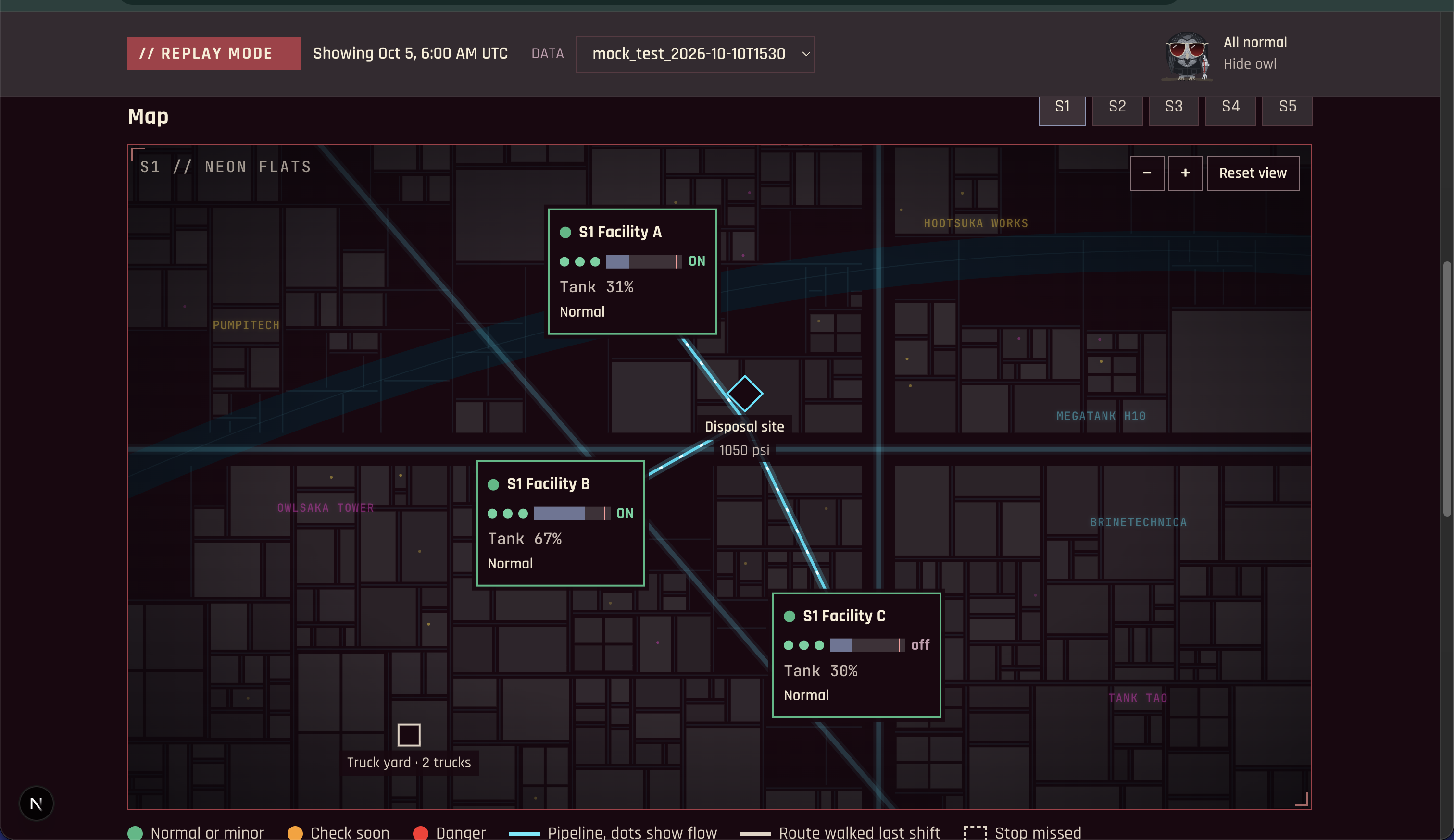
NightShift is a night-shift console that reads EOG’s sensor data to catch pump failures, worn pumps and pipeline leaks, counts down to the moment a tank hits its shutdown limit, and finds the cheapest way to keep the wells running. It compares sending trucks, shutting in wells early, or doing nothing, and plans the whole system together since facilities share the same few trucks.
A Nemotron AI agent runs the whole triage on its own as soon as new data loads, and every number it reports comes from our own code, so it never guesses. Out in the field, the operator wears Ray-Ban Meta glasses that speak the alarm and the cheapest fix right in their ear hours before the tank trips, not after. If they spot a leak, they just say “Flag leak,” and the glasses snap a photo and log it without them ever taking their hands off their tools.
When the shift ends, NightShift writes a plain-English handover for the morning crew, ranks what needs to be checked first, and exports the full events log.
How we built it
Built with Python and FastAPI with SQLite for the backend, NVIDIA Nemotron (a Super model for the triage agent and Nano Omni for checking camera frames), Next.js for the control room dashboard, SwiftUI for the iPhone app, Meta’s Wearables Device Access Toolkit for the Ray-Ban Meta Gen 2 camera relay, Apple’s speech frameworks for voice commands and spoken alerts, and a Cloudflare tunnel to connect it all.
Challenges we ran into
A big challenge we ran into was connecting the glasses to our backend. The camera link wouldn’t work on a free Apple developer account until we switched it to Bluetooth Classic, and the venue Wi-Fi blocked our phone from reaching our laptop, so we had to tunnel around it. Even after that, the phone’s shift reports came in a different format than our backend expected, and we had to rework the upload.
Another challenge was that our first idea used the glasses camera to spot faults, but after reading EOG’s full requirements we realized detection had to come from the sensor data. We rebuilt the console around that and kept the glasses as the operator’s hands-free tool in the field.
Accomplishments that we’re proud of
We are proud that our plans matched EOG’s own answer key on all three practice snapshots, including the hardest cases where three pumps fail within an hour and only two trucks are available. It found every problem in progress, put the alerts in the right order, and landed within about a minute on the countdowns.
Technically speaking, getting real smart glasses streaming live video, speaking alerts and taking voice commands at the same time, all connected to an AI agent and a full dashboard in a 24-hour window, was something we are really proud of.
What we learned
Technical Skills - FastAPI, Next.js, SwiftUI, AI agents with tool calling, NVIDIA Nemotron, computer vision, Bluetooth audio, Meta’s Wearables SDK, cost optimization. Non Technical Skills - read the full requirements before building, iterate fast when the plan changes, let code handle the math and AI handle the explaining, and design for the actual person using it at 3 AM.
What’s next for NightShift connecting to live field data instead of recorded files training the vision check on real equipment photos support for whole crews working the same shift fleet planning, so operators know how many trucks each system really needs
