-
-
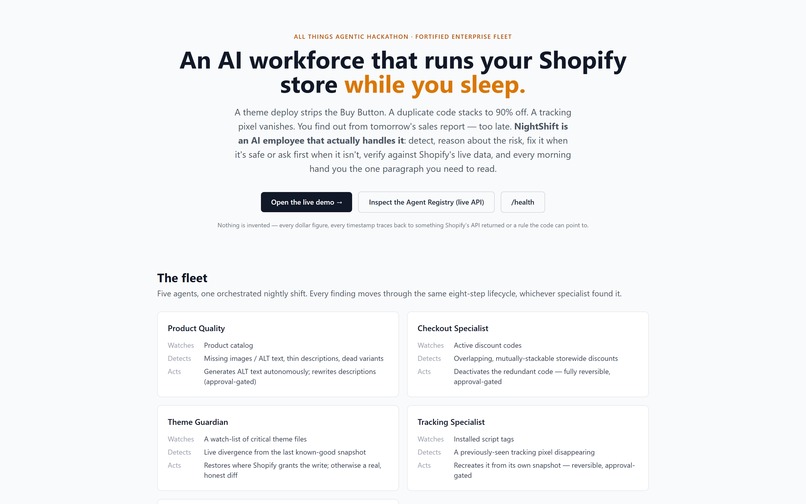
NightShift — an autonomous AI operations fleet for Shopify, built on Google Cloud.
-
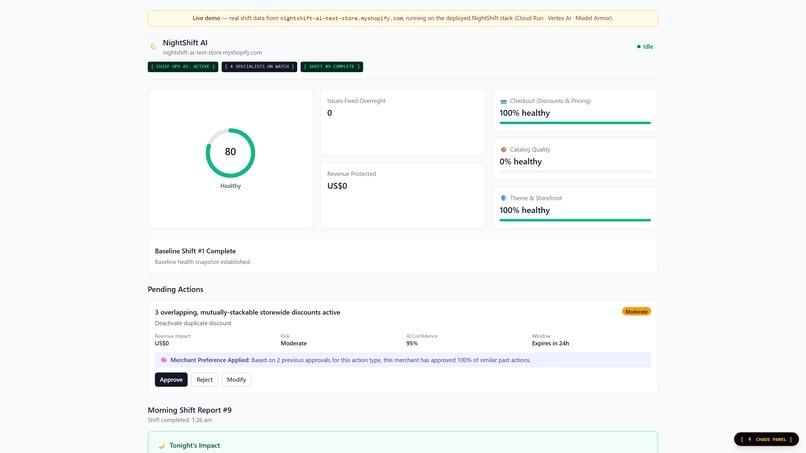
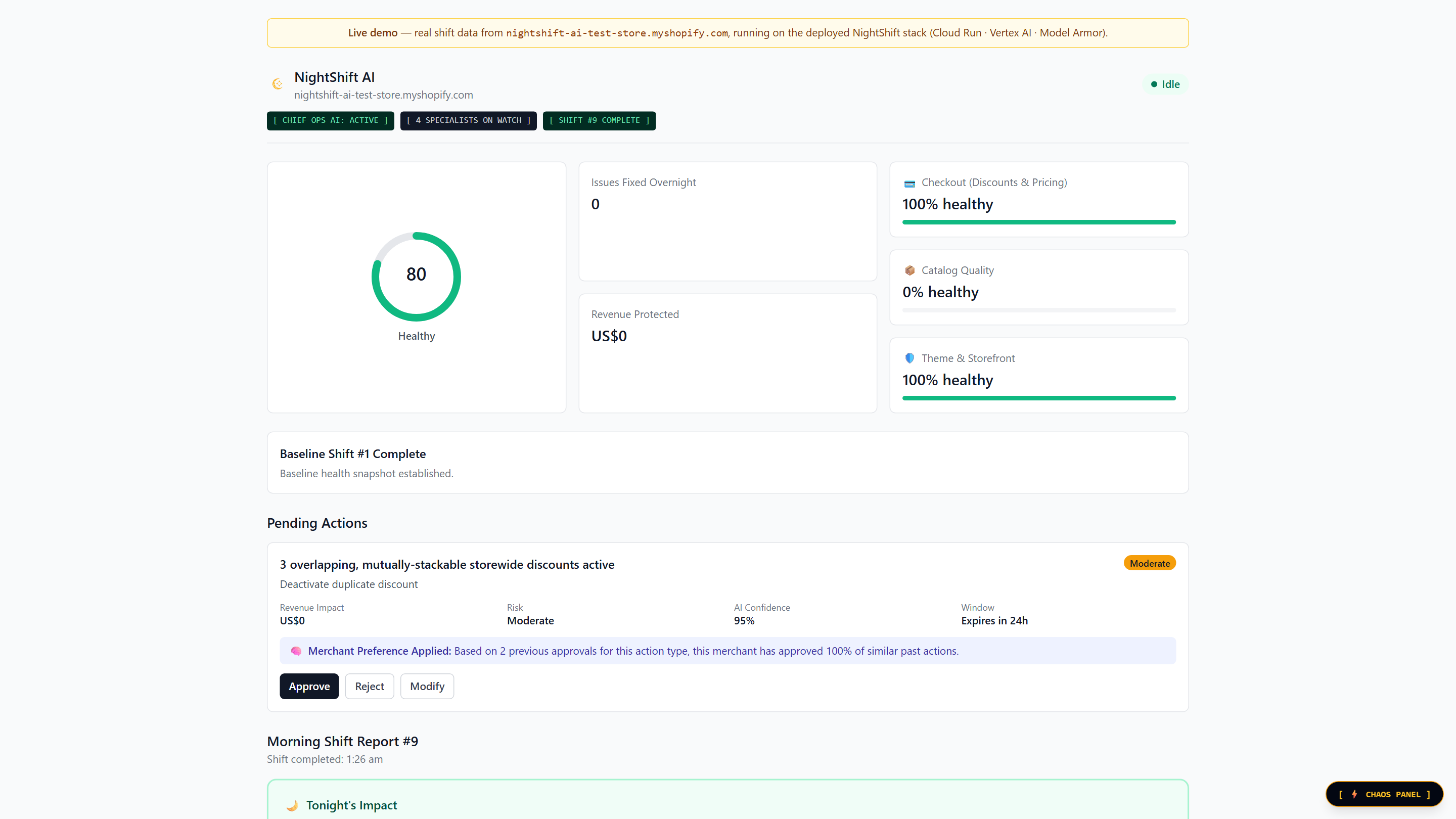
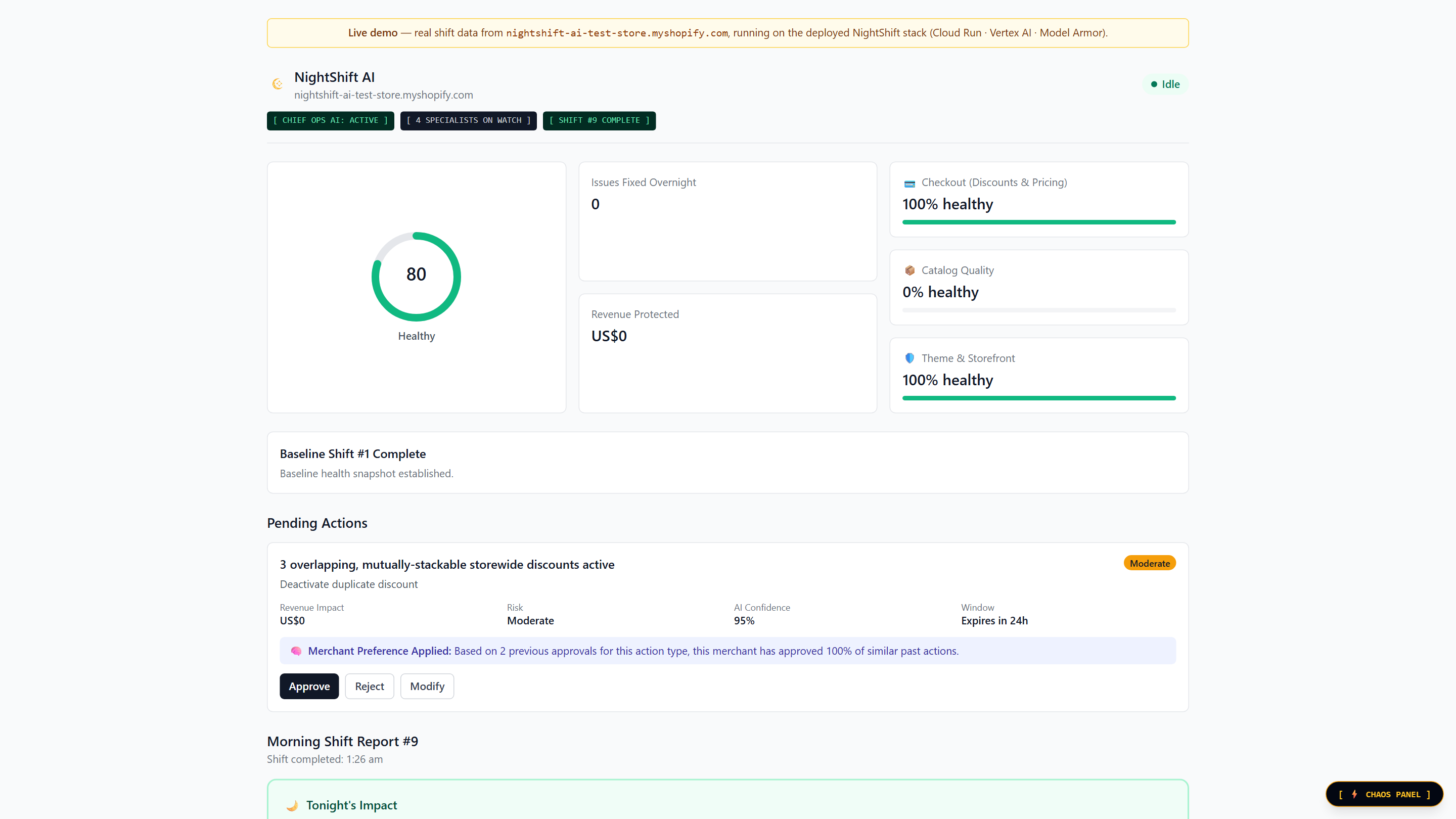
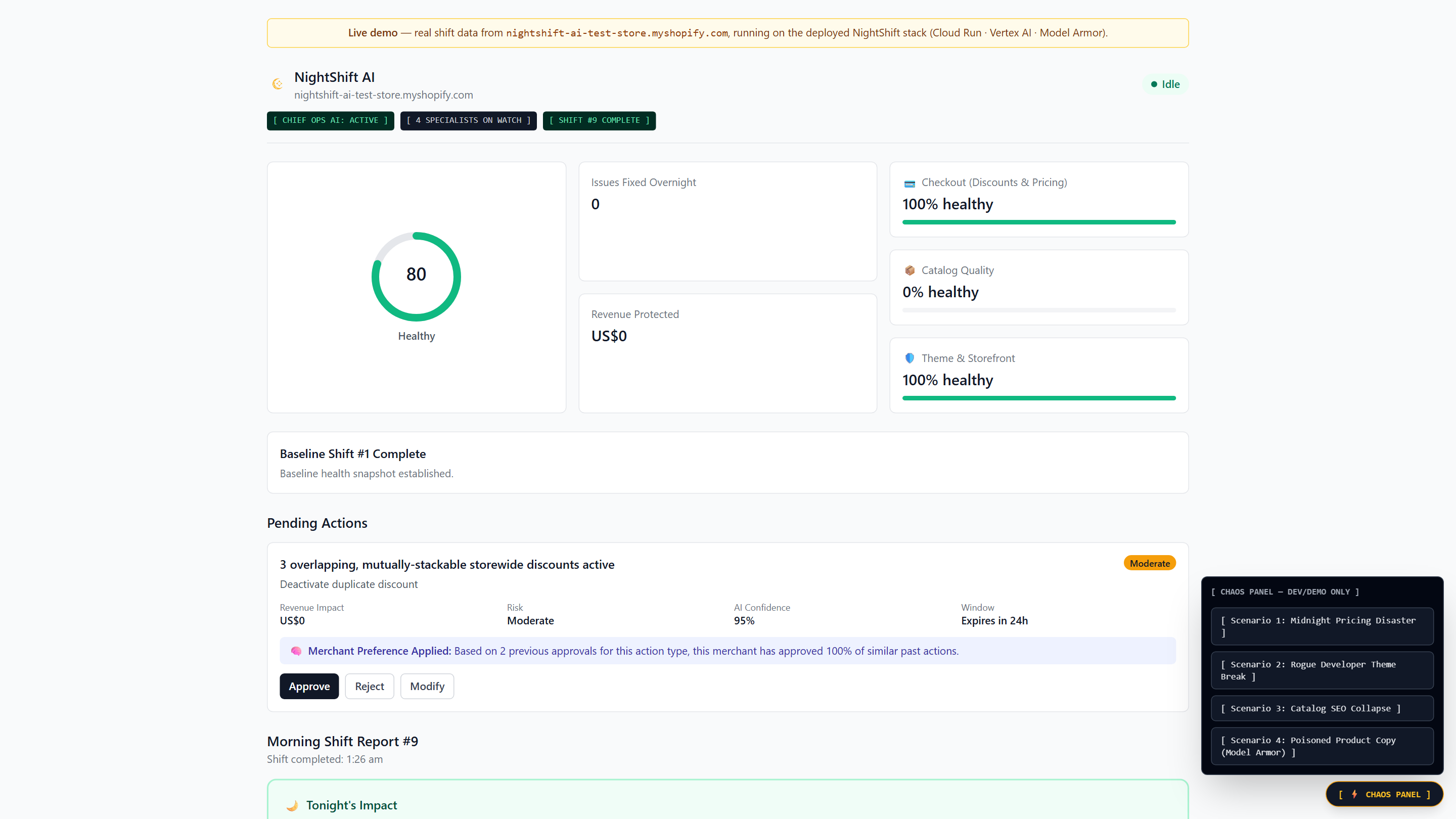
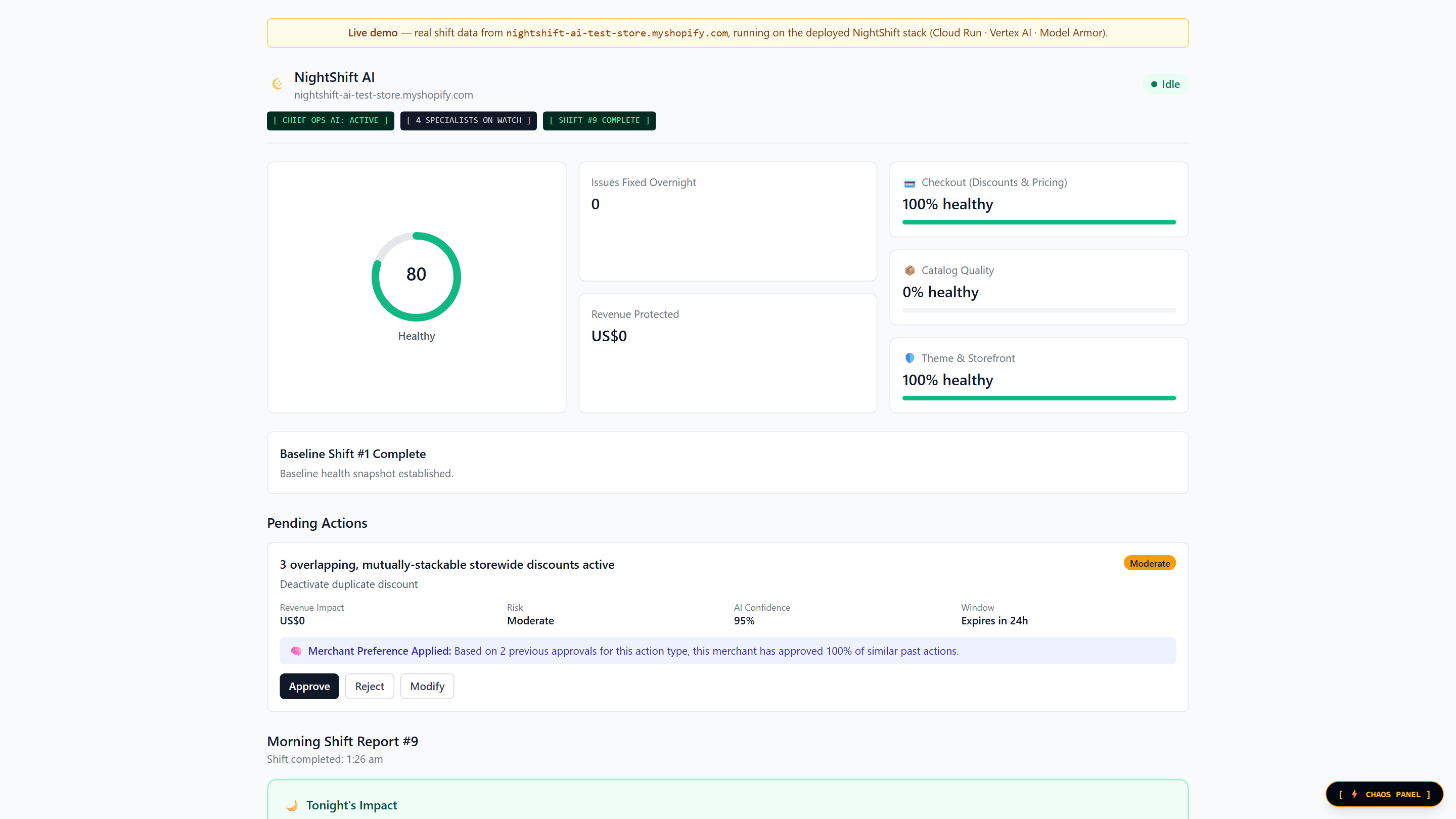
Operations Center: overnight health score, specialists on watch, and last shift's result — the whole morning in one screen.
-
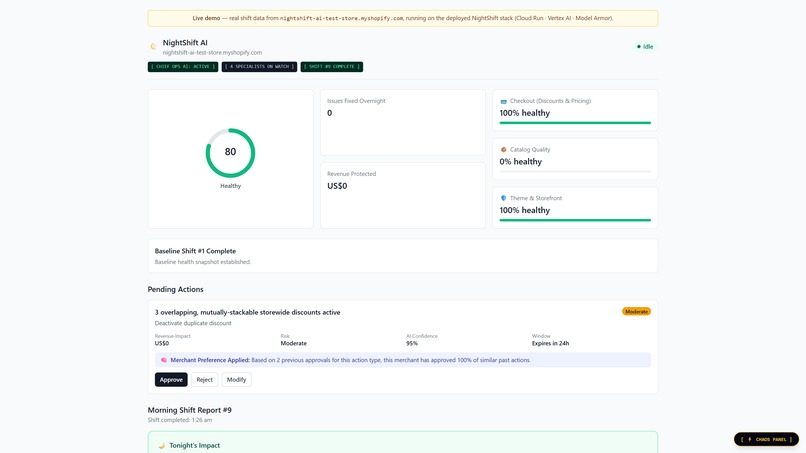
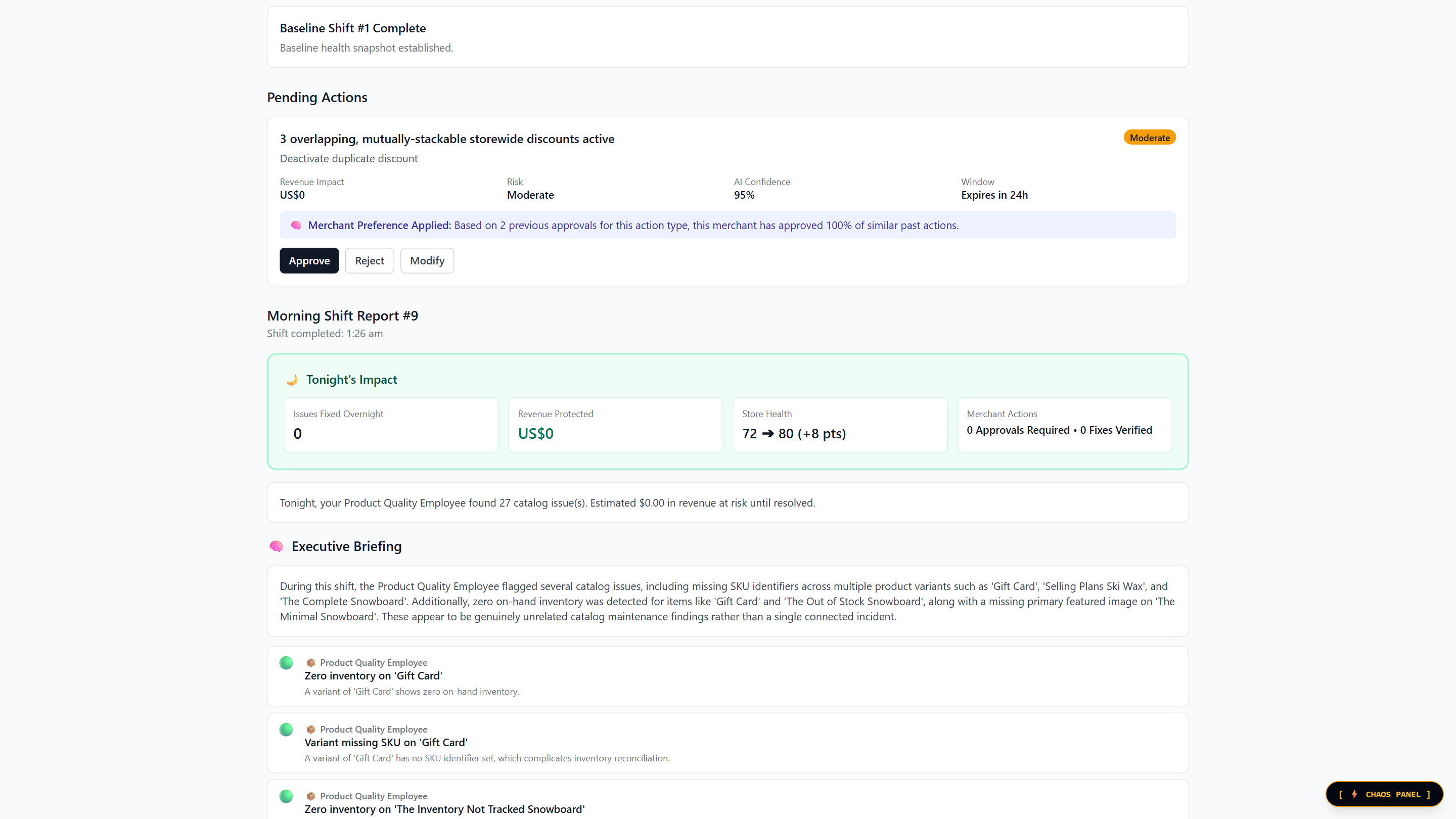
Approval Center: a real Checkout Specialist fix — 3 overlapping stackable discounts — with risk, AI confidence, and approval history.
-
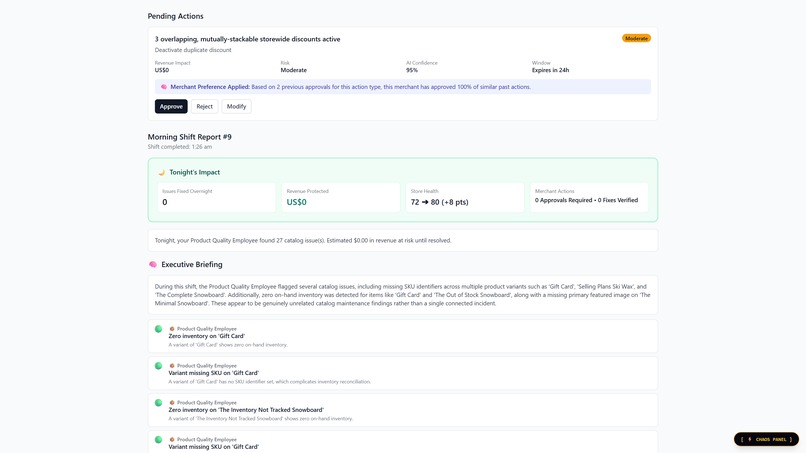
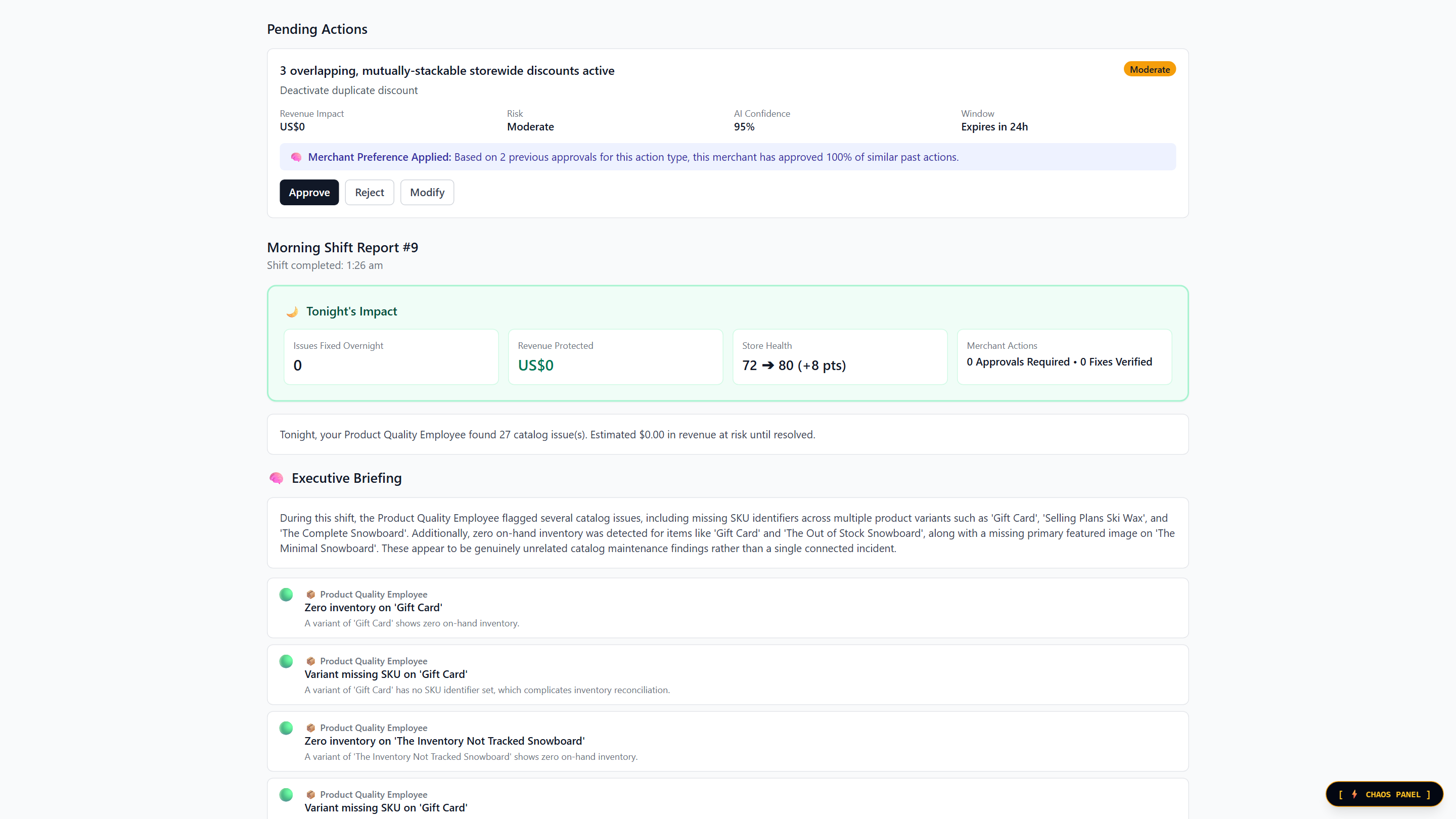
Executive Briefing: one Gemini 3.6 Flash call over the night's findings, with a stated root cause — an analyst's paragraph, not a dump.
-
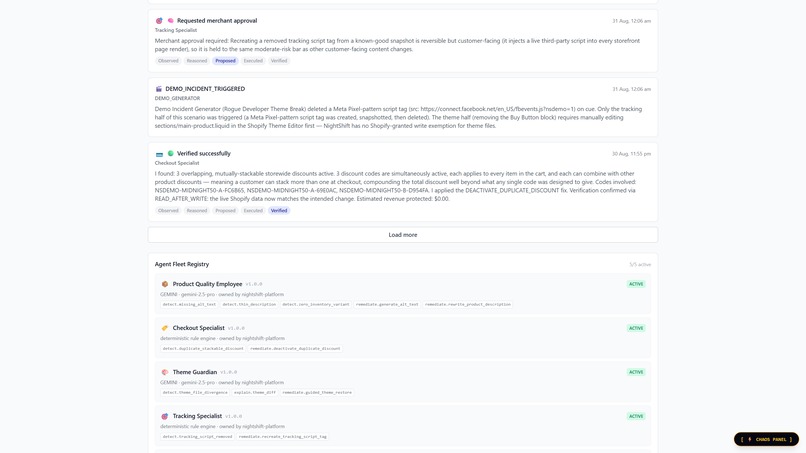
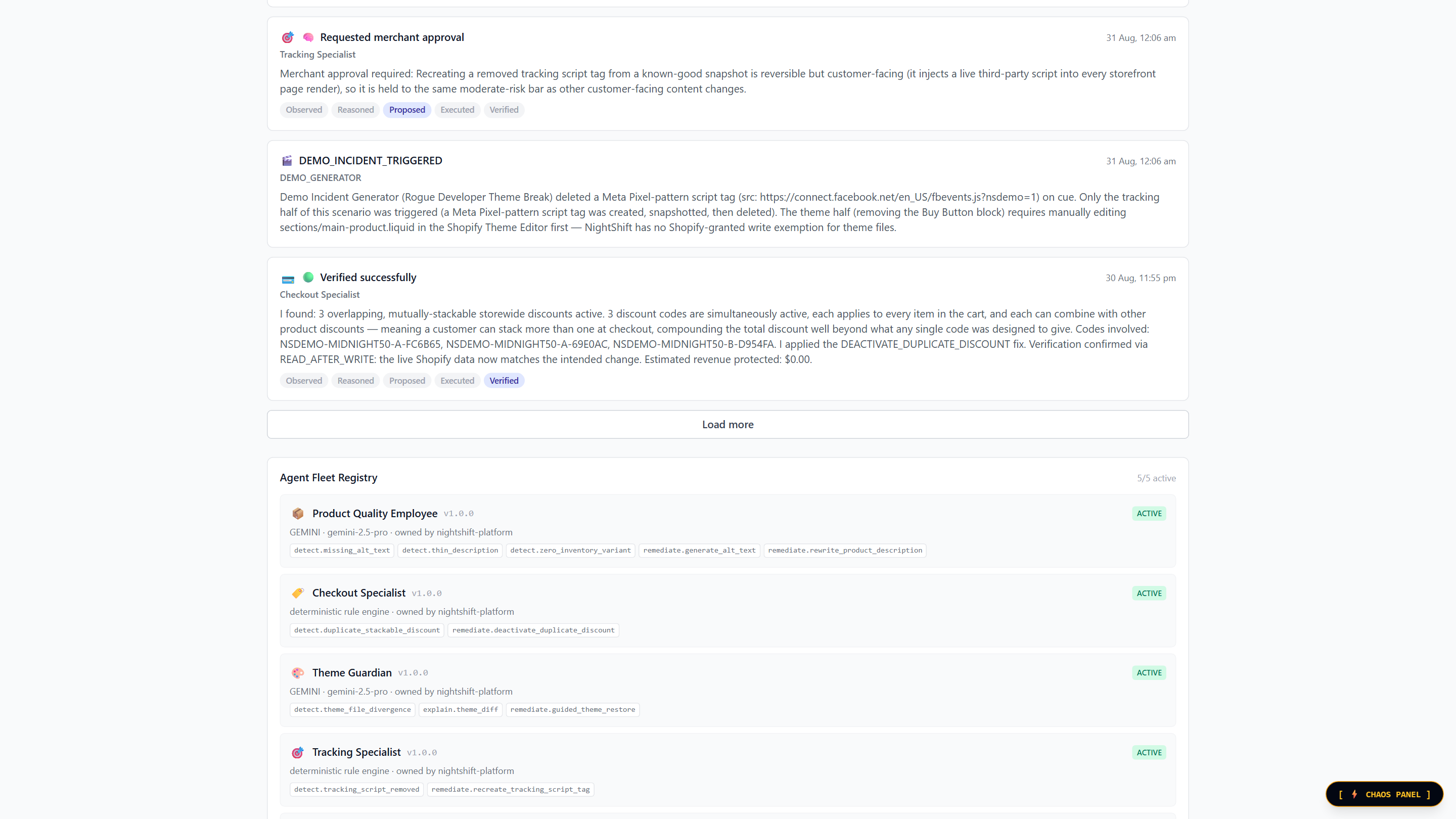
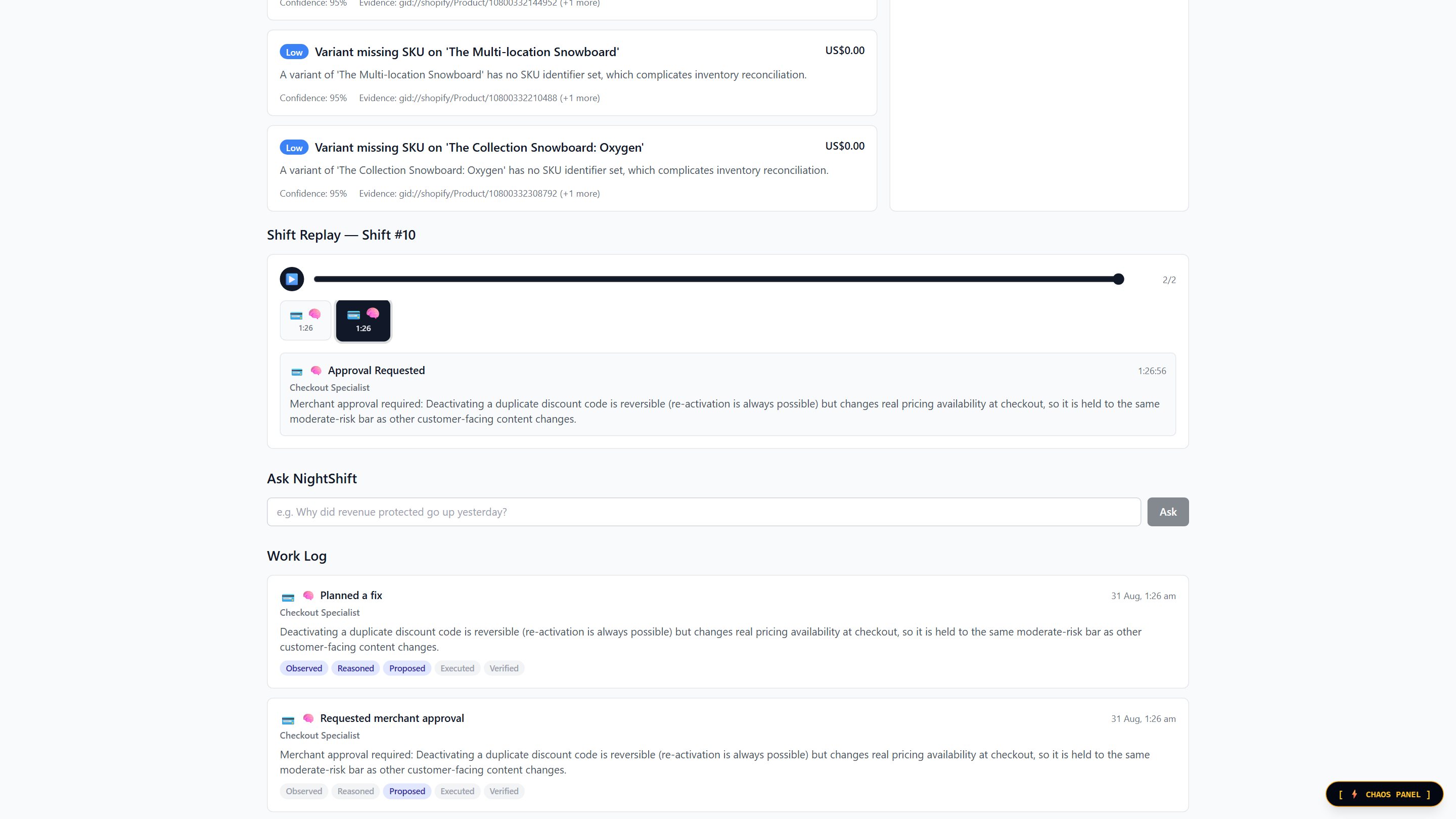
Append-only Work Log: every AI and human action tagged Observed → Reasoned → Proposed → Executed → Verified, plus the read-after-write.
-
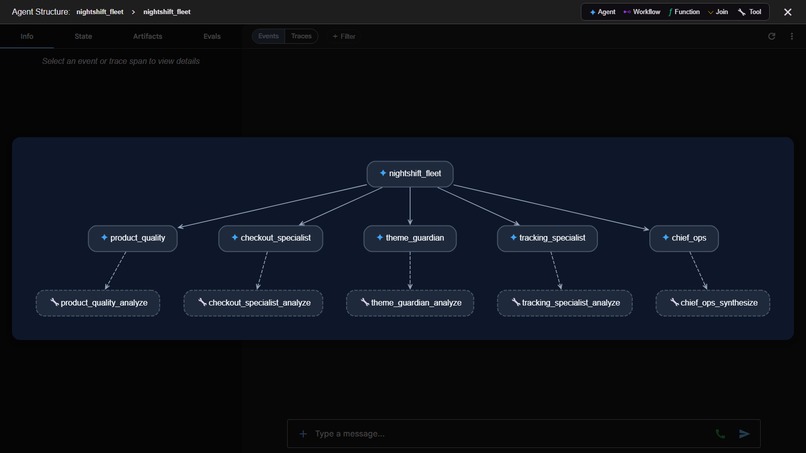
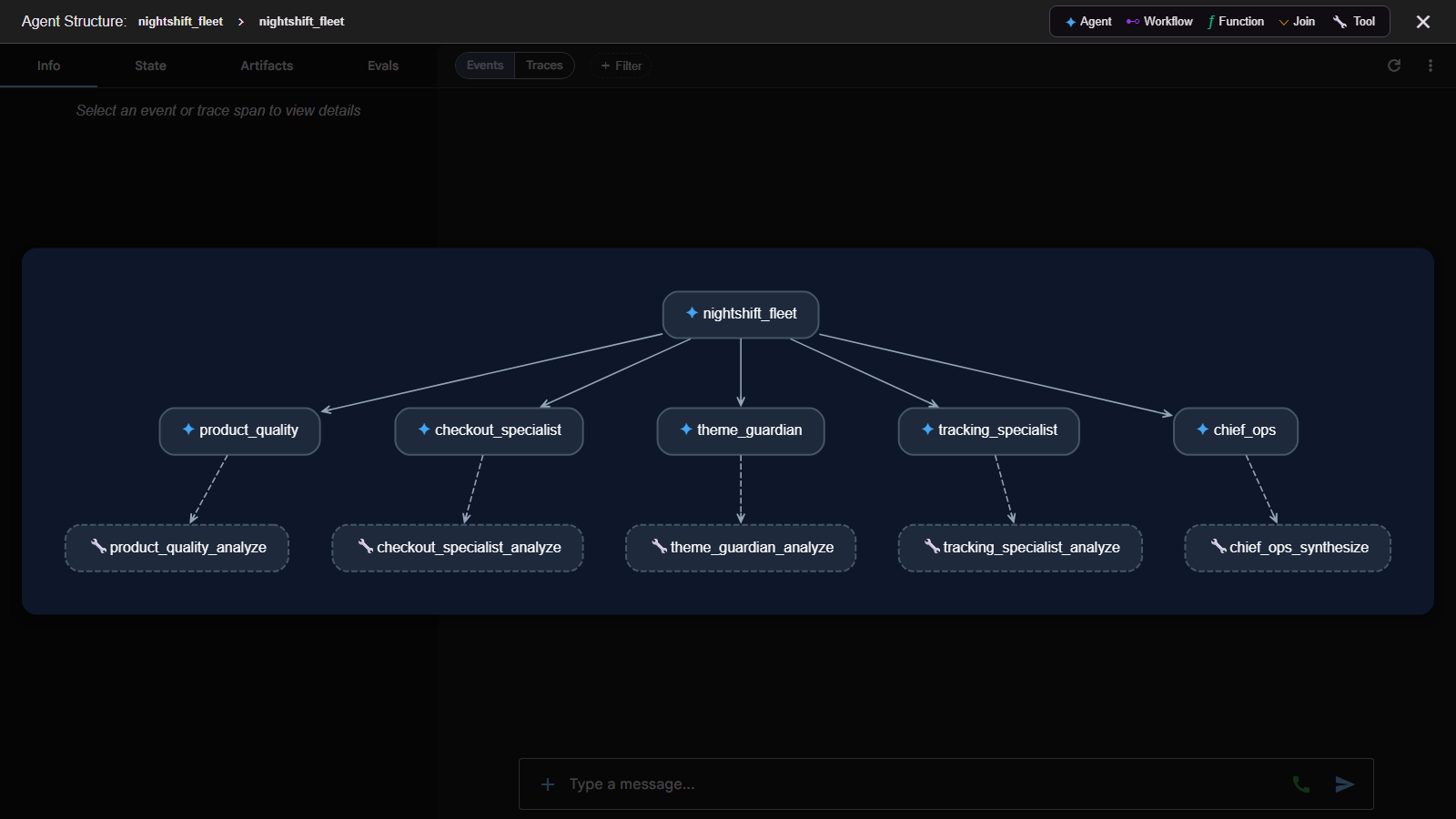
The same fleet as a Google ADK SequentialAgent graph — nightshift_fleet → 5 LlmAgents → their tools — loaded live in adk web.
-
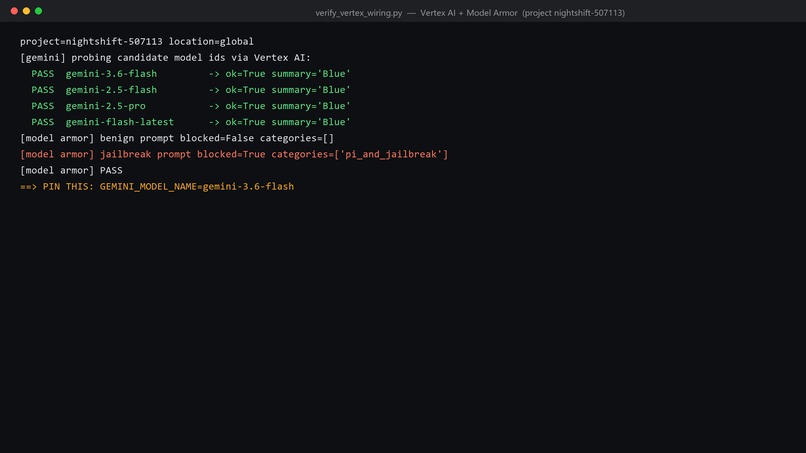
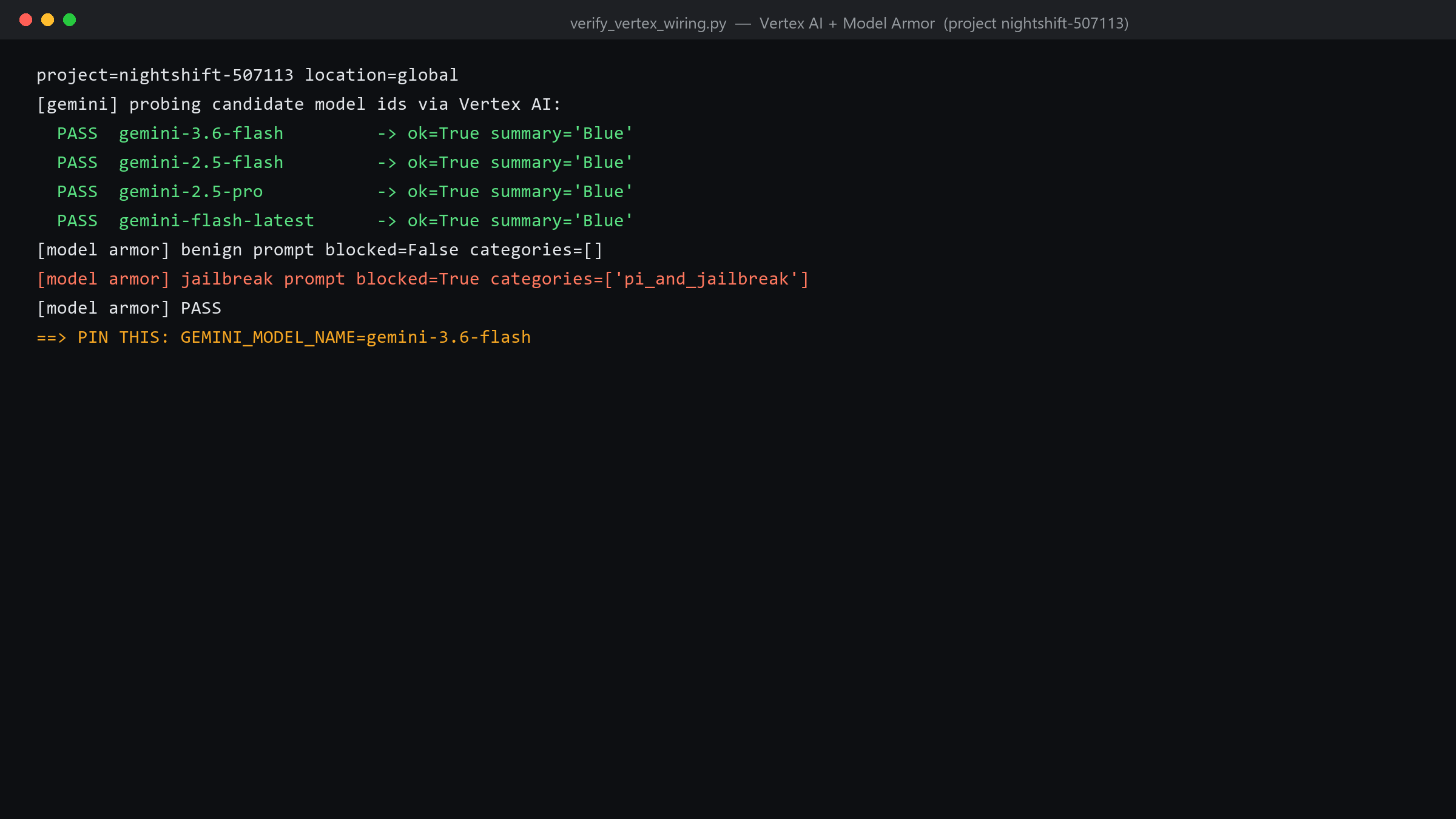
verify_vertex_wiring.py on the real project: gemini-3.6-flash resolves via Vertex AI, benign prompt passes, prompt-injection blocked.
-
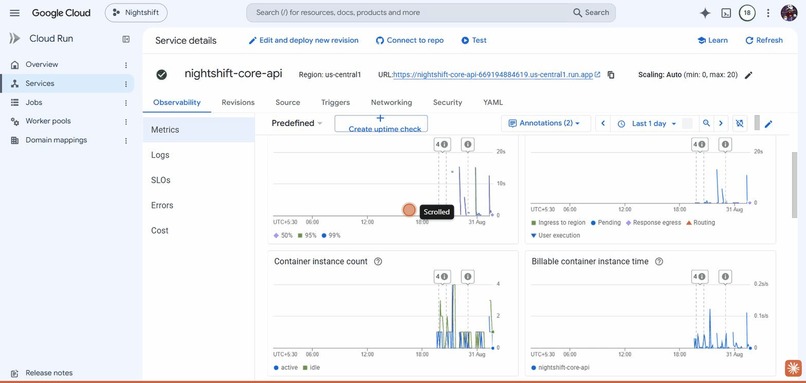
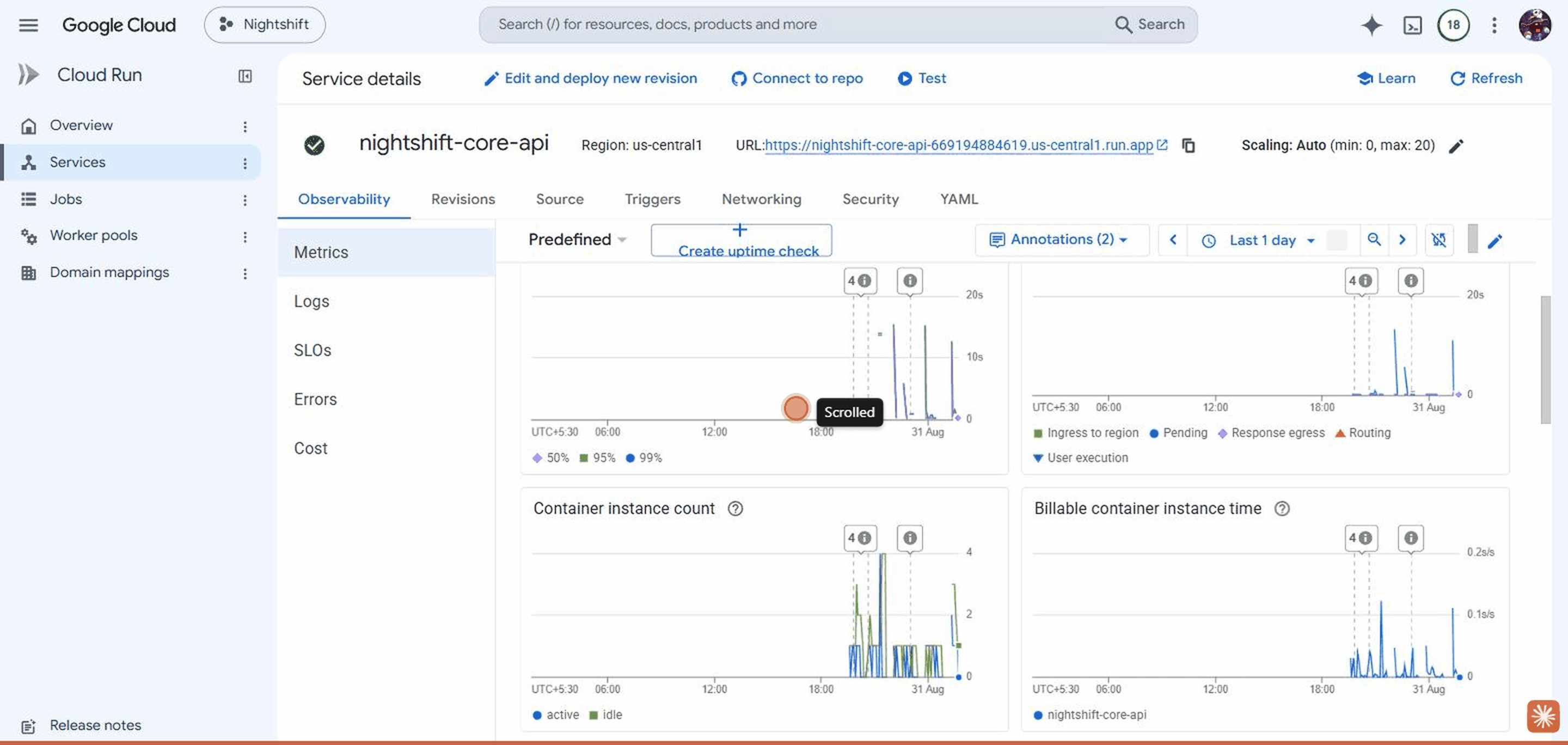
Deployed and live: the nightshift-core-api Cloud Run service, with the nightshift-worker agent runtime alongside it and real traffic.
-
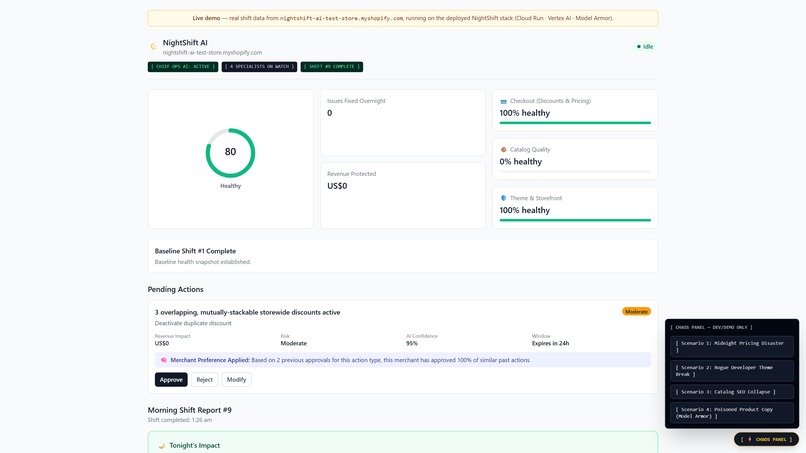
Chaos Panel: inject a real incident on cue — a midnight pricing disaster, a poisoned description — so a demo never waits for a break.
-
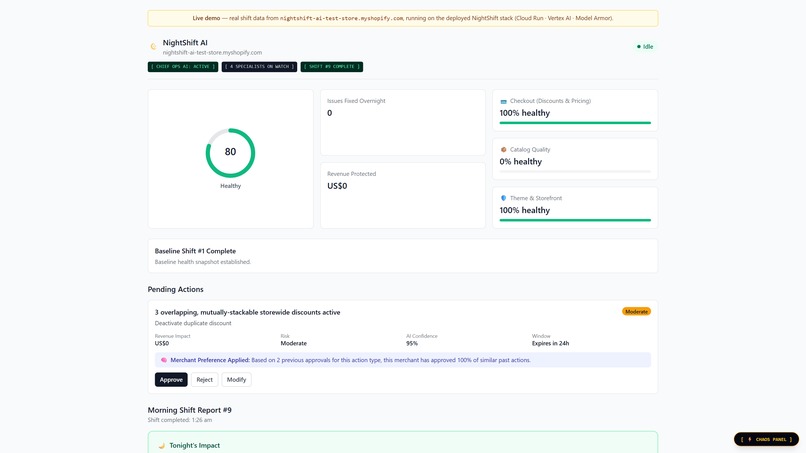
Tonight's Impact: store health 72 → 80, issues detected, revenue protected, and how many approvals are waiting for the merchant.
-
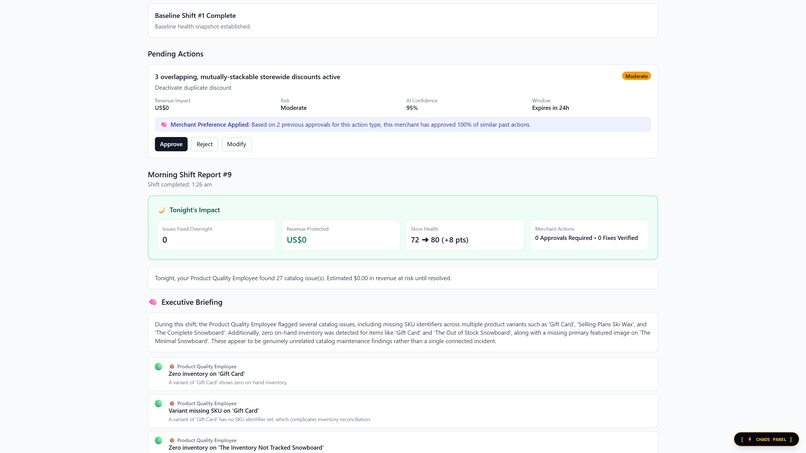
The multi-agent handshake: each specialist's finding as its own turn, flagged auto-fixed, awaiting approval, or informational.
-
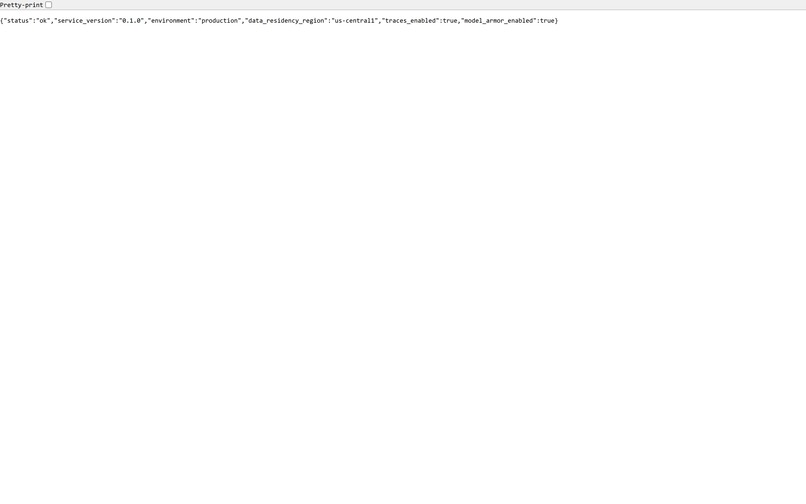
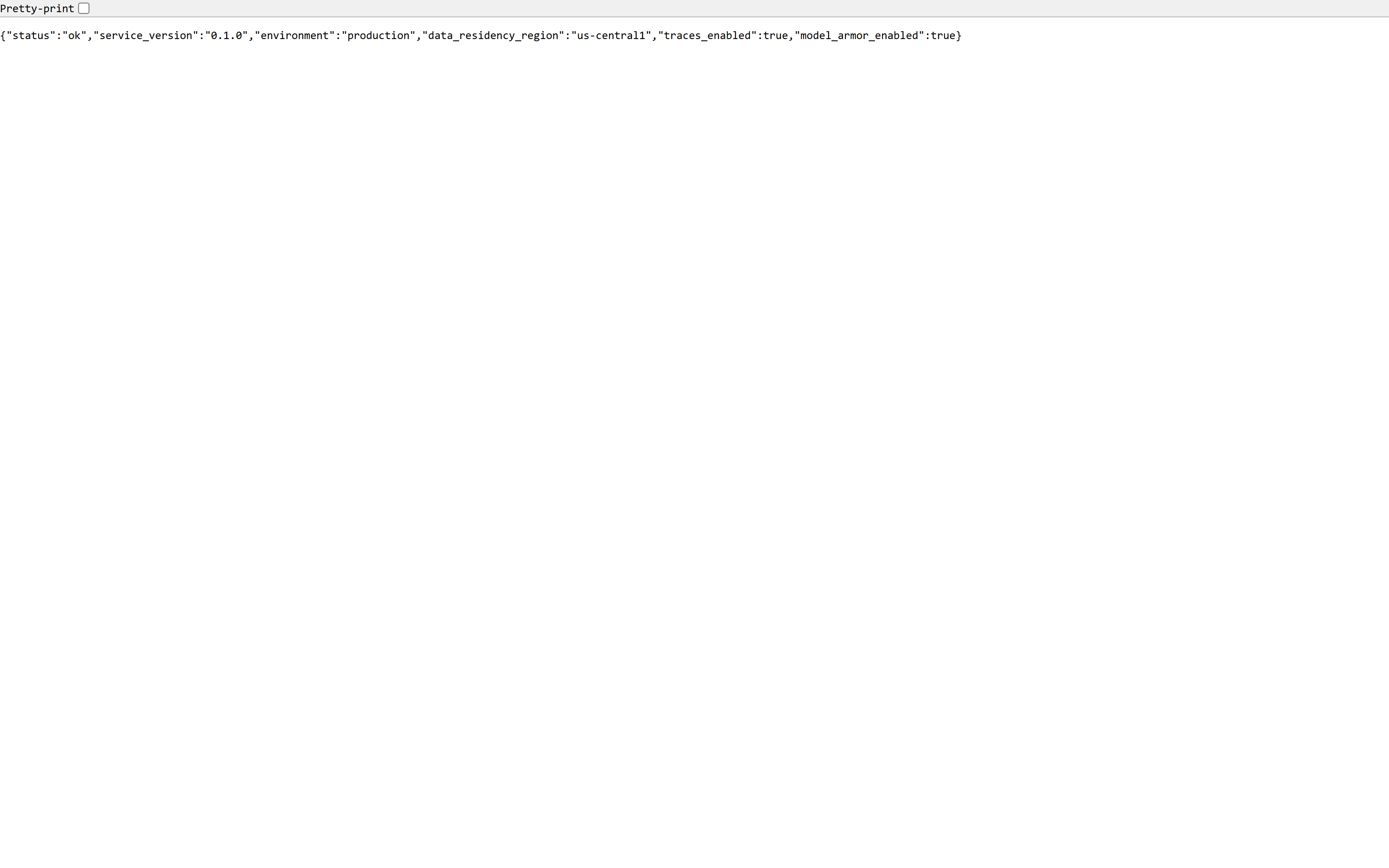
The live /health endpoint on Cloud Run: traces_enabled: true, model_armor_enabled: true, region-pinned.
-
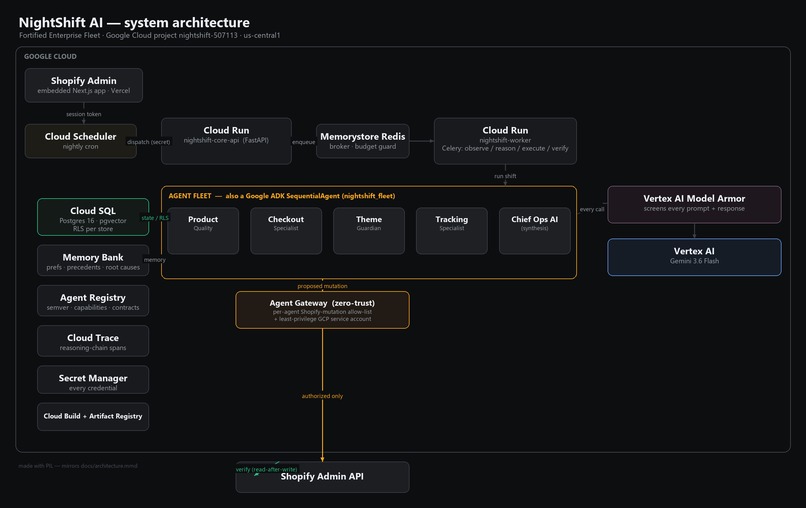
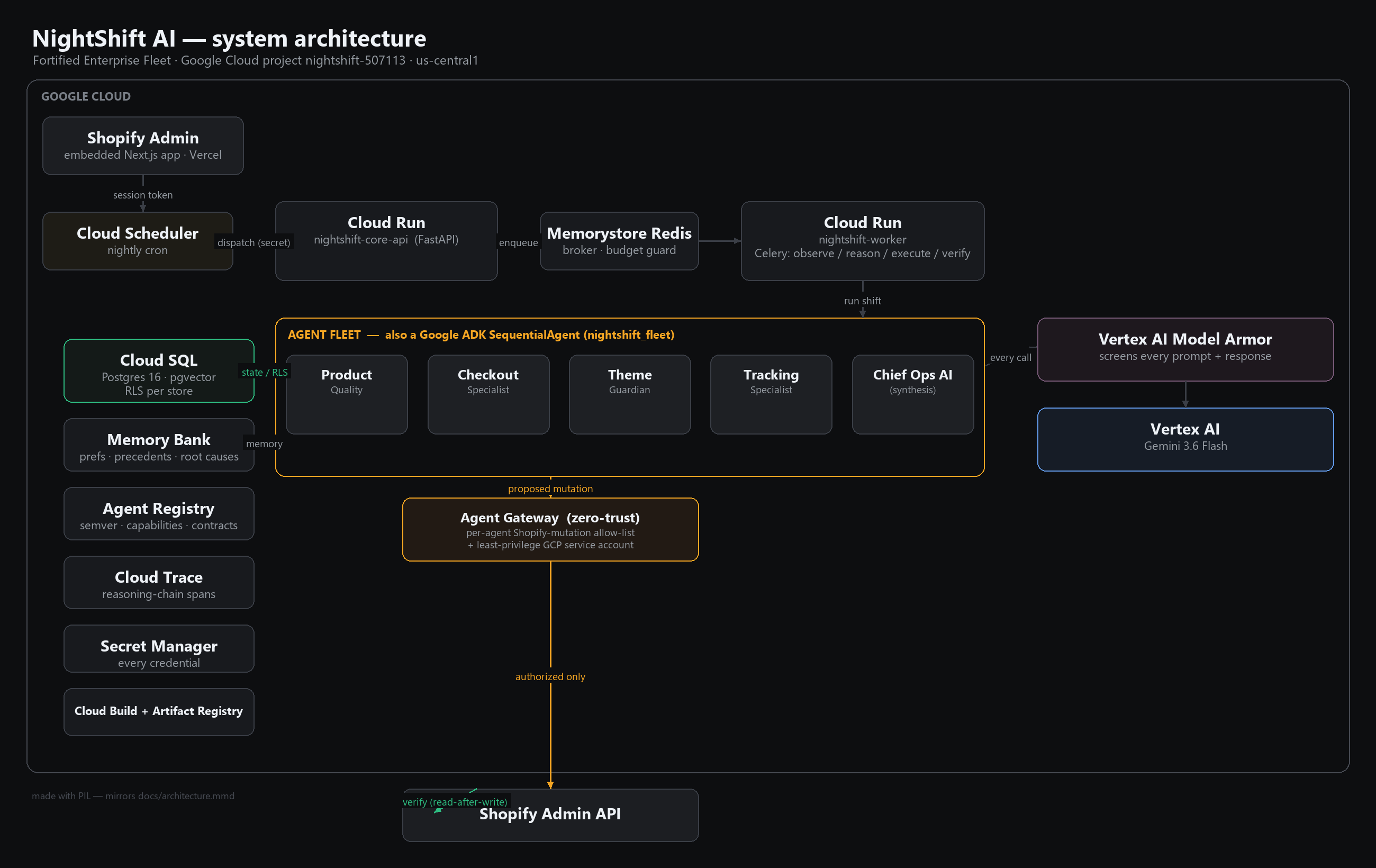
System architecture: every Google Cloud service, and the zero-trust Agent Gateway between the fleet and the Shopify Admin API.
-
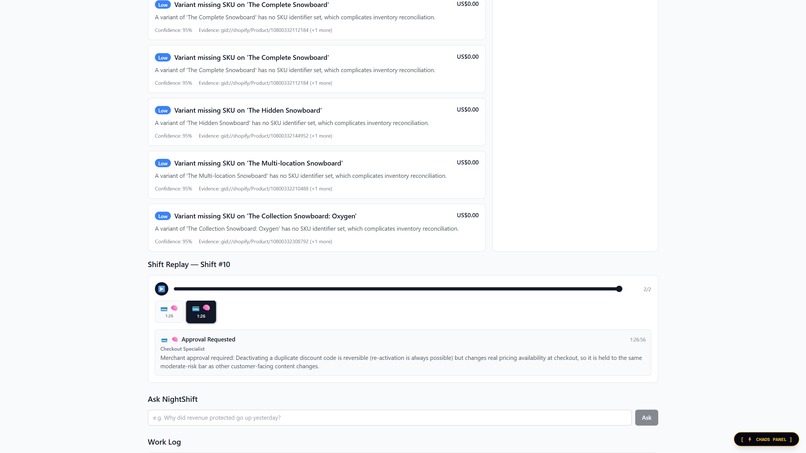
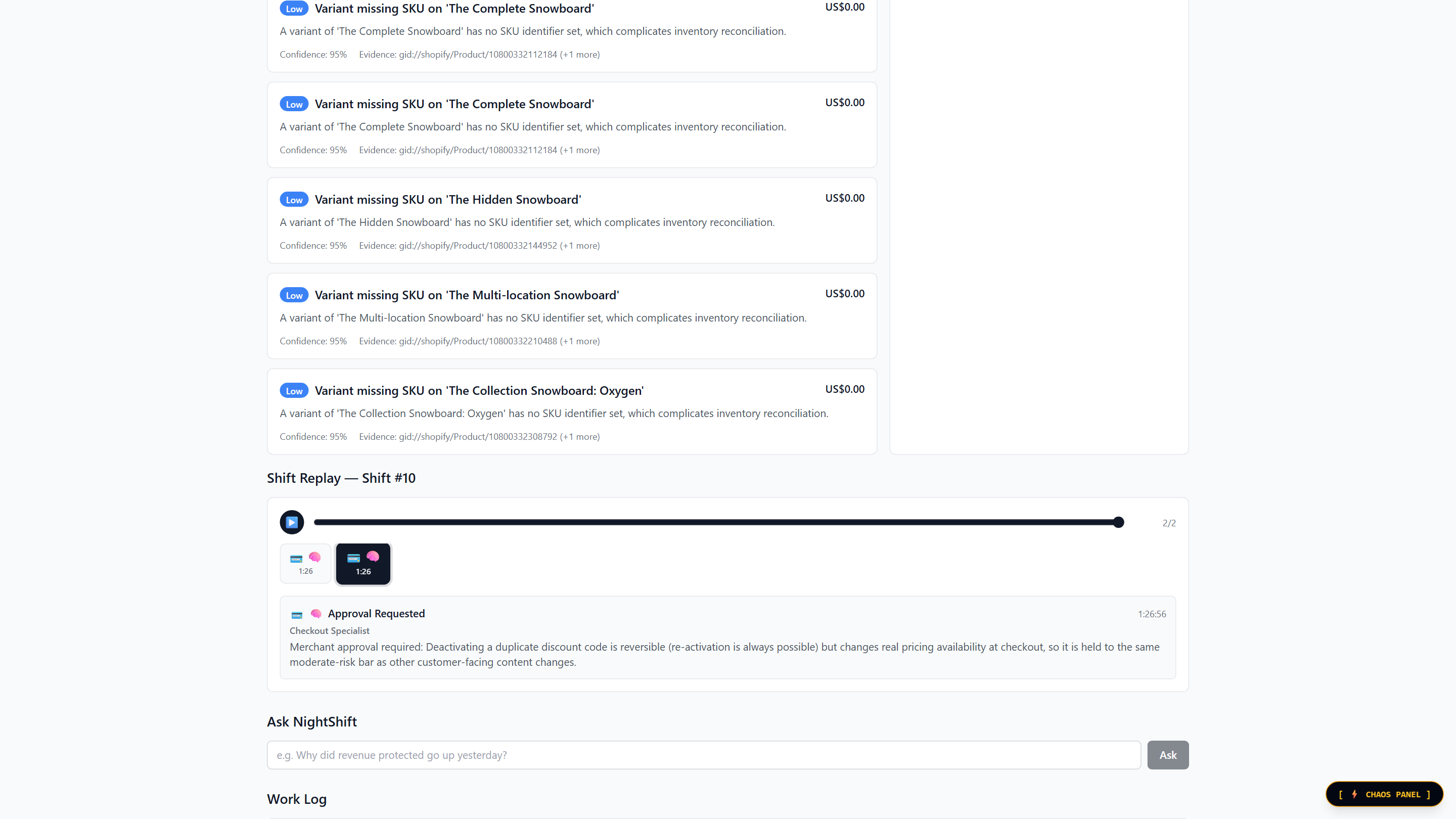
Shift Replay: scrub the full detect → reason → risk → approve → execute → verify timeline for any past shift.
-
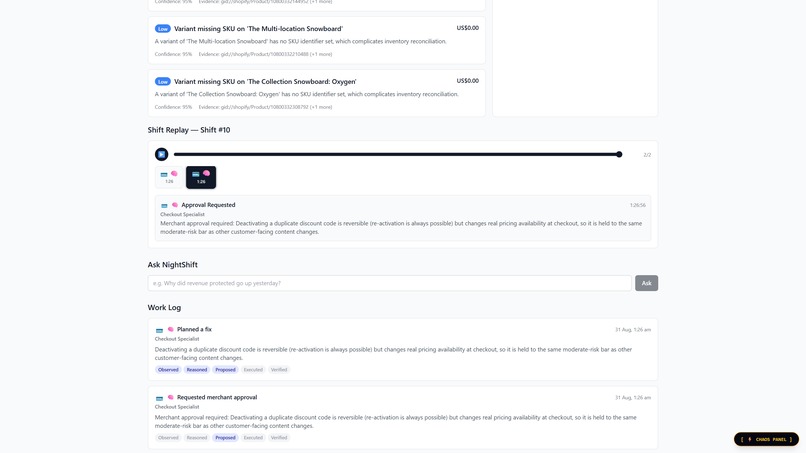
Ask NightShift: a conversational surface over Chief Ops AI's synthesis, grounded in the actual shift data.
The problem
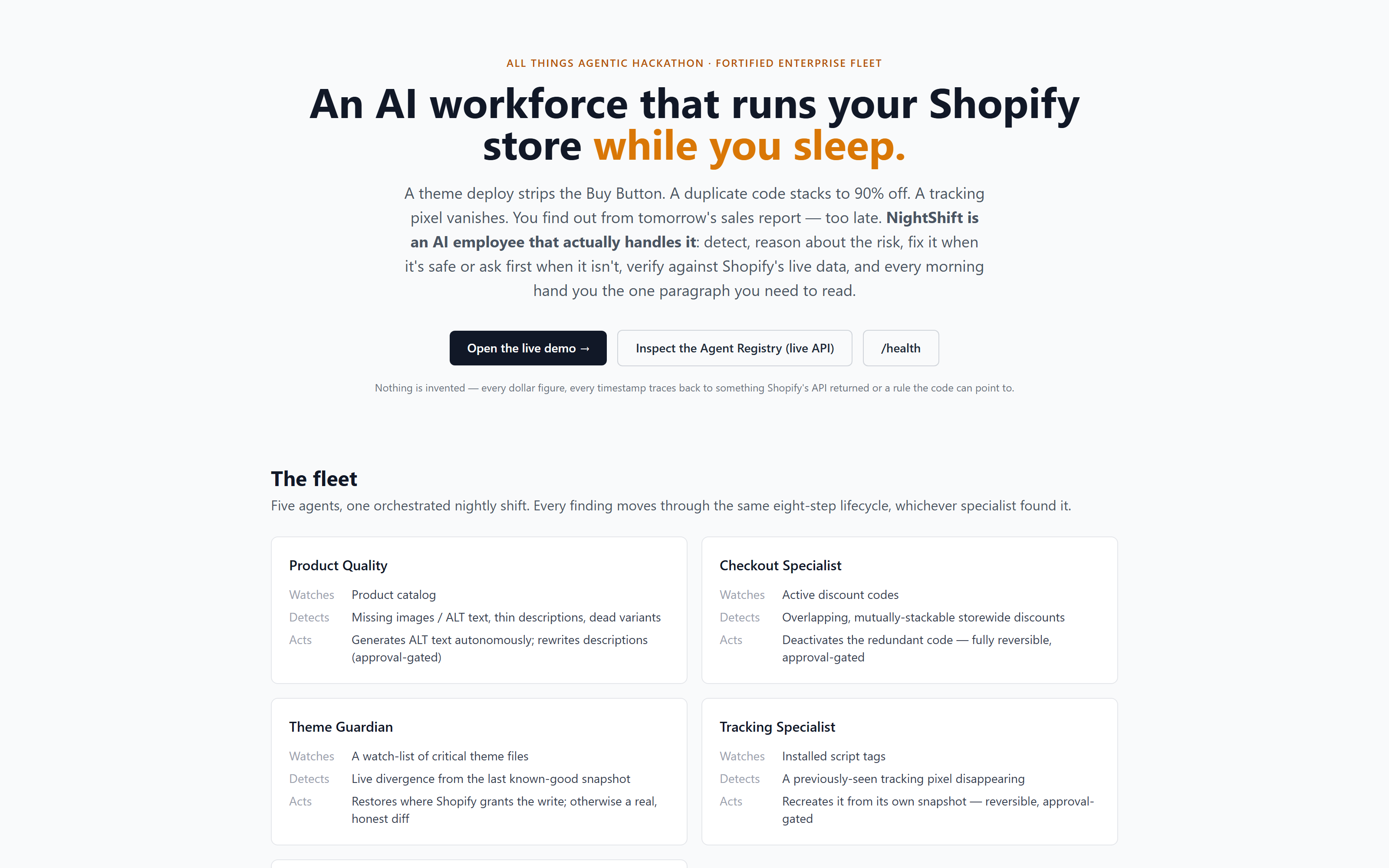
Every Shopify merchant goes to sleep a little worried. A theme deploy silently drops the "Add to Cart" button. A new discount code stacks with an old one and sells everything at 90% off. A tracking pixel disappears and a week of attribution data is gone. You find out from the next morning's sales report — hours too late, thousands of dollars down.
A chatbot doesn't help. It can't watch your store, and it can't fix anything.
What NightShift is
NightShift is an AI employee that does both. Five specialist agents run an orchestrated "shift" every night against your live store:
| Agent | Watches | Acts |
|---|---|---|
| Product Quality | Catalog | Generates ALT text (auto); rewrites thin descriptions (approval) |
| Checkout Specialist | Active discounts | Deactivates redundant / overlapping stackable codes |
| Theme Guardian | A watch-list of critical theme files | Restores where Shopify grants the write; else an honest diff |
| Tracking Specialist | Installed script tags | Recreates a vanished tracking pixel from its own snapshot |
| Chief Ops AI | Every specialist's findings | One Gemini call → an executive briefing with a stated root cause |
Every finding — whichever agent catches it — moves through the same eight-step lifecycle: Observe → Reason (Gemini) → Assess Risk → Approve → Execute → Verify → Explain → Persist. A fix is auto-applied only when its risk classification says it is genuinely safe and reversible; anything customer-facing waits in the Approval Center. Every executed fix is re-verified with a read-after-write against Shopify's live data, and rolled back if it didn't take.
How we built it
- Orchestration — a Celery DAG (
inspect_catalog → inspect_discounts → inspect_theme_files → inspect_tracking_scripts → plan_cognitive_tasks → compile_shift_report) on Cloud Run, triggered by Cloud Scheduler. The same fleet is also expressed as a Google ADKSequentialAgentof fiveLlmAgents, loadable withadk web. - Reasoning — every specialist's analysis and Chief Ops AI's cross-agent synthesis go through Gemini 3.6 Flash on Vertex AI (billed through the project, not an API key).
- Security / governance — every agent runs under a named
AgentPrincipalwith a least-privilege GCP service account and an explicit Shopify-mutation allow-list. Every agent-initiated mutation passes through one Agent Gateway chokepoint; a disallowed action becomes anAGENT_SCOPE_VIOLATIONand aGATEWAY_DENYaudit row, never a silent proceed. Every Gemini prompt and response is screened by Vertex AI Model Armor — a block degrades to a deterministic path and is recorded asAI_INPUT_BLOCKED/AI_OUTPUT_BLOCKED. - Durable state — Cloud SQL (Postgres 16, Postgres RLS per store) holds missions, issues, immutable shift reports, an append-only
audit_logstable, and a Memory Bank of learned merchant preferences that is re-read at the next plan step days later. Idempotency keys stop a retried task from double-mutating Shopify. Memorystore Redis backs the Celery broker and a daily LLM budget guard that survives worker restarts. - Telemetry — OpenTelemetry spans over the whole reasoning chain, exported to Cloud Trace (
CloudTraceSpanExporter), with queue-hop context propagation so plan → execute → verify → report land in one trace tree. - Everything else — Secret Manager for every credential, Cloud Build + Artifact Registry for the images, an embedded Next.js admin UI on Vercel, 397 hermetic backend tests (pytest, in-memory fakes for every port, no key / no account / no network).
What we learned
- Cloud Run's default is CPU-only-during-requests — a background Celery worker silently freezes between health probes until you set
--no-cpu-throttling. That single flag was the difference between "it deploys" and "it actually processes a shift." - Model Armor is genuinely easy to bolt on as a decorator around a structured LLM client — the hard part is making every downstream caller degrade gracefully when it blocks, which fell out for free because a
ModelArmorBlockedErrorsubclasses the existing schema-validation error every caller already handles. - "Success is a contract, not a status code" — verifying the outcome (read-after-write against the real API) rather than "did the step run" is what makes autonomous mutation trustworthy.
Challenges
- Getting a Celery worker to behave on Cloud Run (CPU throttling, a health-shim for the required
$PORTlistener, a Serverless VPC connector to reach Memorystore). - A Windows
core.autocrlfcheckout shipped a#!/bin/sh\rshebang that made Cloud Run fail with "no such file or directory" — fixed with.gitattributes+ a build-timesed. - Keeping the in-code fleet and the registry / ADK graph in lockstep so
GET /api/v1/agents, the Operations Center panel, andadk weball show the same five versioned agents.
Try it
- Live demo dashboard (pre-seeded store, real shift data): https://nightshift-lite.vercel.app/dashboard
- Live API: https://nightshift-core-api-fs6fkuhoiq-uc.a.run.app/health ·
/api/v1/agents - Prove the Gemini + Model Armor path yourself:
cd services/core_api && GCP_PROJECT_ID=nightshift-507113 python scripts/verify_vertex_wiring.py
Built With
- celery
- cloud-build
- cloud-run
- cloud-scheduler
- cloud-sql
- cloud-trace
- docker
- fastapi
- gemini
- google-adk
- google-genai
- memorystore
- model-armor
- next.js
- opentelemetry
- postgresql
- pytest
- python
- react
- redis
- secret-manager
- shopify
- tailwindcss
- typescript
- vertex-ai

Log in or sign up for Devpost to join the conversation.