-
-
-
-
-
-
-
-
-
-
-
-
-
-
-
-
benchmarks
Inspiration
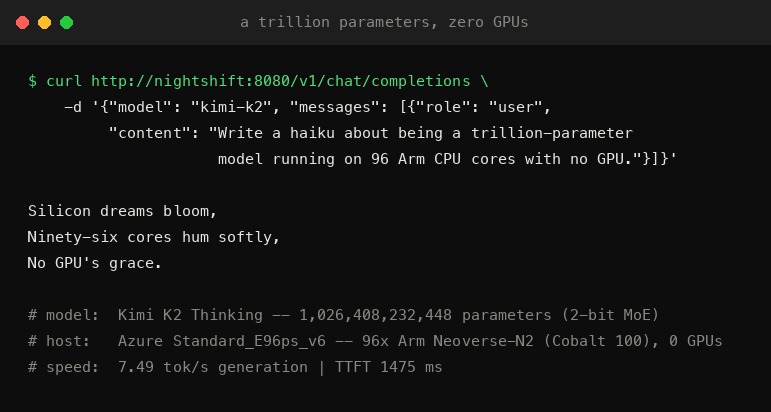
Everyone "knows" a trillion-parameter model needs a rack of GPUs. I didn't quite believe it — because modern frontier models are mixture-of-experts (MoE). Kimi K2 has $1.04\text{T}$ parameters but activates only $\sim32\text{B}$ per token; Kimi K3 has $2.8\text{T}$ and activates $\sim104\text{B}$. The full model never has to be computed at once — it only has to fit in memory. Compute per token scales with the active params, not the total:
$$\text{FLOPs}{\text{token}} \approx 2 \cdot N{\text{active}}.$$
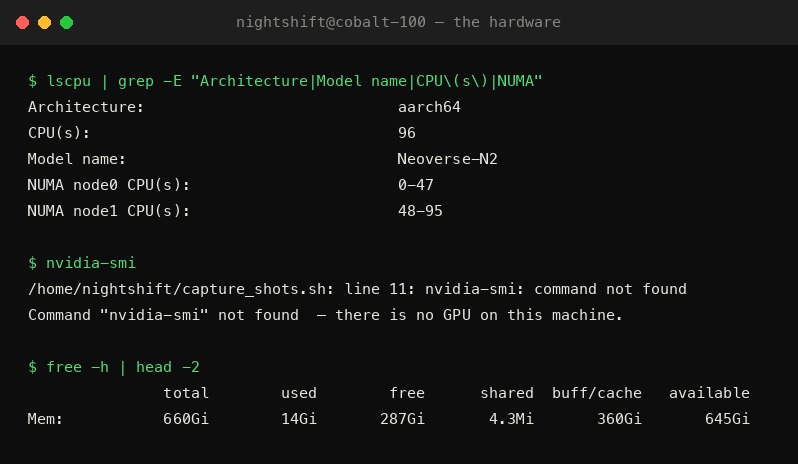
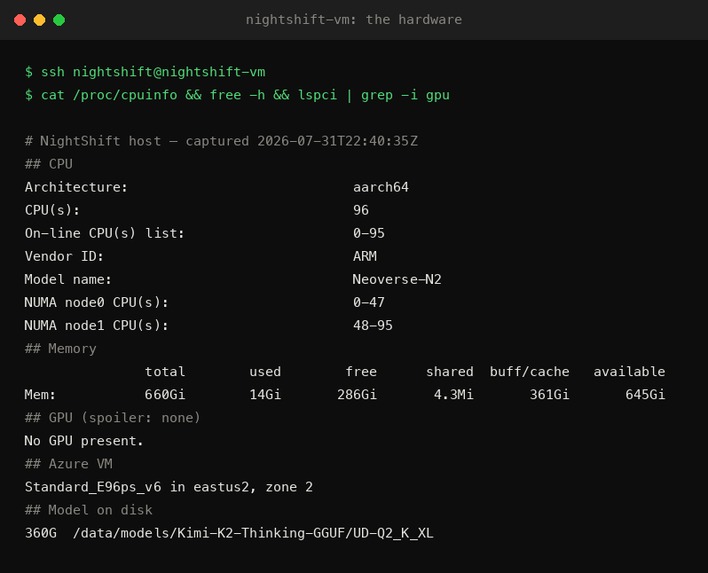
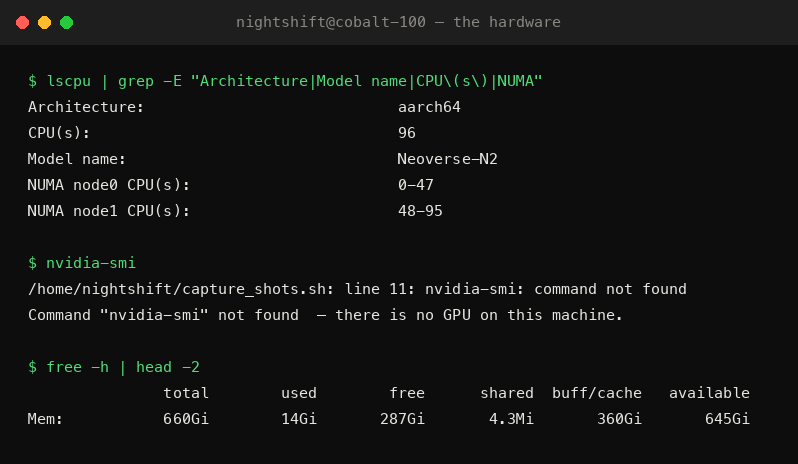
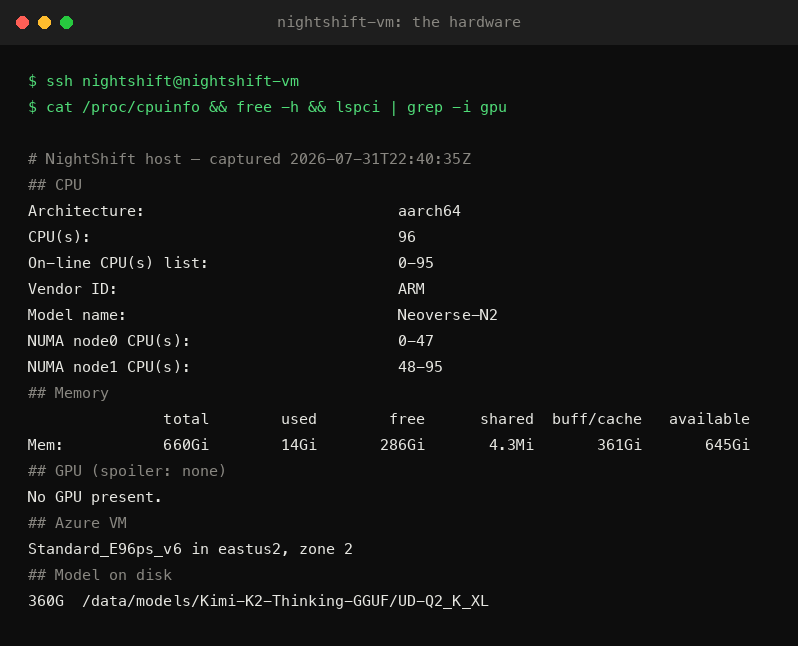
So memory capacity becomes the gate — and that's exactly what Arm cloud CPUs have, cheaply. An Azure Cobalt 100 VM gives you $96$ Neoverse-N2 cores and $660\text{ GiB}$ of RAM for ~\$1/hour on spot, with zero GPUs. I asked: can I run a trillion-parameter AI engineer on one Arm CPU VM and put it to work on the developer jobs where cost matters and latency doesn't — overnight PR review, issue triage, code generation? That became NightShift.
What it does
NightShift turns one Arm CPU VM into a private, trillion-parameter dev engineer:
- One-command deploy —
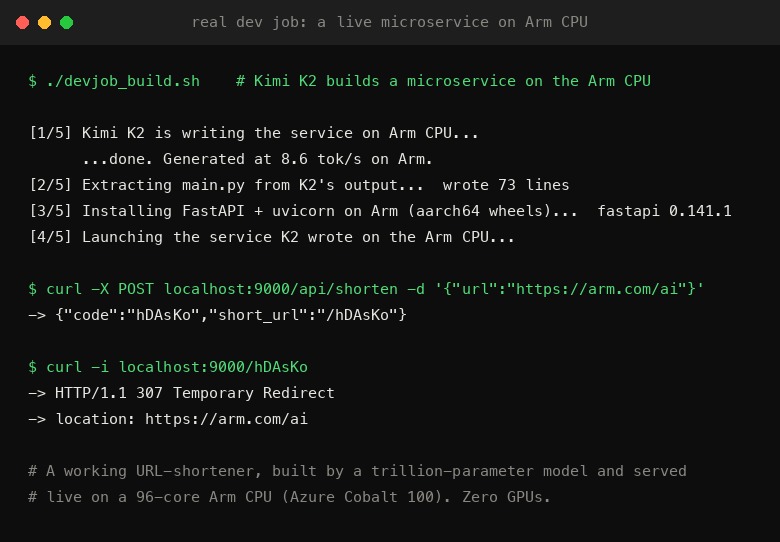
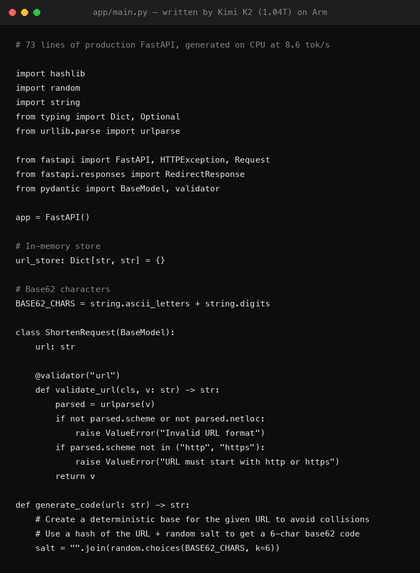
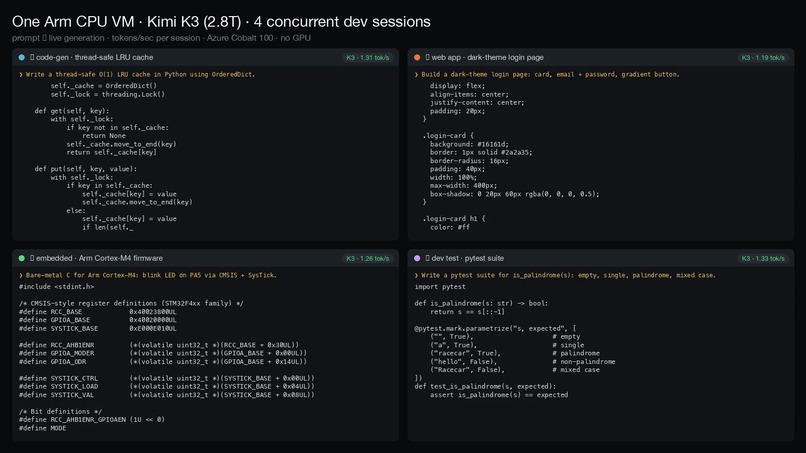
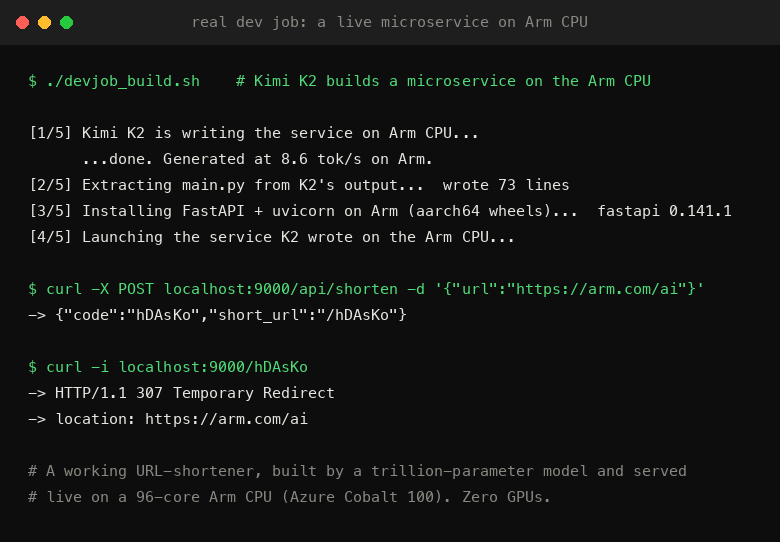
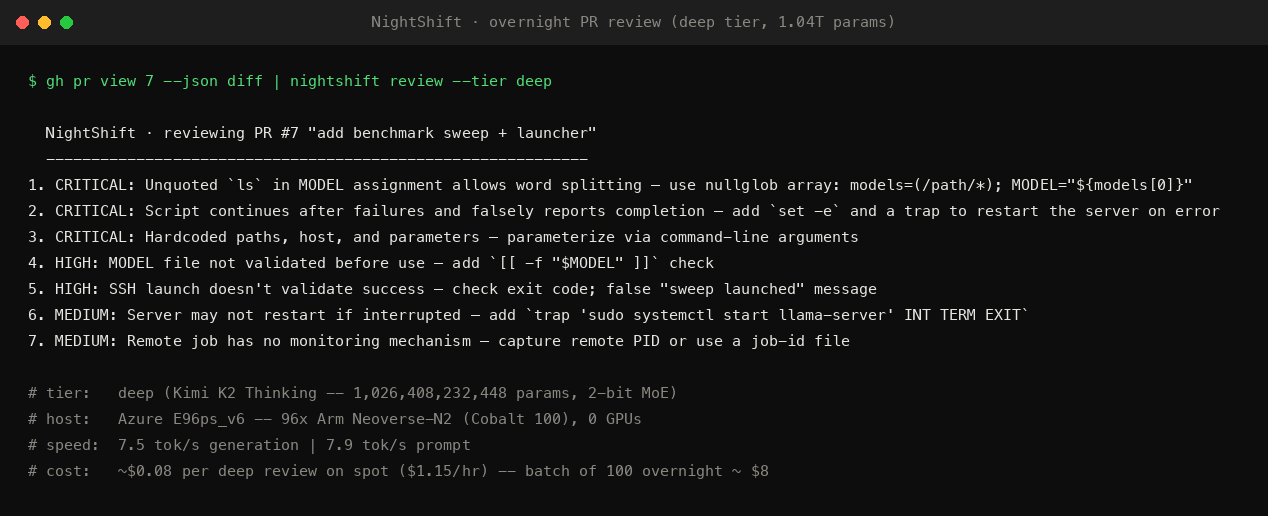
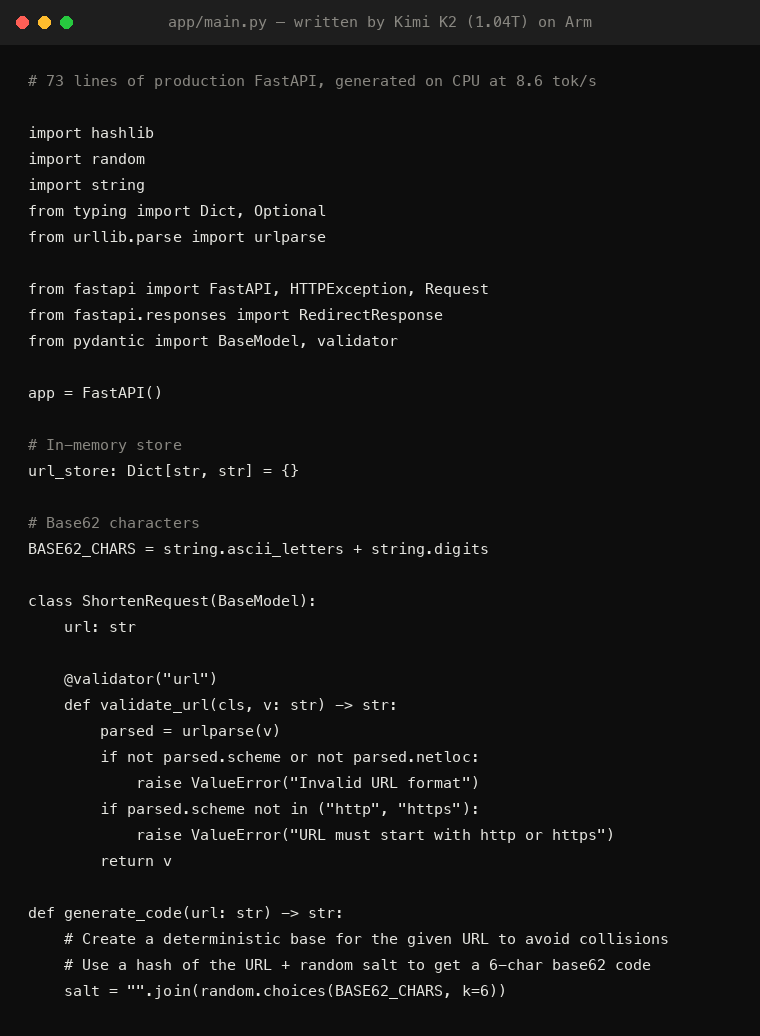
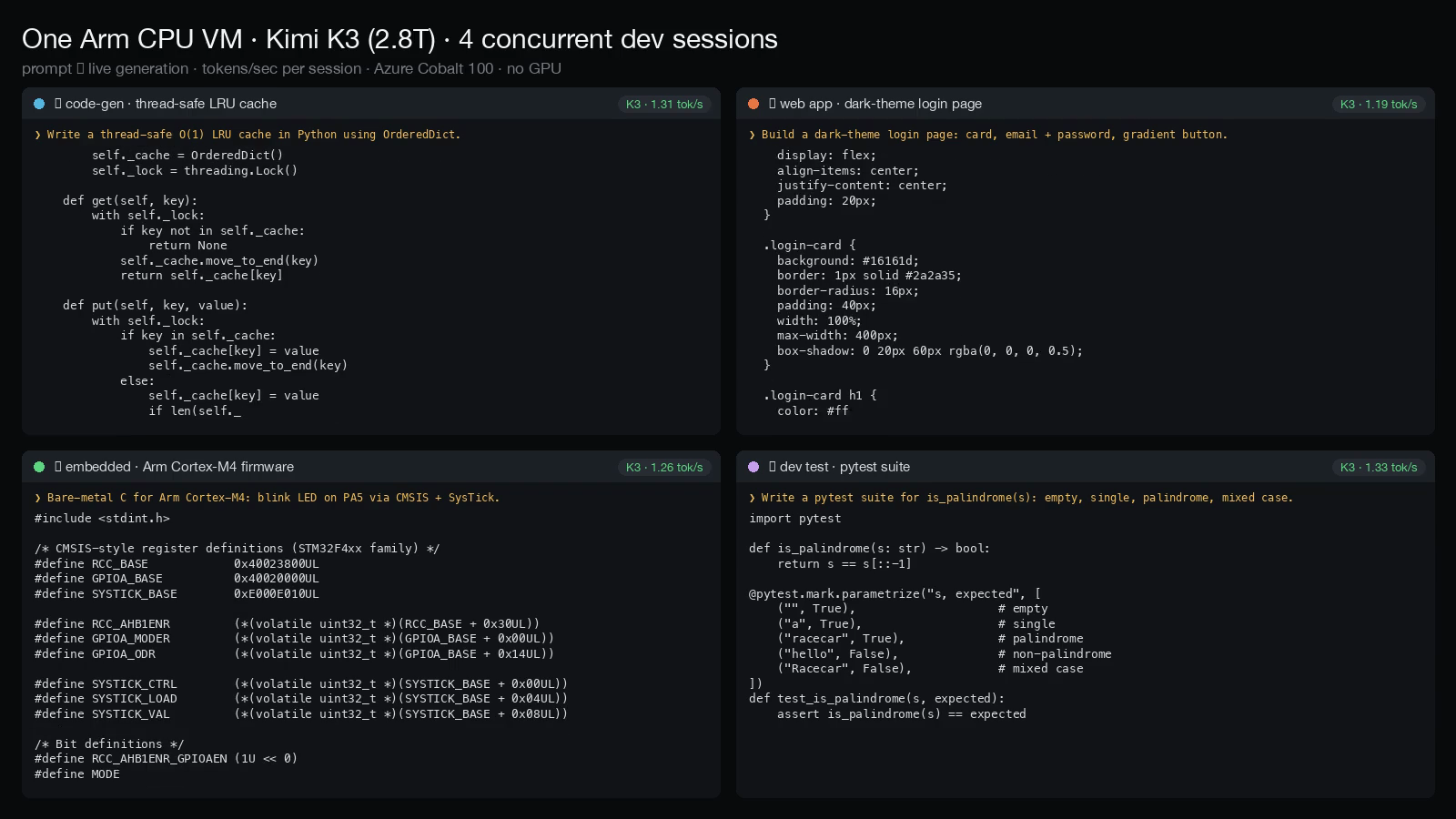
terraform applystands up an OpenAI-compatible endpoint serving Kimi K2 (1.04T) or K3 (2.8T) via llama.cpp + Arm KleidiAI, no GPU. - Real dev work — it writes and runs software on the Arm CPU (a live FastAPI microservice), reviews pull requests overnight (a GitHub Action that found real bugs in this repo), and serves four concurrent dev sessions at once via continuous batching.
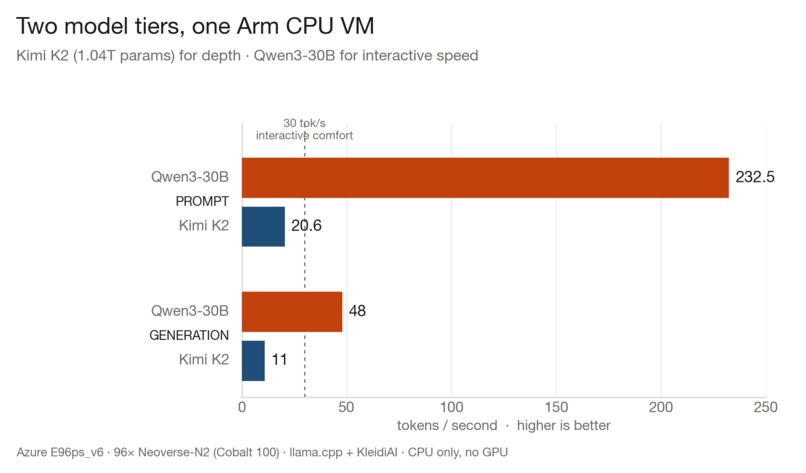
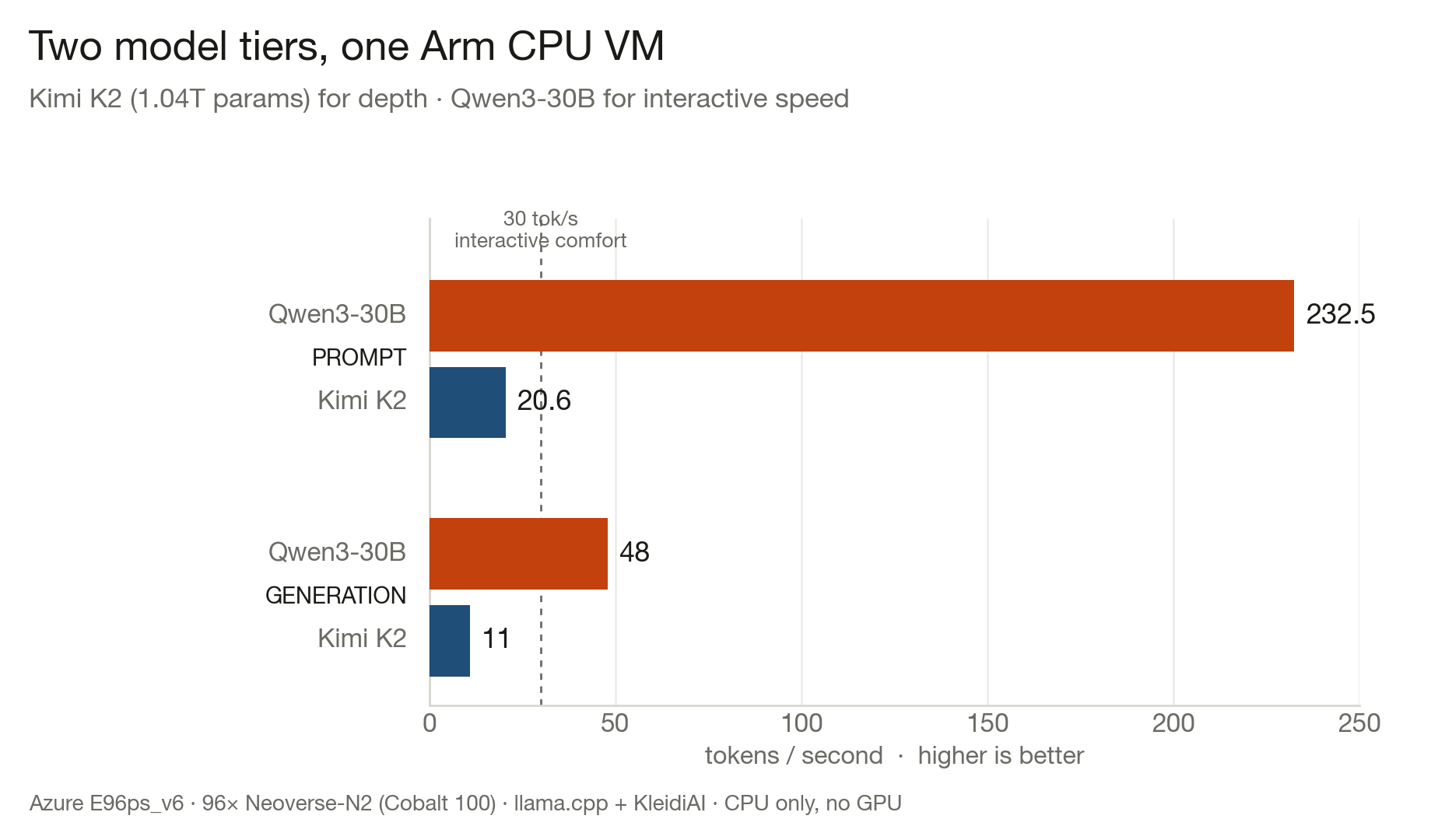
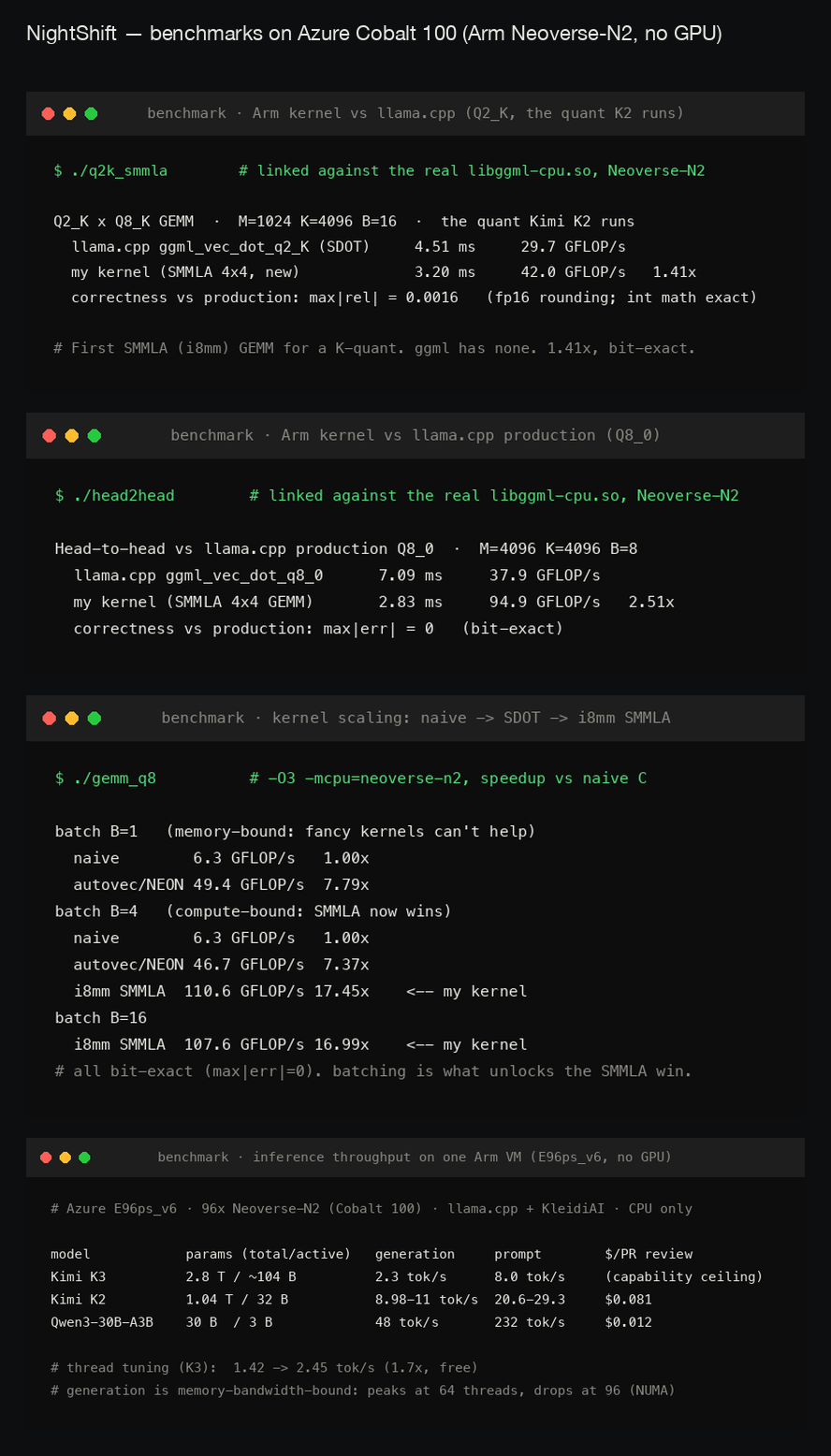
- Two tiers, one VM — K2/K3 for deep async work; Qwen3-30B for interactive coding at ~48 tok/s.
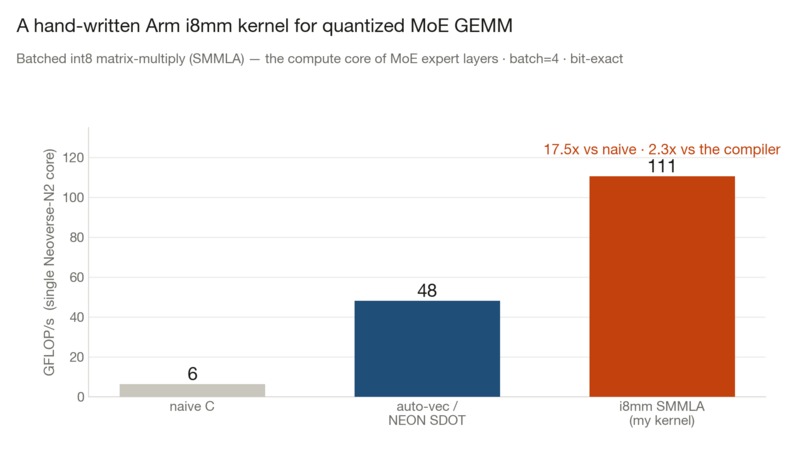
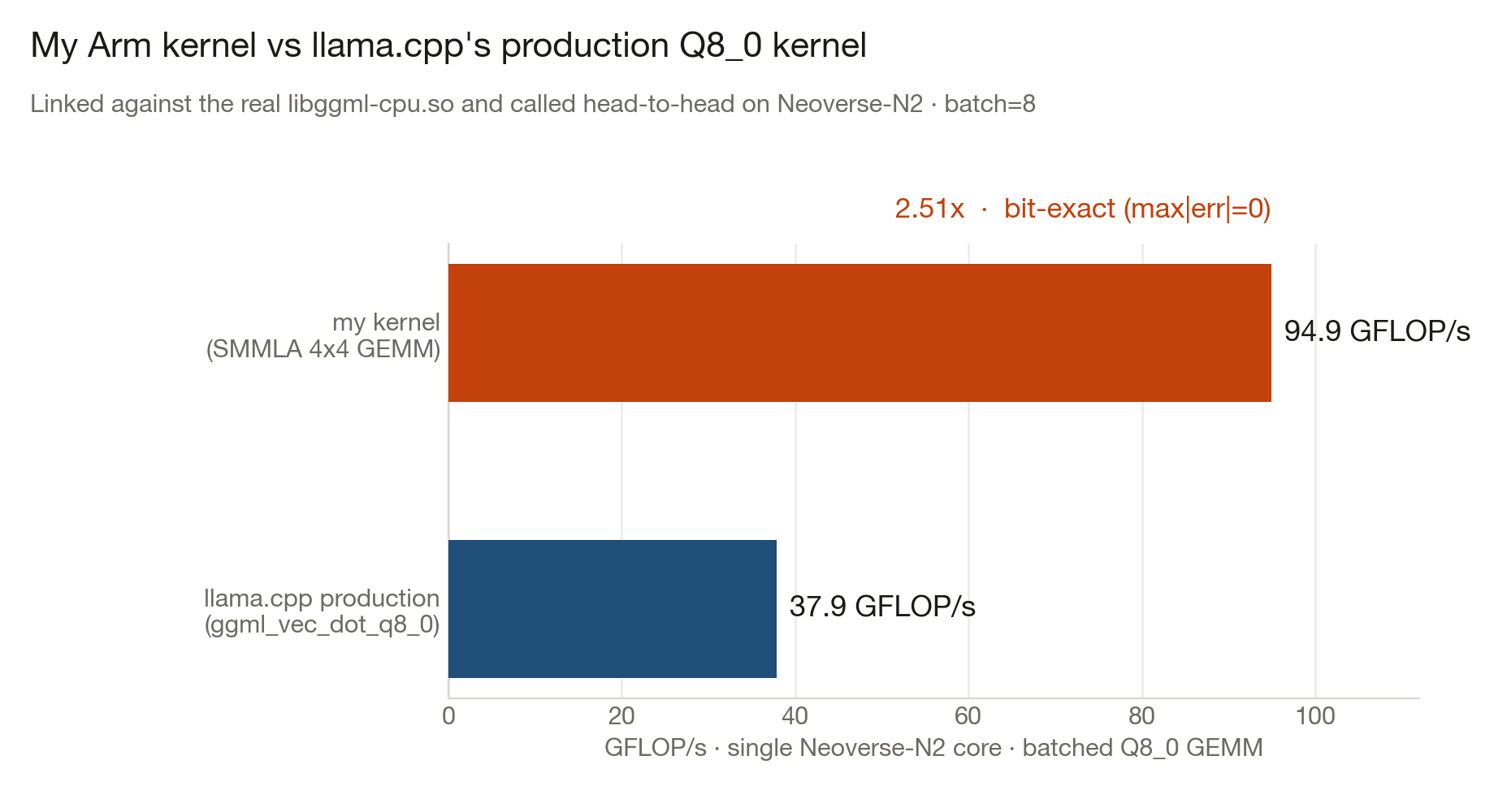
- A hand-written Arm kernel — the first
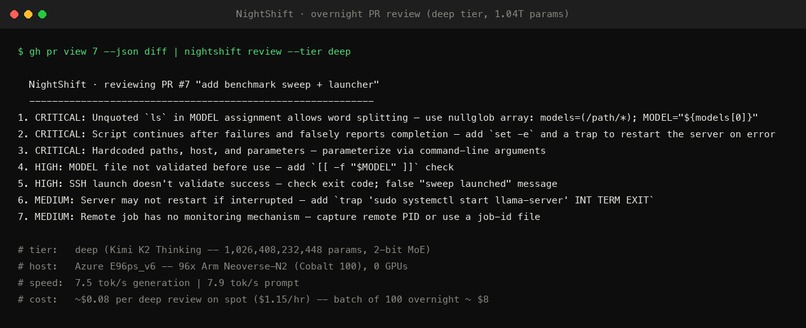
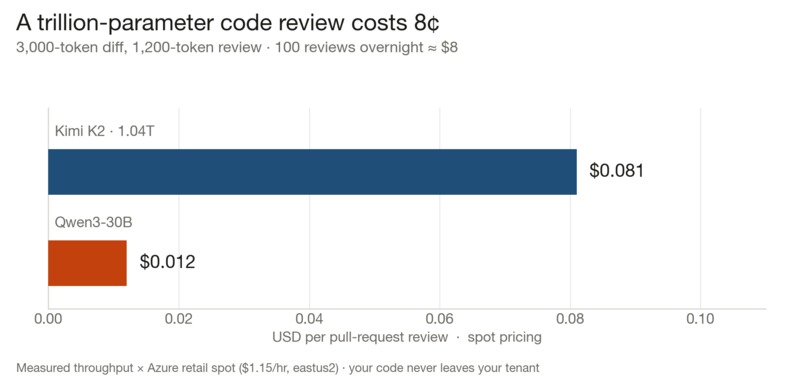
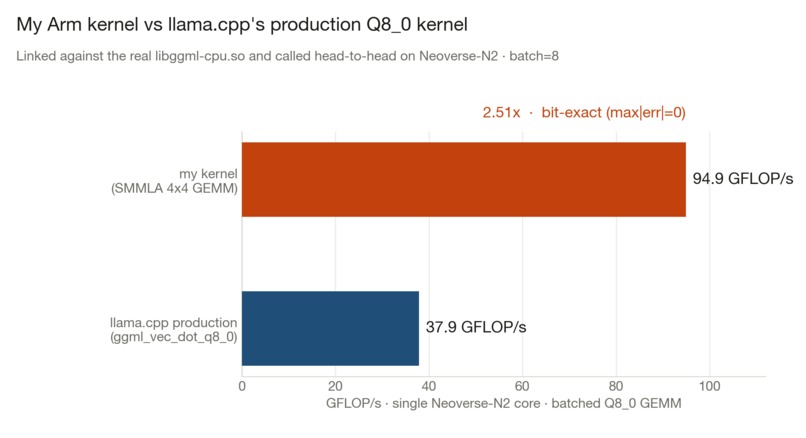
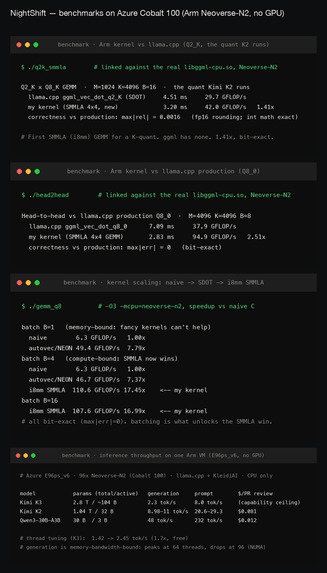
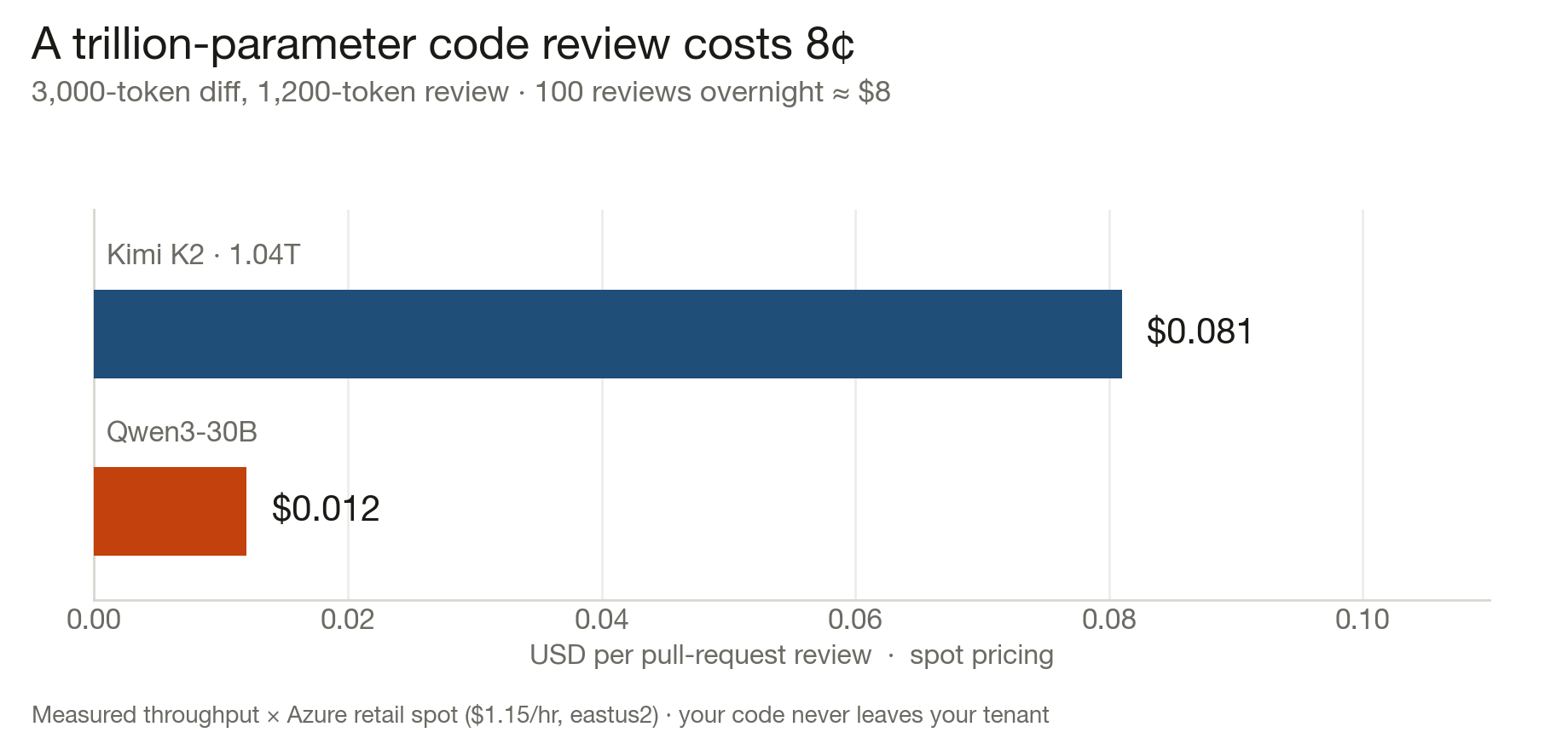
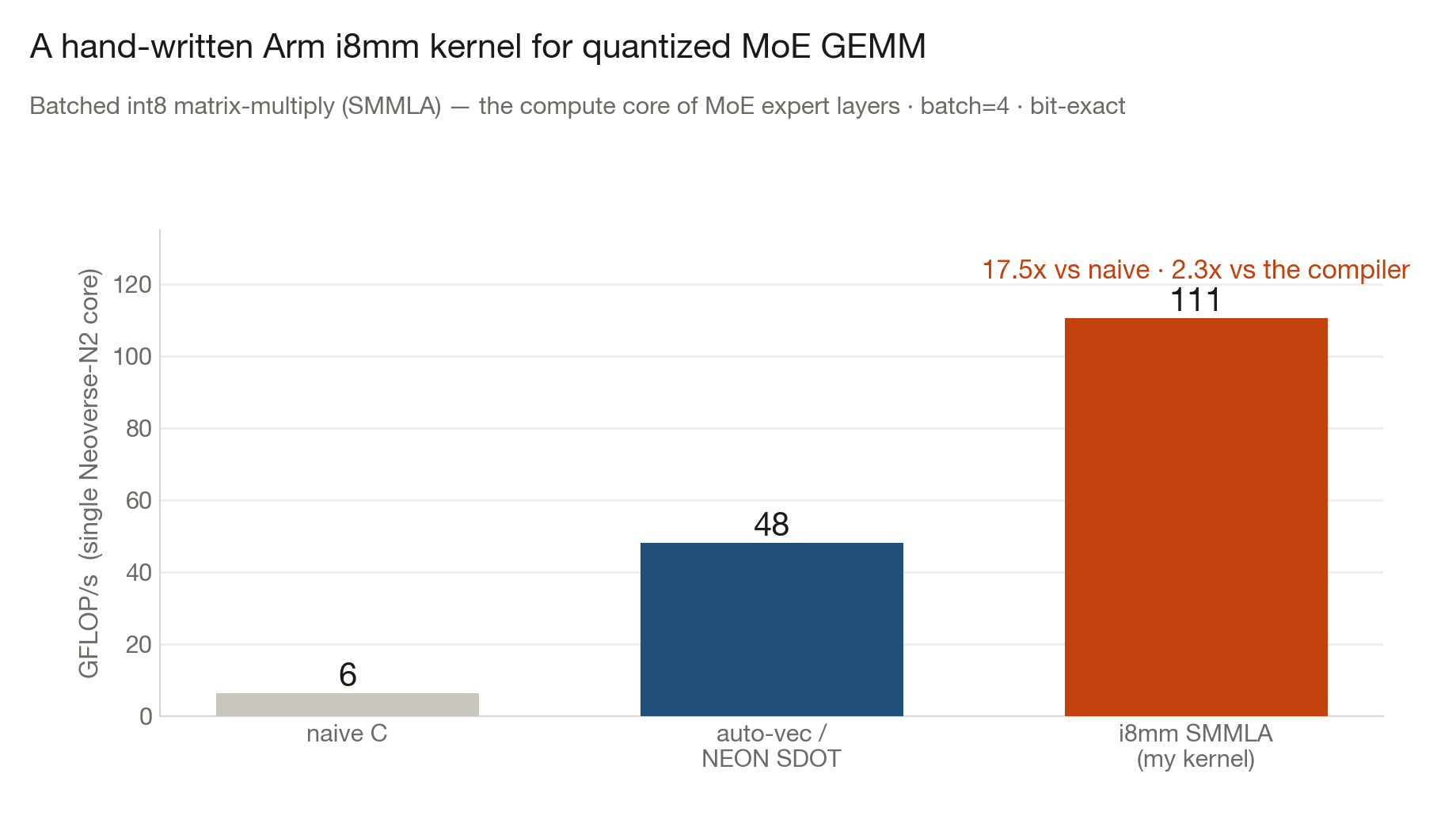
i8mm/SMMLA GEMM for a K-quant, beating llama.cpp's production kernel 1.41×, bit-exact. - A reproducible playbook — every benchmark and chart, regenerable from source. Your code never leaves your tenant; a trillion-parameter PR review costs about 8 cents.
How we built it
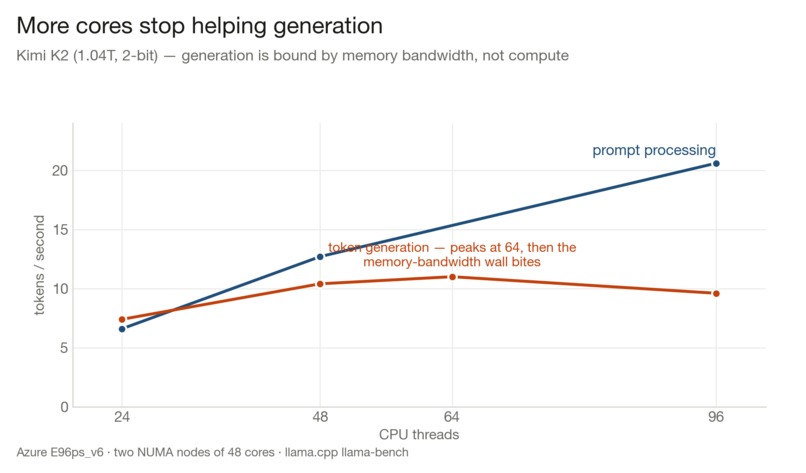
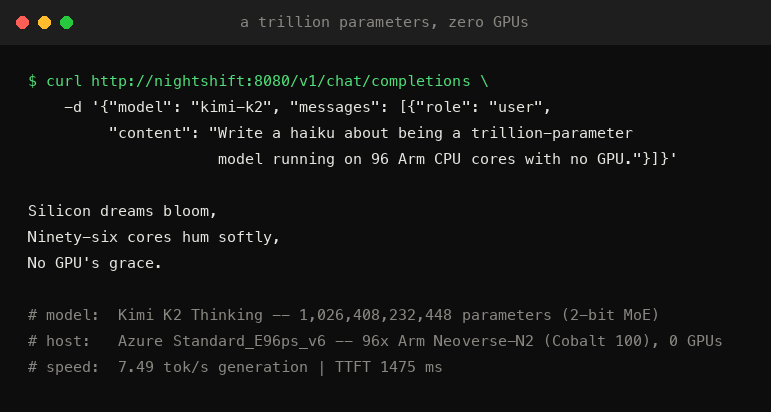
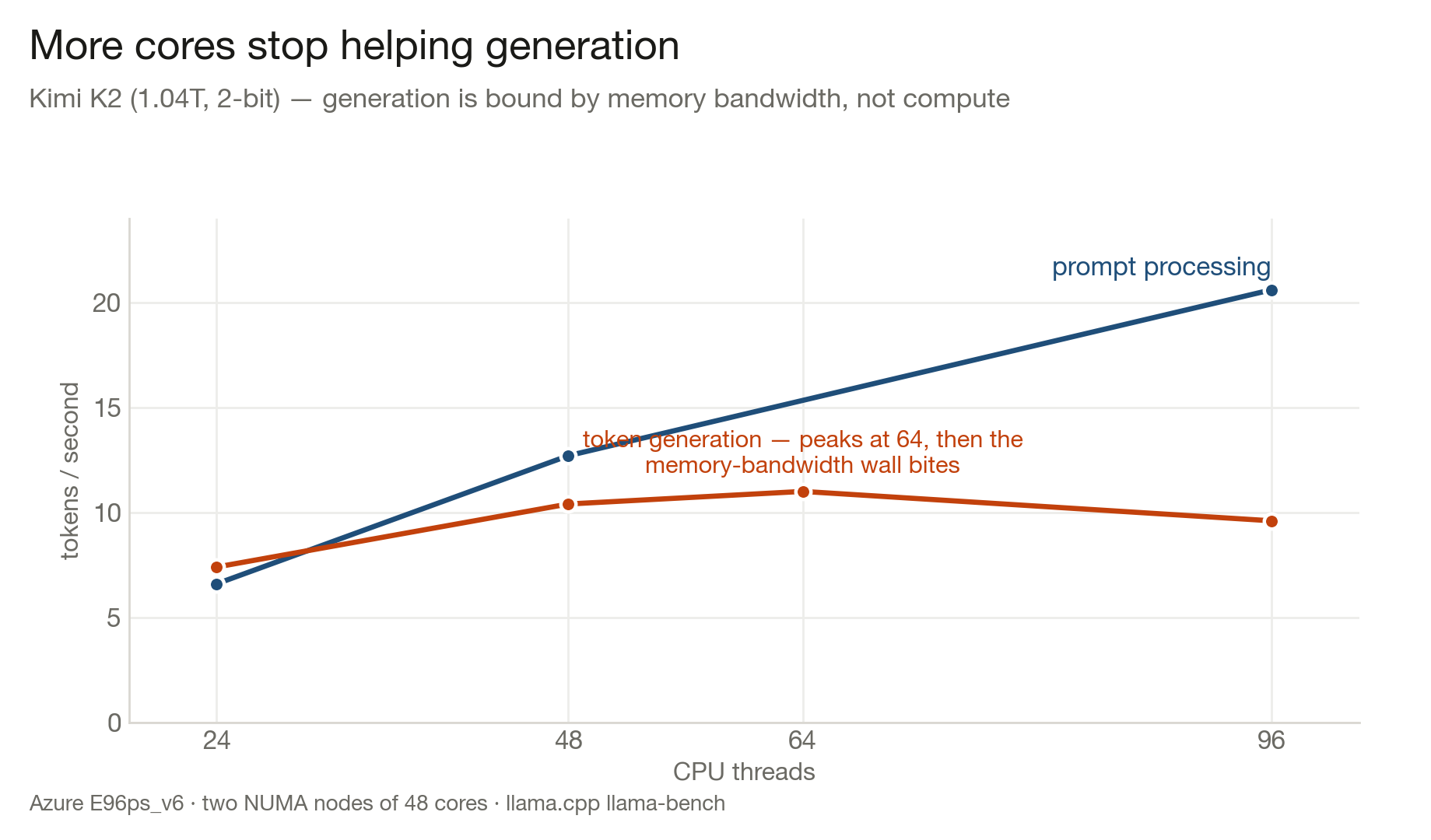
I began by proving the thesis: Kimi K2 (2-bit) generating at ~9–11 tok/s on a single
E96ps_v6, with only ~15 GiB hot RAM while its 360 GB of weights stayed memory-mapped. Then I
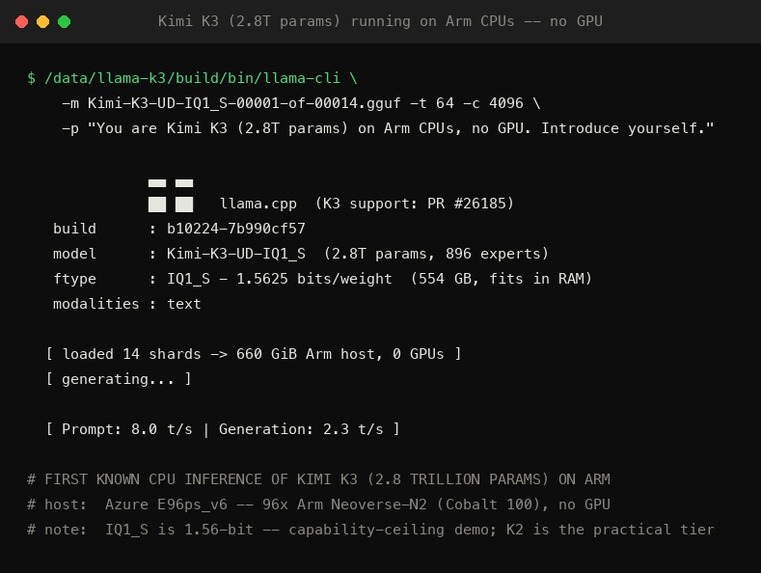
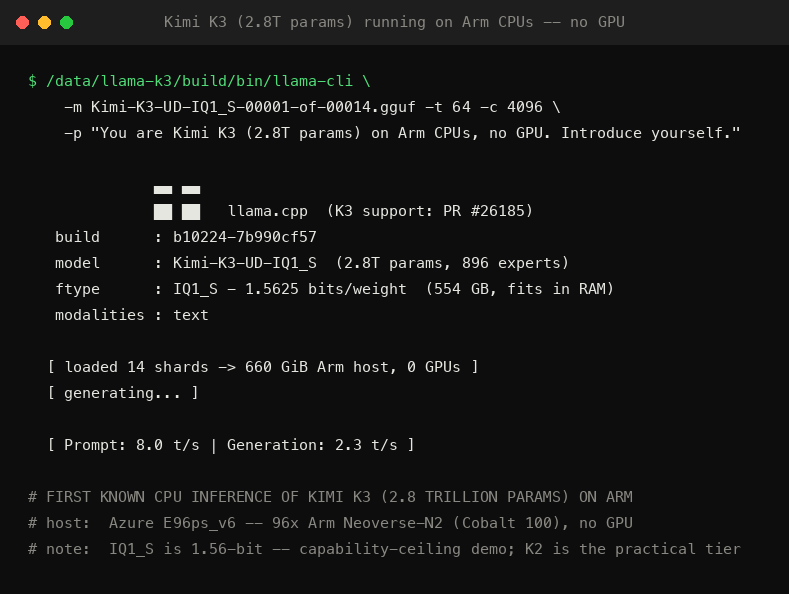
pushed to the frontier — five days after Moonshot released Kimi K3 (2.8T), I built llama.cpp
from its unmerged support PR and ran it on the same Arm box: to my knowledge the first CPU
inference of K3 on Arm silicon (~2.3 tok/s).
The stack: Terraform + cloud-init provision the VM, a PremiumV2 model disk, and a llama.cpp build
with -DGGML_CPU_KLEIDIAI=ON; Unsloth dynamic GGUF quants; a benchmark harness; ExpertAtlas, a
C++ tool that hooks llama.cpp's graph eval callback to record which experts fire on real dev
traffic; a GitHub Action for PR review; and a hand-written Arm kernel. That kernel targets the
quantized GEMM at the heart of every expert layer using SMMLA (a $2\times2$ int8
matrix-multiply):
$$C_{ij} \mathrel{+}= \sum_{k} A_{ik}\,B_{jk},\qquad A,B \in \mathbb{Z}_8^{2\times8}.$$
Challenges we ran into
- The bandwidth wall. Generation is memory-bandwidth-bound: $B_{\text{token}} \approx 20$ GB for K3, so at $\sim200$ GB/s the ceiling is $\text{tok/s}{\max}\approx\text{BW}/B{\text{token}} \approx 10$. I wanted 20 tok/s single-stream and had to accept — honestly — that it's above Cobalt 100's physics, and report the real levers (batching, speculative decoding, Cobalt 200).
- Azure capacity. Mid-project the region ran dry of Arm VMs —
E96,E48, andE32all failed to allocate in my zone. I made the model disk snapshot-restorable and zone-portable in Terraform and rebuilt elsewhere. - A VPN that kept breaking SSH. Every command timed out for a stretch; the cause was my VPN changing my egress IP while the VM firewall allowed only one.
- Bleeding-edge K3. The unmerged support PR was unstable under load until I moved the server
under
systemd. - Beating a production kernel. My first SMMLA kernel only matched llama.cpp ($0.97\times$) — the per-16-element scale correction was being done in scalars. Moving it into vector registers unlocked the win.
Accomplishments that we're proud of
- First known CPU inference of Kimi K3 (2.8T) on Arm silicon — five days after release.
- A hand-written Arm kernel that beats llama.cpp's production code. On
Q2_K(the quant K2 runs), which had noi8mmpath in ggml, my SMMLA GEMM hits 41.9 vs 29.7 GFLOP/s (1.41×), bit-exact against the linkedlibggml-cpu.so. - A trillion-parameter model doing real, runnable work — building and serving a live microservice, and four concurrent dev sessions, on one CPU VM.
- Honest, reproducible economics: ~8¢ per deep PR review; one
terraform applyto reproduce the whole thing.
What we learned
- Memory bandwidth is the real currency of CPU LLM inference — the NUMA cliff, the "fewer experts didn't help" result, and why speculative decoding matters all fall out of the roofline.
- MoE sparsity is what makes trillion-parameter CPU inference possible, and routing is measurably skewed (ExpertAtlas: the hottest 50% of experts cover 76.5% of activations).
- Arm's
i8mm/SMMLA is powerful, but only with the right shape — batched, with the dequant/scale work kept vectorized — and llama.cpp already optimizes Q8_0, so the honest, novel contribution was the un-optimized K-quant path. - I also found Colibri, an x86 engine proving this thesis — and the gap it leaves open is Arm, which is exactly where NightShift lives.
What's next for NightShift — a trillion-parameter AI engineer on Arm CPUs
Wire ExpertAtlas's placement policy in to fit K3 on a smaller, cheaper VM; upstream the K-quant
SMMLA kernel to llama.cpp; add speculative decoding for Kimi (the one lever that beats the
per-token bandwidth wall); and benchmark Azure Cobalt 200 (+50% memory bandwidth) the moment
it's available. NightShift is open source (Apache-2.0) — one terraform apply, and your code
never leaves your tenant.


Log in or sign up for Devpost to join the conversation.