-
-
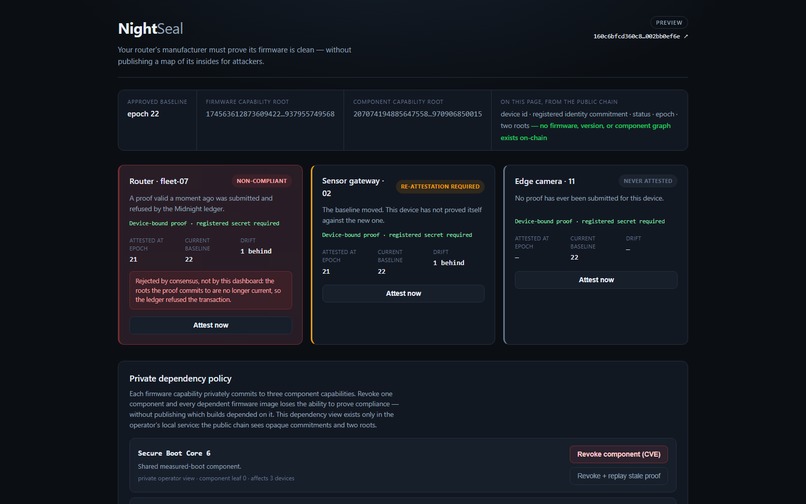
replay-rejected
-
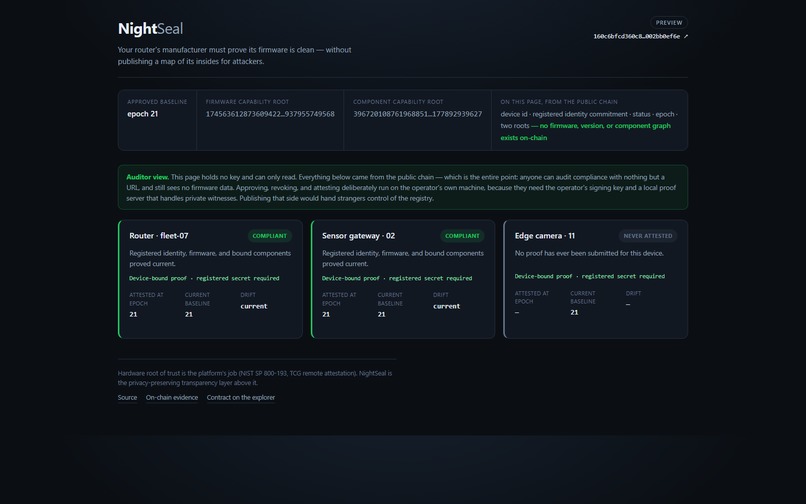
dashboard-live
-
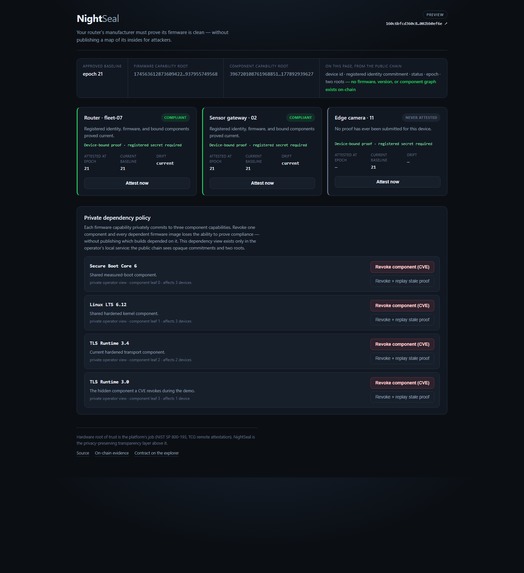
operator-panel
-
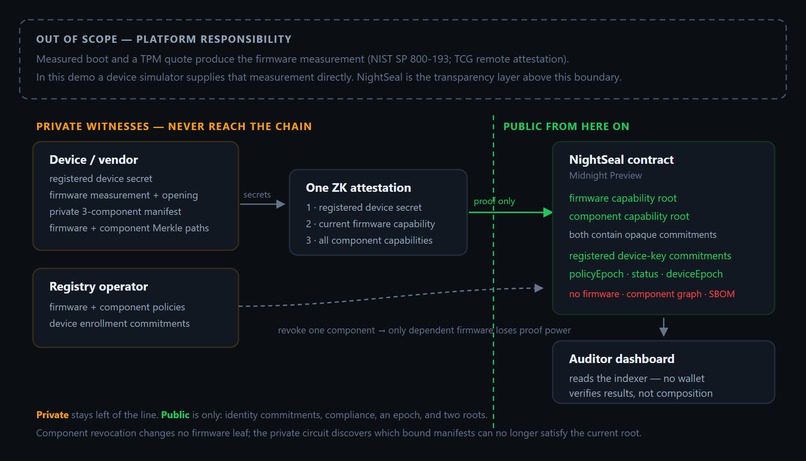
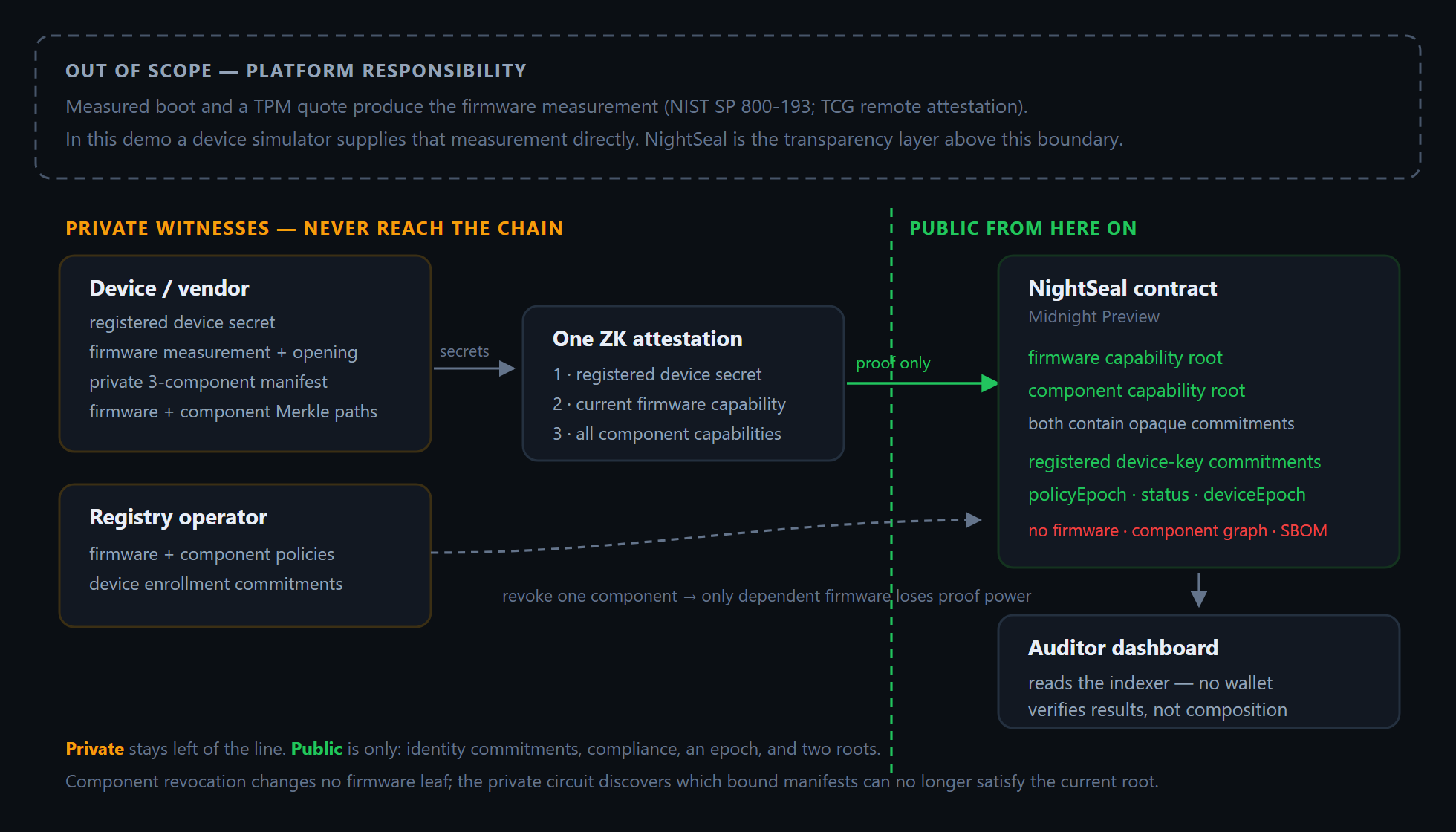
architecture
-
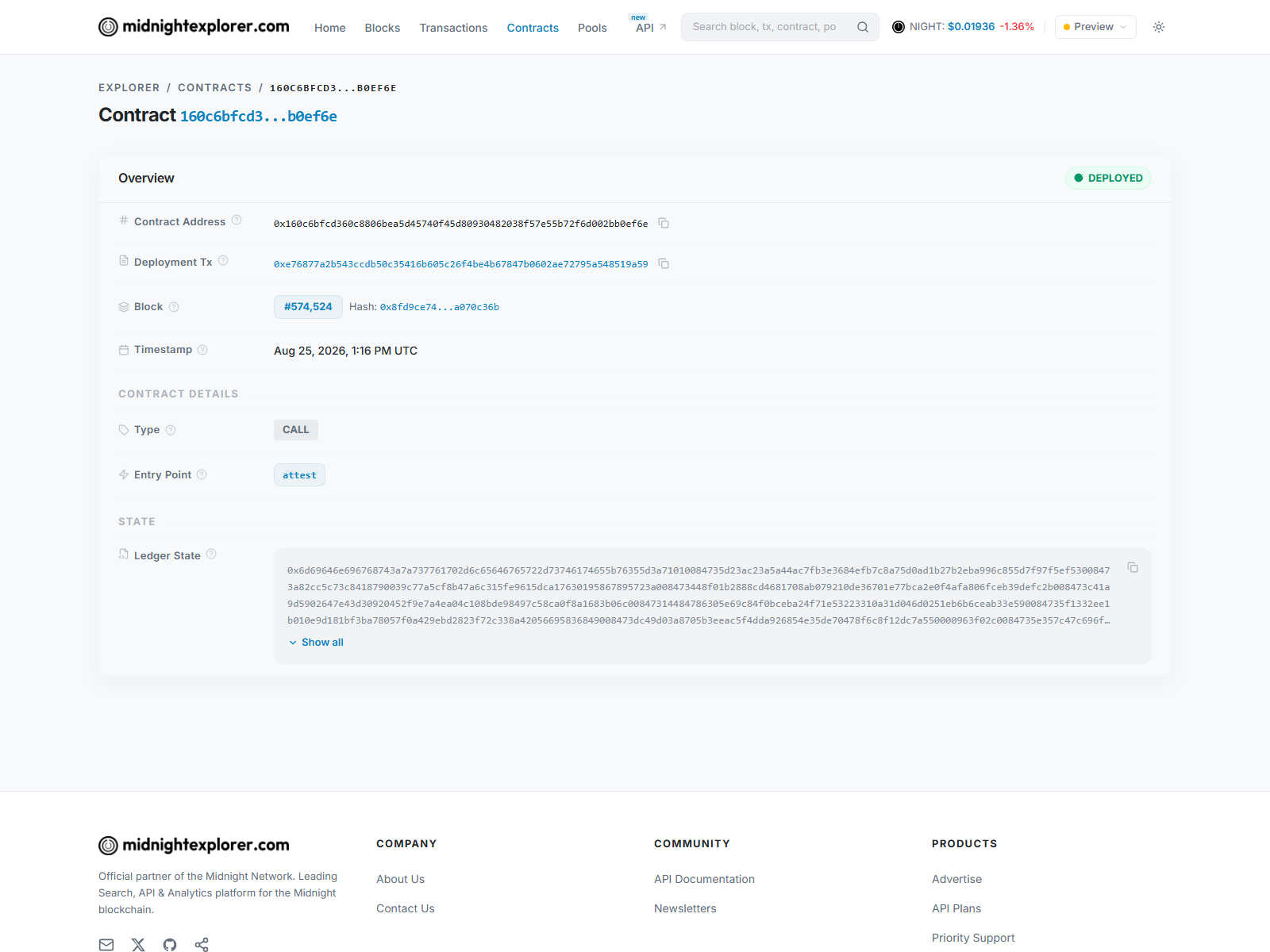
explorer-contract
-
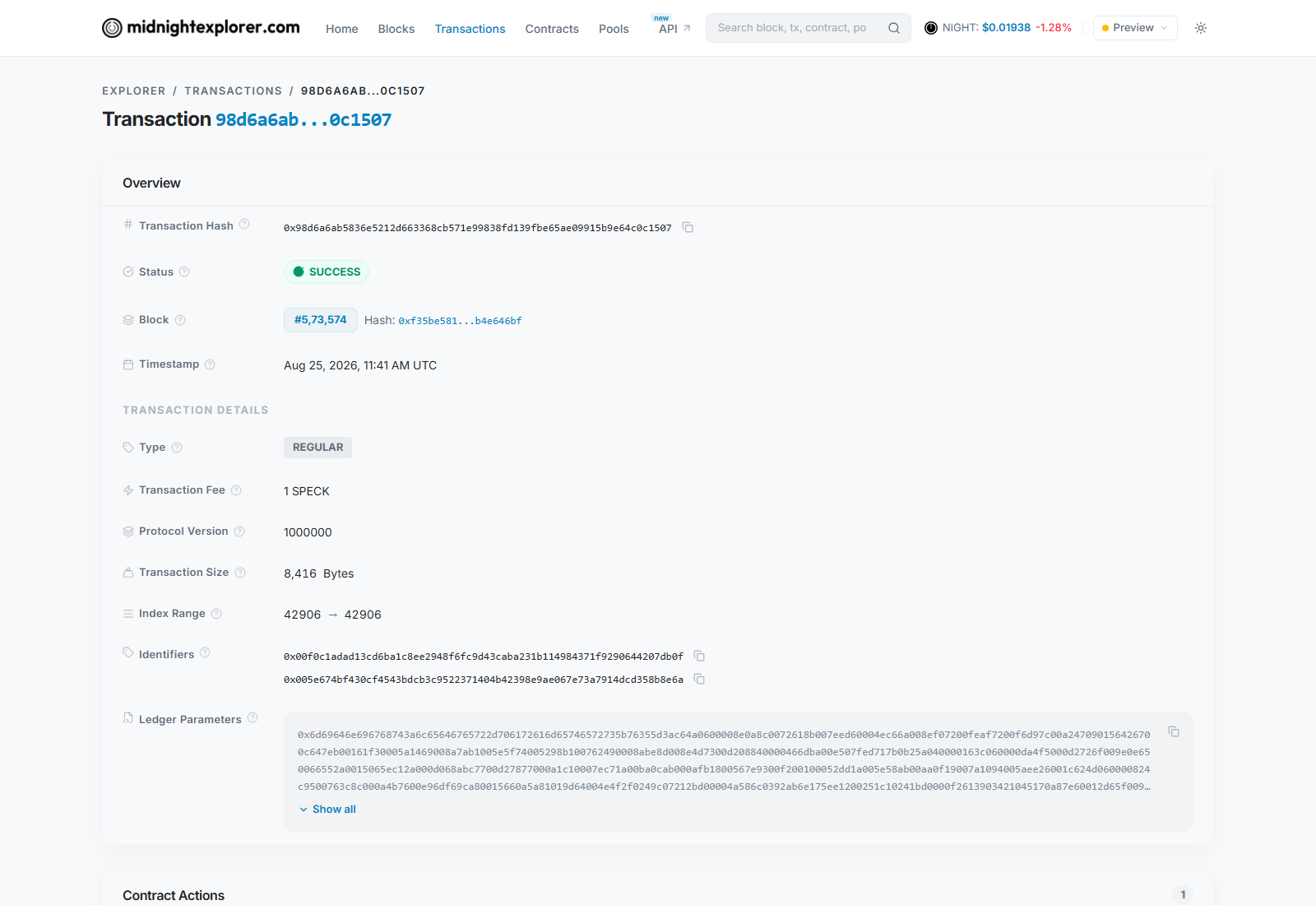
explorer-revocation-tx
-
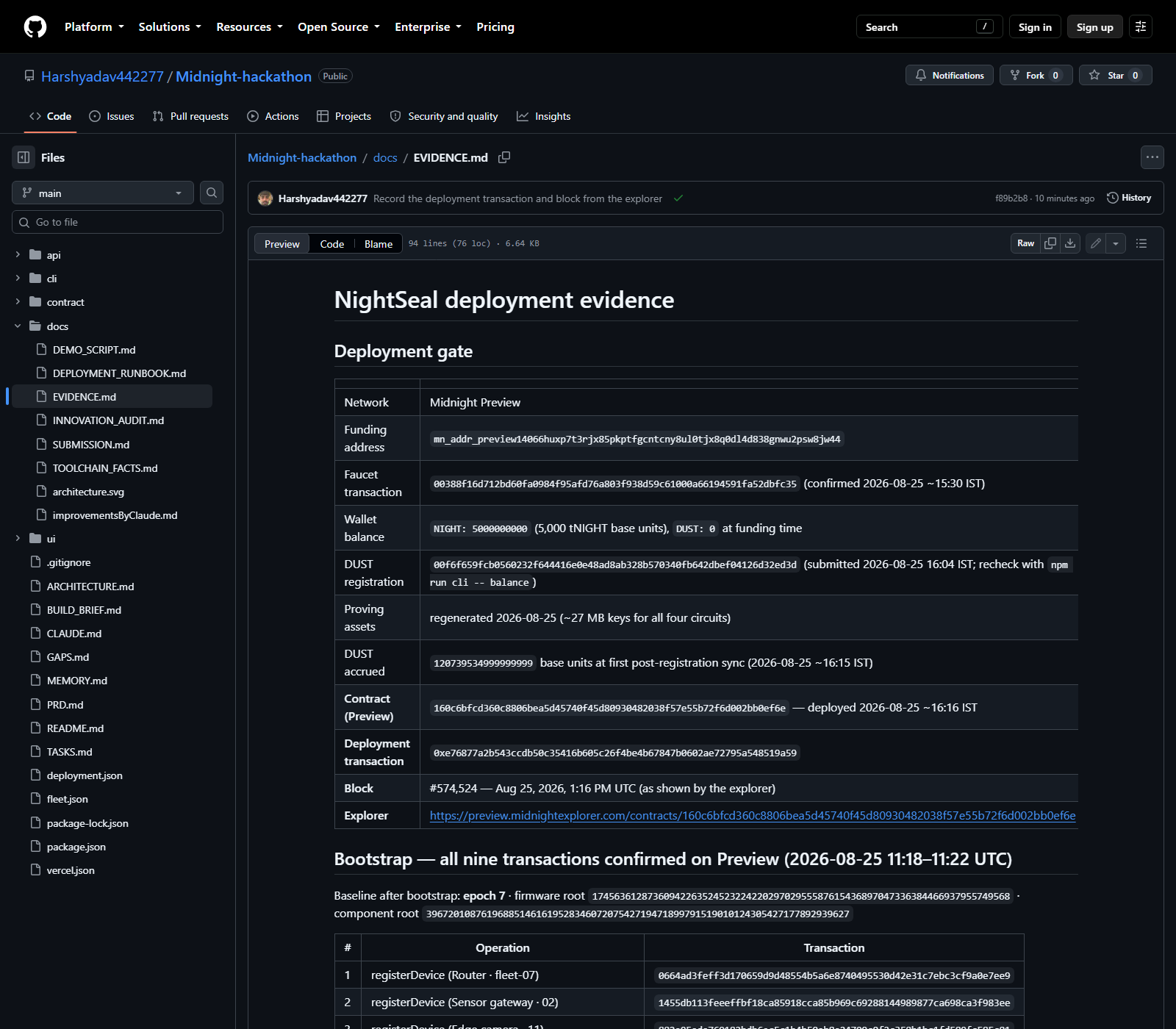
evidence-github
-
-
Inspiration
Firmware security has a disclosure paradox. Regulators — CERT-In directions, NIST SP 800-193, IEC 62443, EN 303 645 — increasingly demand demonstrable firmware provenance. But the obvious way to demonstrate it, publishing firmware hashes and component inventories (SBOMs), hands attackers a target map and leaks competitively sensitive supply-chain data. Every existing answer picks a side: a public allowlist satisfies auditors by betraying vendors; a private database protects vendors but asks auditors to just trust its operator.
The deeper inspiration was noticing that revocation is usually modeled backwards. Systems mark things unsafe — a flag, a CRL entry, a status column — and then everyone must check the flag, forever, and the flag itself reveals what was condemned. We wanted the inverse: compliance as a capability that can be cryptographically destroyed. Nothing gets marked. The revoked thing simply loses the mathematical ability to prove it belongs — and on a chain like Midnight, nobody watching can even tell what was removed, or that a removal happened at all.
Your router's manufacturer must prove its firmware is clean — without publishing a map of its insides for attackers.
What it does
NightSeal is a privacy-preserving firmware attestation registry, deployed and verified on Midnight Preview. One zero-knowledge attestation proves three things at once, atomically:
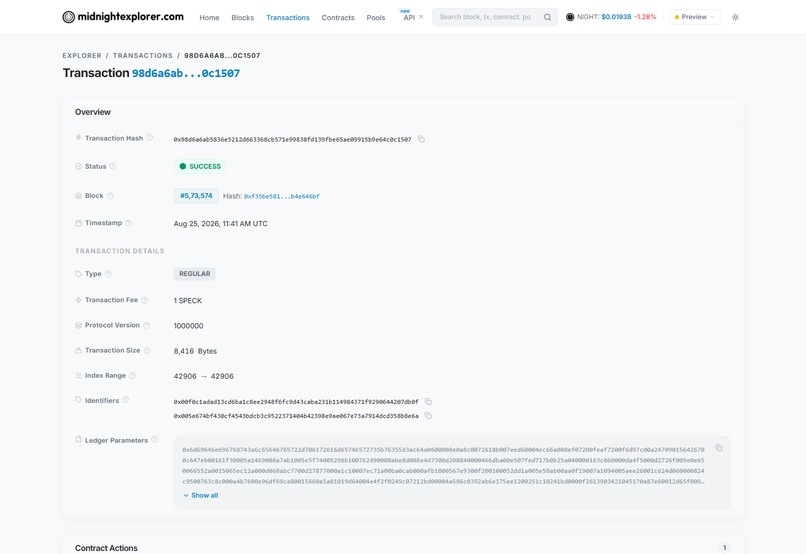
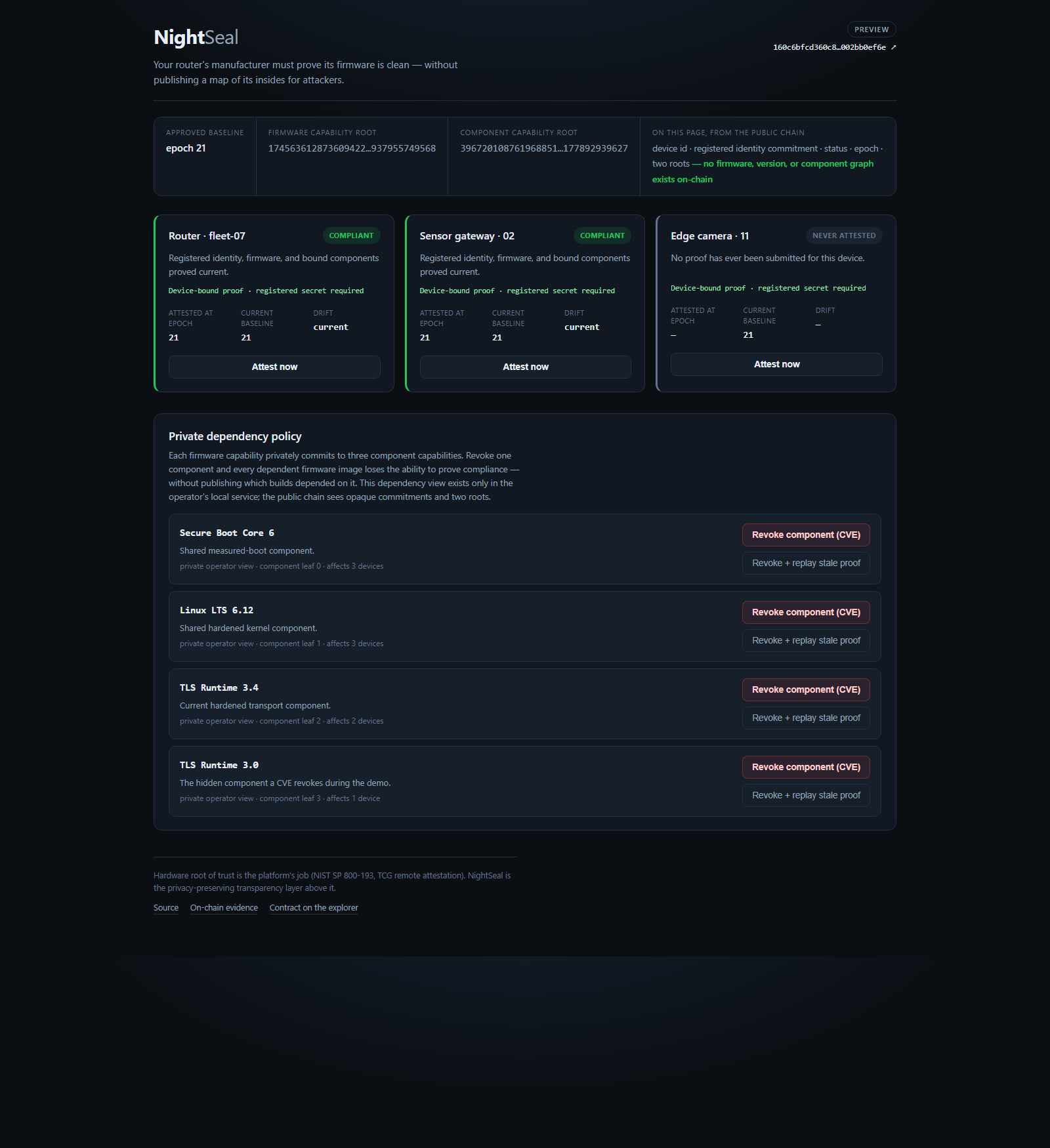
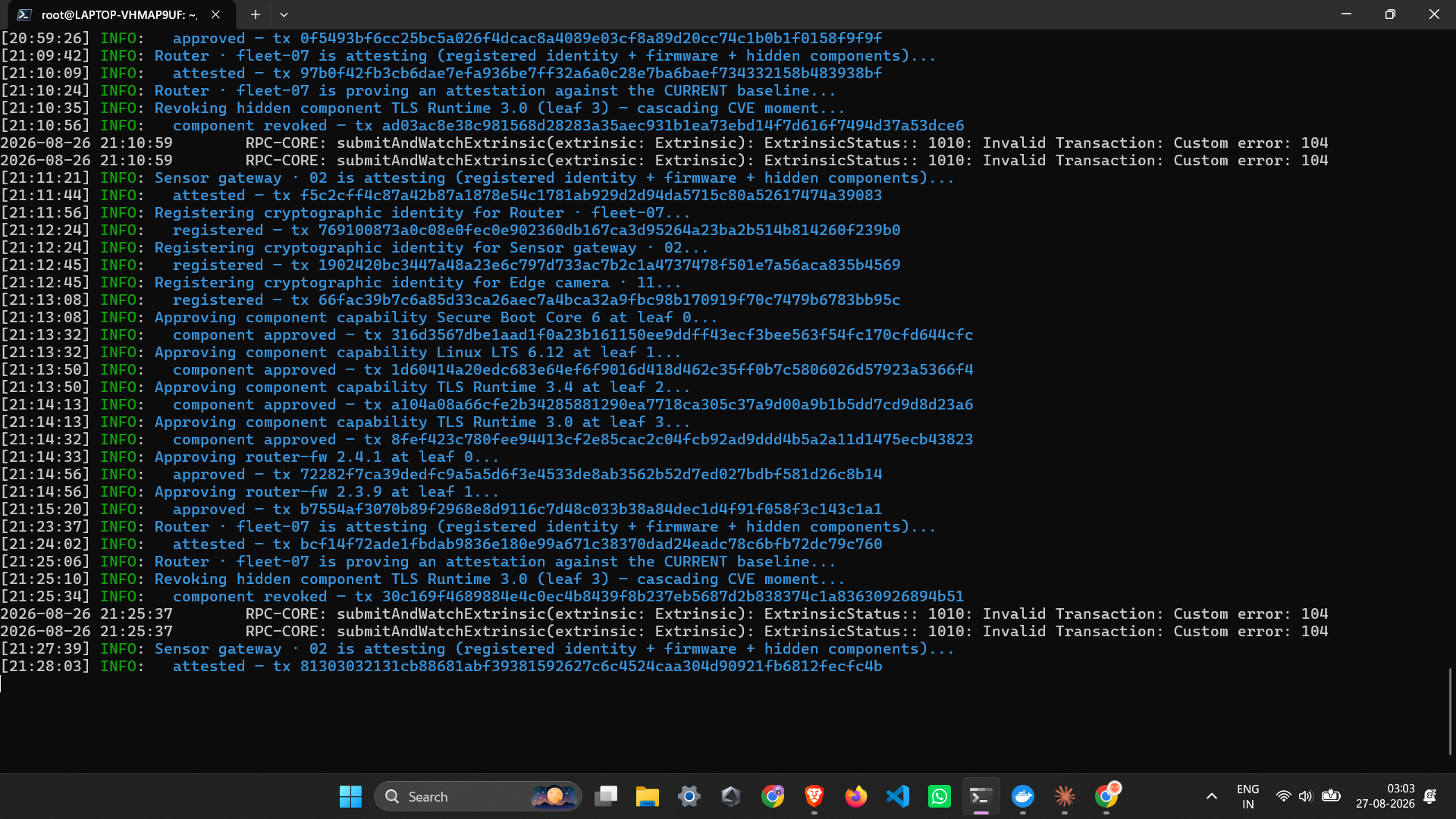
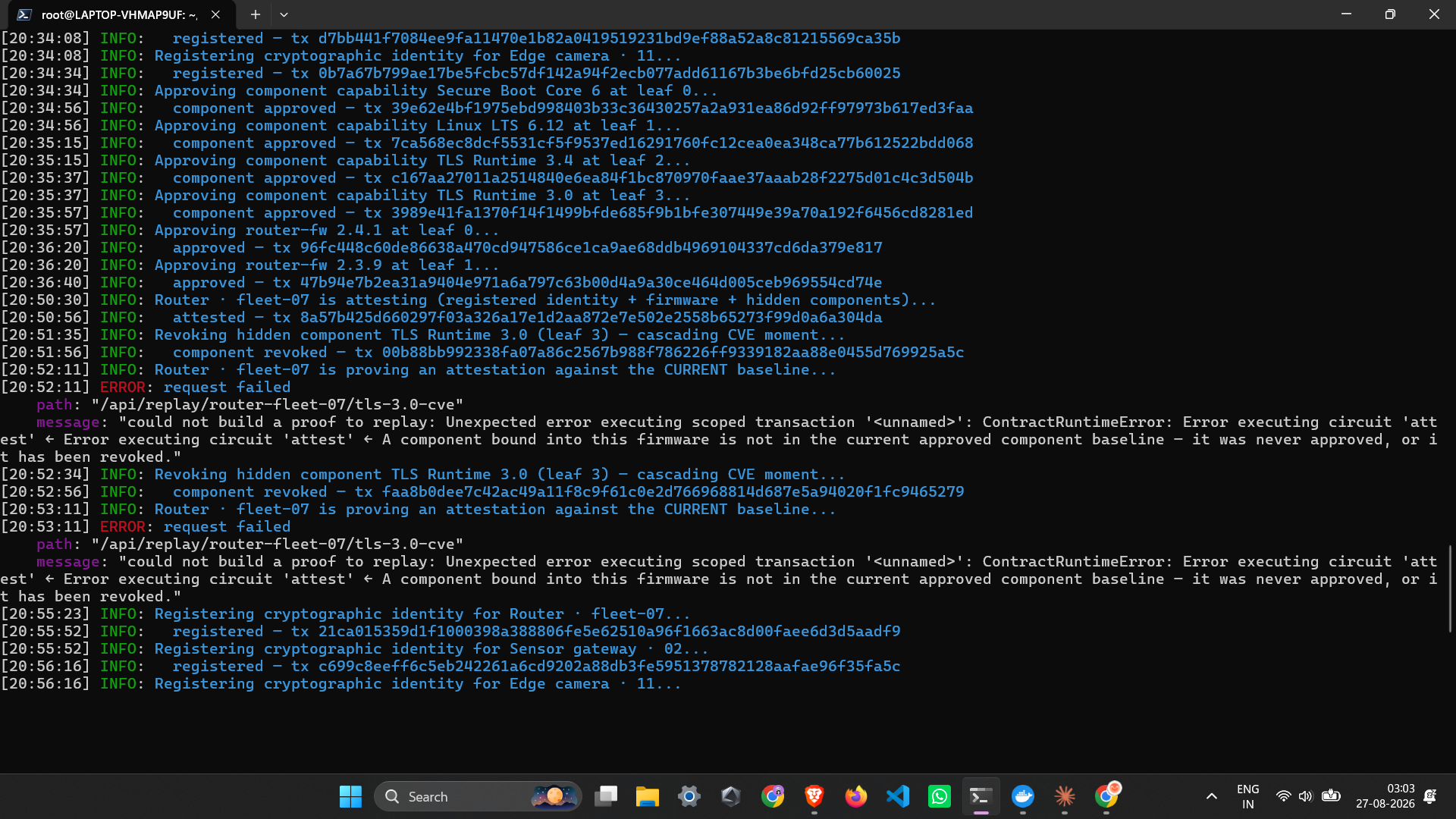
I control this registered device — the proof requires the device's enrolled secret, so Device A's valid proof can never authorize Device B; my hidden firmware is currently approved — a Merkle membership proof against a current-only capability tree whose leaves are opaque commitments, never hashes; every component privately bound inside that firmware is also currently approved — a second capability tree, checked in the same circuit, over a three-slot component manifest whose digest is sealed inside the firmware commitment itself. That third gate is the flagship. When a CVE lands in one component, the operator replaces that component's leaf with a random tombstone nobody can open. The firmware tree is untouched — we verified the root byte-identical on-chain — yet exactly the devices whose firmware secretly contains that component lose the ability to prove compliance. The blast radius is computed by cryptography, not by a backend looking up a dependency database, and the chain never learns which firmware was affected, or why.
Three properties make this more than a membership demo:
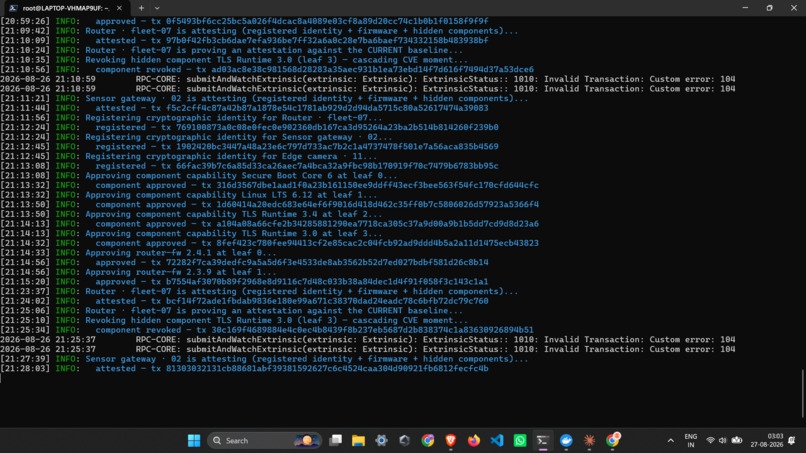
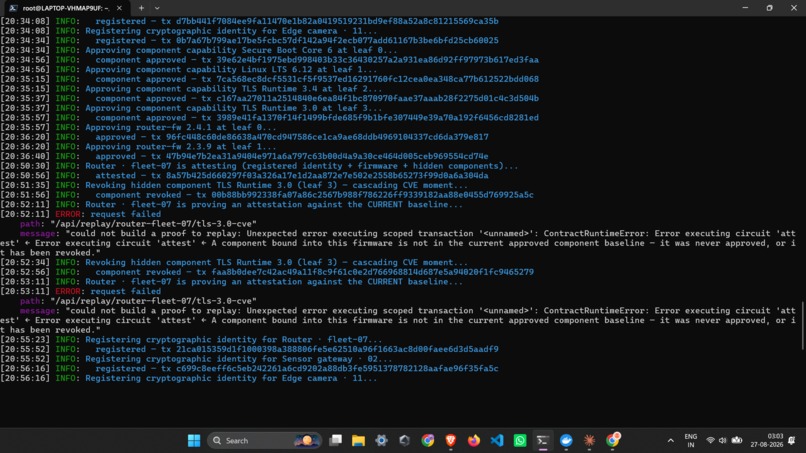
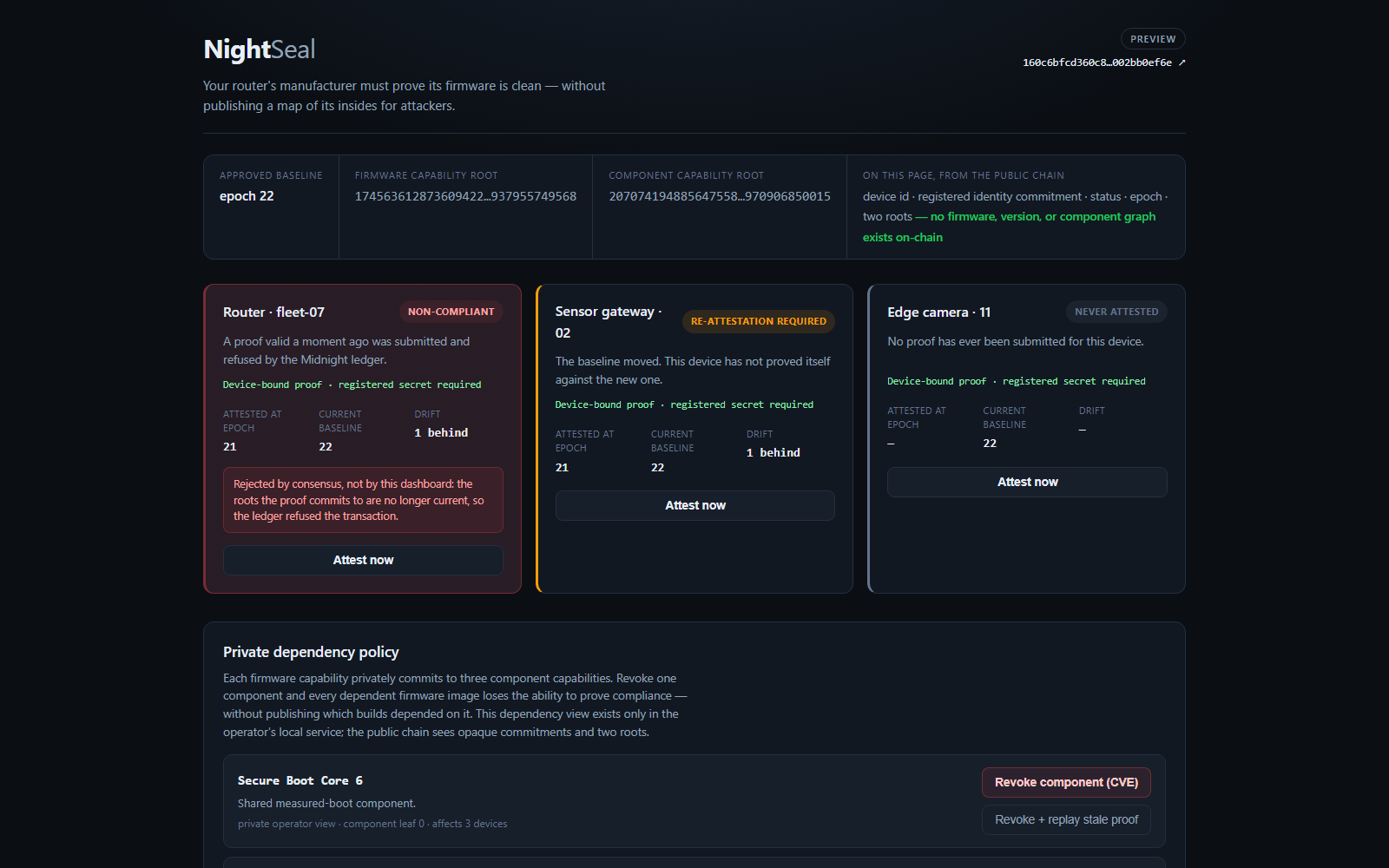
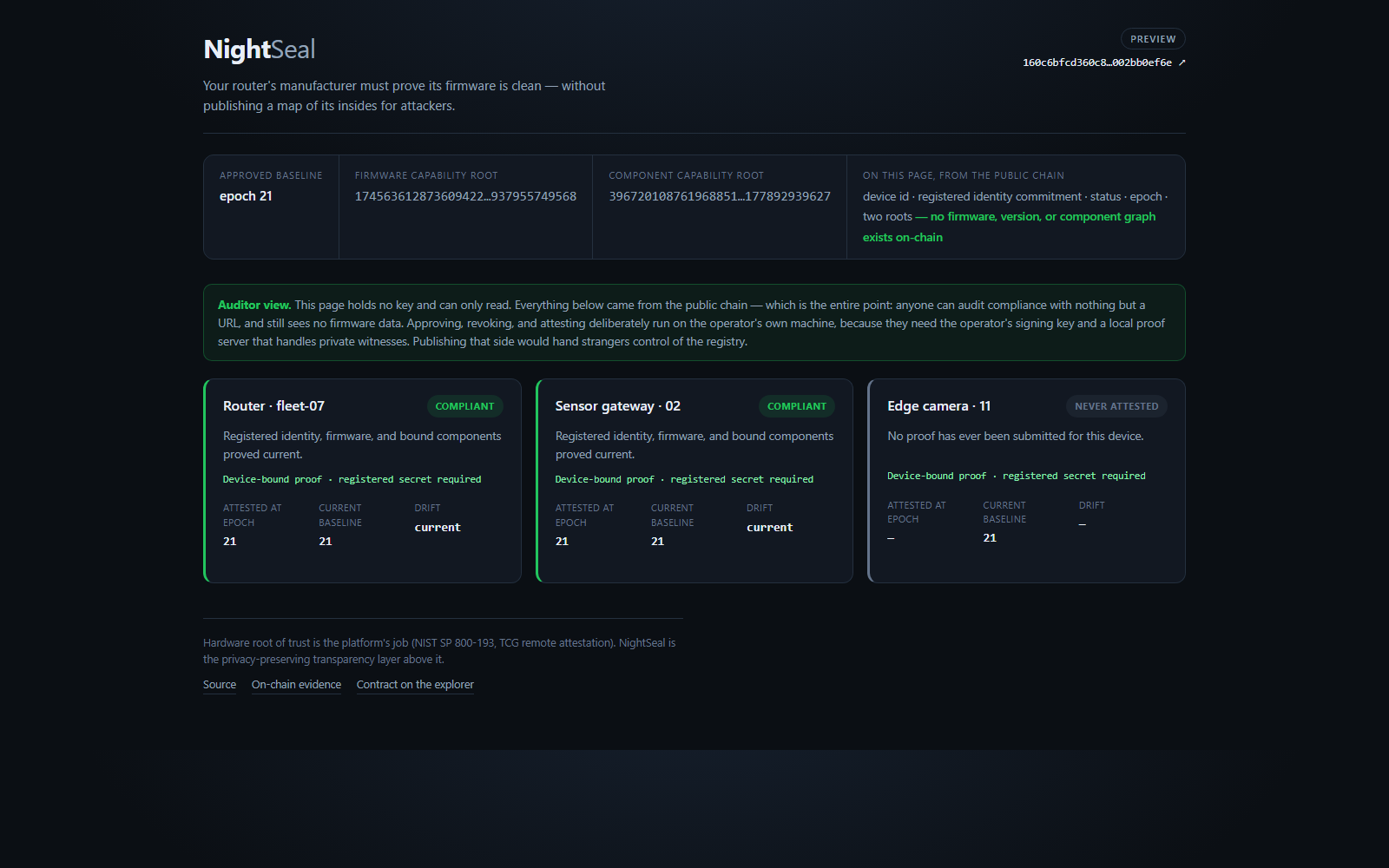
Silent revocation. Approval, revocation, and cover rotation are the same circuit writing one opaque 32-byte value. An observer cannot distinguish a routine update from a CVE response — there is no "revocation event" to watch for. We test this indistinguishability explicitly. Failure is a chain verdict, not an app decision. A proof generated before a revocation — honest, fully valid — was submitted after it. The Midnight ledger re-checked the roots in its transcript against present state and refused the transaction outright. We demonstrate this live with one dashboard click. The audit side needs no trust and no wallet. The public dashboard (nightseal.vercel.app) reads ledger state straight from the indexer: device id, status, epoch, two roots — and provably nothing else, because nothing else exists on-chain. What is public: device id → identity commitment, compliance status, attested epoch, two Merkle roots, opaque leaves. What is private, always: device secrets, firmware measurements, component manifests, blinding randomness, Merkle paths, versions, SBOMs, suppliers.
How we built it
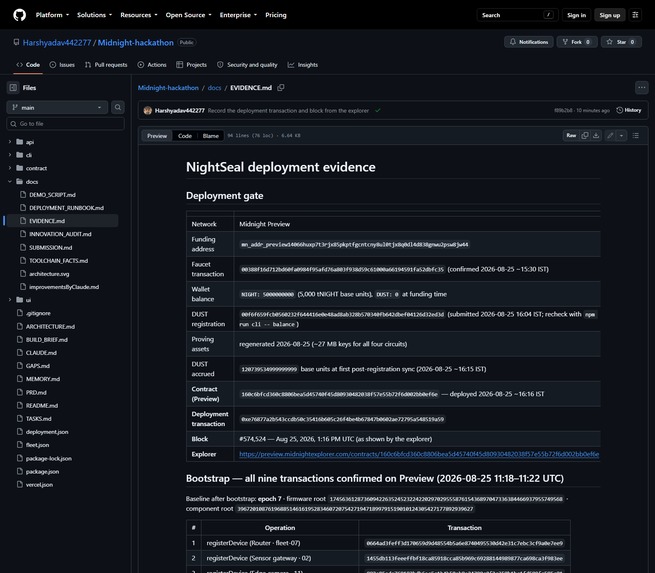
Contract: ~180 lines of Compact. Two current-only MerkleTree<10, Bytes<32>> capability sets; a device-identity map; four transaction circuits (registerDevice, updateFirmwareLeaf, updateComponentLeaf, attest) plus five pure helper circuits. Domain-separated persistentCommit/persistentHash bind a firmware measurement and its component-manifest digest into a single leaf commitment. We deliberately chose plain MerkleTree over HistoricMerkleTree: accepting only the current root is exactly what makes revocation destroy old capabilities. Off-chain: TypeScript witnesses resolve Merkle paths from public state while secrets stay in local private state; a headless-wallet CLI and a small operator service (plain node:http) drive deploy/approve/revoke/attest/replay; a React + Vite auditor dashboard shows both roots, epoch drift, and per-device state with an honest distinction between its data sources. The replay mechanism required no circuit change: we intercept the wallet's balanceTx to hold a fully proven but unbalanced transaction, move the baseline, then balance and submit it — letting consensus, not our code, reject it. Verification: 13 adversarial tests (impersonation, component substitution, root replay, rogue operator, secrecy serialization, approval/revocation indistinguishability), then the entire lifecycle executed on Midnight Preview with every transaction hash recorded in docs/EVIDENCE.md. Toolchain: Compact compiler 0.31.1 under WSL, local proof server 8.1.0 in Docker, midnight.js 4.1.1, Vercel for the read-only dashboard (serverless function + the committed ledger decoder — no wallet, no seed, no proof server in the cloud).
Challenges we ran into
The bug our tests could not see. Every simulator test passed while every live transaction failed with expected instance of StateValue. Cause: npm resolved two copies of Midnight's WASM onchain-runtime (one hoisted for compact-runtime's ^3.0.0, one pinned by midnight-js-protocol at 3.0.0), producing two StateValue classes whose instanceof checks reject each other — but only on the code path where indexer-deserialized state enters circuit execution, which simulators and deploys never cross. One overrides pin fixed what hours of staring at our own code could not.
Holding a transaction starves the next one. Our first replay implementation captured the finalized transaction — which reserves the wallet's DUST, so the revocation that had to happen next died with Insufficient Funds. The fix was conceptual, not mechanical: capture before fee-balancing, hold a proven-but-unbalanced transaction, and attach fees only at submission time.
Ecosystem sharp edges, each now documented in the repo: the indexer serves a freshly deployed contract a beat after deployment confirms (the same-process bootstrap dies without a retry); the private-state provider silently requires setContractAddress() before any access; wallets re-sync Preview from genesis (~10 minutes) on every process start, which forced a warm-service architecture where the demo runs over HTTP in seconds; and the Compact compiler has no Windows build, so the project straddles Windows (Docker, editing) and WSL (compiling, proving) with git as the only bridge.
Accomplishments that we're proud of
The invariant, measured on a public network: component root moved, firmware root byte-identical, and only the secretly dependent device lost the ability to prove — clean device recovered at the next epoch. Anyone can re-check every transaction hash. A consensus-level rejection as a demo beat. The ledger itself refusing a valid-moments-ago proof is the strongest evidence a revocation system can show, and it is one button in our dashboard. Privacy that includes metadata. Most ZK demos hide data but leak events. NightSeal's approvals and revocations are indistinguishable transactions — verified by a test that compares their public shapes. Honesty as a feature. No non-membership proofs, ever — so "device X failed" is never written on-chain, and the dashboard's two red states say exactly where each verdict came from (the chain refused a proof vs. no proof could be built). The repo keeps a standing limitations ledger (GAPS.md), including what we mock (hardware root of trust) and what still leaks (root movement and timing correlation). A finished, reproducible system: deployed contract, live public auditor URL, 13/13 adversarial tests, one-command demo service, and paste-ready evidence.
What we learned
Model revocation as capability destruction, not status marking. It composes: one hidden component's removal cascades through a dependency graph the chain never sees. Metadata is part of the privacy budget. Hiding what changed is half the job; hiding that and when something changed is the other half, and circuit-shape design (one opaque update operation) is what buys it. The witness boundary is the architecture. Deciding early what may exist only in local private state — measurements, openings, paths, device secrets — dictated everything from the commitment scheme to why the proof server must stay local. Simulators cannot vouch for the network boundary. Version skew across WASM module instances broke only the live path. If it touches serialization or module identity, test it against the real chain. ZK UX is latency choreography. Proofs take 30–70 seconds; a demo survives only if the narration, the UI states, and the script are designed around honest waiting.
What's next for NightSeal
Split-authority revocation: give the component tree to a regulator/CERT key while vendors keep firmware and enrollment. A CERT revokes one hidden component capability and every affected vendor's firmware, industry-wide, loses provability — without any vendor disclosing its composition to the regulator. The contract shape already supports it. Vendor-blind approvals: vendors submit self-generated commitments so even the registry operator never learns firmware measurements (the contract already accepts opaque commitments; this is workflow, not circuit work). Break-glass selective disclosure: commitments are binding, so the operator can reveal exactly one leaf's opening to a court — verifiable against chain history, leaking nothing else. Scale knobs: larger bounded manifests and deeper trees (depth is a compile-time parameter), and a real measured-boot/TPM integration to replace the mocked device layer. Fleet-level threshold proofs ("≥98% compliant") — deliberately deferred until per-device status itself goes confidential; with today's public per-device dashboard the aggregate is already public, and we refused to ship decorative ZK.
Supporting links
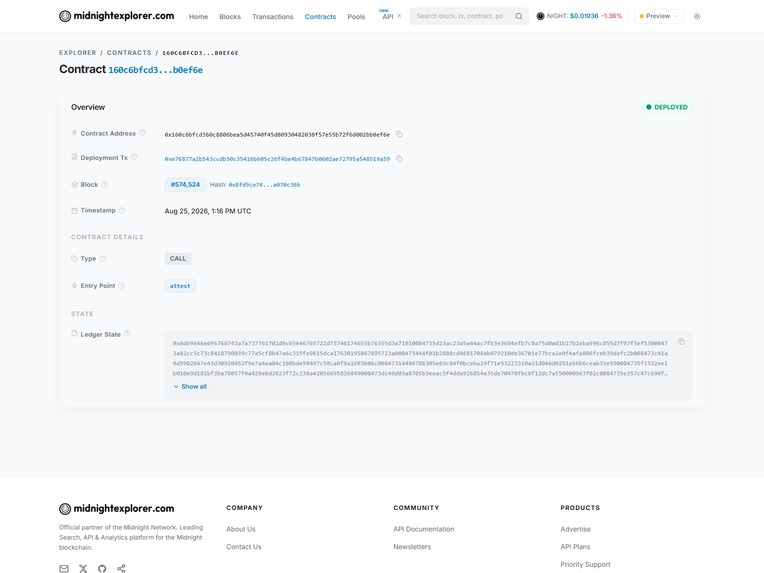
Deployment transaction (block #574,524): https://preview.midnightexplorer.com/transactions/e76877a2b543ccdb50c35416b605c26f4be4b67847b0602ae72795a548519a59 Component-revocation (root-update) transaction: https://preview.midnightexplorer.com/transactions/98d6a6ab5836e5212d663368cb571e99838fd139fbe65ae09915b9e64c0c1507 Attestation transaction: https://preview.midnightexplorer.com/transactions/73dea0b0f198c8033eb7e90f796b871819574bc2adc4a36869b264dcf95ab0e7 Post-revocation recovery: https://preview.midnightexplorer.com/transactions/040fd591c82b0a0029893c4cd55650d85a20e2a451850a29b07340466560353d Full on-chain evidence: https://github.com/Harshyadav442277/Midnight-hackathon/blob/main/docs/EVIDENCE.md
Built With
- compact
- docker
- merkle-trees
- midnight
- midnight.js
- node.js
- react
- typescript
- vercel
- vite
- vitest
- wsl
- zero-knowledge-proofs


Log in or sign up for Devpost to join the conversation.