-
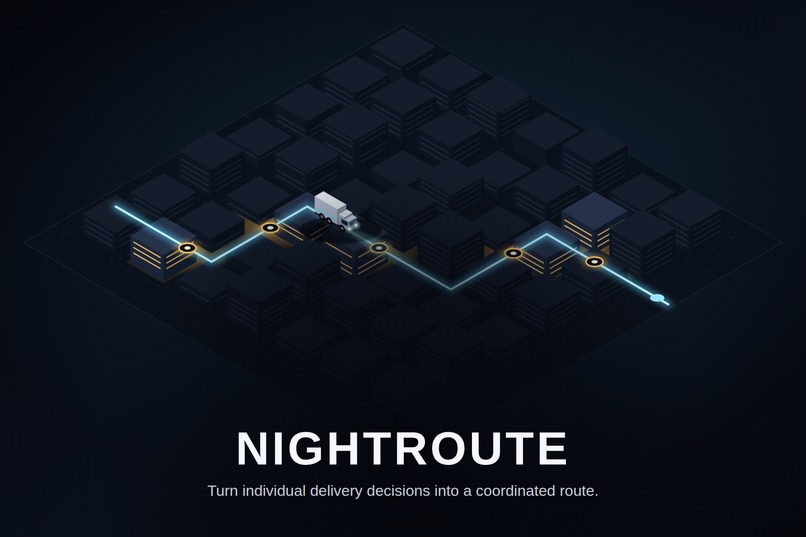
NightRoute: one coordinated night route instead of scattered daytime deliveries.
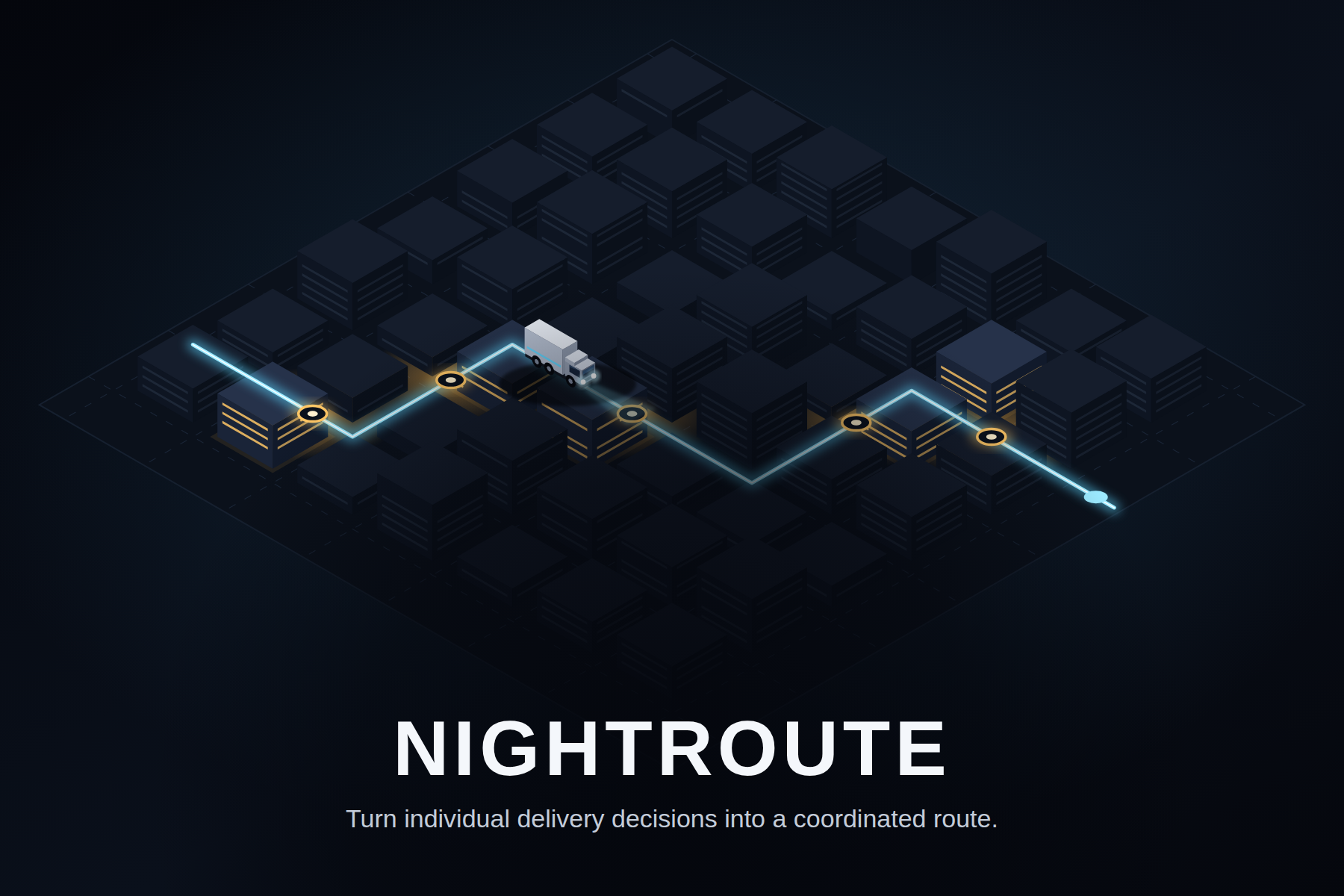
NightRoute
Turn individual delivery decisions into a coordinated route.
NightRoute is a logistics innovation proposal for coordinating off-hour commercial deliveries. It is a non-code submission: the deliverable is an operating mechanism, an economic model, and a pilot plan.
The Problem
Moving deliveries from congested daytime hours to off-hours can lower carrier costs and reduce daytime truck activity. But the decision is split between two parties:
- Receivers: "I won't switch unless others do."
- Carriers: "I won't build a night route unless enough receivers switch."
Each side waits on the other, so the route never forms.
The Mechanism
NightRoute combines four components into one route-level mechanism.
- Route Pledge. Receivers make a conditional commitment to accept off-hour delivery. It becomes binding only if enough compatible receivers on the same route participate.
- Economics-Based Threshold. The activation threshold is calculated from the carrier's route economics (off-hour and daytime route cost, fixed costs, number of stops, cost of the remaining daytime stops, receiver credits, route fee, implementation costs). There is no fixed "50%" rule.
- Night Credit. Once a route activates, participating receivers get a recurring credit funded from the carrier's estimated off-hour savings.
- Night Access. A standardized addendum covers the delivery window, receiving location, access method, security procedure, receiving responsibilities, exceptions, and emergency contact.
Activation condition:
Off-hour route savings > receiver credits + NightRoute fee + implementation costs + residual-route penalty
If the condition is not met, nobody is bound and the daytime route continues.
Illustrative Economics
| Daytime Route | Night Route | |
|---|---|---|
| Fixed cost | $320 | $220 |
| Cost per stop | $40 | $25 |
| Total, 12 stops | $800 | $520 |
Gross saving: $280. With a $10 credit per stop ($120) and a $40 route-day fee, the carrier keeps $120/day. The threshold is route-specific because leftover daytime stops can form an expensive standalone route and erase the saving.
What Is New
Off-hour delivery, receiver incentives, and delivery windows all have prior art. The proposed novelty is the combination: conditional route-level pledges, an economics-derived threshold, recurring carrier-funded receiver credits, and standardized access conditions. In the research reviewed, we found no documented example combining all four.
Target Routes and Business Model
- Target: dense, repeat commercial routes with compatible receiving patterns (food and beverage distribution, grocery and convenience, retail corridors, hospitality).
- Revenue: a flat fee per activated route-day, paid by the carrier. No activated route, no fee.
Pilot Plan
- Baseline (about 4 weeks): measure an existing daytime route.
- Route formation: recruit 10 to 20 receivers on one dense corridor for conditional pledges.
- Activation: if the threshold is reached, the route moves to off-hours and credits begin.
- Measurement (about 12 weeks): route savings, participation, credit cost, carrier net benefit, delivery reliability, access incidents, noise complaints, receiver satisfaction, and retention after incentives are reduced.
Risks
| Risk | Mitigation |
|---|---|
| Too few pledges | Target dense corridors; no commitment if threshold fails |
| Inefficient residual daytime route | Include residual-route cost in the threshold |
| Receiver defection | Trial periods, replacement recruitment, refundable commitments |
| Night noise and disruption | Low-noise procedures; measure complaints and incidents |
| Carrier builds it in-house | Focus on fragmented, multi-carrier corridors and business associations |
Research Basis
NYC DOT Off-Hour Delivery programs, NYSERDA Off-Hour Delivery / Trusted Vendor research, Chicago regional off-peak delivery research, Holguín-Veras research on receiver incentives, joint receiver-carrier policy research, and assurance-contract literature.
Graphiques Innovation Challenge: Logistics & Supply Chain
NightRoute is a non-code innovation: a new participation mechanism, route-specific economic model, recurring incentive, standardized operating conditions, and a measurable pilot.
Full proposal: https://drive.google.com/file/d/1cahiPpYu_oxg_G6CV--lwZvsbJQVHcKk/view?usp=sharing
Built With
- assurance-contracts
- chatgpt
- financial-modeling
- google-docs
- google-drive
- logistics-research
- mechanism-design
- off-hour-delivery
- route-economics

Log in or sign up for Devpost to join the conversation.