Inspiration
Nightmare Nursery started with a simple idea: what if babysitting became a simulation & management game? I liked the contrast between something familiar and harmless—a nursery—and the chaos of caring for babies who inherited supernatural powers from supervillain parents. That led to a short, high-pressure game built around multitasking, resource management, and deciding which problem needs attention first.
What it does
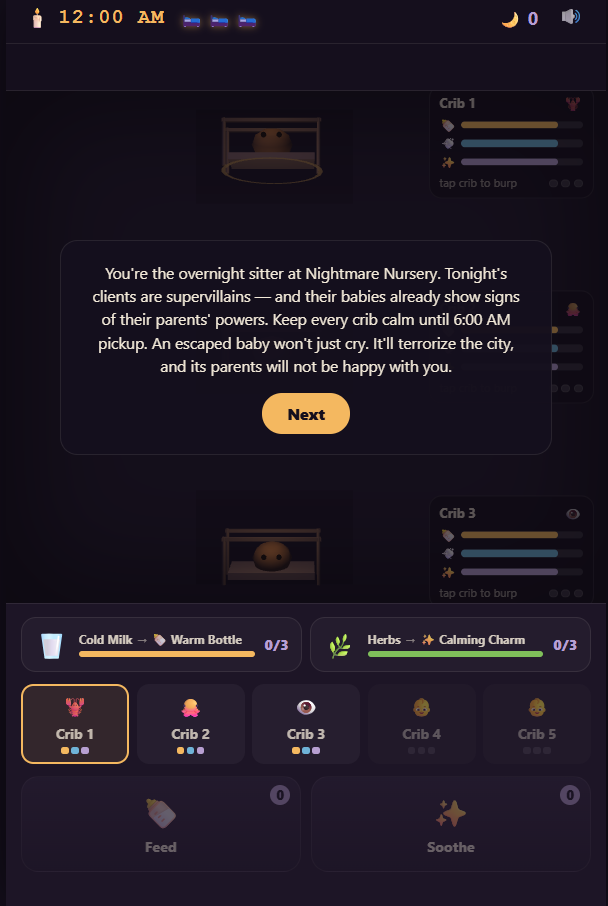
Nightmare Nursery puts the player on an overnight babysitting shift from 12:00 AM to 6:00 AM. The goal is to keep a growing nursery of superpowered babies fed, soothed, and cared for until pickup.
Players prepare warm bottles and calming charms, manage limited supplies, monitor each crib's needs, and react when a baby becomes distressed. Neglected babies transform and activate different abilities—stealing supplies, hiding crib information, disrupting resource stations, or upsetting nearby babies. Lose too many babies and the shift ends early.
How we built it
I built Nightmare Nursery as a mobile-first HTML5 prototype using JavaScript and Three.js, with Claude assisting throughout development.
The game combines a Three.js nursery scene with a responsive HTML interface for meters, resources, notifications, and actions. Most of the game is contained in a single HTML file, including the game logic, procedural animations, notification system, and Web Audio-based sound effects.
I developed the prototype in small passes: first establishing the core care loop, then adding resource preparation, drag-and-drop interactions, unique baby powers, escalating difficulty, feedback systems, haptics, sound, and mobile UI improvements.
Challenges we ran into
The biggest challenge was making the game feel hectic without becoming confusing. With several babies, three needs per crib, limited resources, monster abilities, and incoming notifications, the screen could easily become overwhelming.
I spent a lot of time improving how information is communicated. This included creating a dedicated notification area, prioritizing urgent alerts, preventing outdated messages from appearing late, keeping resource feedback close to the resource stations, and making each monster power visually and mechanically distinct.
Another challenge was designing the game around a short play session. The player needs enough time to learn the systems while still experiencing meaningful escalation before the shift ends.
Accomplishments that we're proud of
I'm especially proud that the different babies are more than visual variations. Each monster type changes the player's priorities in a different way.
A Tentacle baby can steal carried supplies. An Eye baby can temporarily hide another crib's meters. A Claw baby can damage preparation stations. A Horn baby increases pressure on neighboring cribs.
I'm also proud of how the resource loop developed. Players don't simply press a Feed or Soothe button—they gather raw supplies, prepare them into usable items, carry a limited amount, and decide when and where to use them.
The final prototype brings those systems together into a complete three-minute shift with a clear beginning, escalating middle, and win or lose state.
What we learned
One of my biggest lessons was that more mechanics do not automatically create more depth. The game became stronger when I stopped adding systems and instead focused on making the existing systems interact with each other.
I also learned how important immediate feedback is in a management game. Small things such as drag feedback, haptics, sound cues, meter changes, transformation animations, and prioritized warnings make it much easier for the player to understand what is happening without stopping the action.
Building the prototype also reinforced the value of making frequent small changes and playtesting each one rather than attempting large redesigns all at once.
What's next for Nightmare Nursery
The next step is continued playtesting and balancing. I want to refine the difficulty curve, make sure every monster ability is immediately understandable, and ensure the full progression of the nursery can be experienced during a single shift.
Beyond the prototype, Nightmare Nursery could expand with additional superpowered babies, new caretaker tools, different nursery locations, additional night-shift scenarios, and more combinations of powers that force players to adapt their strategy.
The core idea would remain the same:
Keep the babies happy. Keep them human. Survive until morning.
Built With
- chatgpt
- claude

Log in or sign up for Devpost to join the conversation.