-
Nightlight Patrol
-
Reality to Imagination
-
UI Concept
Inspiration
My inspiration for Nightlight Patrol came from memories of playing with road rugs as a child. I would drive toy cars across the printed streets and imagine that the little town on the rug was alive. At the same time, I grew up playing tower defense games and always wanted to design one myself.
That combination became the core idea: what if a childhood playmat did not just act as a map, but transformed into a living toy-scale world? I also wanted to push tower defense in a direction that felt different. Instead of defending a stationary base while enemies walk toward it, Nightlight Patrol makes the base move. The player protects a rolling convoy as it travels through danger.
The result is a game about keeping imagination alive: a flat bedroom playmat becomes an adventure world, toy defenders come to life, and the player must protect the glowing Nightlight before the world fades.
What it does
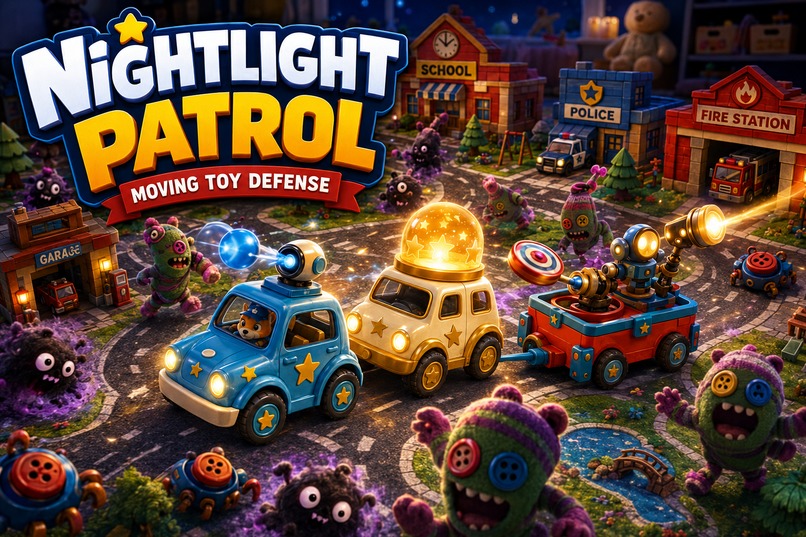
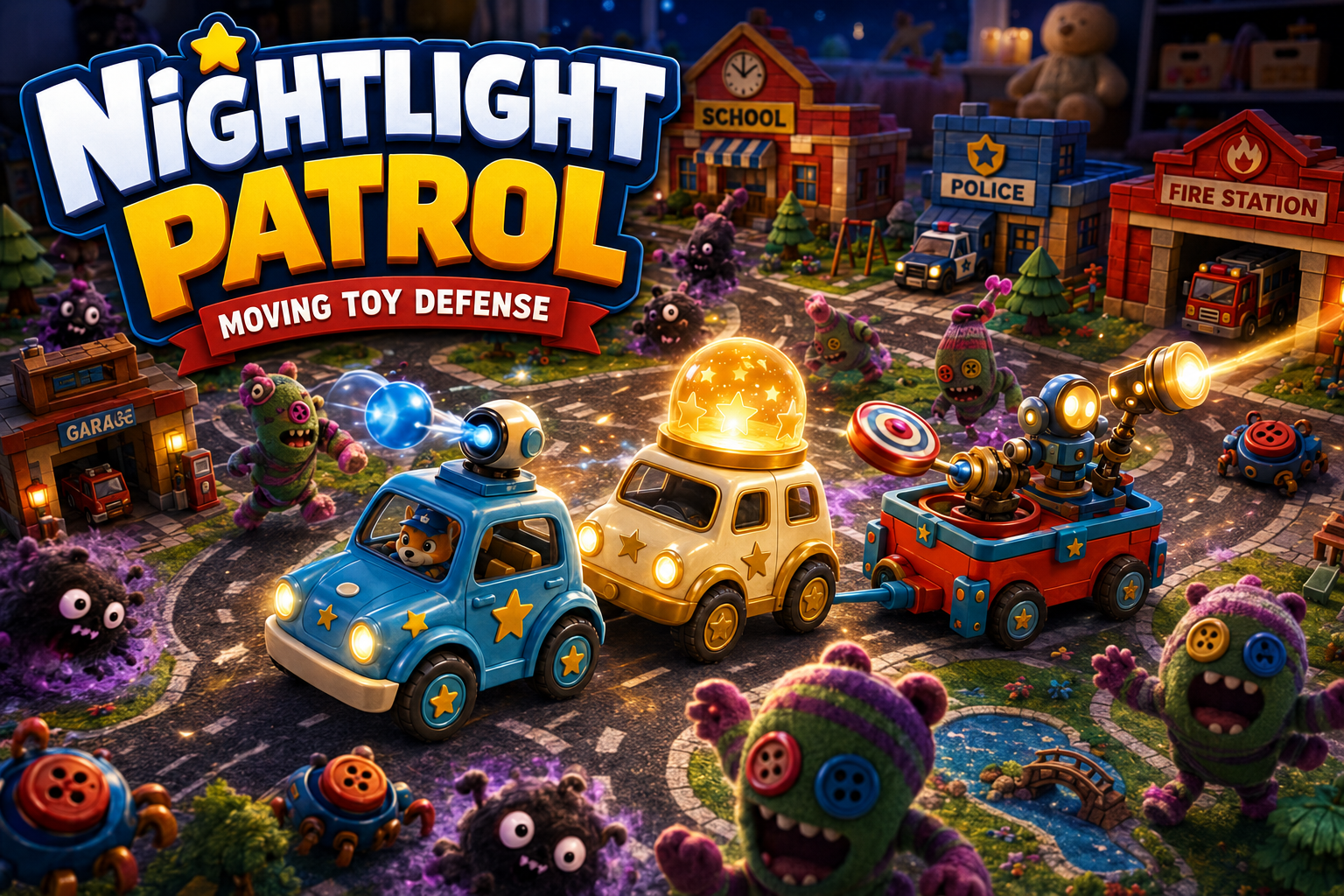
Nightlight Patrol is a mobile-first moving tower defense game where ordinary bedroom playmats transform into living toy-scale battlefields. The player protects the Nightlight Convoy, a three-vehicle toy convoy carrying the last glowing Nightlight.
The core loop is:
Preview the playmat → Build defenses → Survive a danger zone → Upgrade → Keep moving
Players switch between two connected views:
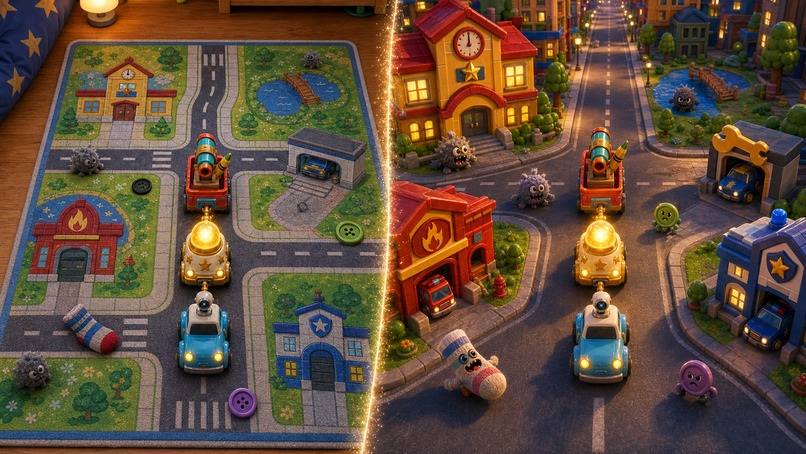
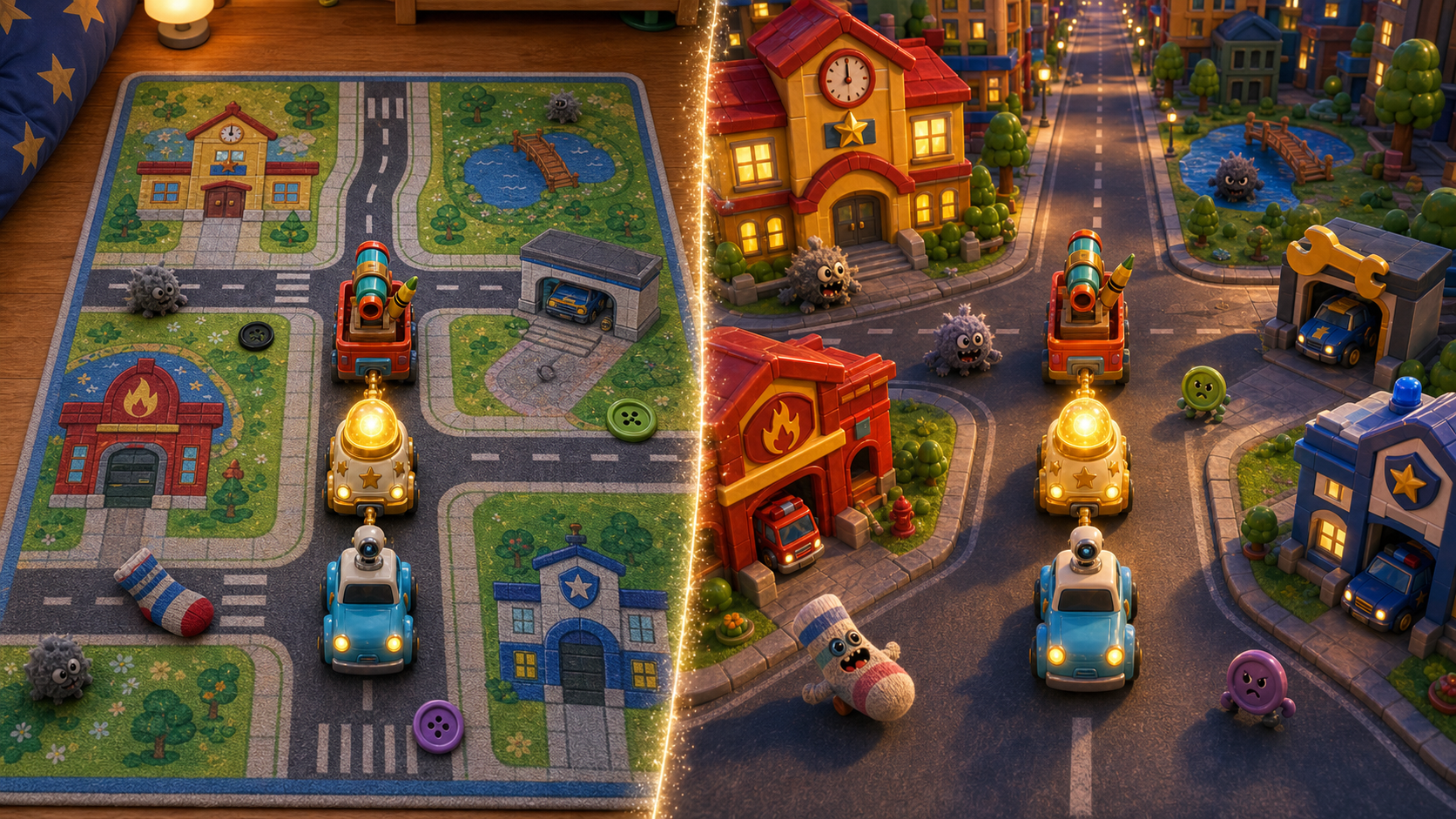
- Real Playmat View, where the rug is seen as a flat physical playmat on a bedroom floor. This is used for planning, route reading, upgrades, and tactical decisions.
- Imagination View, where that same flat playmat transforms into a toy-scale town. Roads become streets, printed landmarks become active buildings, and dust, socks, buttons, and lint become playful enemies.
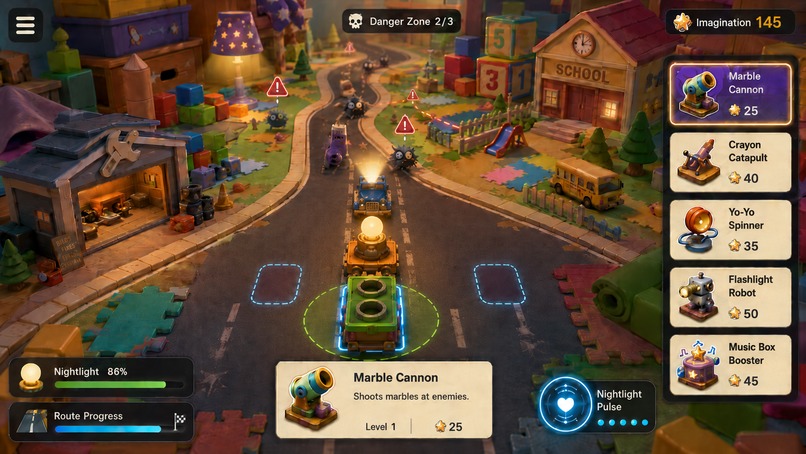
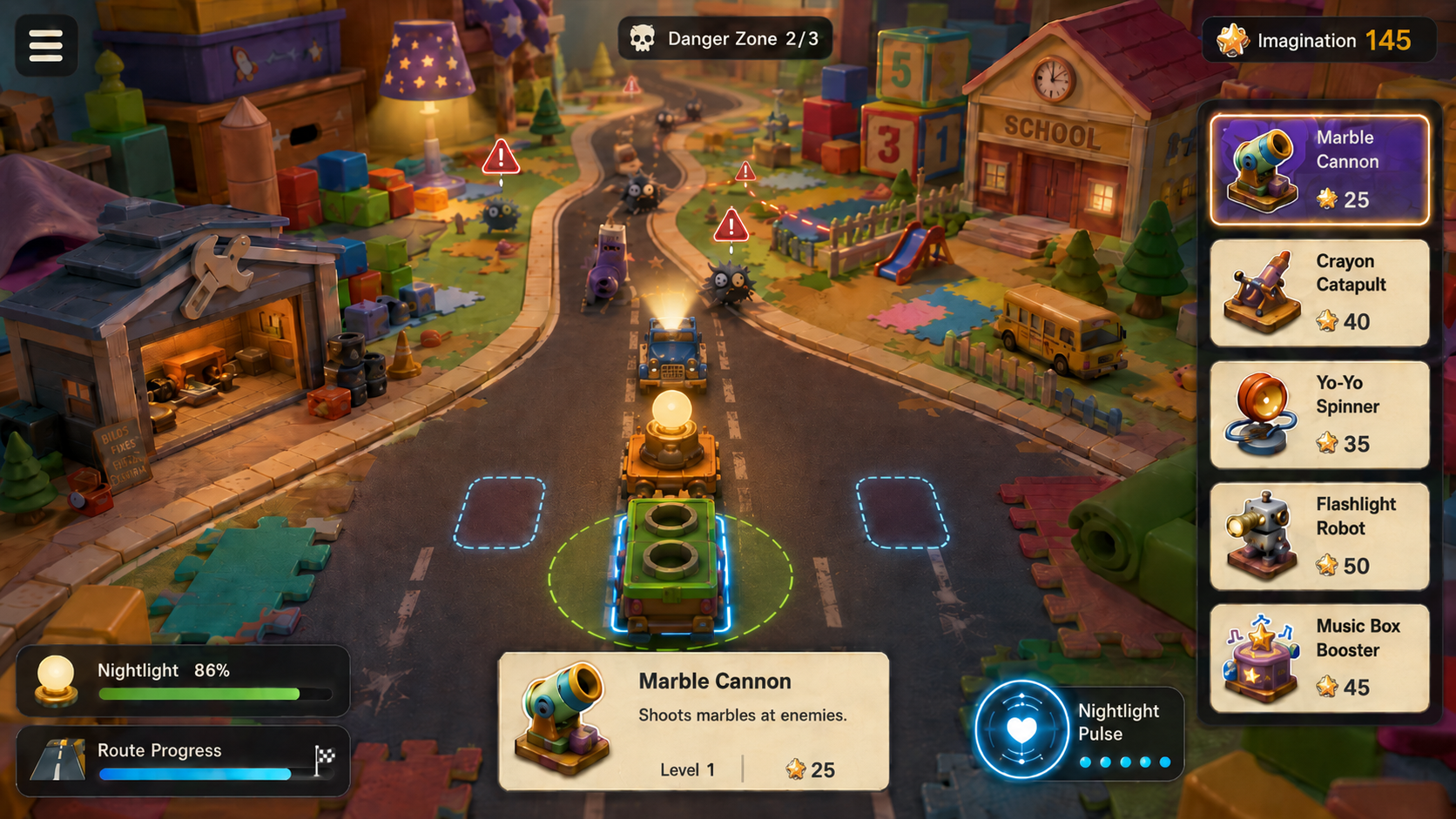
The player places toy defenders on convoy vehicles, activates landmark defenses, chooses route branches, upgrades between encounters, and survives compact danger zones filled with enemies like Dust Bunnies, Sock Goblins, Button Beetles, Lint Leeches, and Shadow Skitters.
The main twist is simple: in most tower defense games, enemies move toward your base. In Nightlight Patrol, your base moves through enemy territory.
How we built it
This project was built as a complete game design package for the Meta Horizon Creator Competition. Since the submission is focused on game design, the work centered on creating a clear, buildable, and visually consistent pre-production concept rather than a finished playable build.
We built the project by developing four main artifacts:
- A Game Design Document that defines the concept, target player, core loop, progression, retention, fun factor, and future expansion.
- A Player Journey Map that shows the first 15 minutes of the experience, from the first playmat hook to the first danger zones, upgrade choice, reward, and return hook.
- A Visual Concept Package that establishes the real playmat view, imagination view, convoy identity, enemies, towers, color palette, and gameplay mockup direction.
- A Production Plan that scopes the MVP into buildable phases, including one starter playmat, three convoy vehicles, a small set of defenders, enemy roles, upgrades, and short danger zones.
The design was refined around several core rules: the convoy must stay readable, the playmat and imagination world must map to each other, the game must work on mobile, and the visuals must feel playful rather than scary.
We also created a consistent art direction called Bright Toy Box Adventure TD, focused on chunky toy proportions, warm nightlight glow, soft materials, and readable mobile-friendly silhouettes.
Challenges we ran into
One of the biggest challenges was creating art that communicated the idea the way I imagined it. The game depends heavily on a specific visual contrast: the real-world rug must feel like a flat childhood playmat, while the imagination view must feel like that same world has come alive. If the art looks too much like a generic fantasy town, the core idea is lost. If it looks too flat, it does not feel exciting enough.
Another challenge was consistency. Early concept directions could easily drift: the convoy vehicles might change order, the rug might stop feeling like a real playmat, the camera could become too cinematic, or the gameplay mockups could look more like posters than actual game screens. We had to keep refining the rules so the same game showed up across every document and image.
We also had to balance ambition with buildability. The idea naturally suggests many possible playmats, enemies, co-op roles, and procedural routes, but the MVP needed to stay focused. The first version has to prove the core promise before adding too many extra systems.
Accomplishments that we're proud of
I am proud that the project now has a clear identity. Nightlight Patrol is not just “a tower defense game with toys”; it has a distinct hook: a moving base, a playmat that transforms into an imagination world, and a Nightlight that gives the whole experience emotional focus.
I am also proud of how the design connects nostalgia with strategy. The road rug is familiar and personal, but the gameplay adds real tactical decisions: where to place defenders, when to use landmark defenses, which route to choose, when to spend resources, and how to protect a moving objective.
Another accomplishment is the consistency across the submission package. The Game Design Document, Player Journey Map, visual direction, and production scope all support the same concept. The project now has a defined convoy, clear enemy roles, a readable core loop, a buildable MVP, and a future path for expansion.
What we learned
I learned how important clean documentation is when presenting a game idea. A strong concept is not enough by itself; it needs to be organized so someone else can understand what the player does, why it is fun, and how it could actually be built.
I also learned the importance of visual consistency. Small details matter: convoy order, camera angle, color palette, enemy shapes, UI readability, and whether the world feels like a playmat or a generic level. The more consistent those choices became, the stronger the project felt.
Another major lesson was that stylization is not just decoration. The art style affects how readable the game is, how buildable it feels, and whether the player understands the fantasy immediately. For Nightlight Patrol, the right style had to feel bright, toy-like, warm, and playful while still supporting real tower defense strategy.
What's next for Nightlight Patrol
The next step for Nightlight Patrol would be turning the design into a playable prototype. The first prototype would focus on the Town Road Playmat, the three-vehicle Nightlight Convoy, basic convoy movement, one or two mounted defenders, a few enemy types, and a short danger zone.
After that, the priority would be testing whether the moving-base tower defense loop feels fun. The key questions would be: does the convoy feel worth protecting, are enemies readable, do players understand the route pressure, and do players want to replay for a cleaner run?
Future versions could add more defenders, more route branches, stronger landmark defenses, daily route remixes, co-op patrol roles, and new playmat worlds. The strongest next expansion would be the Ocean Adventure Playmat, where the same core idea shifts from toy cars on roads to a toy fleet traveling between islands, docks, reefs, and whirlpools.
The long-term goal is to make Nightlight Patrol feel like a game where every new playmat creates a new childhood imagination world, while the core promise stays the same:
Keep the convoy moving. Keep the Nightlight alive. Defend the imagination world.
Built With
- ai
- mybrain


Log in or sign up for Devpost to join the conversation.