-
-
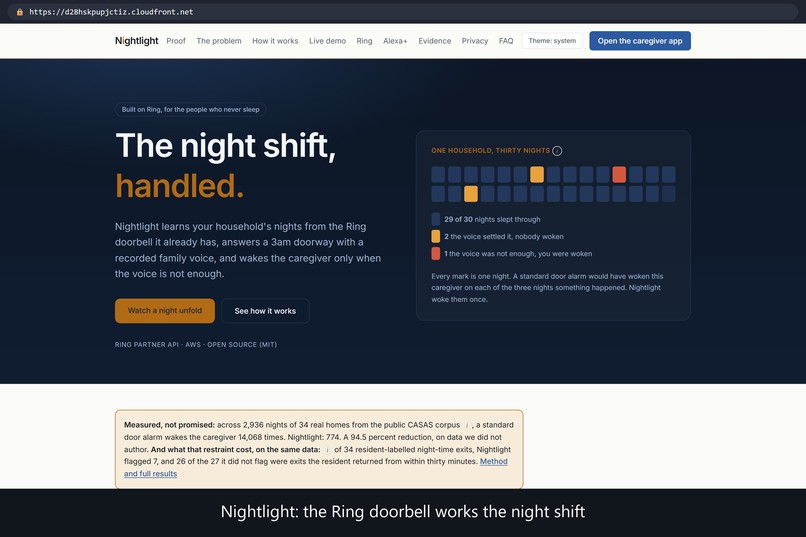
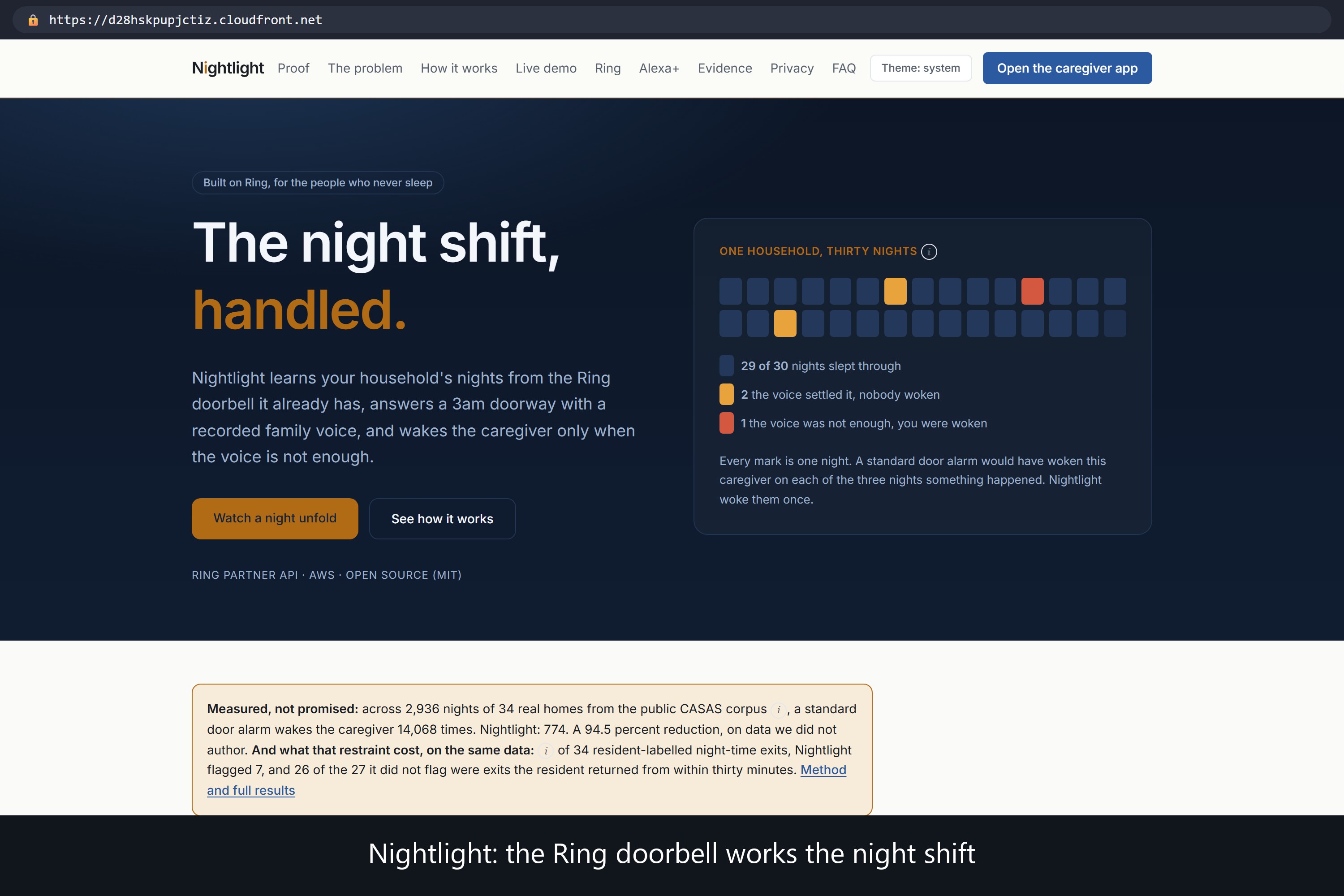
A month of nights for one household: 29 of 30 slept through. Nightlight answers a 3am doorway before it ever wakes anyone.
-
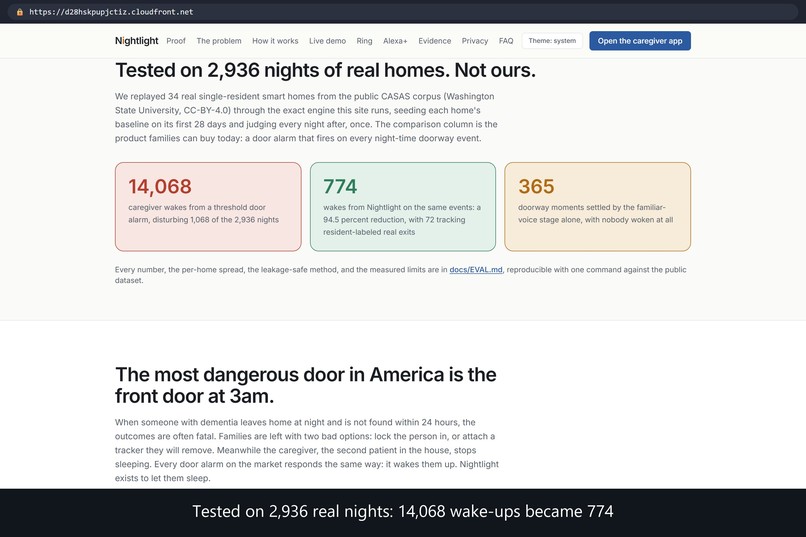
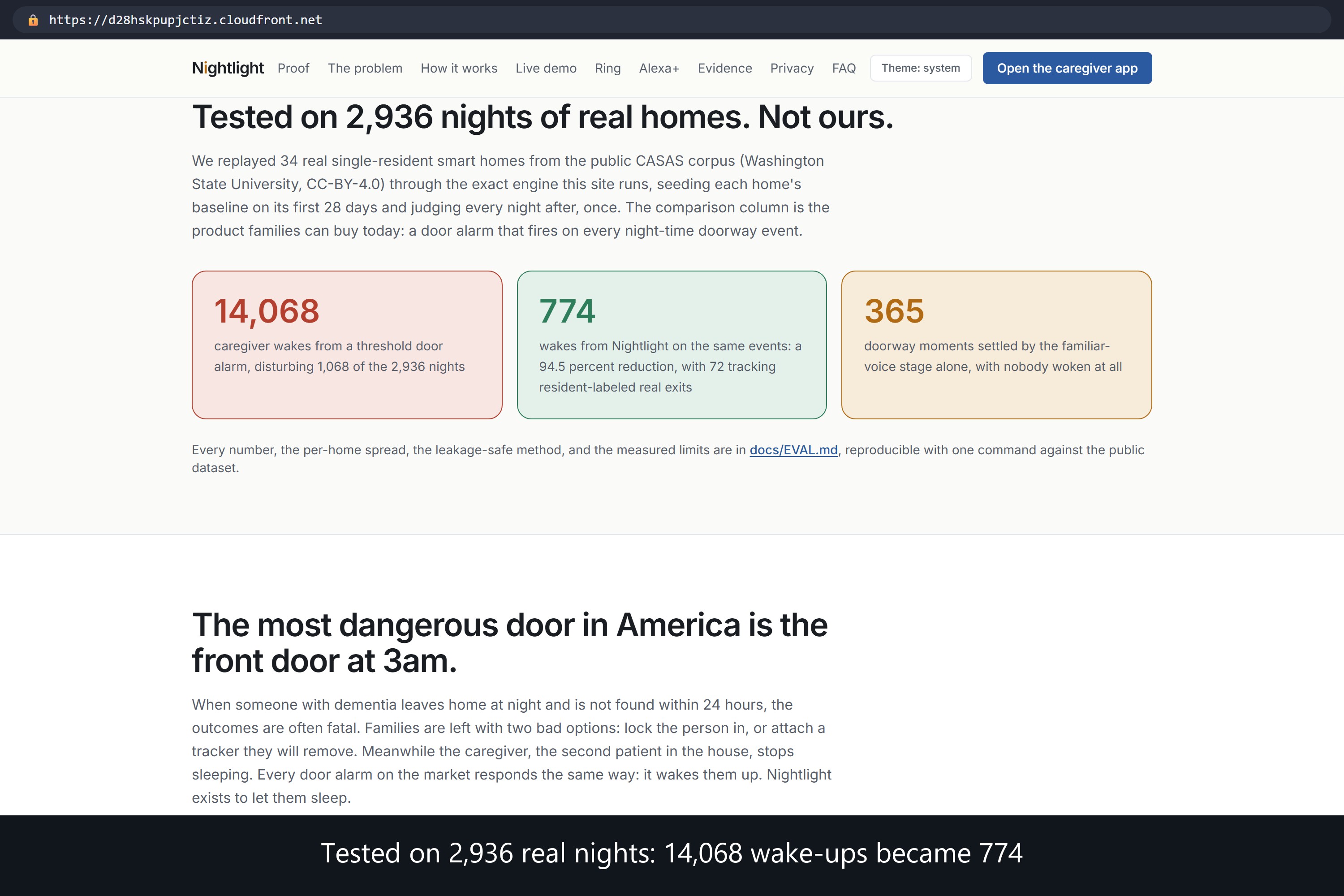
We replayed 2,936 nights from 34 real homes. A standard alarm would have woken caregivers 14,068 times. Nightlight: 774.
-
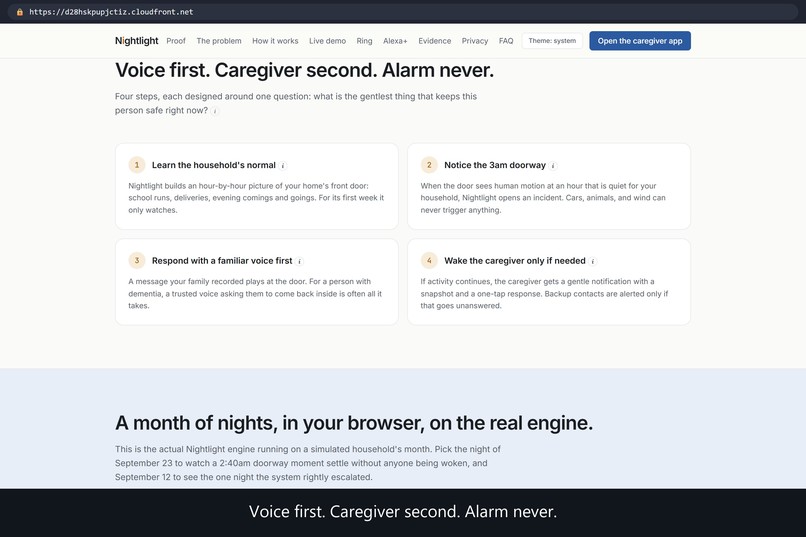
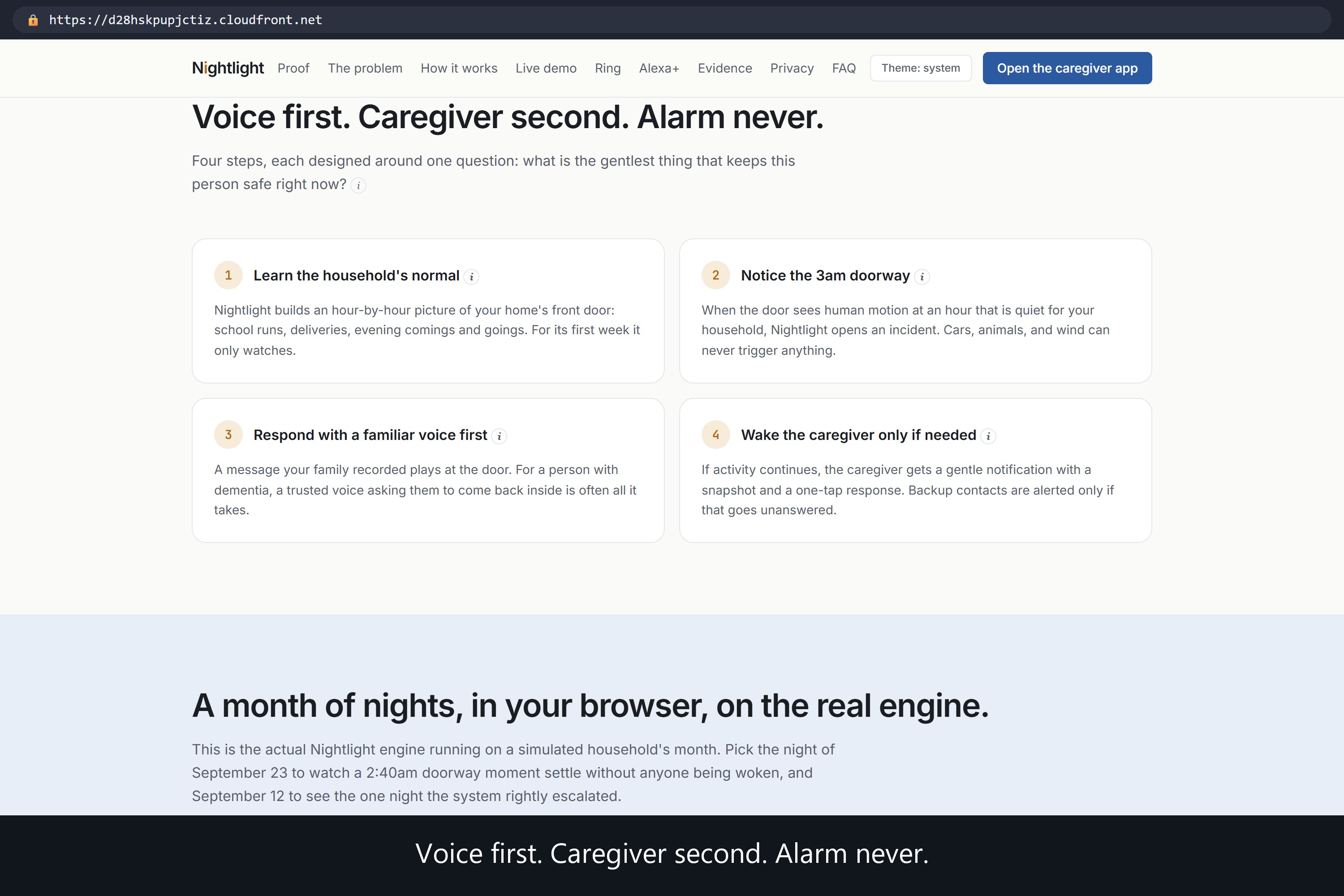
Four steps, each asking the same thing: what's the gentlest way to keep this person safe right now?
-
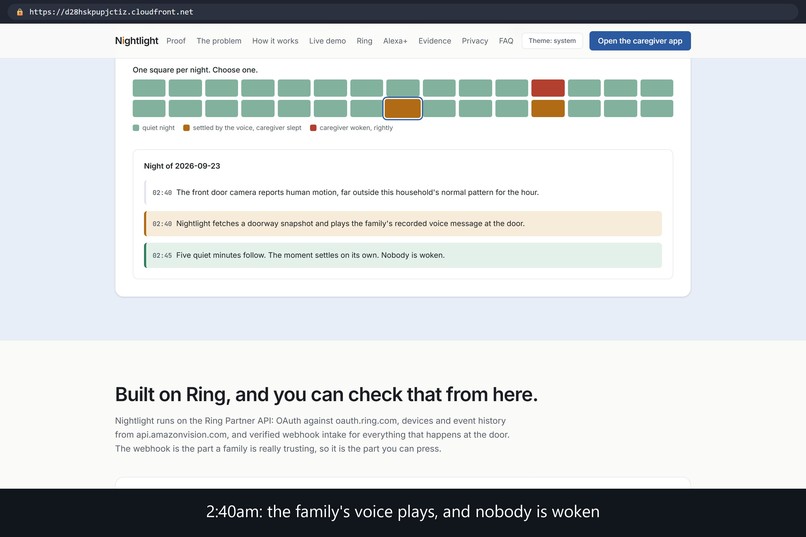
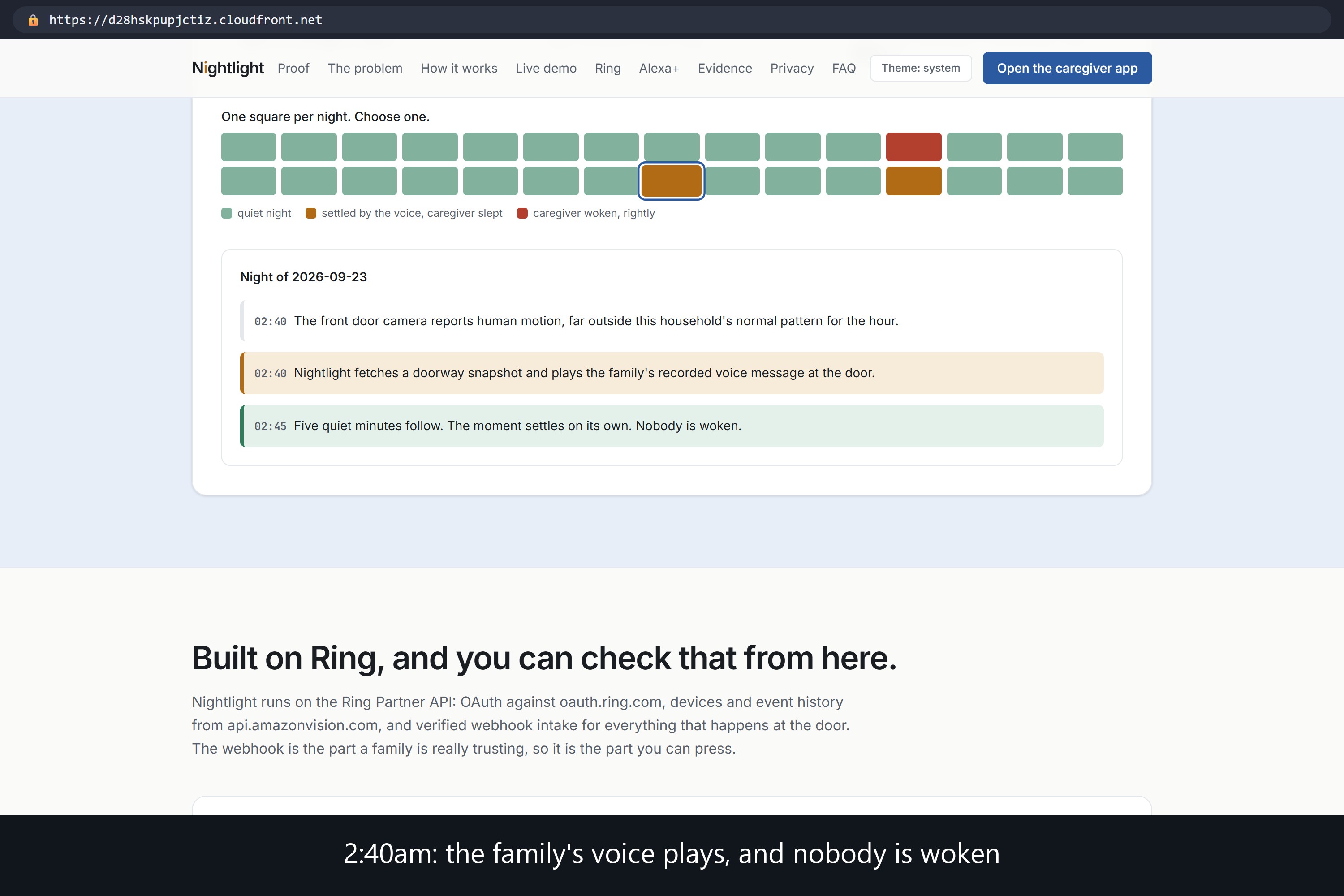
2:40am, the front door opens. The family's recorded voice plays, Dad comes back inside, and nobody has to get up.
-
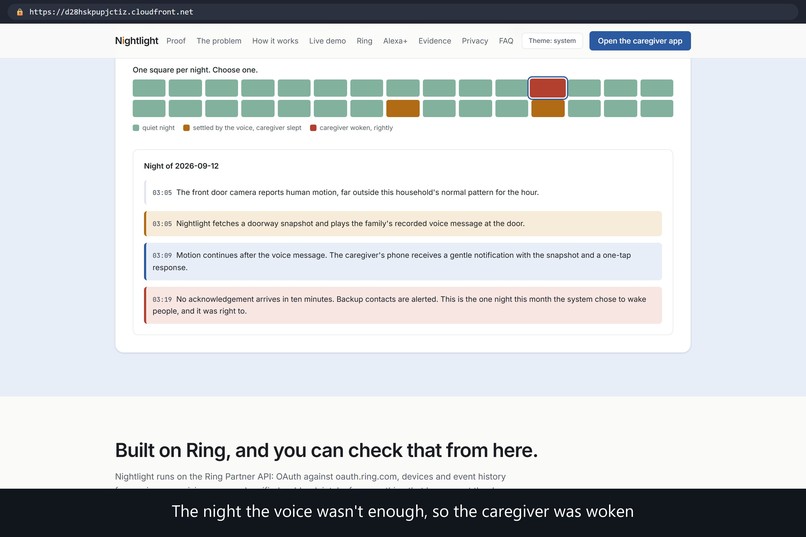
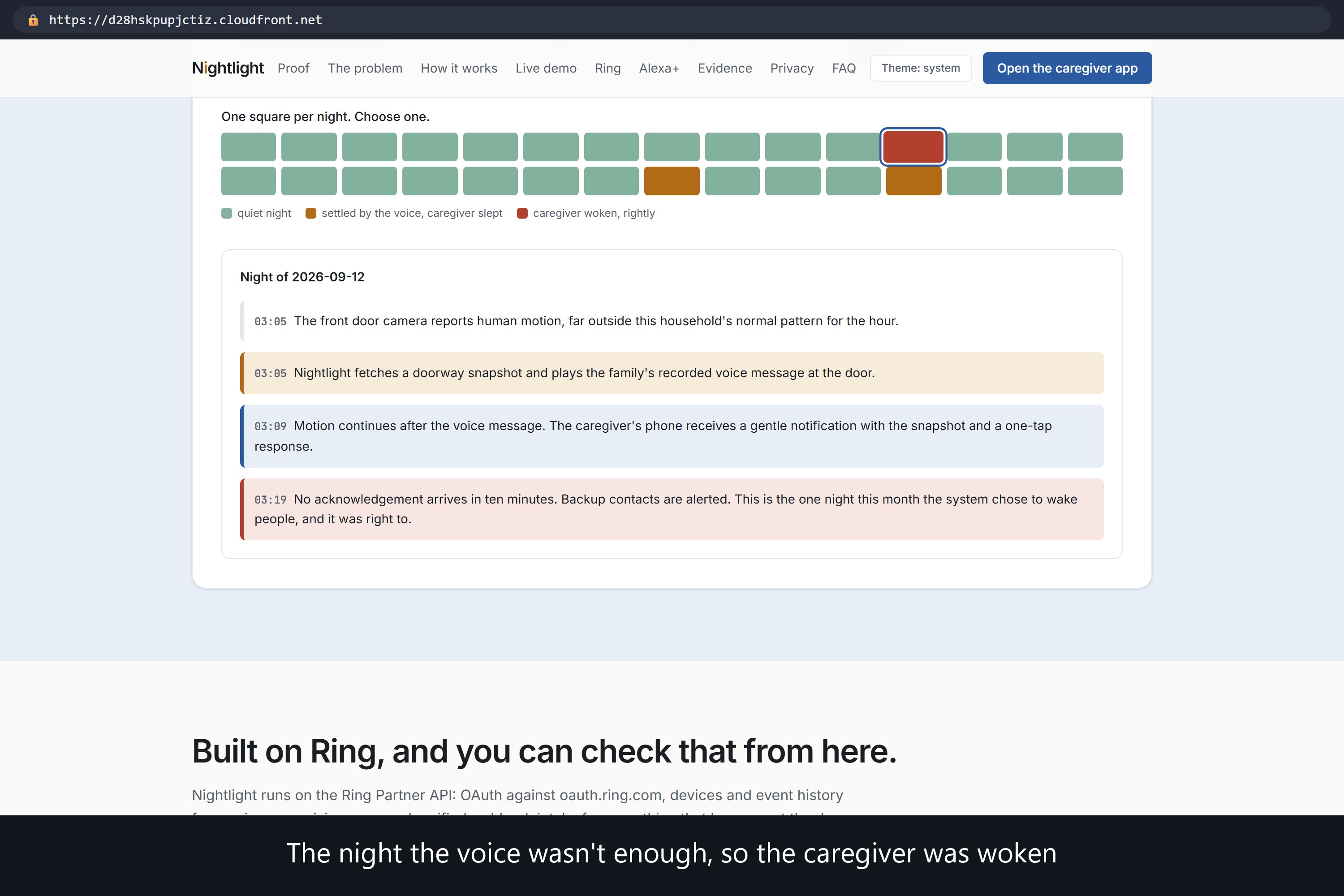
The one night the voice wasn't enough. Motion kept going, so the caregiver got a gentle alert, then backup contacts.
-
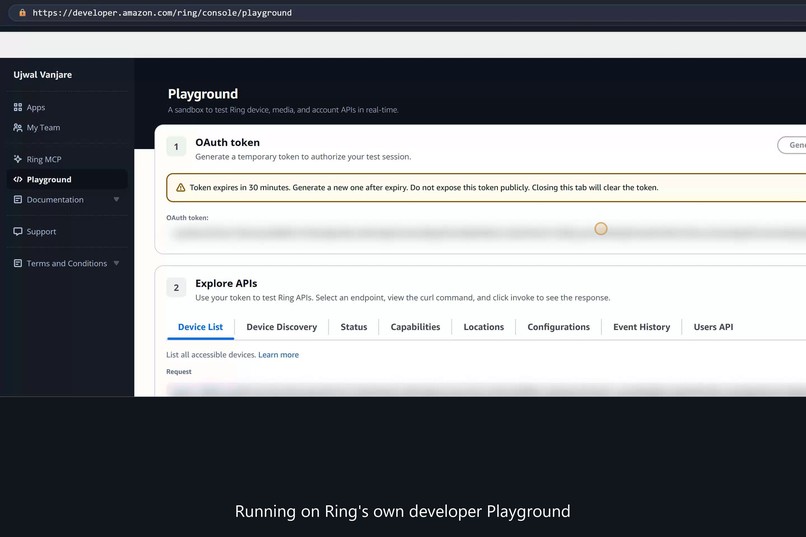
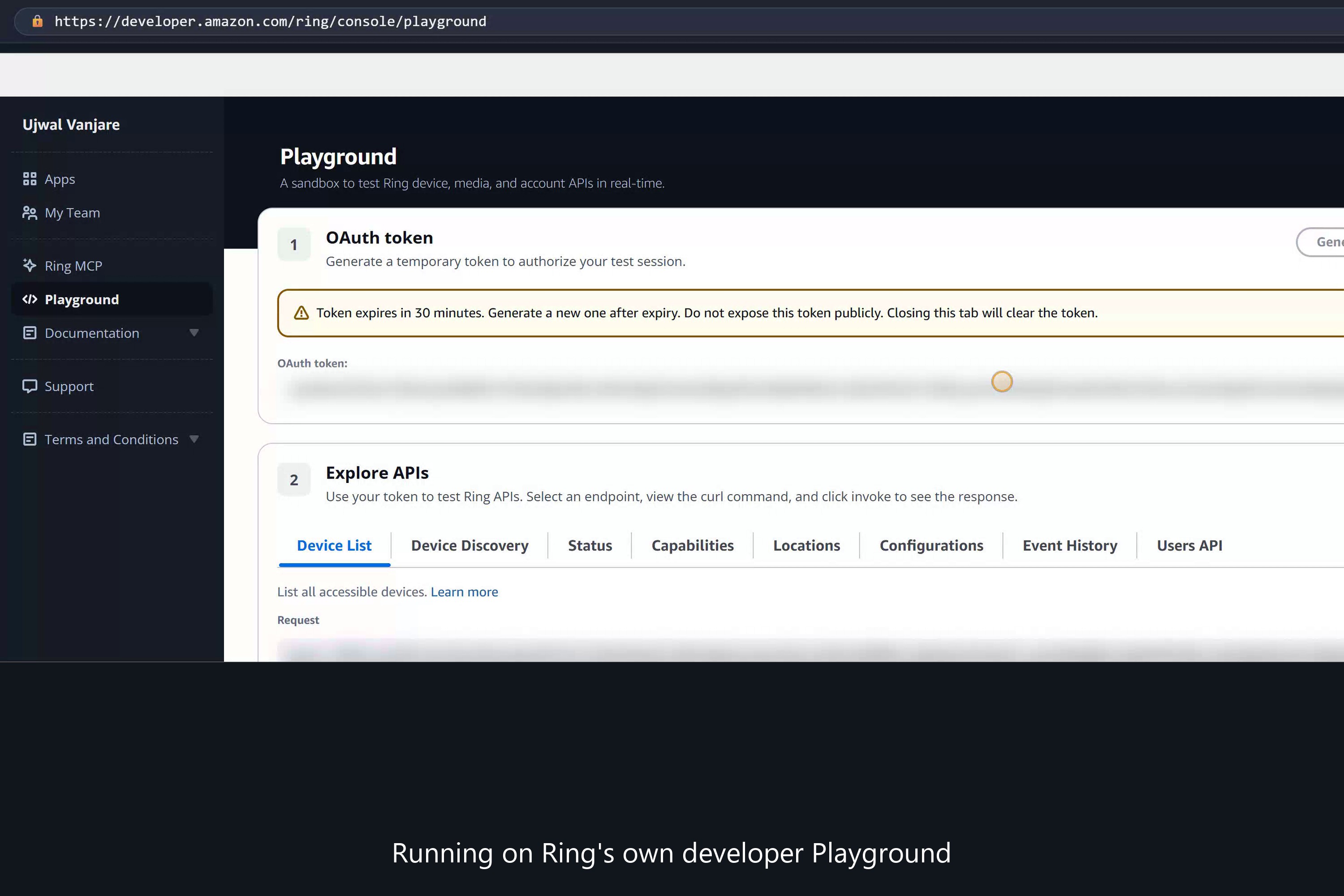
Nightlight on Ring's own developer Playground, where the Ring API answers for real. Tokens and IDs are blurred.
-
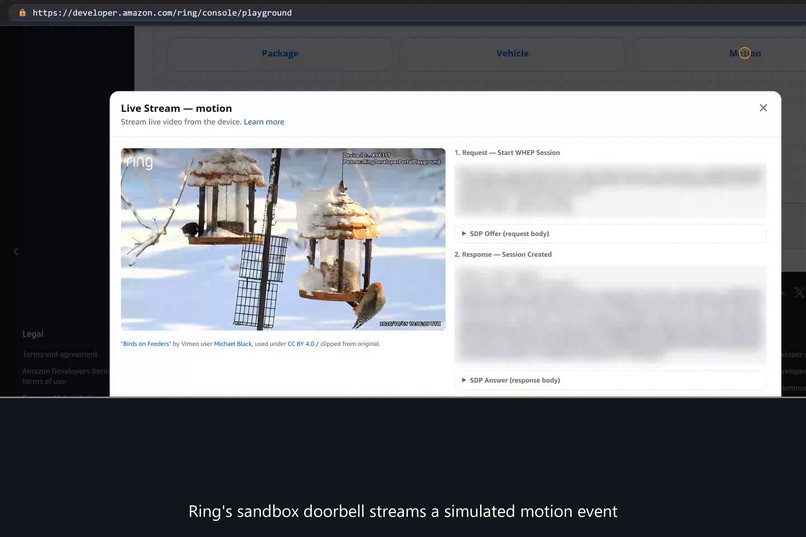
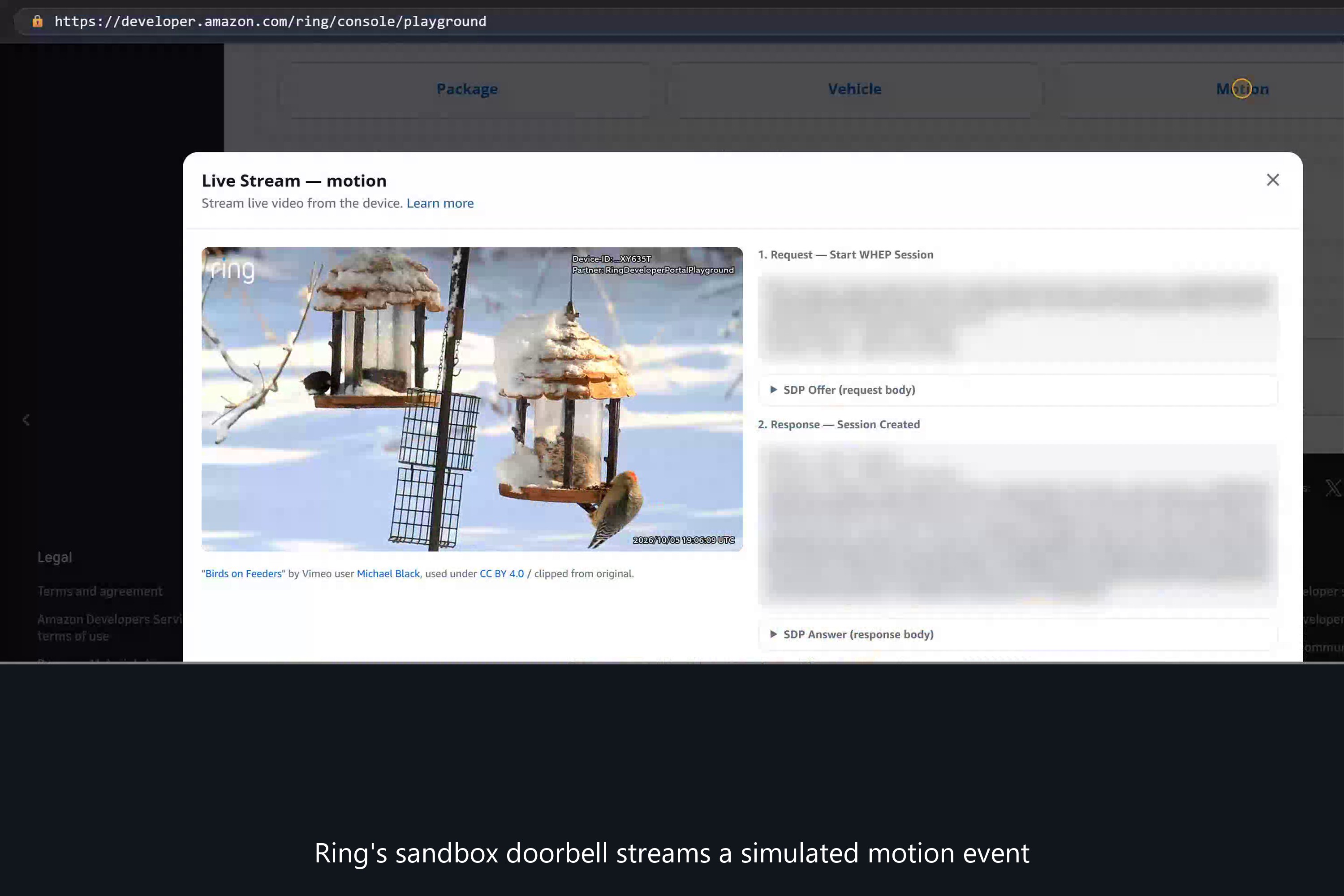
Ring's sandbox doorbell streaming a simulated motion event, the kind of moment Nightlight is built to answer.
-
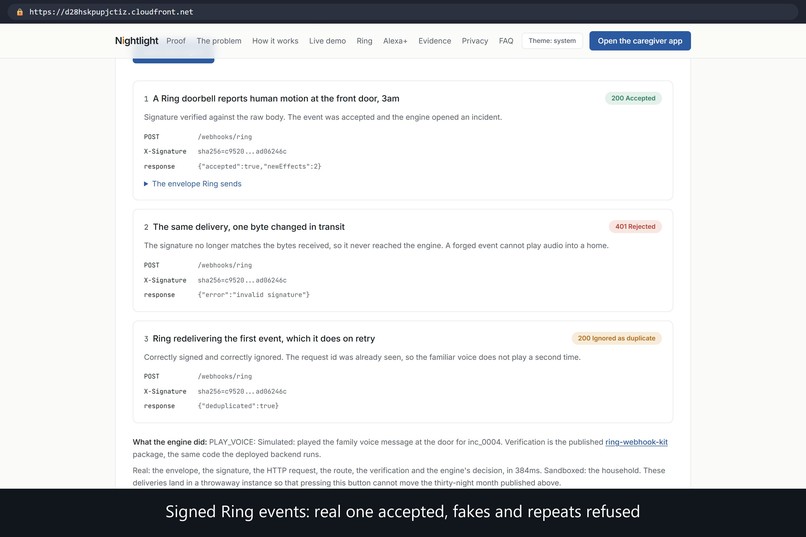
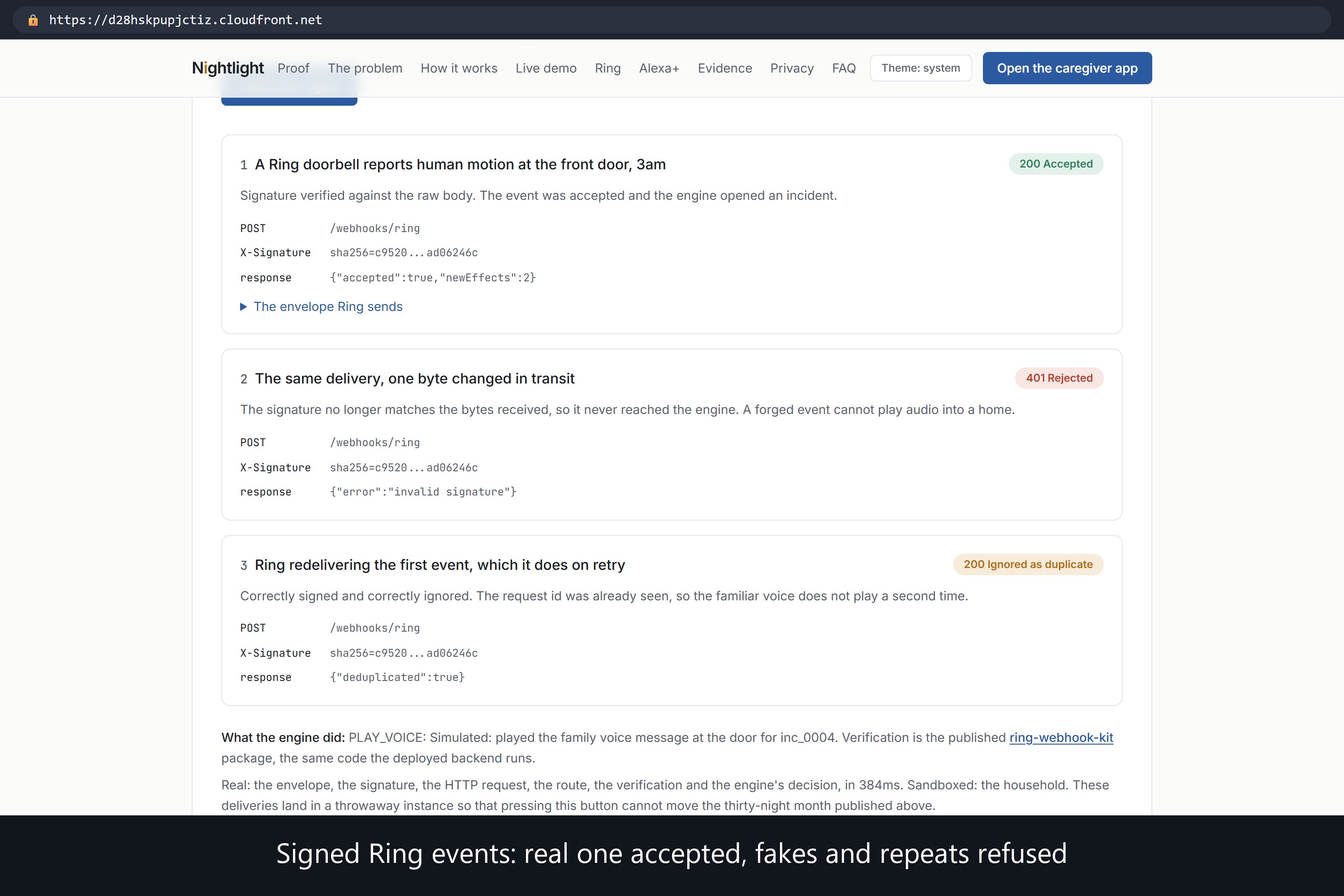
Press one button and send three signed Ring events. The real one gets in. A tampered copy and a repeat don't.
-
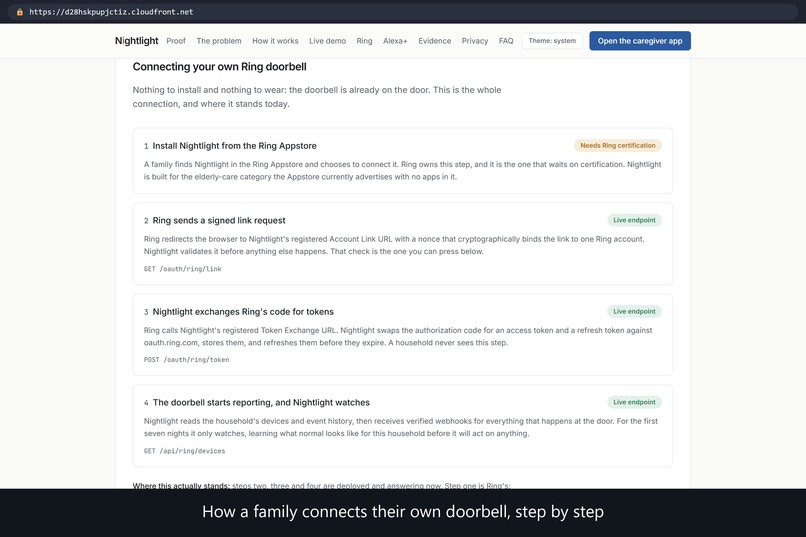
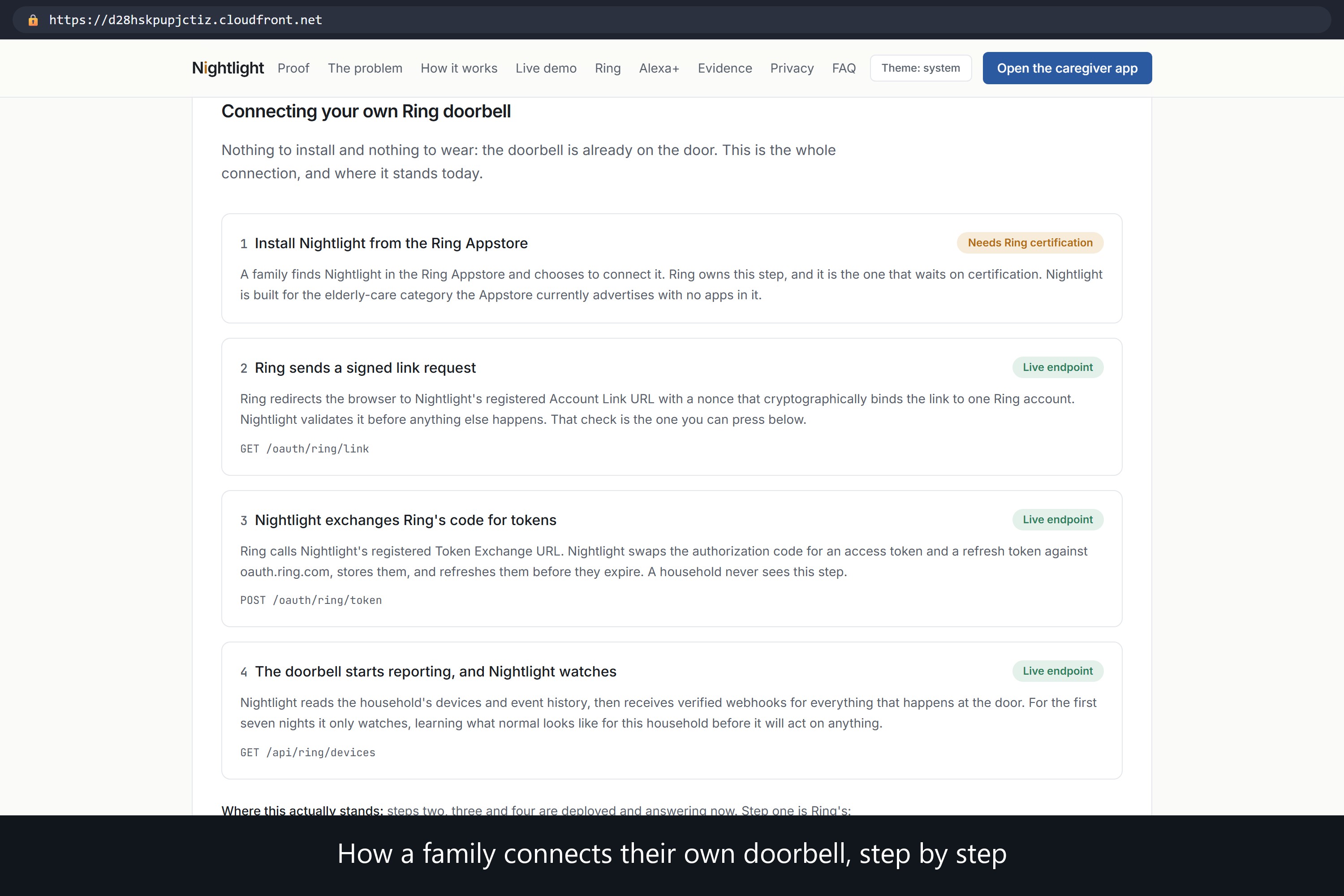
How a family connects their own doorbell. Three steps are live today. The first waits on Ring certification.
-
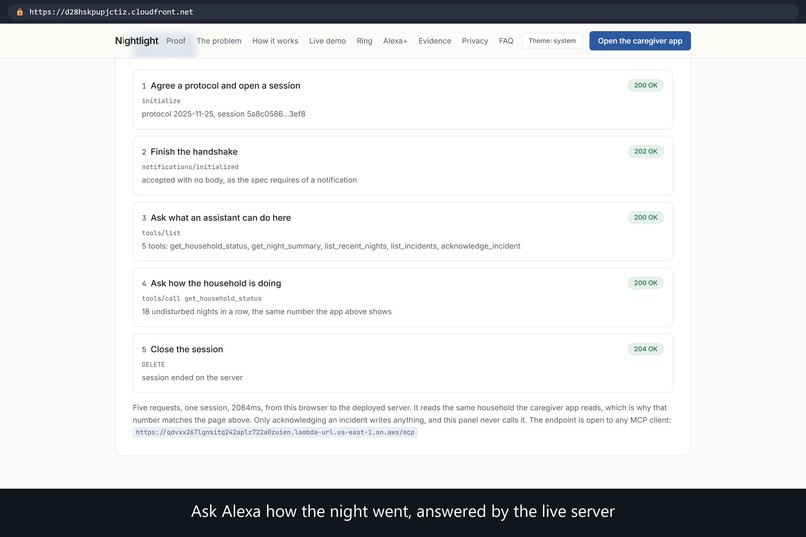
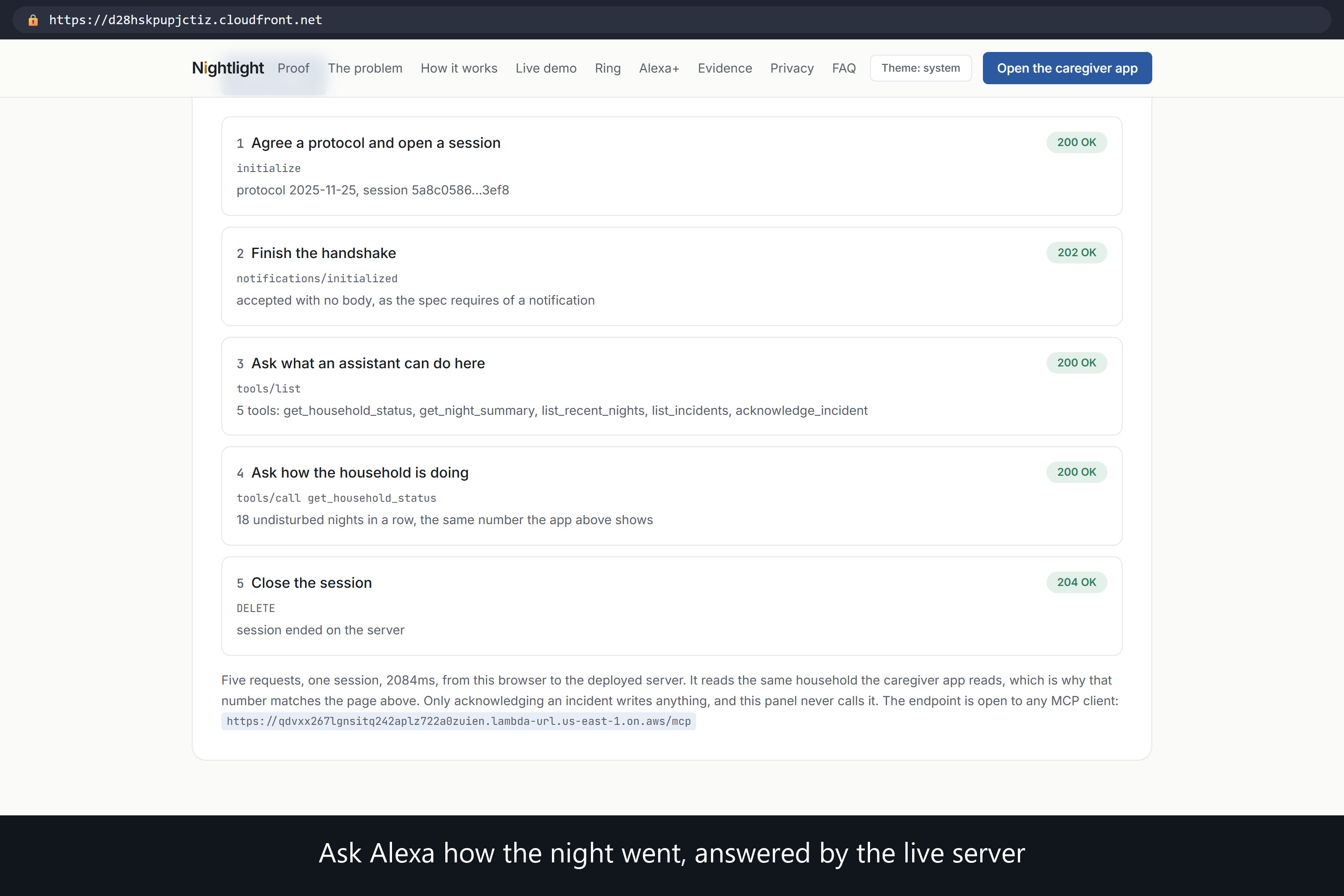
Ask Alexa how the night went. Your browser opens a real session with the live server and gets the same answer the app shows.
-
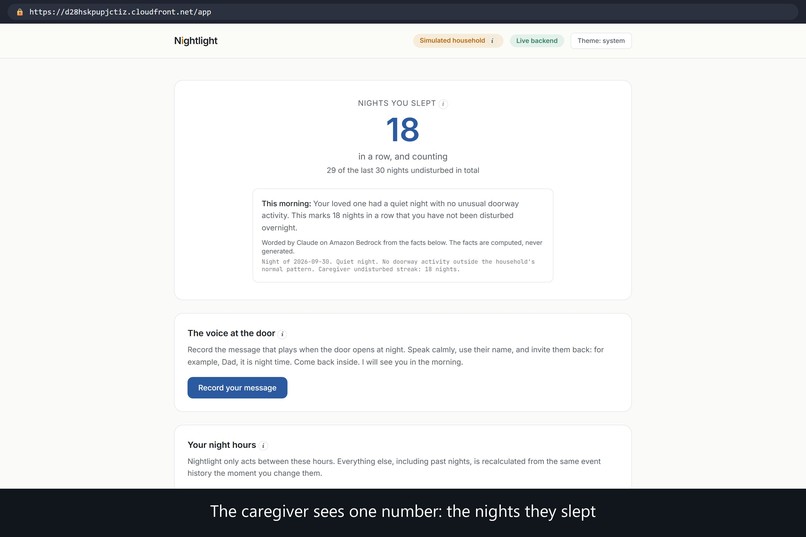
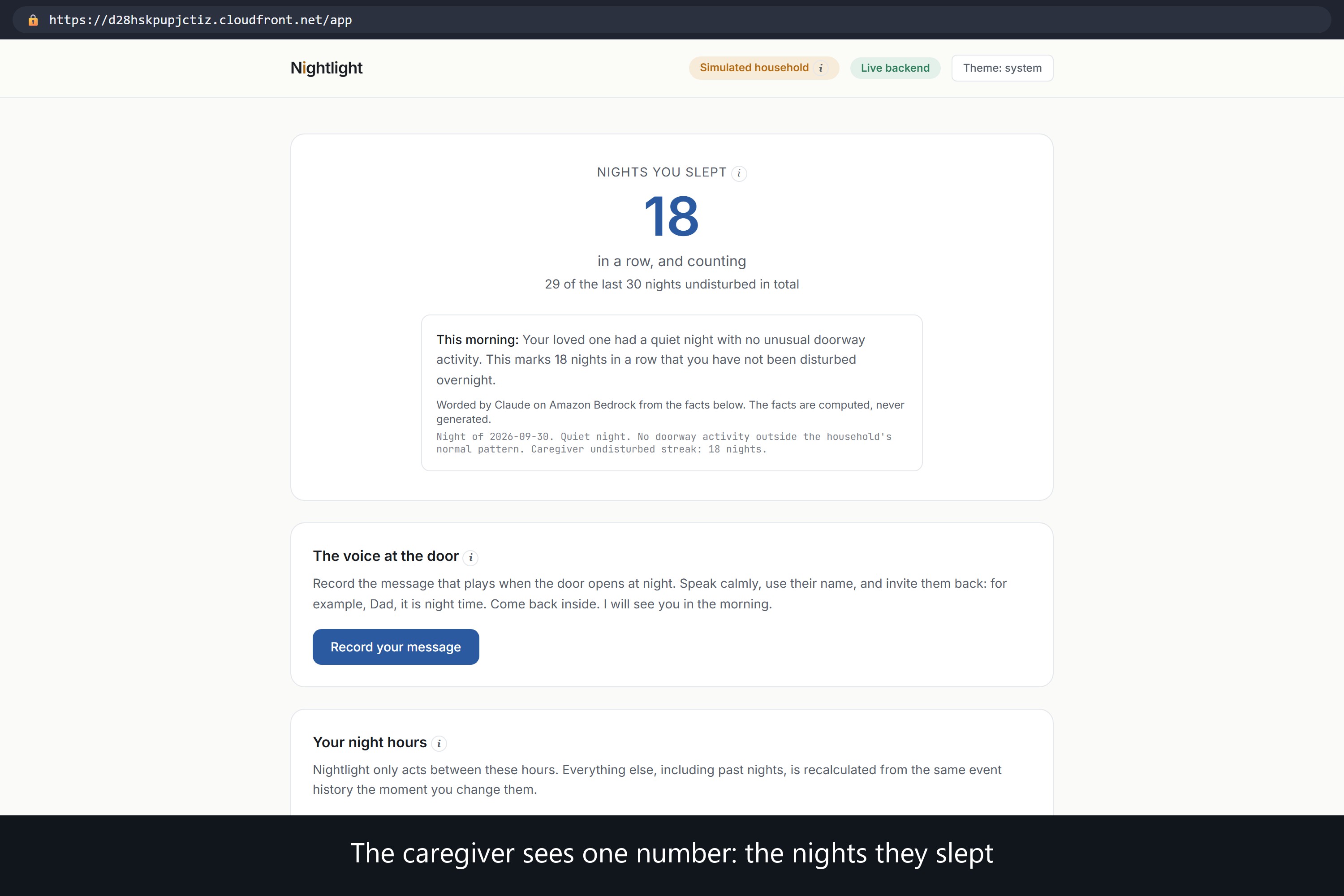
The caregiver sees one number: nights they slept. Claude on Amazon Bedrock writes the morning note from facts, never guesses.
-
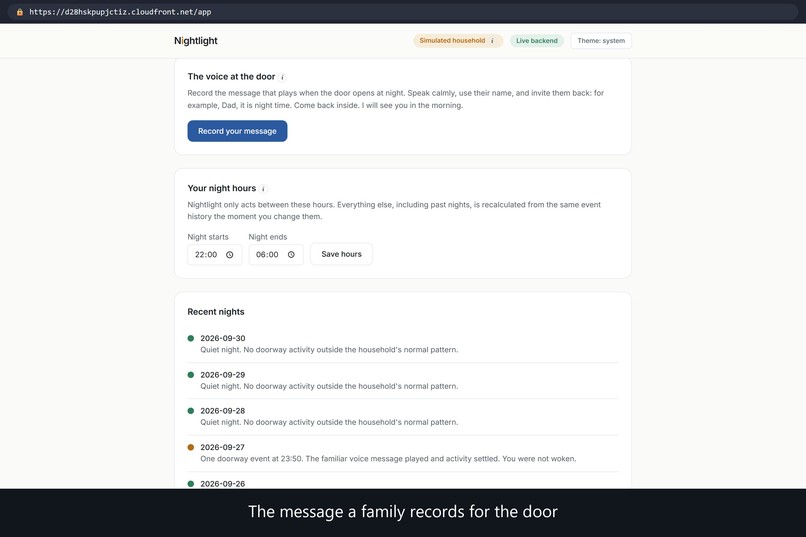
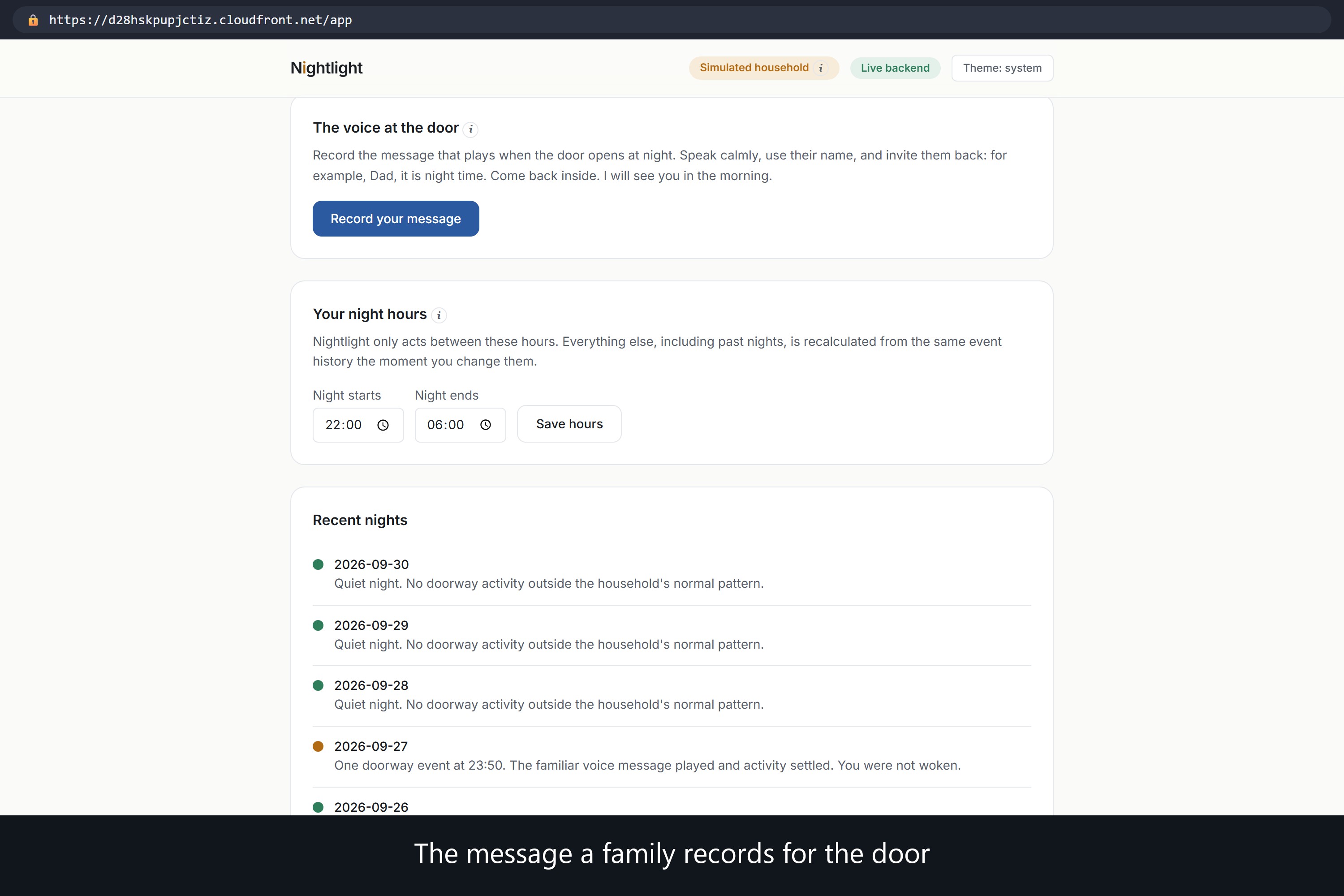
Where a family records the message for the door: "Dad, it's night time. Come back inside. I'll see you in the morning."
-
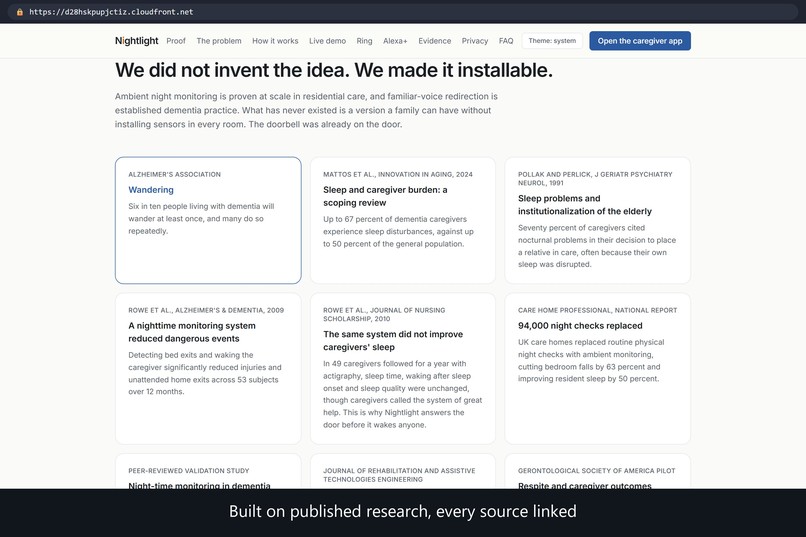
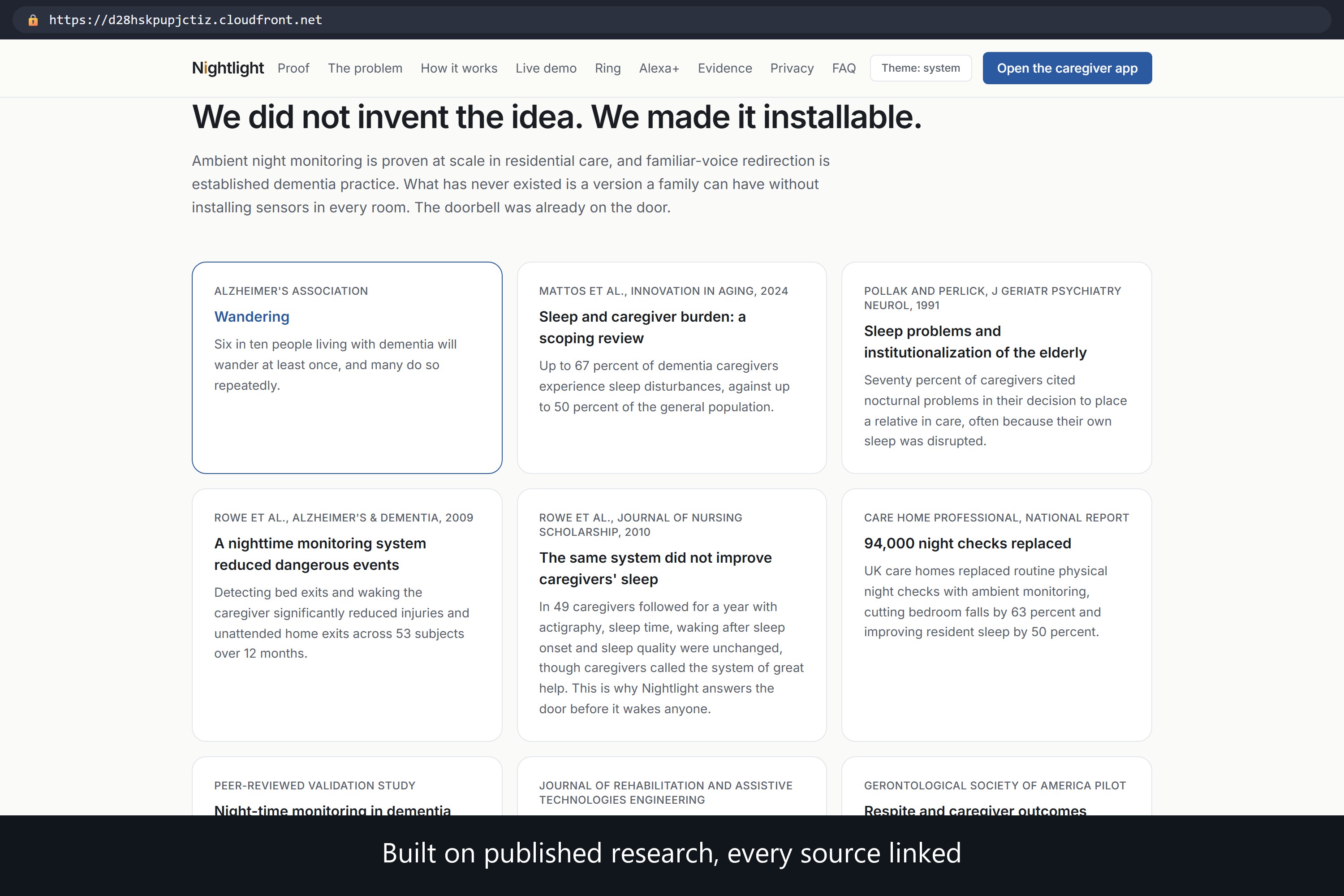
We didn't invent the idea. Night monitoring and familiar-voice redirection are proven in care. We made them fit a home.
-
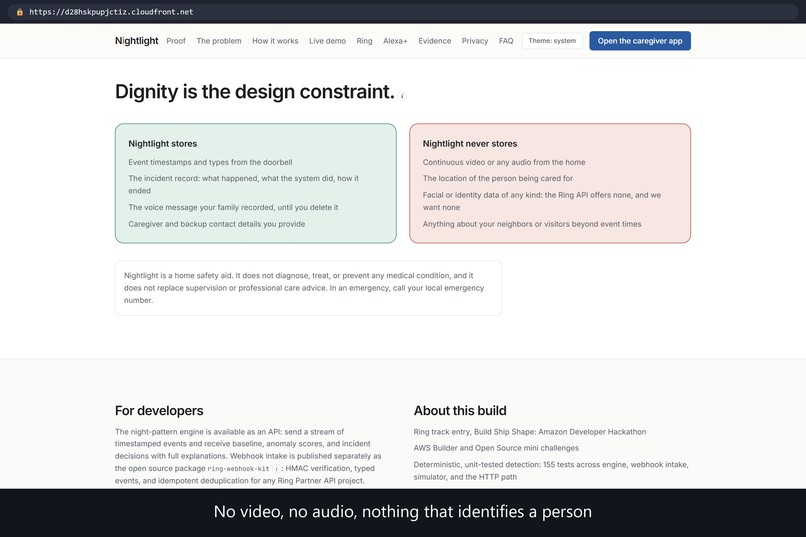
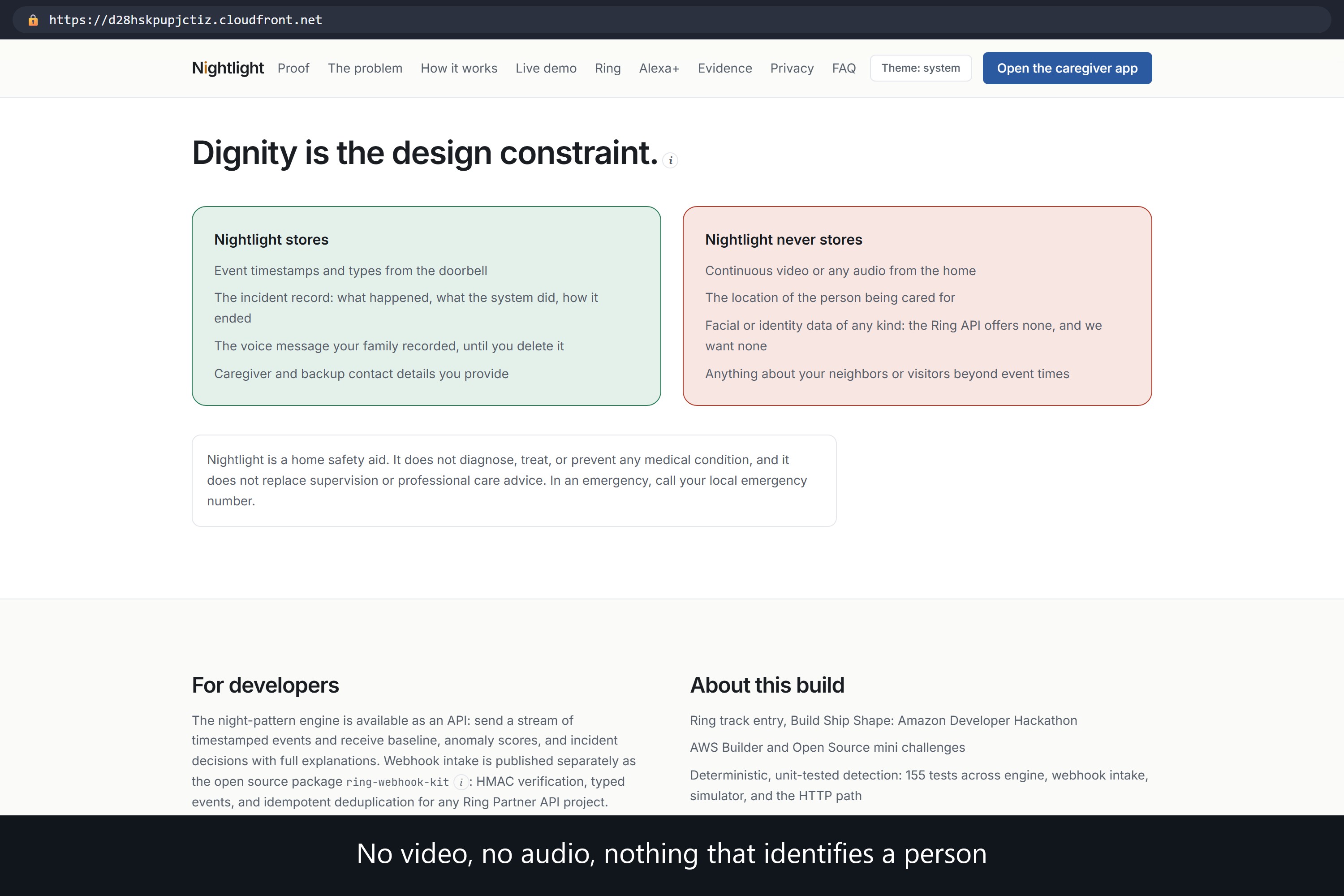
Dignity first. Nightlight keeps event times and what happened. Never video, never audio, never anything that identifies a person.
Inspiration
At 3am, a person living with dementia opens the front door. Most door alarms respond the same way: they wake the caregiver. Night after night.
That caregiver is the second patient in the house, and the night is usually what ends care at home:
- 6 in 10 people living with dementia will wander at least once [1], and night-time wandering occurs in about 60% of cases [2].
- Nearly half of dementia caregivers (46.84%) have trouble falling back to sleep after being woken at night [3].
- 70% of families who moved a relative into a care home cited night-time problems in that decision, often their own lost sleep [4].
Researchers already tested the obvious answer. A night monitoring system that woke the caregiver made people safer, with fewer injuries and unattended exits [5]. But in the companion trial, 49 caregivers were followed for a year and their sleep did not improve on any measure [6]. They felt supported and stayed just as tired, because the system's only response was to wake them.
So we asked a different question: what if the first response to a 3am doorway did not wake anyone?
What it does
Nightlight is software behind the Ring doorbell a family already owns. No new hardware, no wearable, no locked doors.
- Learns the household. For its first week it only watches, building a picture of a normal night in this home, hour by hour. It learns new quiet quickly and new activity slowly, so a night of wandering can never teach it that wandering is normal.
- Notices the unusual 3am doorway. Only people count. Ring's person detection and doorbell presses can start an alert, so cars, pets and wind never wake anyone.
- Answers with a familiar voice first. A message the family recorded plays at the door through Ring: "Dad, it is night time. Come back inside. I will see you in the morning." If no recording exists yet, a natural synthesized voice is used.
- Wakes the caregiver only if the voice is not enough. If activity continues, the caregiver gets a notification with a doorway snapshot and a one-tap "I have it". Backup contacts are alerted only if that goes unanswered.
- Writes a calm morning note. A short summary of the night, worded by Claude on Amazon Bedrock from facts the engine computed. It never adds facts of its own.
It never fails into silence: if the voice cannot play, the caregiver is woken immediately.
The number on the dashboard is the product: nights the caregiver was not woken.
Does it work? Measured on real homes
We replayed 2,936 nights from 34 real homes in the public CASAS smart-home research dataset [7] through the same engine that runs in production.
| Times the caregiver is woken | |
|---|---|
| Standard door alarm | 14,068 |
| Nightlight | 774 |
That is a 94.5% reduction, and 365 doorway moments were settled by the recorded voice alone, with nobody woken.
Waking someone less is easy if you ignore everything, so we also measured what that restraint costs. Of 34 night-time exits labeled in the dataset, Nightlight flagged 7 as unusual. Of the 27 it let pass, 26 were exits the resident came back from within thirty minutes. Both numbers, the per-home results and the limits are published in the repository.
Try it yourself
On the live site you can:
- Send real Ring webhooks to the deployed system and watch it accept a genuine 3am doorbell event, reject the same message with one byte altered, and ignore a duplicate.
- Ask Alexa how the night went: open a live session from your browser to the household's agent server and see the same answer the caregiver sees.
- Walk through a demo month night by night. Demo data is simulated and always labeled as such.
- Get a household of your own with a free API key, no account. Replay a month into it, post your own doorbell's events into it, change its night window and ask an assistant about it, without touching the shared demo. No key still works for everything.
How we built it
- Ring Partner API: signed webhook intake, device list, event history, snapshots and chime audio, plus the token exchange and account link endpoints Ring certification requires. Verified against Ring's live API and the sandbox doorbell in Ring's Developer Playground.
- Alexa+ and agents: an MCP server (spec 2025-11-25, Streamable HTTP) with five household tools, so Alexa+ or any agent can ask about the night or acknowledge an alert hands-free. A Strands agent on Amazon Bedrock AgentCore uses it as an independent client.
- AWS: Lambda, DynamoDB (the event log, with exactly-once actions so the voice can never play twice), Bedrock (the morning note, with a plain-template fallback), Polly (the fallback voice), S3 and CloudFront, all deployed by one CDK stack.
- Safe by design: the detection engine is rule-based and explainable. No AI model ever decides whether to wake someone.
- Open source: we extracted the Ring webhook intake into
ring-webhook-kiton npm (MIT, zero dependencies), so other Ring developers do not have to rewrite signature checking.
Running cost: under 20 cents per household per month, measured on the live deployment.
Why it matters
A semi-private nursing home room costs $315 a day [8]. A randomized trial that supported family caregivers, without treating the patient at all, delayed nursing home placement by a median of 329 days [9]. Nightlight targets the same thing that trial did: the caregiver's ability to keep going.
We do not claim Nightlight delays placement; that needs a long-term study. What we have measured is a 94.5% cut in night wakings, at a price where one day in that room pays for more than a century of Nightlight.
Challenges we ran into
- Ring's chime audio endpoint does not document which audio formats it accepts, and that decides how our core feature is delivered. We built a fallback through Echo announcements and reported the gap to Ring.
- An early version could slowly learn a wandering night as normal. We redesigned learning to be one-sided so that can never happen.
- Two of the Bedrock models behind our morning note reached end of life and failed silently, hidden by a first choice that still worked. Every fallback is now checked, not just the first.
Accomplishments that we're proud of
- A headline number that counts wakes that did not happen, measured on real homes and published next to what it missed.
- A real Ring integration, not a mockup: live API calls, signed webhooks and a working sandbox device.
- One deployment serving both the Ring and the Alexa+ experience from the same household data.
What we learned
Restraint is a feature. The hard part was never detecting a door opening. It was earning the trust to stay quiet.
What's next
Ring certification into the Appstore's elderly care category, support for homes with more than one door, and a caregiver sleep study with a dementia care organization.
Nightlight is a home safety aid. It does not diagnose or treat any condition and does not replace supervision or professional care.
Sources
- Alzheimer's Association, Wandering
- Serban et al., Alzheimer's & Dementia, 2025, PMC12725205
- Osakwe et al., Frontiers in Aging Neuroscience, 2022, full text
- Pollak and Perlick, Journal of Geriatric Psychiatry and Neurology, 1991, DOI
- Rowe et al., Alzheimer's & Dementia, 2009, PubMed
- Rowe et al., Journal of Nursing Scholarship, 2010, abstract
- CASAS HH dataset, Washington State University, Zenodo 15708568 (CC BY 4.0)
- CareScout Cost of Care Survey, 2025, results
- Mittelman et al., JAMA, 1996, PubMed
Every claim with its full citation: EVIDENCE.md
Built With
- alexa-plus
- amazon-bedrock
- amazon-bedrock-agentcore
- amazon-cloudfront
- amazon-dynamodb
- amazon-polly
- amazon-web-services
- aws-cdk
- aws-lambda
- claude
- fastify
- mcp
- node.js
- python
- ring-partner-api
- strands-agents
- typescript

Log in or sign up for Devpost to join the conversation.