-
-
we vow to be your light in the night!
Inspiration 💡
The inspiration behind ‘nightlight’ stemmed from an issue that all of us have experienced; fear at night. As teenage girls, we repeatedly dread taking transportation systems, like the TTC, alone. We often come across anecdotal posts shared by other women on social media that recount their horrific experiences on public transit.
An experience shared by a 20-year-old woman on TikTok “I was literally taking the bus home after getting some drinks with my friends when this guy pulled out his phone and started filming me [...] This is not any woman’s fault, but be careful because there are some people who will take advantage of any one they see.”
With this problem in mind, our team decided to create an application that would act as one’s “light in the night” in order to reduce the risk of harassment that females, minorities and people in general experience on public transport.
What it does
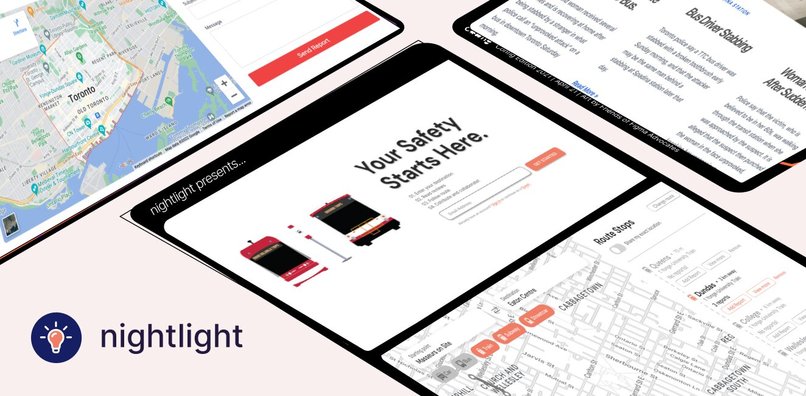
In an attempt to improve physical security and to champion women, our responsive web application informs the user on potential risk factors at bus stops, train and subway stations! As a user, simply…
- Enter your starting location and destination
- Select a public transit route
- View updated reports about each public transit station written by other public transit users
- Make reports about public transit stations, as needed, and notify authorities
- Share your location with friends and family
- Follow the indicated route
- Contribute and collaborate!
- We develop a community of women empowering women, by allowing users to report any suspicious activity or incidents that they have either seen or experienced using public transport. E.g, harassment, sexual assault, invasion of privacy By standing together in solidarity, public transit has never been safer!
How we built it
We used Figma to design our web application in order to showcase the potential interactive elements we could include, as well as the concept of our safe-router tool. Additionally, Figma was used in order to ideate the UI/UX aspects of ‘nightlight’, making it as user friendly as possible.
To make our application completely responsive, we developed it using TailwindCSS, a utility-first CSS framework. Then, we used HTML, CSS, and JavaScript for the front-end.
Challenges we ran into
To allow users to search for and report public transit stations, we wanted to connect a Google Maps API to the frontend. However, after hours of research, financial and time restraints prevented us from connecting it. Instead, we made placeholder locations that replicated what we could have achieved with Google Maps API.
We also struggled with code collaboration as our initial platform, Replit, did not support TailwindCSS or React.js. After conducting substantial research, we learned about how to do live code sharing on VS Code and how to create shareable local servers. As well, we learned how to set up a Git repository and stage and commit changes directly from the VS Code terminal.
What we learned
As a team, we learned the importance of perseverance and using all available resources to our advantage. In such a short time frame, it became evident that several of the features we wished to include would not be possible. However, despite the number of obstacles that we encountered, we still remain extremely passionate about this project and plan to continue it beyond TechNova. We strongly believe that nightlight has real-world capabilities that will empower womxn to feel safe on public transit. Through further development, we will learn RESTful API, SQL, and Jquery to implement backend features.
What's next for Nightlight
The most notable technical implementations that we have in store for ‘nightlight’ include enabling the Google Maps API system in order to use location services, and to access a database in order to safely store the data of our users. Proper integration of S.O.S (calling 911) in order to immediately notify local authorities. Additionally, we want to make a long-lasting impact and we believe that nightlight’s concept can be feasibly applied to law enforcement. The collected reports created by the general public can be stored and then shared with local police and transit organizers to ensure better security in higher risk areas.
Built With
- css
- html
- javascript
- tailwindcss


Log in or sign up for Devpost to join the conversation.