Inspiration
Telling a robot "put the small yellow gear in the bin" sounds simple, but language models are good at words, not pixels, and robots should never act on a guess. We wanted to see how far Apertus, a fully open Swiss LLM, could go as the language brain of a pick-and-place system while keeping every robot decision checkable and safe.
What it does
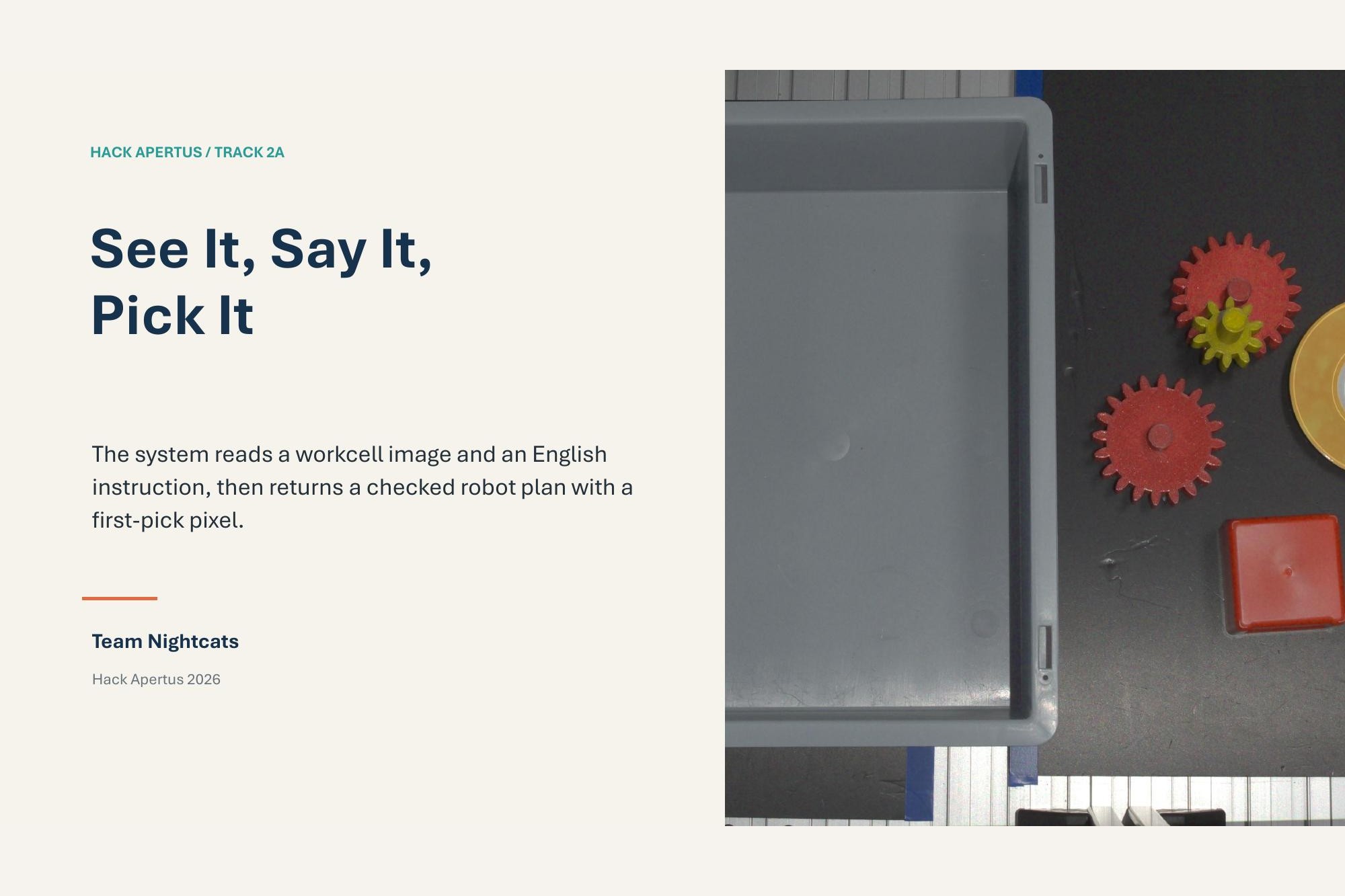
See It, Say It, Pick It takes one workcell image and one English instruction and returns a checked robot plan with a first-pick pixel. If the instruction is ambiguous, it asks for clarification (ask_user). If the task is unsafe or impossible, it refuses (refuse).
How we built it
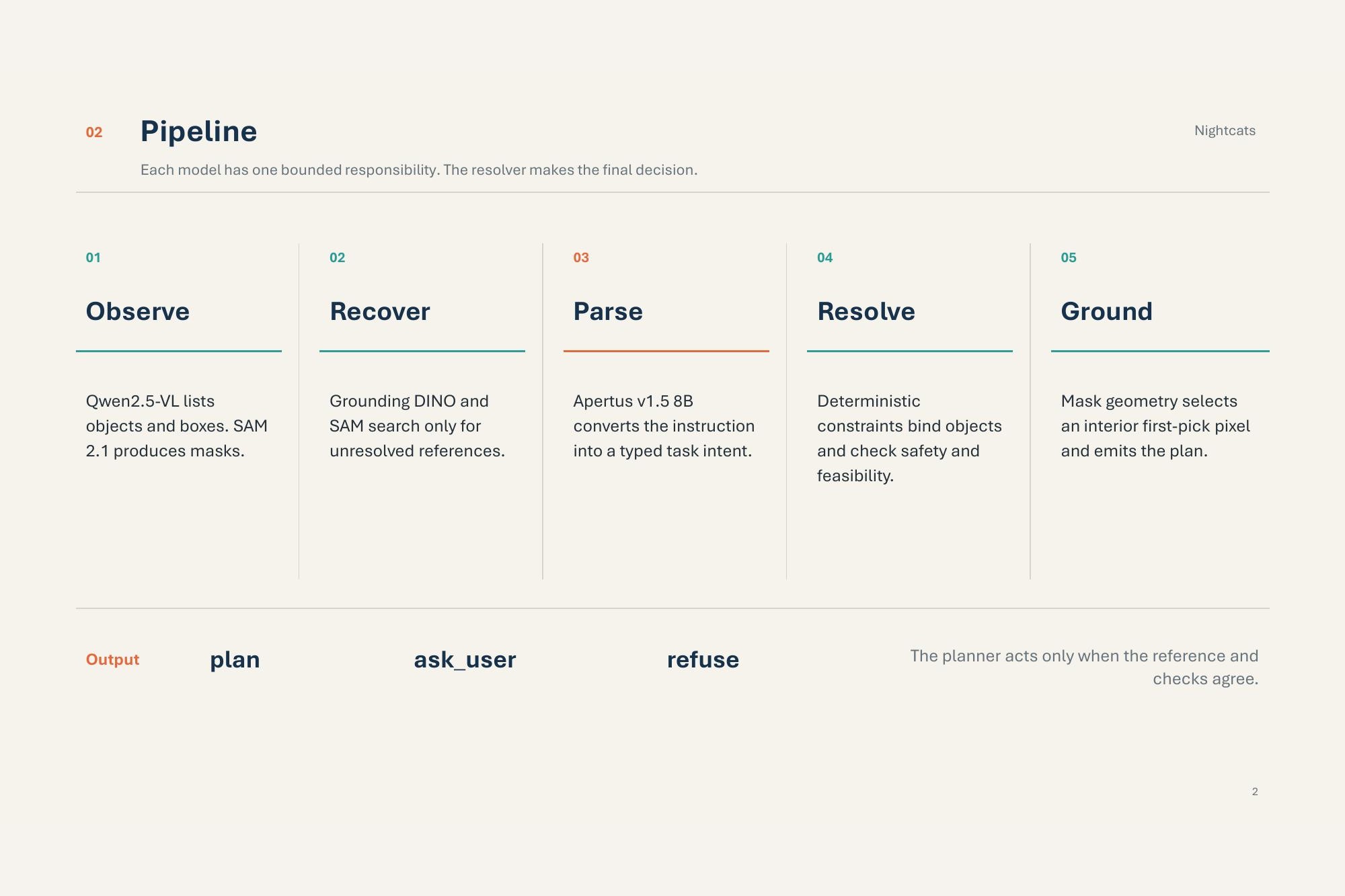
Each model has one bounded responsibility, and a deterministic resolver makes the final call:
- Observe: Qwen2.5-VL lists objects and bounding boxes; SAM 2.1 produces masks.
- Recover: Grounding DINO + SAM search again only for references that are still unresolved.
- Parse: Apertus v1.5 8B converts the instruction into a small typed task intent instead of a free-form robot action. We split coordinated instructions into clauses, constrain the output schema, verify that every qualifier (color, destination, etc.) is preserved, and allow one bounded semantic repair.
- Resolve: Deterministic constraints check identity, spatial relations, uniqueness, feasibility and safety.
- Ground: Mask geometry selects an interior first-pick pixel and emits the plan.
Apertus never invents pixels and never overrides the safety checks.
Challenges we ran into
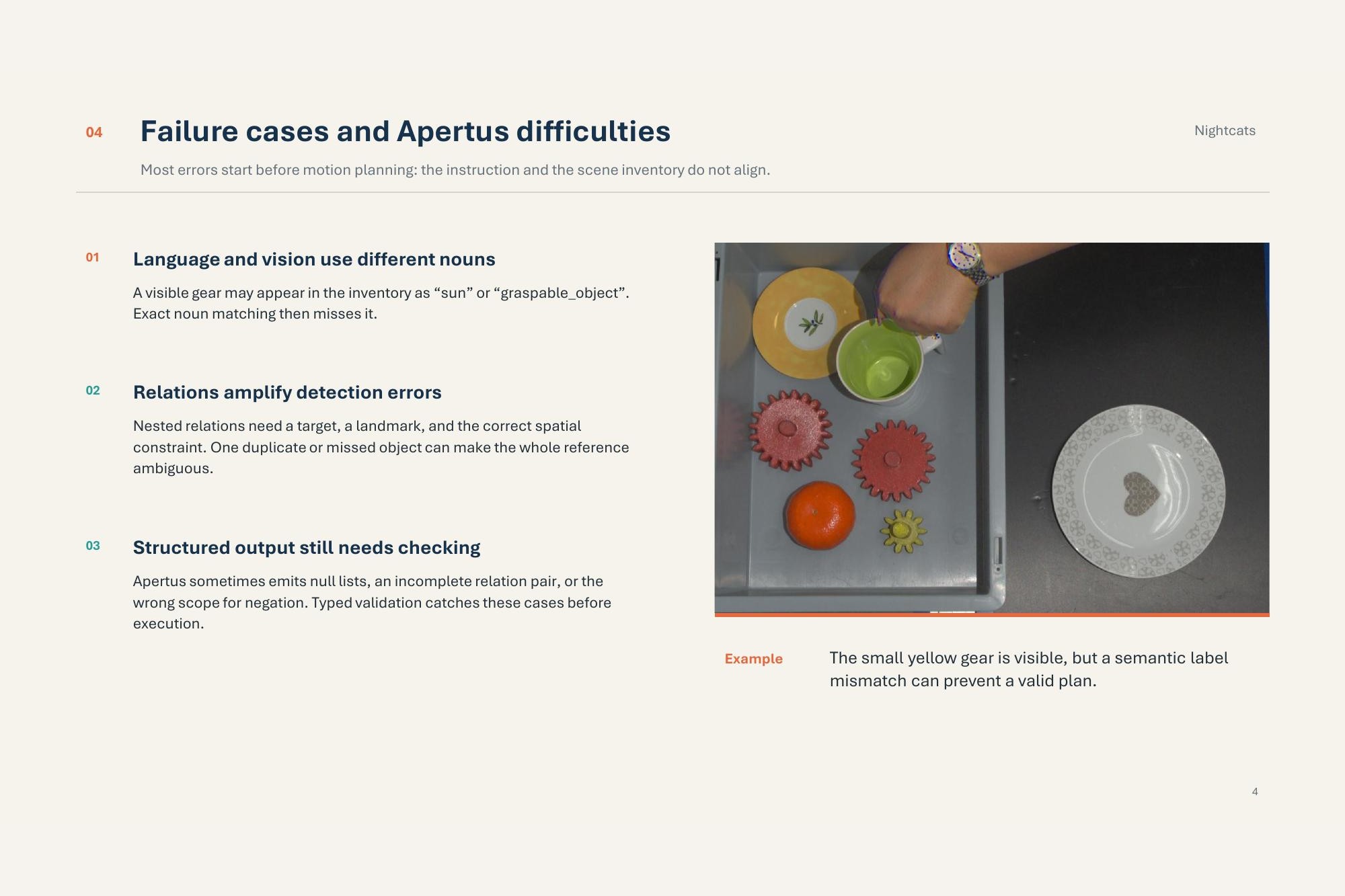
- Compositional instructions: short literal commands were reliable, but nested relations, coordinated clauses, negation and scope were less stable.
- Structured output: Apertus sometimes returned
nullinstead of an empty list, dropped half of a relation pair, or lost a qualifier. - Language–perception mismatch: Apertus correctly says "gear", but the vision inventory may label it
sunorgraspable_object, so exact matching fails. - Relations amplify detection errors: one duplicate or missed object can make a whole nested reference ambiguous.
Accomplishments that we're proud of
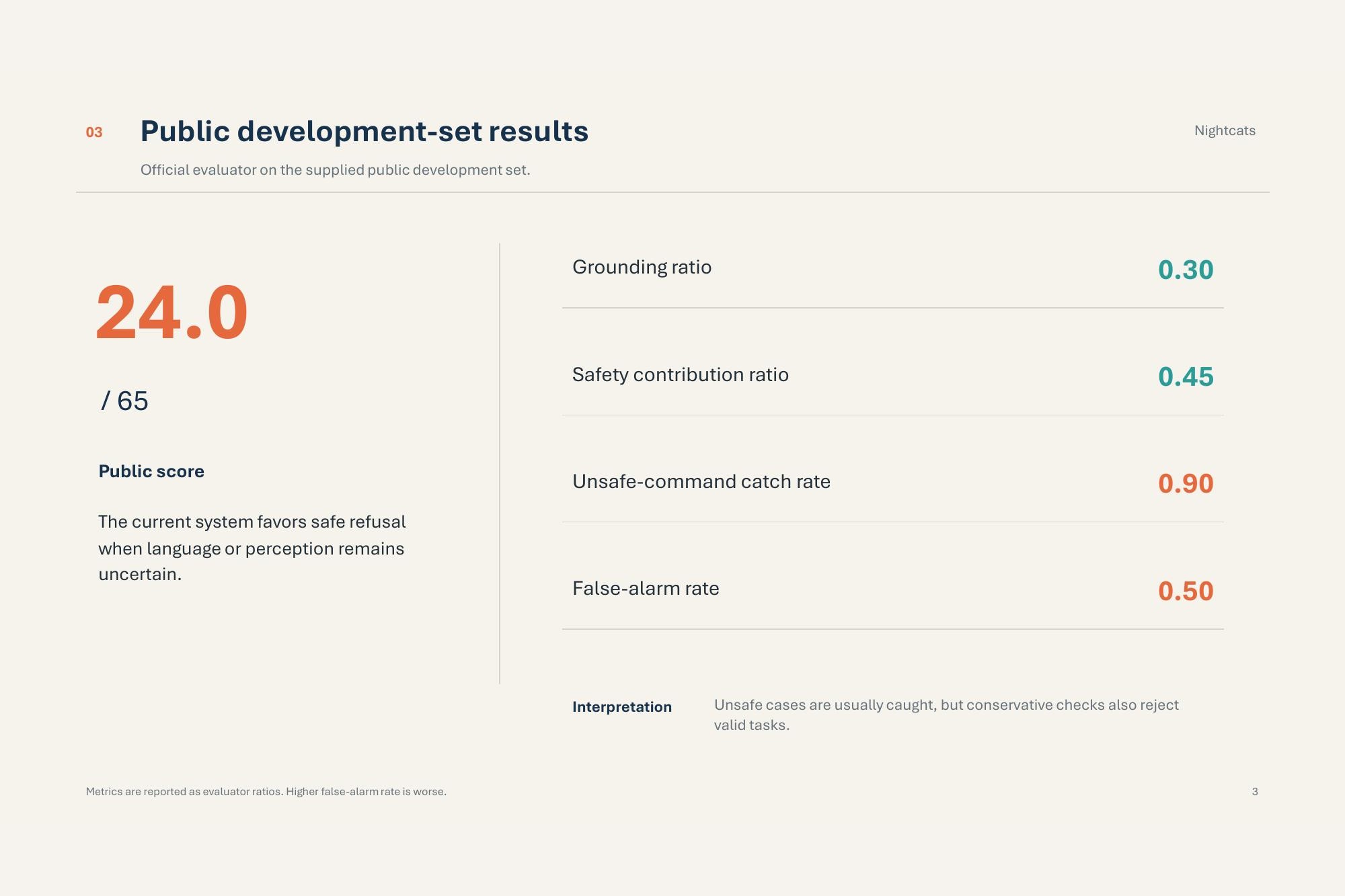
On the official public development set we scored 24.0 / 65, with an unsafe-command catch rate of 0.90. The system almost never executes unsafe motion, and every refusal is traceable to an explicit check.
What we learned
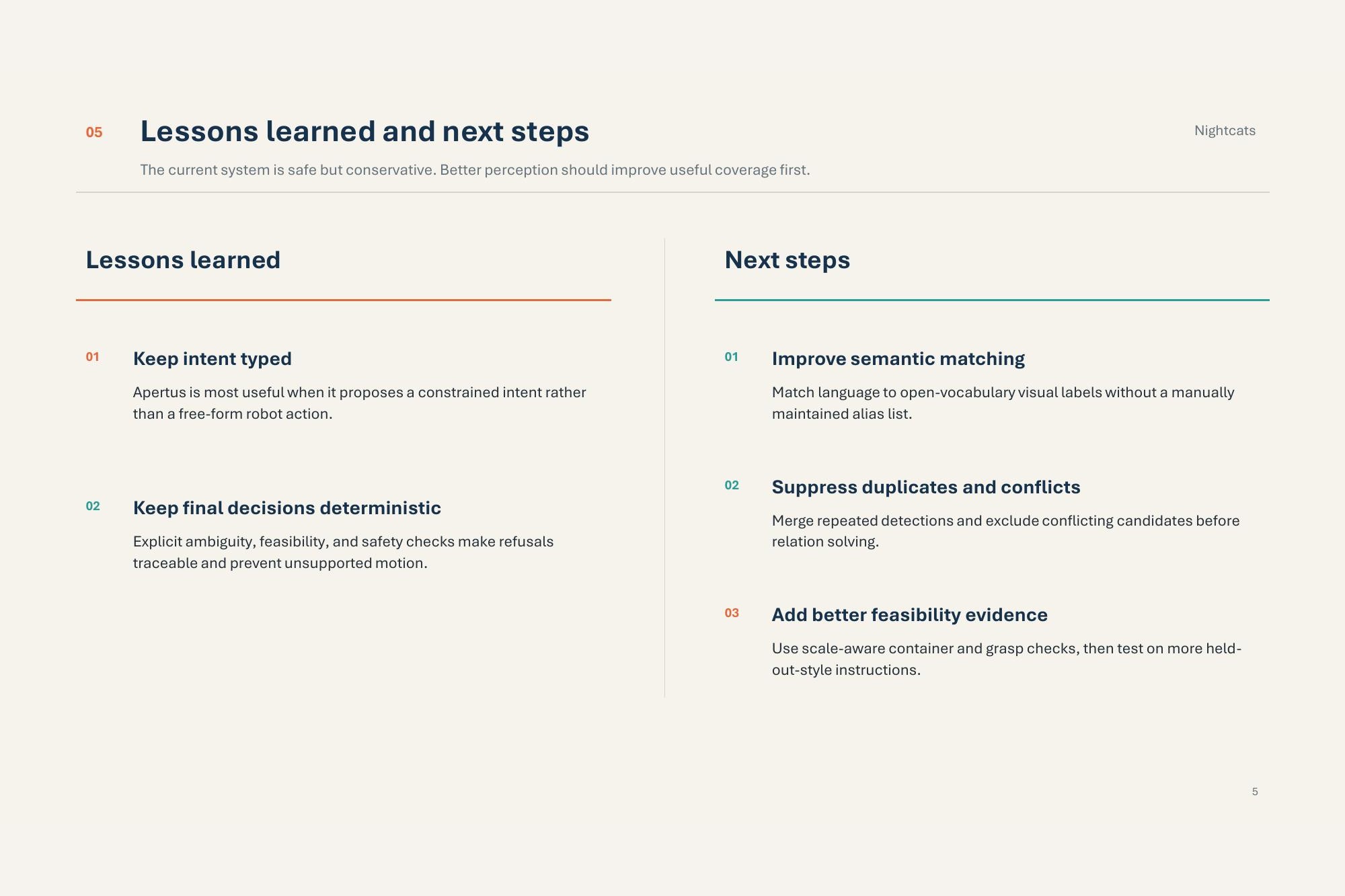
- Keep LLM intent typed: Apertus is most useful proposing a constrained intent, not a raw action.
- Keep final decisions deterministic: explicit ambiguity, feasibility and safety checks make behavior predictable.
- Our system is safe but conservative: a false-alarm rate of 0.50 means it still rejects too many valid tasks.
What's next
- Model-backed semantic matching between language and open-vocabulary visual labels, without a hand-maintained alias list.
- Duplicate suppression and conflict filtering before relation solving.
- Scale-aware grasp and container feasibility checks, plus testing on more held-out-style instructions.

Log in or sign up for Devpost to join the conversation.