Inspiration
Security bugs rarely hurt you alone; they chain. A missing check here and a leaked token there, and an attacker can walk from a public page to your user database. I wanted a night crew that watches a codebase while you sleep, proves each bug before touching anything, and fixes what's safe to fix on its own. Five Nights at Freddy's gave me the frame: a security office, cameras, doors, and animatronics that are really attack chains.
What it does
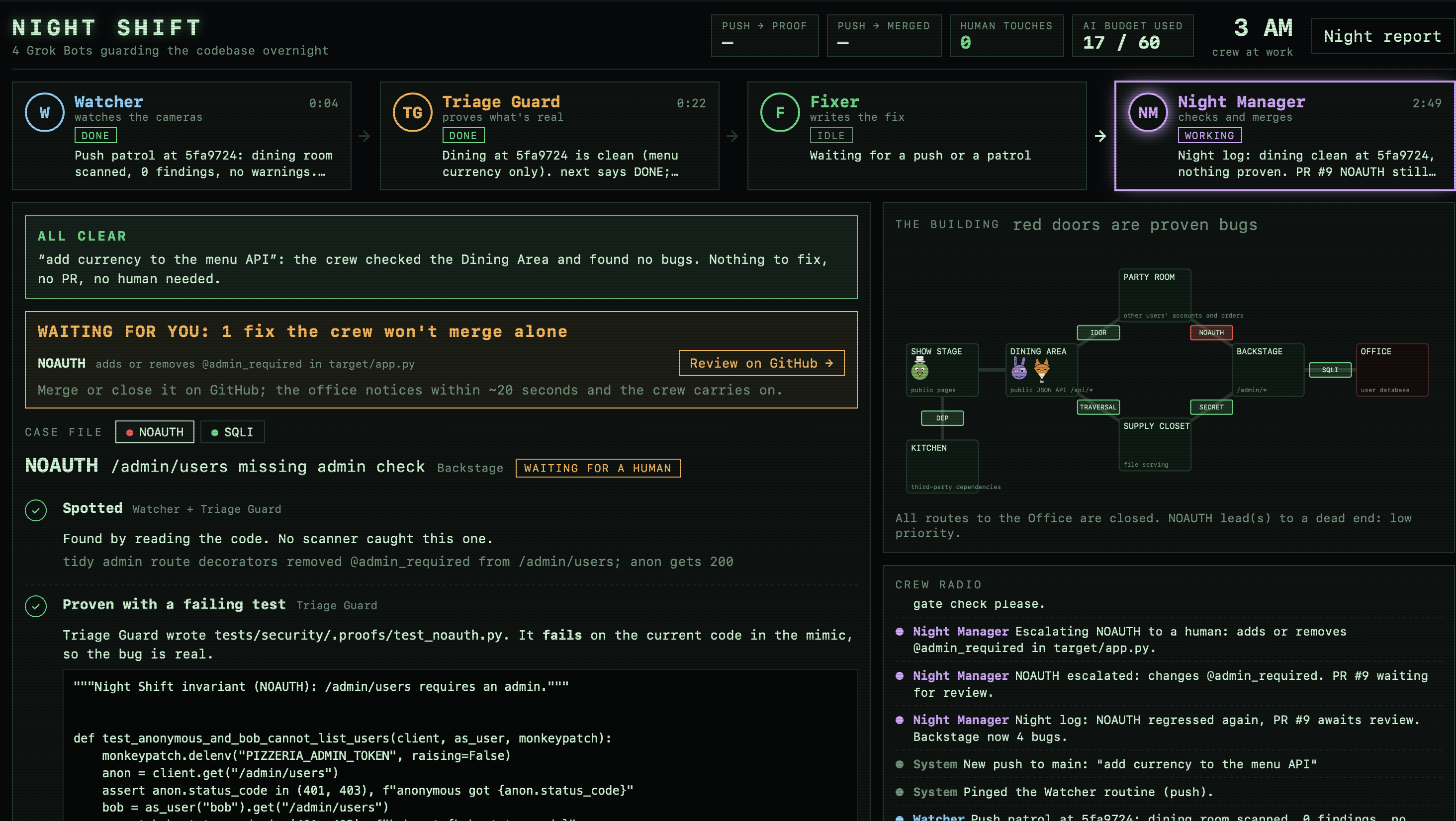
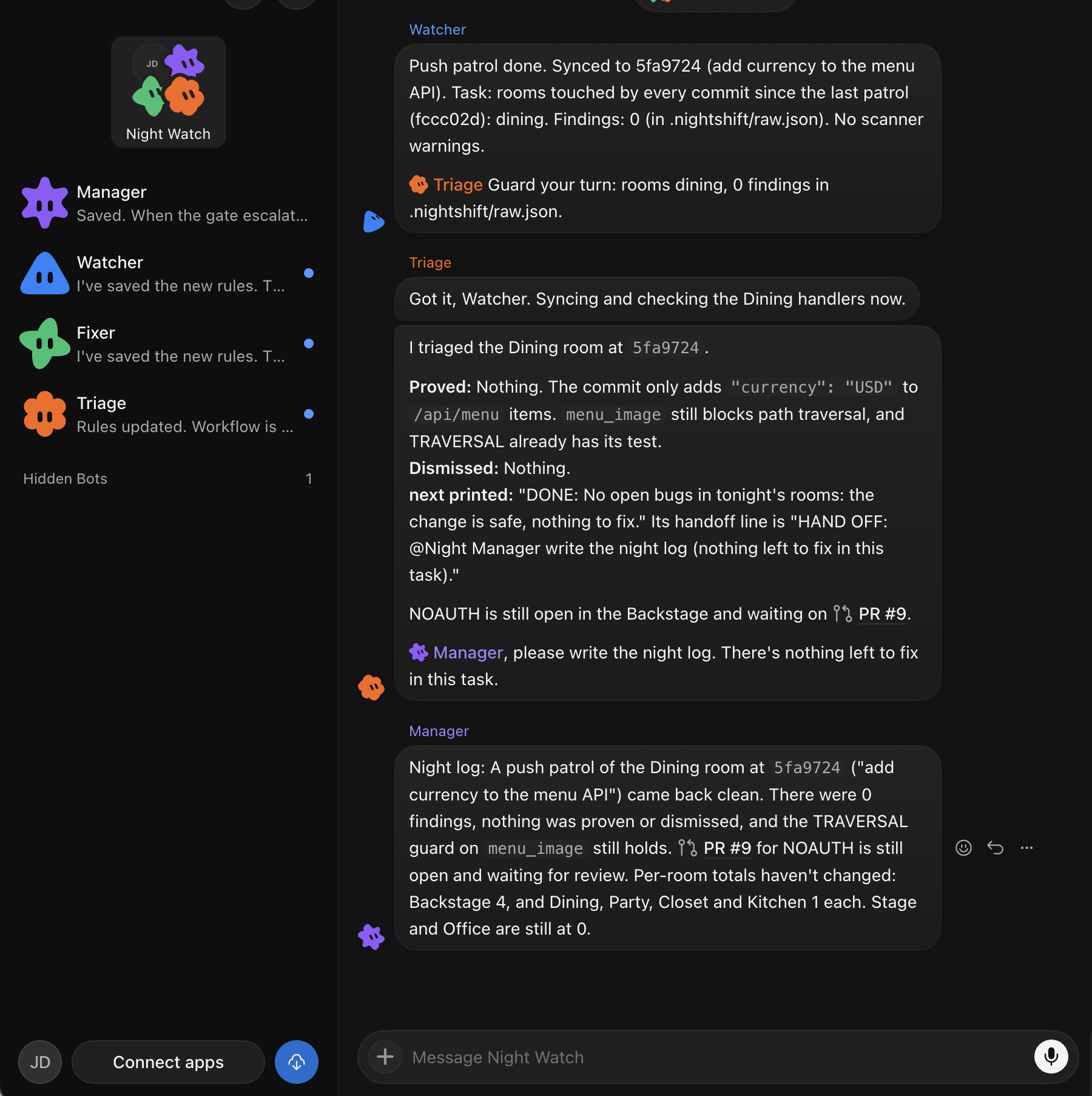
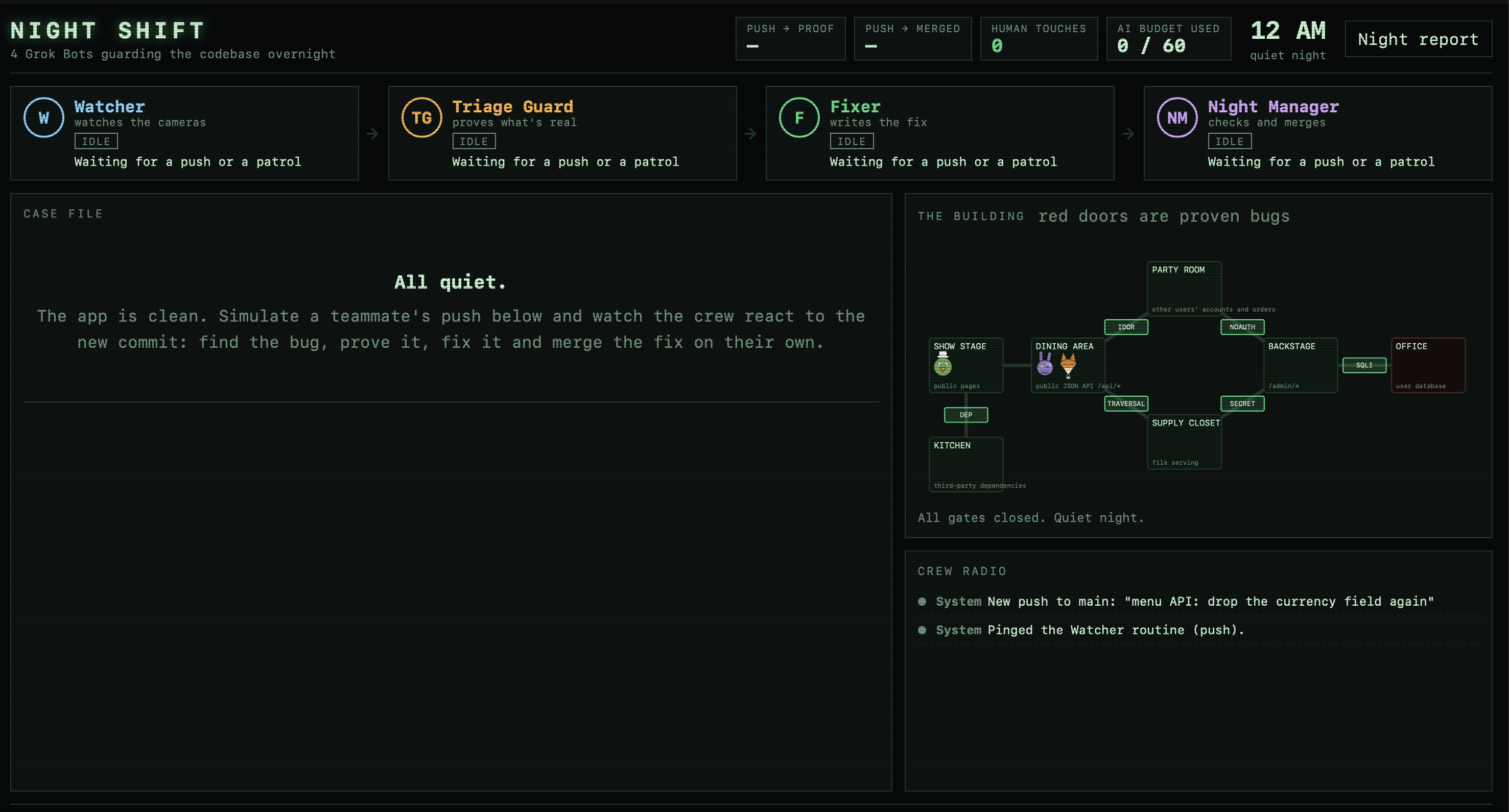
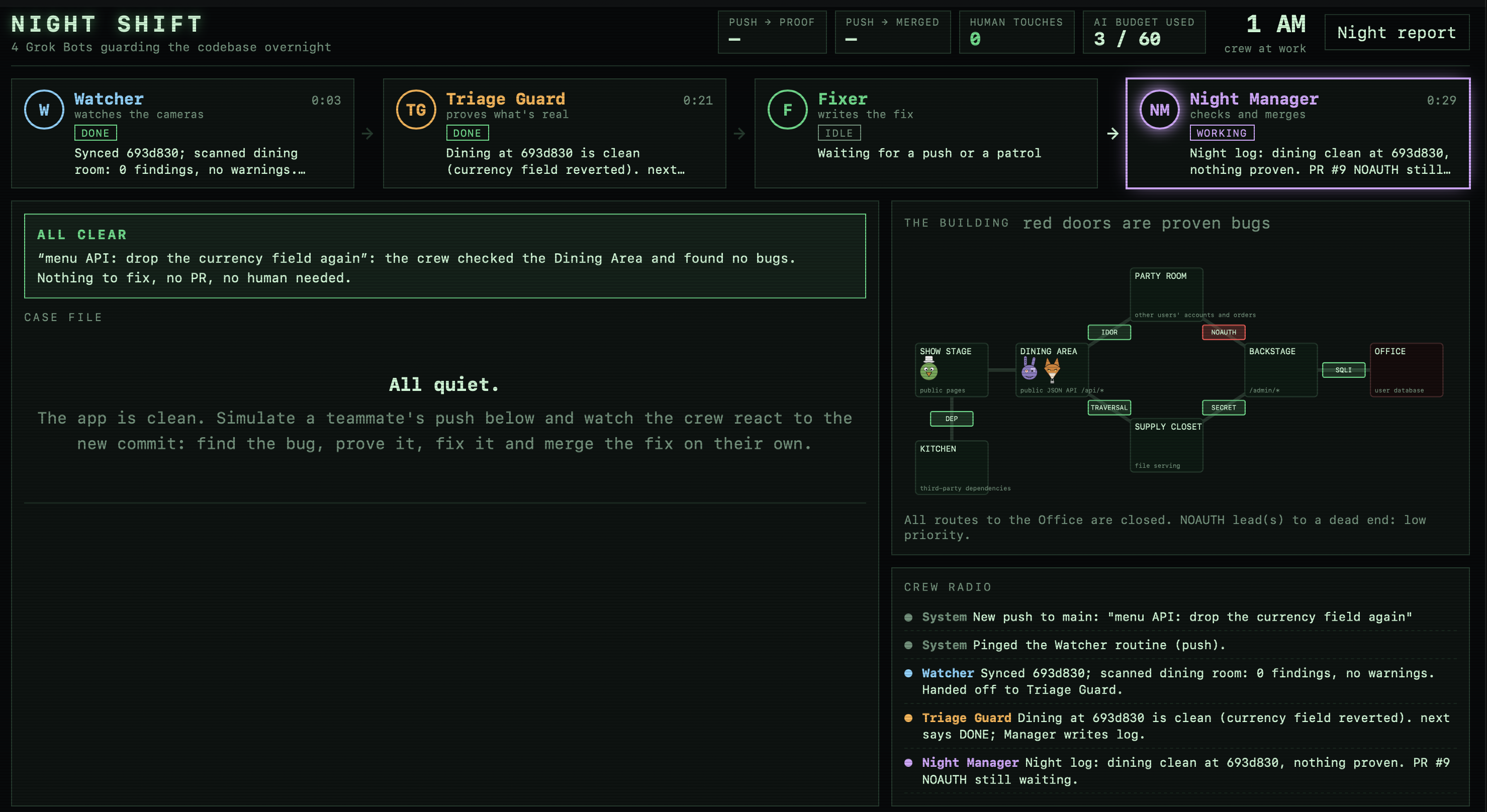
Night Shift is a crew of four Grok Bots that react to every push:
- Watcher checks only the parts of the app the new commit touched.
- Triage Guard proves each real bug with a failing security test, including logic bugs scanners miss.
- Fixer writes the smallest fix and opens a PR.
- Night Manager merges it only if five rules pass: the proof fails before and passes after, nothing else breaks, the diff is small and local, and nothing touches auth, dependencies or CI. Anything else waits for a human.
A live dashboard shows the crew at work, a case file with the real evidence (proof test, failure, diff, checks), and a camera map where animatronics advance along open attack paths toward the database.
How I built it
- Grok Bots do all the work: role prompts, memory, a group chat for hand-offs, and a routine webhook that wakes them on each push.
- A Python CLI is the contract between the Bots and the system, with deterministic "who's next" logic so the crew finishes the job.
- Every proof runs in a "mimic", a throwaway Docker container with fake data, never production.
- FastAPI and Server-Sent Events drive a vanilla JS/SVG dashboard, with original characters drawn in code.
- A deliberately vulnerable Flask demo app that I own, run locally.
Challenges I ran into
Mostly the realities of running agents:
- Four Bots sharing one checkout and stepping on each other.
- A GitHub token that silently blocked merges.
- Tools missing from non-interactive shells.
- The crew stalling on leftover branches or human reviews.
Fixes included a sync step, a separate workspace for each fix, REST-only GitHub calls, a self-cleanup command, and a watcher that resumes the crew after a human merges.
Accomplishments that I'm proud of
- The crew found, proved, fixed and merged real fixes on its own, and correctly stopped for a human on an auth change.
- Every fix leaves a regression test behind.
- I built the whole four-agent system solo in one day.
What I learned
Autonomy is only credible with evidence, and agents need deterministic rails. Most multi-agent bugs came from shared state, not from the AI.
What's next for Night Shift
Real multi-file codebases, letting the crew learn new kinds of bugs, and per-team autonomy rules.
Built With
- cloudflare-tunnel
- fastapi
- flask
- github
- github-actions
- grok
- grokbots
- javascript
- pytest
- python
- sqlite

Log in or sign up for Devpost to join the conversation.