-
-
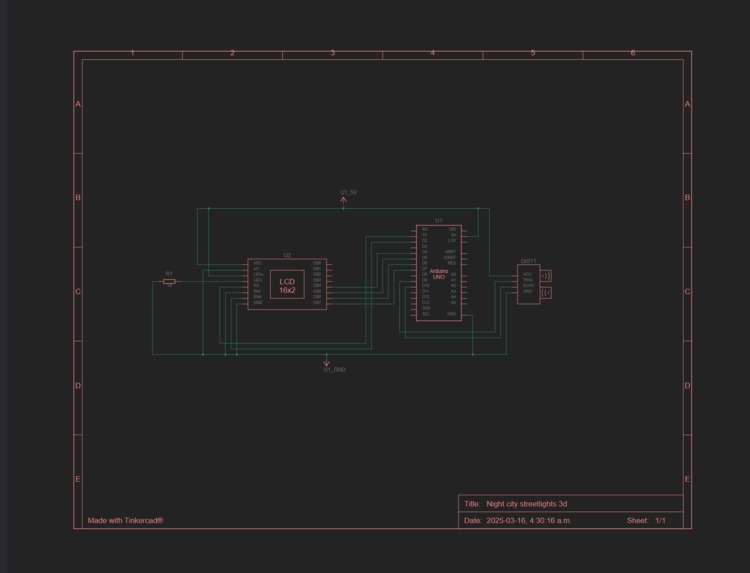
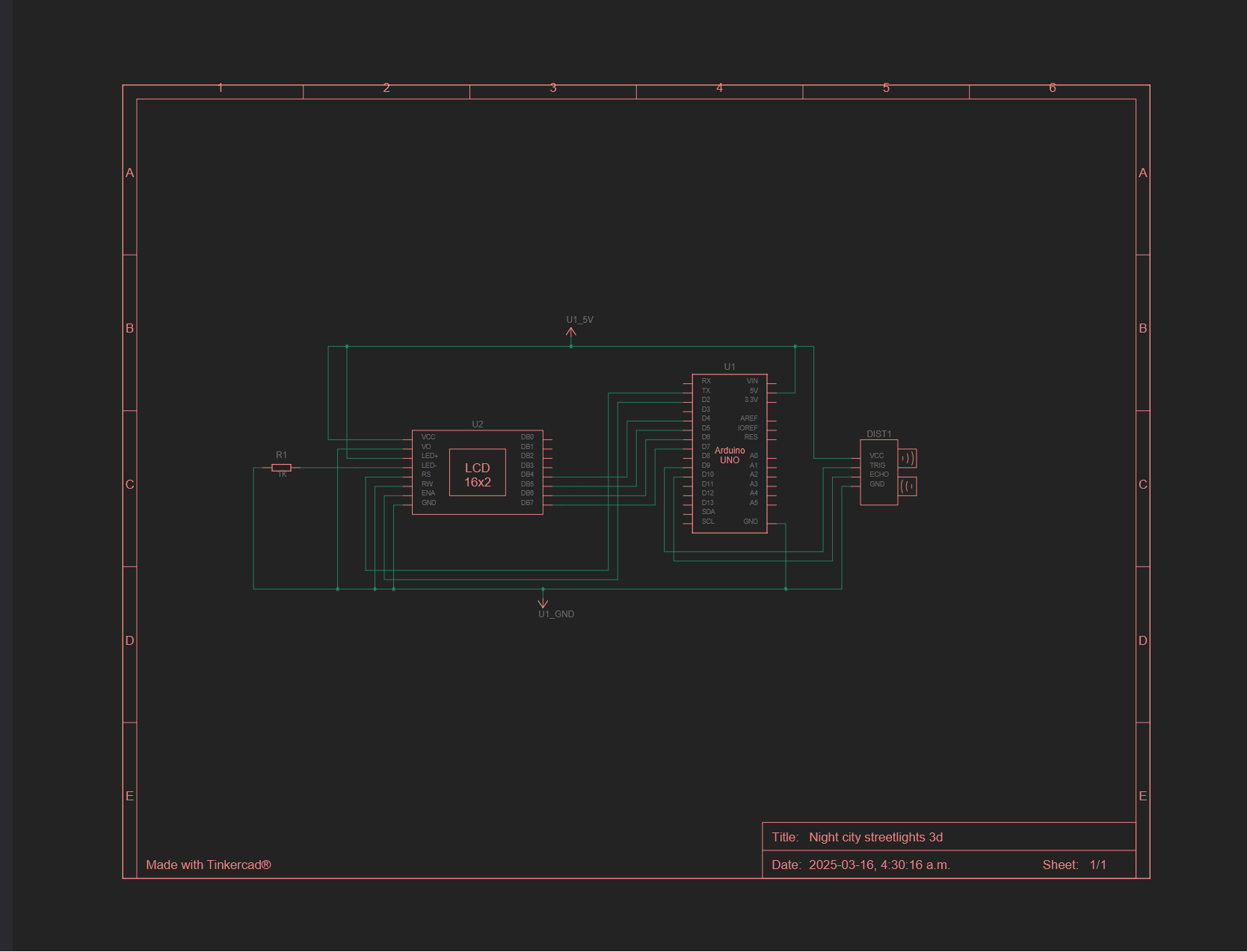
schematic
Did you know that street lighting can account for up to 40% of a city’s electricity usage? (Source: U.S. Department of Energy (DOE) – DOE LED Roadway & Street Lighting)
Traditional streetlights remain at full brightness all night—even when no one is present—wasting energy, taxpayer dollars, and contributing to unnecessary CO₂ emissions. Our Innovative Solution
We have developed a motion-based street lighting system that only brightens when needed, cutting energy waste and reducing environmental impact. How It Works
Components:
Ultrasonic Sensor: Detects motion by measuring distance.
Arduino Controller: Processes sensor data to decide whether to activate the lights.
LED Bulbs: Efficient lighting that adjusts brightness.
Servo Mechanism (Optional): Extends a lamp (rotating 180°) when motion is detected from a farther lane.
Operation:
When motion is detected within a set threshold (e.g., less than 125 cm), the bulbs instantly switch to full brightness (or the lamp extends).
When no motion is detected, the bulbs dim to 30% brightness (or retract), conserving energy.
Implementation Simplicity:
Utilizes widely available hardware and open-source code.
Straightforward wiring and programming allow for rapid, scalable deployment.
Real-Life Benefits & Sustainability
Energy Savings:
70–80% reduction in energy usage per lamp compared to traditional always-on street lighting.
(Source: DOE reports on LED retrofit projects – DOE LED Roadway & Street Lighting)
Cost Reduction:
Potential annual savings of $300,000–$500,000 for mid-sized cities by reducing wasted electricity.
(Source: Municipal retrofit case studies (EPA & Energy Star programs) – EPA Green Lighting)
Carbon Footprint Reduction:
Up to 60–80% decrease in CO₂ emissions from street lighting operations.
(Source: EPA estimates on energy efficiency improvements – EPA Energy Efficiency)
Resource Efficiency:
Reduced strain on power grids and lower fossil fuel consumption, leading to overall environmental benefits.
Future Enhancements & Scalability
IoT Integration & Smart Grids:
Connect every streetlamp into a city-wide network to monitor real-time data (traffic, weather, air quality) and dynamically adjust lighting levels.
(Source: IEEE Smart Grid Research)
Predictive Maintenance with AI:
Use machine learning algorithms to predict component failures and schedule maintenance before issues occur, reducing downtime and repair costs.
(Source: International Energy Agency Reports on Smart Maintenance)
Renewable Energy & Local Storage:
Integrate solar panels and battery systems to power streetlights autonomously—cutting grid dependency and further reducing carbon emissions.
(Source: IEA Solar Energy Outlook)
Emergency Response Enhancement:
Enable streetlights to automatically brighten along emergency routes, assisting first responders and even communicating with autonomous vehicles for safer navigation.
Community Energy Trading:
Transform streetlights into nodes of a microgrid that trade excess energy back to the community, generating revenue and reinforcing sustainable energy use.
Augmented Reality for Maintenance:
Implement AR tools to help maintenance crews quickly diagnose and fix issues, reducing maintenance costs and downtime.
Conclusion & Impact
Recap: “Our motion-based street lighting system isn’t just about saving energy—it’s about transforming urban infrastructure to be smarter, safer, and greener.”
Memorable Impact Statement: “Imagine a city where only the necessary lamps shine—saving hundreds of thousands of dollars, reducing millions of kilowatt-hours of energy, and preventing thousands of tons of CO₂ emissions each year.”
Call to Action: “Join us in revolutionizing urban lighting. Let’s light up our cities intelligently and create a sustainable future for everyone!”

Log in or sign up for Devpost to join the conversation.