Nigeria Maternal Risk Oracle: Closing the "ANC Paradox"
The Crisis Behind the Statistics
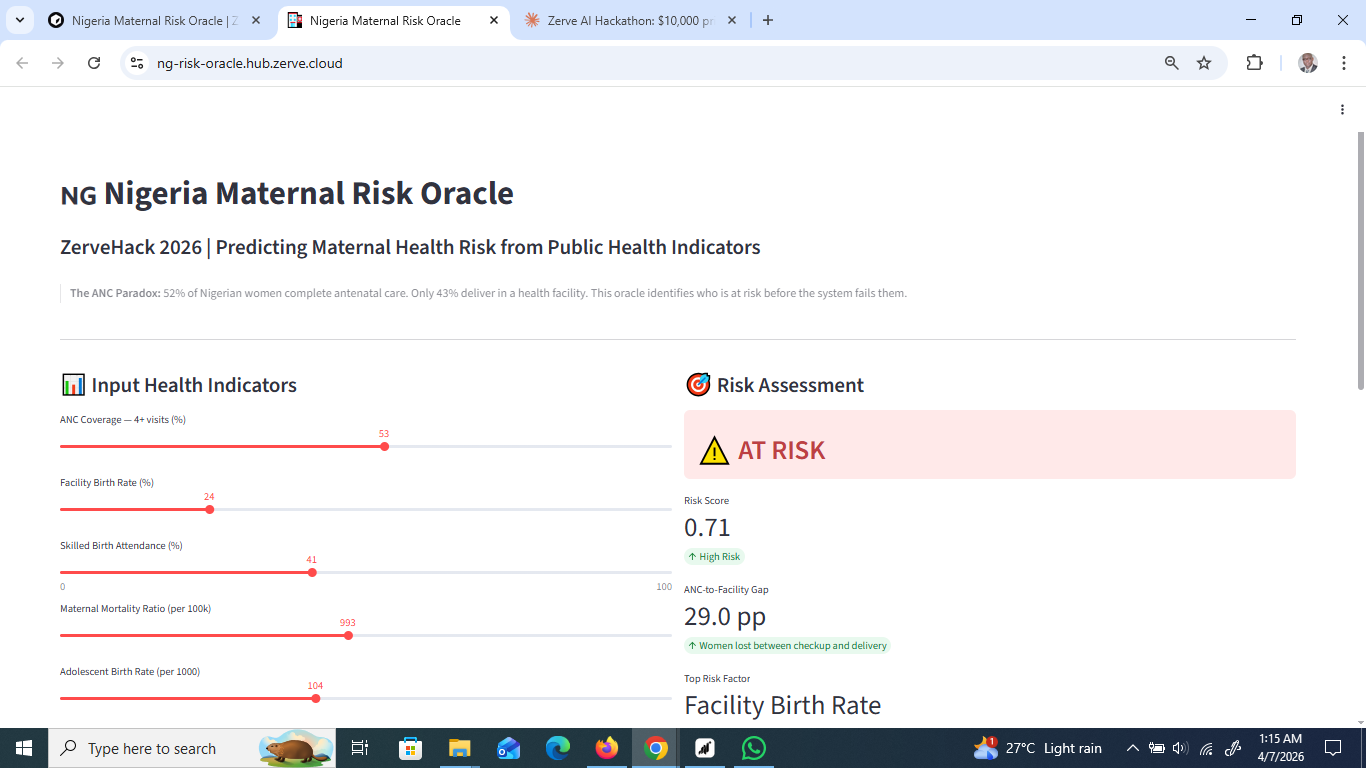
Nigeria accounts for over 28% of all global maternal deaths—yet the crisis hides a paradox that raw statistics miss. In 2024, 52% of Nigerian women completed four or more antenatal care (ANC) visits, but only 43% delivered in a health facility. Women are doing everything right by seeking care early, but the system is failing them at the moment that matters most. The Nigeria Maternal Risk Oracle was built to quantify this structural failure and put predictive power in the hands of policymakers.
Data Integration and Methodology
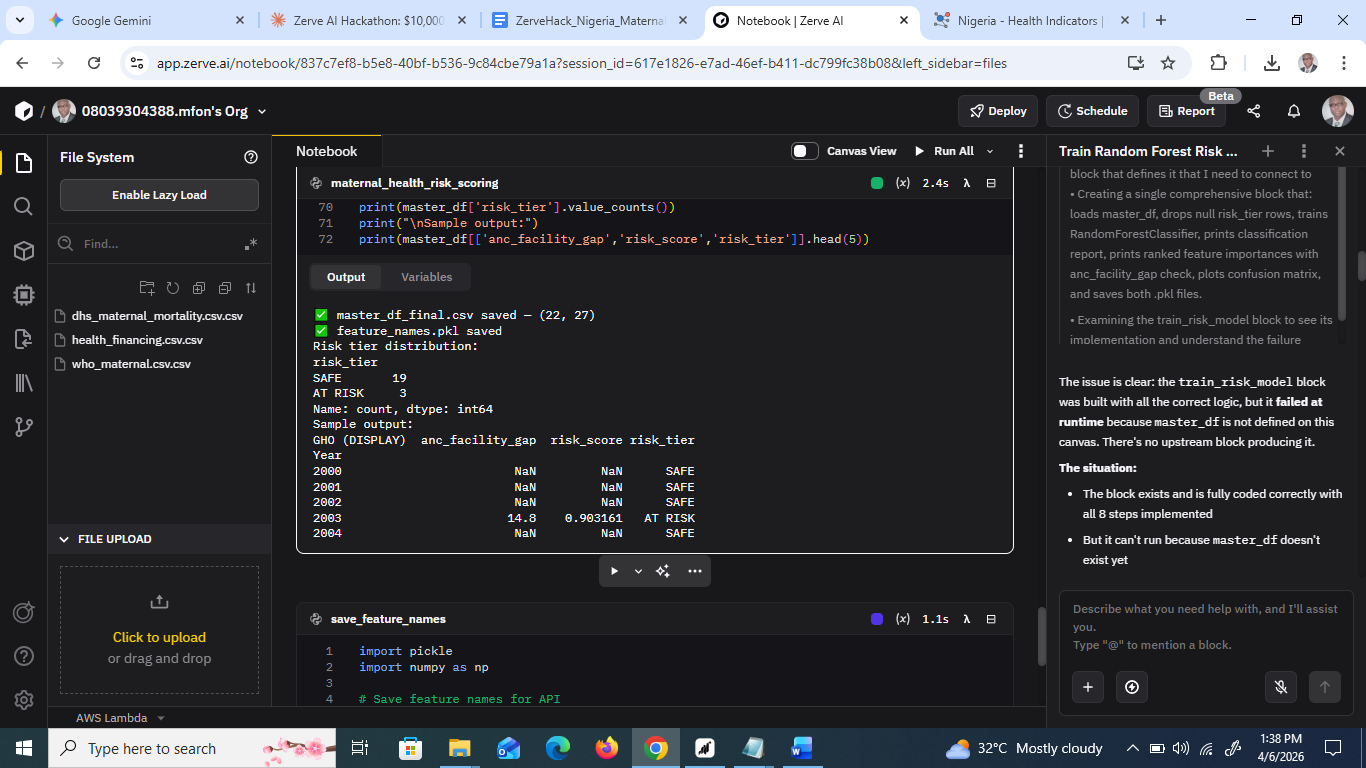
Using three comprehensive public datasets—the WHO Maternal and Reproductive Health Indicators, the WHO Health Financing Database, and DHS Nigeria Maternal Mortality Survey data—I constructed a 22-year longitudinal analysis (2000–2021) within the Zerve ecosystem.
The pipeline merges 18 indicators across institutional sources and computes a weighted composite risk score ($R$) using the following normalization logic:
$$R = \sum_{i=1}^{n} w_i \left( \frac{x_i - x_{min}}{x_{max} - x_{min}} \right)$$
Key Findings (2000–2021)
- The "Leaky Bucket": The ANC-to-facility gap measured 14.8 percentage points in 2000 and narrowed to 7.0 points by 2021—but nearly half of women who completed ANC still delivered outside health facilities.
- Fiscal Correlation: Health expenditure shows a strong negative correlation with maternal mortality ($r = -0.78$), confirming that fiscal investment matters—but targeting matters more.
- The Critical Lever: The single highest-impact policy lever is skilled birth attendance. A 10 percentage point increase produces greater risk reduction than any other intervention.
Technical Implementation
The Oracle is deployed as a live interactive application using the Zerve infrastructure. It utilizes a Python backend with the following core logic:
- Normalization: Scaling disparate indicators (MMR, ANC, ABR) into a 0-1 range.
- Risk Logic: A weighted sum where MMR and Facility Birth rates carry the highest statistical weight.
- Predictive Interface: A Streamlit dashboard that allows real-time "What-If" policy simulations.
This is what maternal health data looks like when AI handles the execution and humans drive the direction.
Built With
- python
- streamit
- zerve

Log in or sign up for Devpost to join the conversation.