-
-
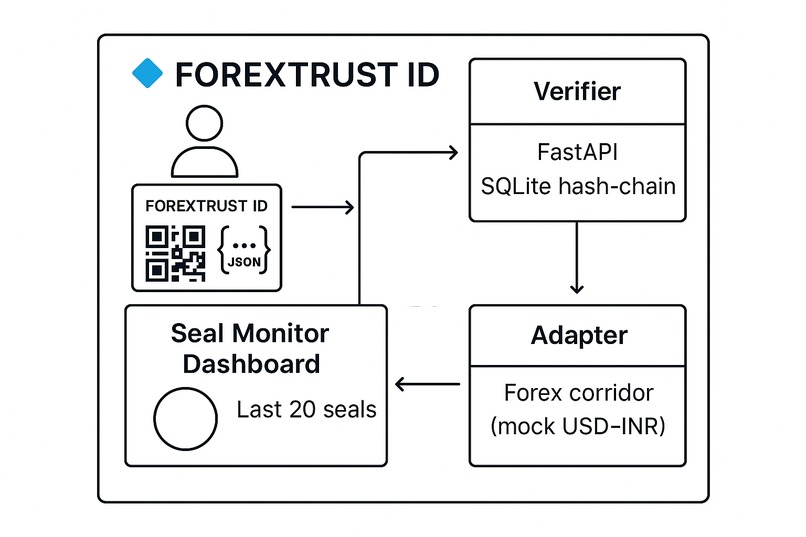
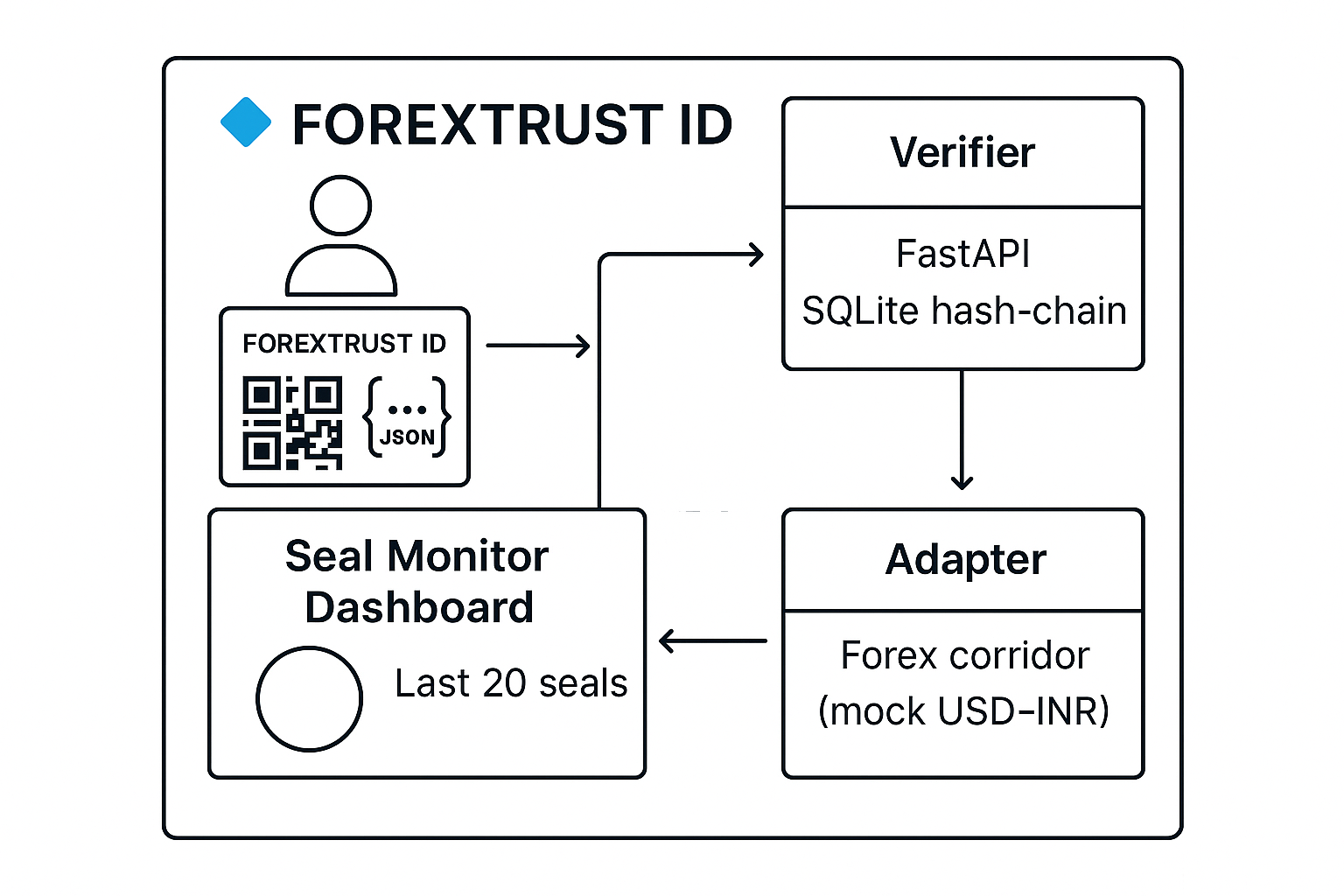
“System flow showing FastAPI → SQLite → Plotly Dash integration for trust event verification.”
-
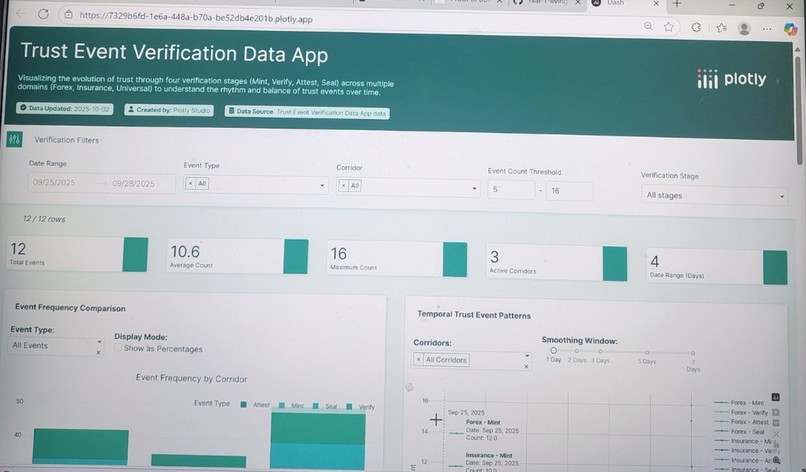
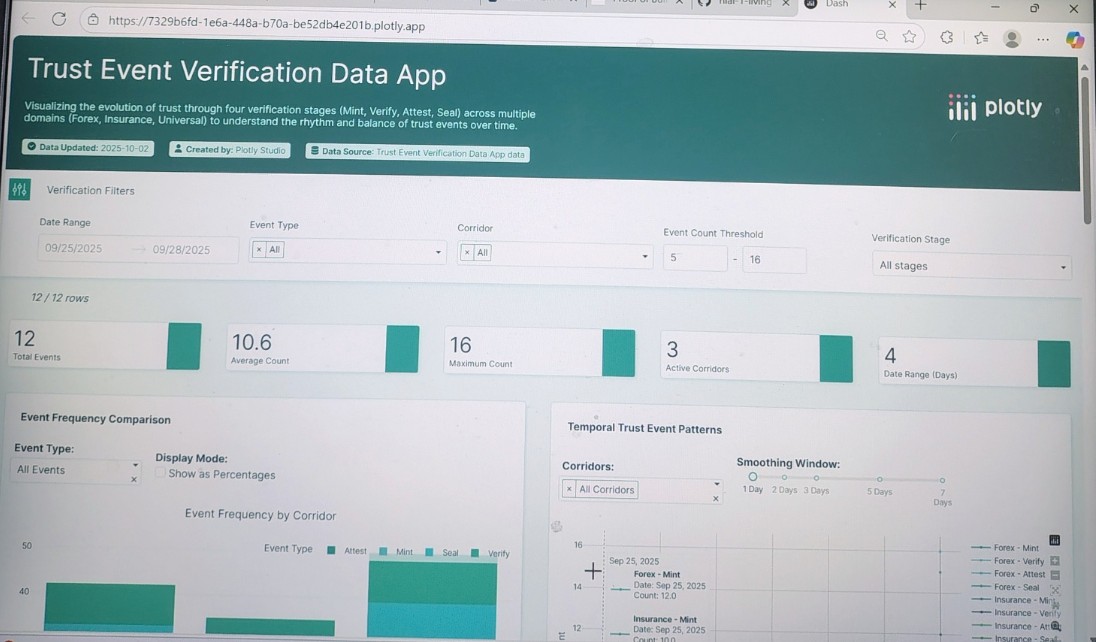
“Live Plotly dashboard visualizing Mint → Verify → Attest → Seal cycles across trust corridors.”
-
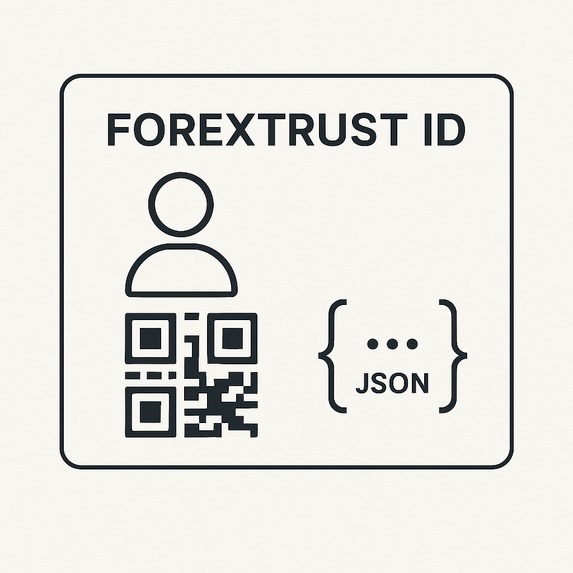
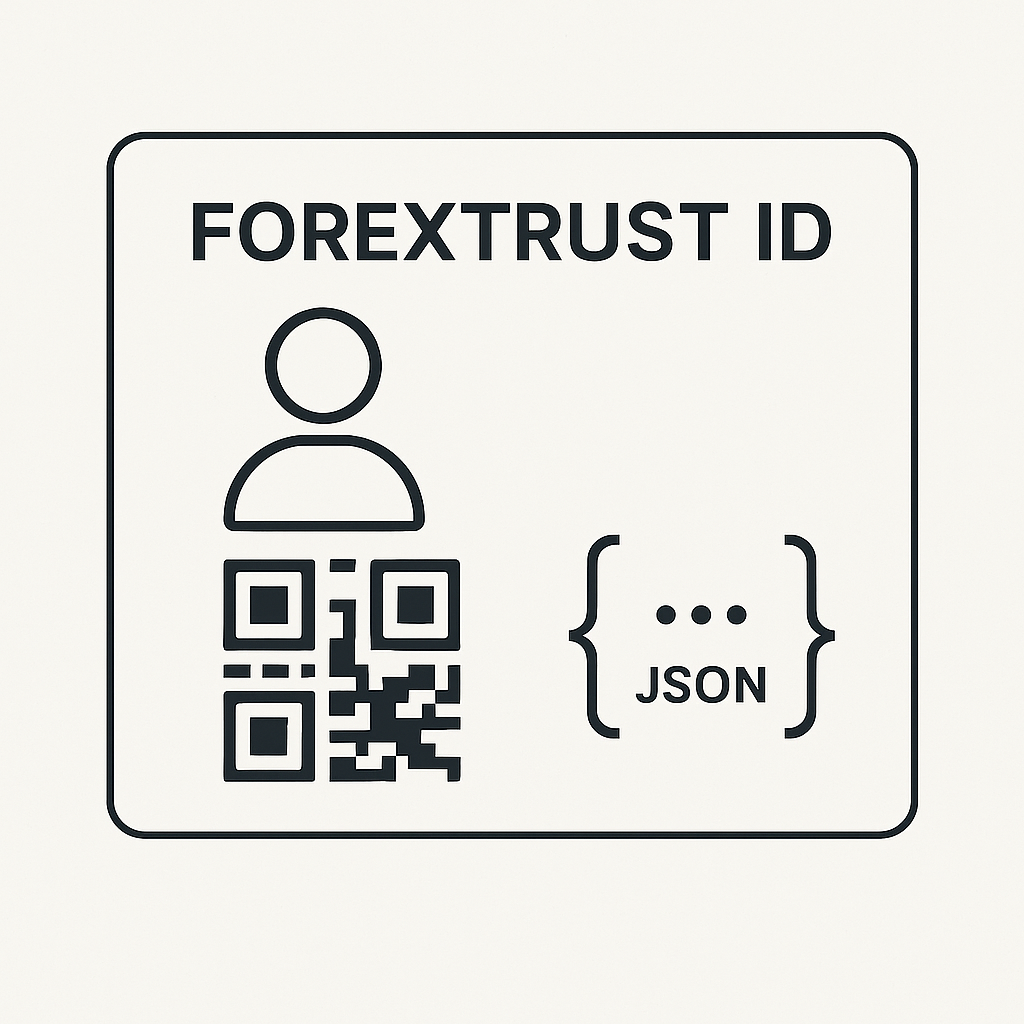
“Prototype of the Living TrustSeal — a digital credential proving verified AI–human integrity.”
Inspiration
In an age ruled by automation, trust has become humanity’s most fragile currency. NIAI-1 was inspired by the idea that intelligence must not only be powerful — it must be verifiable.
Our goal was to build an AI-NI trust framework that records and visualizes integrity events between humans and machines. Every ethical decision, every verified action, becomes a Living Trust Event — sealed and visualized in real time.
What it does
NIAI-1 — The Living Trust Assistant transforms trust into a living, measurable signal between humans and machines.
It allows any AI-driven action — from financial transactions to data verification — to pass through a verifiable sequence:
Mint → Verify → Attest → Seal → Visualize
Each action becomes a TrustSeal, a cryptographic proof of integrity that is stored in a local ledger and rendered as live data through a Plotly dashboard.
The FastAPI backend generates and validates each seal in real time.
The SQLite ledger maintains an immutable record of all trust events.
The Plotly dashboard visualizes these events — showing trust growth, validation depth, and inter-corridor transparency.
The Render deployment makes the framework accessible as an open, web-based trust service.
In essence, NIAI-1 acts as a moral telemetry system — giving data a heartbeat of integrity, and machines a visible conscience.
How we built it
We built NIAI-1 — The Living Trust Assistant as a full-stack trust verification loop that anyone can reproduce locally or deploy to the cloud.
FastAPI powers the backend, handling endpoints for /mint, /verify, and /health, turning every transaction into a cryptographic TrustSeal.
SQLite3 serves as the lightweight ledger that permanently stores corridor, hash, and attestation data.
Plotly Dash provides the real-time visualization layer — plotting trust events as they unfold, creating a living graph of verifiable actions.
Render Cloud hosts the backend, while Plotly Cloud delivers the interactive data app.
Everything is bound together through a clear mint → verify → visualize cycle, ensuring transparency at every step.
Each piece was designed to demonstrate that ethical transparency can be encoded into system design itself — not added later as policy.
Challenges we ran into
Data Synchronization: Bridging live updates between the API, ledger, and dashboard while maintaining consistency across multiple threads.
Storage Constraints: Optimizing the SQLite ledger for minimal latency during continuous seal writes and verifications.
Deployment Limits: Managing Render’s resource ceilings and environment configuration while keeping the build lightweight and reproducible.
Ethical Translation: Expressing “trust” — a human, abstract concept — in technical form without reducing its meaning.
Integration Testing: Maintaining stability between FastAPI and Plotly Dash servers running concurrently in separate processes.
Despite these challenges, every obstacle reinforced our core lesson:
Integrity isn’t just a principle — it’s an architecture.
Accomplishments that we're proud of
Built a fully functional AI–NI trust framework from scratch — integrating backend, ledger, and visualization within 72 hours.
Designed the first working prototype of a Living Trust Assistant — where every machine action can be verified by humans.
Deployed a public Render API and Plotly Dashboard that demonstrate verifiable trust data in real time.
Created a new philosophical model — bridging Natural Intelligence (NI) and Artificial Intelligence (AI) through measurable integrity.
Released v1.0-Hackathon on GitHub as an open, transparent public artifact — ready for future researchers and developers to build upon.
Aligned our mission with the Infinity Code ethos — proving that technology and ethics can evolve together.
What we learned
Integrity can be engineered — not just expected.
Natural Intelligence (NI) can guide Artificial Intelligence (AI) through transparent accountability.
Minimal code can achieve maximum ethical traceability when design follows moral intent.
What's next for NIAI-1 — The Living Trust Assistant
Integrate Google Cloud Attestation Engine for distributed validation.
Expand into multi-corridor trust systems — Finance, Health, Education.
Build the NI-AI Kernel: a universal trust substrate for human–machine ethics.
Connect with civic and ethical AI ecosystems to open-source “Integrity by Design.”

Log in or sign up for Devpost to join the conversation.