-
-
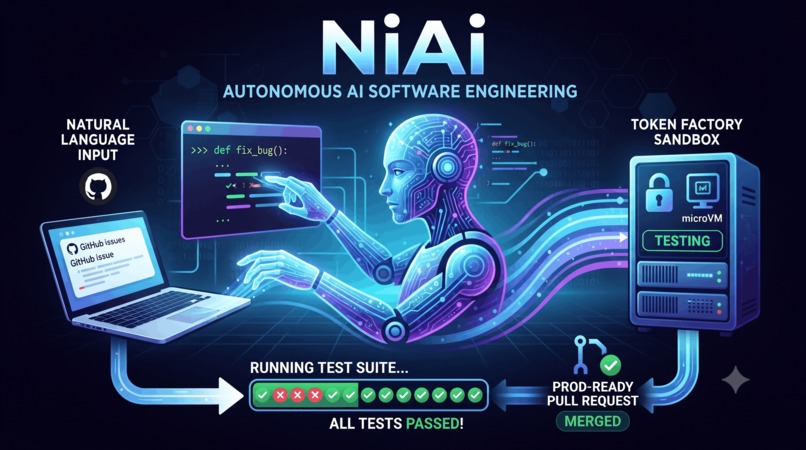
NiAi
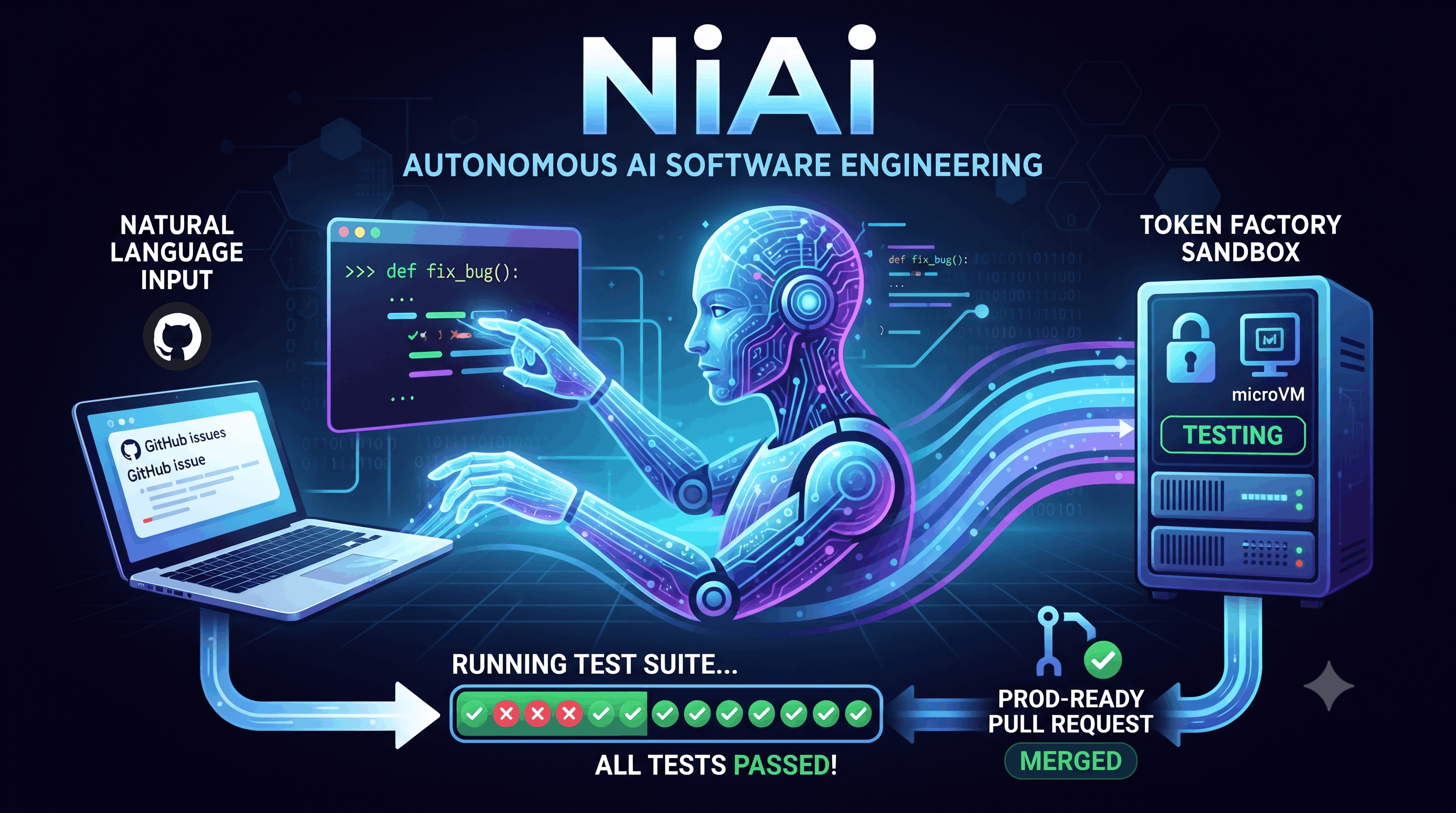
Inspiration The inspiration behind NiAi stemmed from a recurring bottleneck in modern software engineering: while large language models are exceptional at generating isolated snippets of code, transitioning from a natural language feature request or bug report to a fully tested, production-ready pull request remains a fragmented, human-in-the-loop chore. Developers spend countless hours context-switching between writing code, spinning up local containers, debugging failing test suites, and handling tedious boilerplate.
We envisioned a system where an AI agent acts as a genuine autonomous teammate—one that doesn't just suggest lines of code, but actively clones repositories, provisions secure cloud sandboxes, executes test suites, diagnoses stack traces, and self-heals until the code is robust and ready for deployment.
What it does NiAi acts as an autonomous AI software engineer that ingests natural language feature requests, bug reports, or GitHub issues and transforms them into fully tested, production-ready code changes inside secure cloud sandboxes.
Provisions Ephemeral Sandboxes: Automatically spins up isolated microVM environments complete with required runtimes, dependencies, and git-like version control.
Executes Intelligent Code Loops: Employs specialized agent capabilities (shell execution, AST-based file inspection, and patch application) to write and modify source code iteratively.
Performs Self-Healing Testing: Runs native test suites (pytest, jest, etc.), catches failing stack traces, feeds the error diagnostics directly back into its reasoning loop, and refines the code until all tests pass.
Delivers Verified Pull Requests: Packages the final, verified solution into clean commits or pull requests ready for human code review.
How we built it NiAi is built around a secure, modular agent loop powered by cloud-native execution environments. The core architecture comprises three primary pillars:Agent Orchestration & Reasoning Core: Built on top of advanced LLM reasoning pipelines, NiAi interprets complex technical specifications, breaks them down into atomic engineering tasks, and manages iterative execution loops.Token Factory Sandbox Integration: To ensure absolute safety and reproducibility, every task runs inside an isolated, ephemeral microVM sandbox. The agent leverages core capabilities such as:$$\mathcal{C} = {\text{Shell}, \text{Filesystem}, \text{Memory}, \text{Git Branching}}$$Autonomous Feedback Loops: Unlike stateless code generators, NiAi actively runs test suites (such as pytest, jest, or custom build targets) and feeds stdout/stderr directly back into its context window, allowing it to perform automated debugging cycles:$$\text{Error Feedback} \longrightarrow \text{State Analysis} \longrightarrow \text{Patch Generation} \longrightarrow \text{Re-verification}$$
Challenges we ran into Building a truly autonomous coding agent introduced several difficult engineering hurdles:
Handling Context Pollution and Hallucinations: Early iterations of the agent occasionally attempted to modify non-existent files or misinterpreted complex dependency trees when codebase sizes scaled. We overcame this by implementing strict AST-based file inspection tools and modular memory retrieval.
Sandbox Security and Network Isolation: Allowing an agent to execute arbitrary code requires rigorous sandboxing. Ensuring that cloud execution environments remained completely isolated while still permitting necessary package installations (e.g., via pip, npm) required fine-tuning egress controls and snapshot lifecycles.
Deterministic Test Interpretation: Parsing ambiguous test failures across diverse testing frameworks required building robust output parsers to classify failures into syntax errors, logic bugs, or environment issues accurately.
Accomplishments that we're proud of Successfully engineered a closed-loop autonomous developer agent that bridges natural language requirements with production-grade code execution.
Integrated secure, ephemeral cloud microVM sandboxes that safely isolate arbitrary code execution while supporting essential package managers and build tools.
Developed reliable automated test feedback loops that empower the agent to self-heal, parse stack traces, and iteratively fix failing test suites without human intervention.
Implemented a clean git-like branching and snapshot state machine enabling safe experimentation, rollback capabilities, and reproducible task runs.
What we learned Tool Use Trumps Raw LLM Intelligence: Giving an agent specialized, deterministic tools (like targeted file patching and isolated shell execution) yields significantly better results than relying solely on the model's parametric memory.
The Importance of Fast Feedback Loops: The tighter the loop between code modification and test verification, the faster the agent self-corrects. Reducing sandbox spin-up latency was vital to overall agent performance.
State Management is Key: Maintaining a clean git-like branching model inside the sandbox allows the agent to experiment fearlessly, rollback failed refactors, and maintain a pristine history.
What's next for NiAi Multi-Agent Collaboration: Expand NiAi from a single autonomous agent to a multi-agent team where specialized roles—such as an architect agent, a coding agent, a QA tester agent, and a security reviewer agent—collaborate on complex, multi-file pull requests.
Deep IDE & GitHub Integrations: Build native extensions for VS Code and GitHub Apps that automatically trigger NiAi sandboxes directly from issue comments or pull request reviews.
Advanced Memory & Context Graphs: Implement persistent vector memory and codebase-wide AST knowledge graphs to let the agent reason across massive enterprise codebases with minimal token overhead.
Optimized Sandbox Performance: Further drive down microVM initialization latency and incorporate smarter caching for container dependencies to make the test-and-repair loop nearly instantaneous.
Built With
- and
- ast-based
- branching
- build
- custom
- file
- git-like
- inspection
- jest
- management
- patch-application
- python-and-advanced-llm-reasoning-pipelines-cloud-native-microvm-sandboxes-and-token-factory-execution-environments-automated-test-runners-(pytest
- snapshot
- state
- targeted
- targets)
- tools

Log in or sign up for Devpost to join the conversation.