-
-
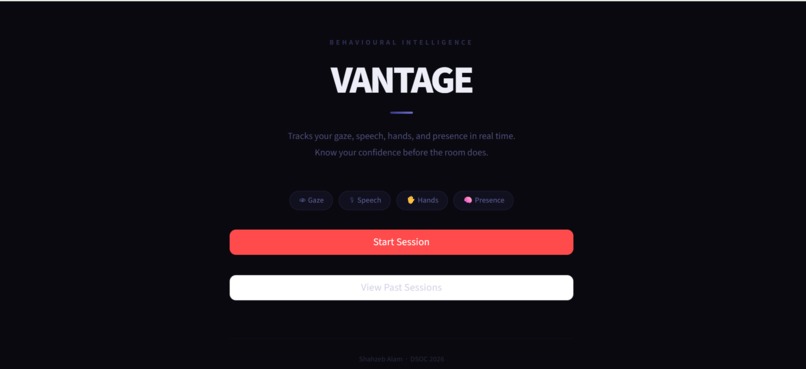
Main page
-
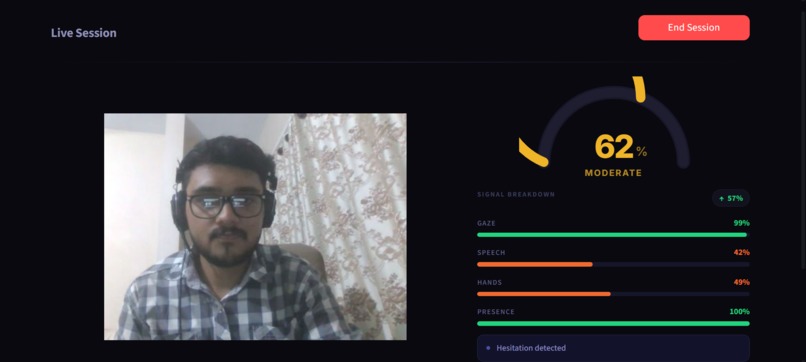
Live Detection

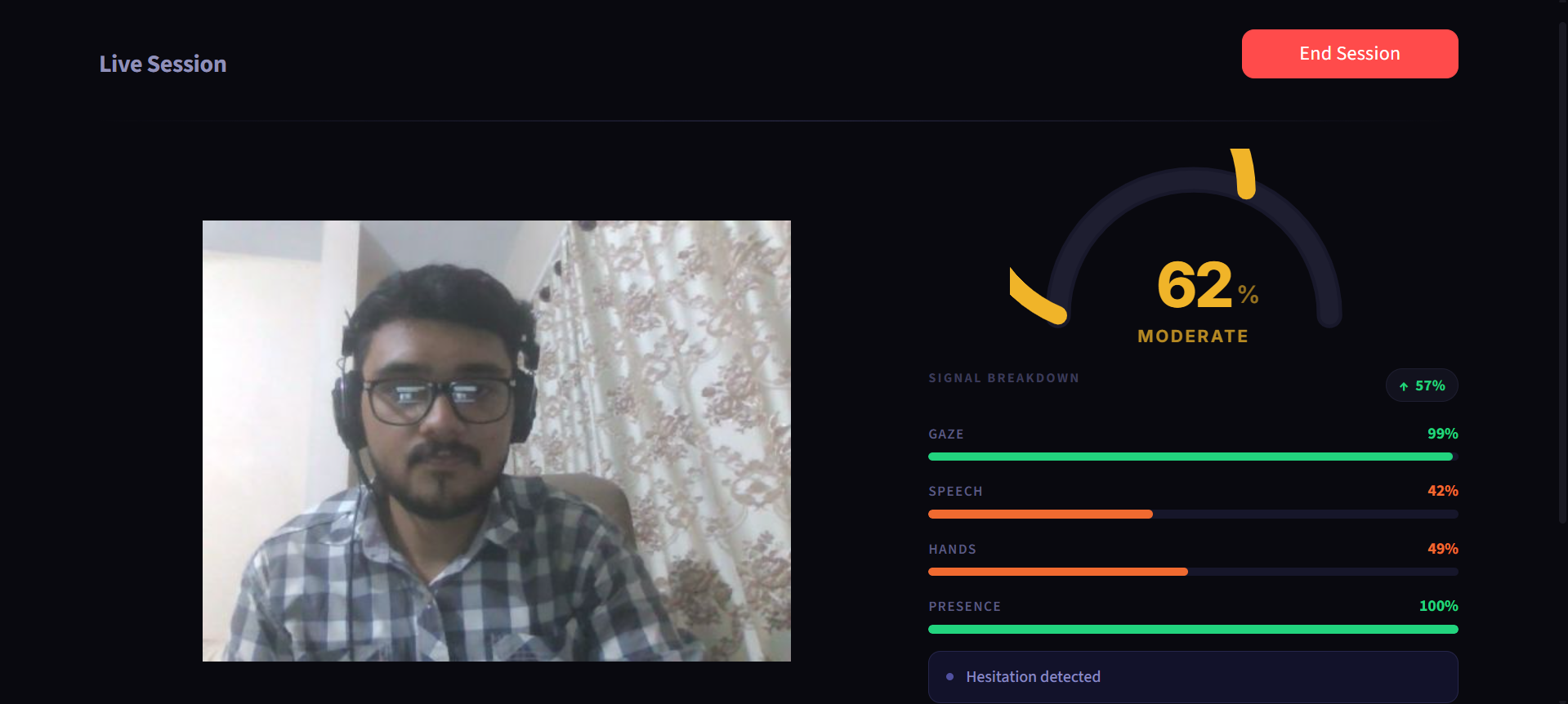
Vantage AI
Inspiration
While preparing for placement interviews, I realized that technical knowledge alone was not enough. During mock interviews, even when I knew the correct answers, my delivery lacked visible confidence. As someone more on the introverted side, maintaining steady eye contact, controlled gestures, and smooth speech under pressure was difficult.
This led to a core question:
Can confidence be measured as observable behavioral stability rather than a subjective feeling?
Instead of relying on human feedback alone, I wanted to build a system that provides measurable, real-time behavioral insights. That idea became Vantage AI.
What it does
Vantage AI is a real-time behavioral confidence analysis system that evaluates three observable signals:
- Eye stability
- Gesture smoothness
- Speech decisiveness
These signals are fused into a unified confidence score that updates in real time, giving the user immediate feedback on their behavioral confidence.
How we built it
The system was built using:
- Python
- OpenCV for real-time camera input
- MediaPipe Face Landmarker for facial and iris tracking
- MediaPipe Hands for gesture detection
- NumPy for feature computation
- Streamlit for UI deployment
Eye tracking
We computed eye positions relative to stable facial landmarks so that head movement would not falsely reduce the stability score. This allowed the system to detect actual eye movement accurately.
Gesture smoothness
Hand motion was tracked and measured for consistency. Sudden jerks or irregular gestures were detected, while smooth movements contributed positively to the confidence score.
Speech decisiveness
Using microphone input, the system detected pauses and hesitation during speech. Longer pauses reduced the confidence score, while smooth, continuous speech increased it.
Challenges we ran into
Head movement interference Initially, moving the head caused the eye stability score to drop incorrectly. Anchoring eye positions relative to the nose solved this.
Sensitivity calibration Small changes in thresholds drastically affected system behavior. Fine-tuning required multiple real-world tests.
Multi-directional eye detection Detecting left, right, up, and down eye movements reliably was tricky. Switching to iris landmarks improved accuracy.
Real-time performance Running face tracking, hand tracking, and UI updates together needed careful optimization to maintain smooth performance.
Environment and deployment issues We faced Python version conflicts, MediaPipe compatibility issues, virtual environment misconfigurations, and Streamlit deployment warnings. Debugging dependencies took significant effort.
Accomplishments that we're proud of
- Real-time multi-modal behavioral analytics system
- Head-compensated eye tracking
- Gesture smoothness computation
- Speech hesitation detection
- Clean, minimal Streamlit interface
What we learned
- Behavioral metrics are highly sensitive to calibration
- Real-time AI systems require balancing responsiveness and stability
- User experience simplicity matters as much as algorithm complexity
- Deployment challenges can be as demanding as technical challenges
- Confidence can be reframed as measurable stability rather than emotion
What's next for Vantage AI
- Personalized baseline calibration for each user
- Session analytics with historical tracking
- Improved speech modeling using lightweight NLP
- Ethical bias auditing
- Cloud deployment with secure session storage
Vantage AI began as a personal attempt to improve interview confidence. It evolved into a behavioral analytics system that reframes confidence as measurable stability.

Log in or sign up for Devpost to join the conversation.