-
-
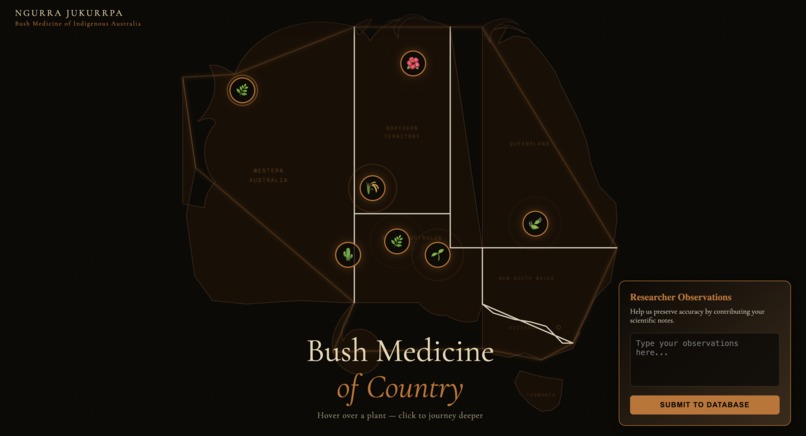
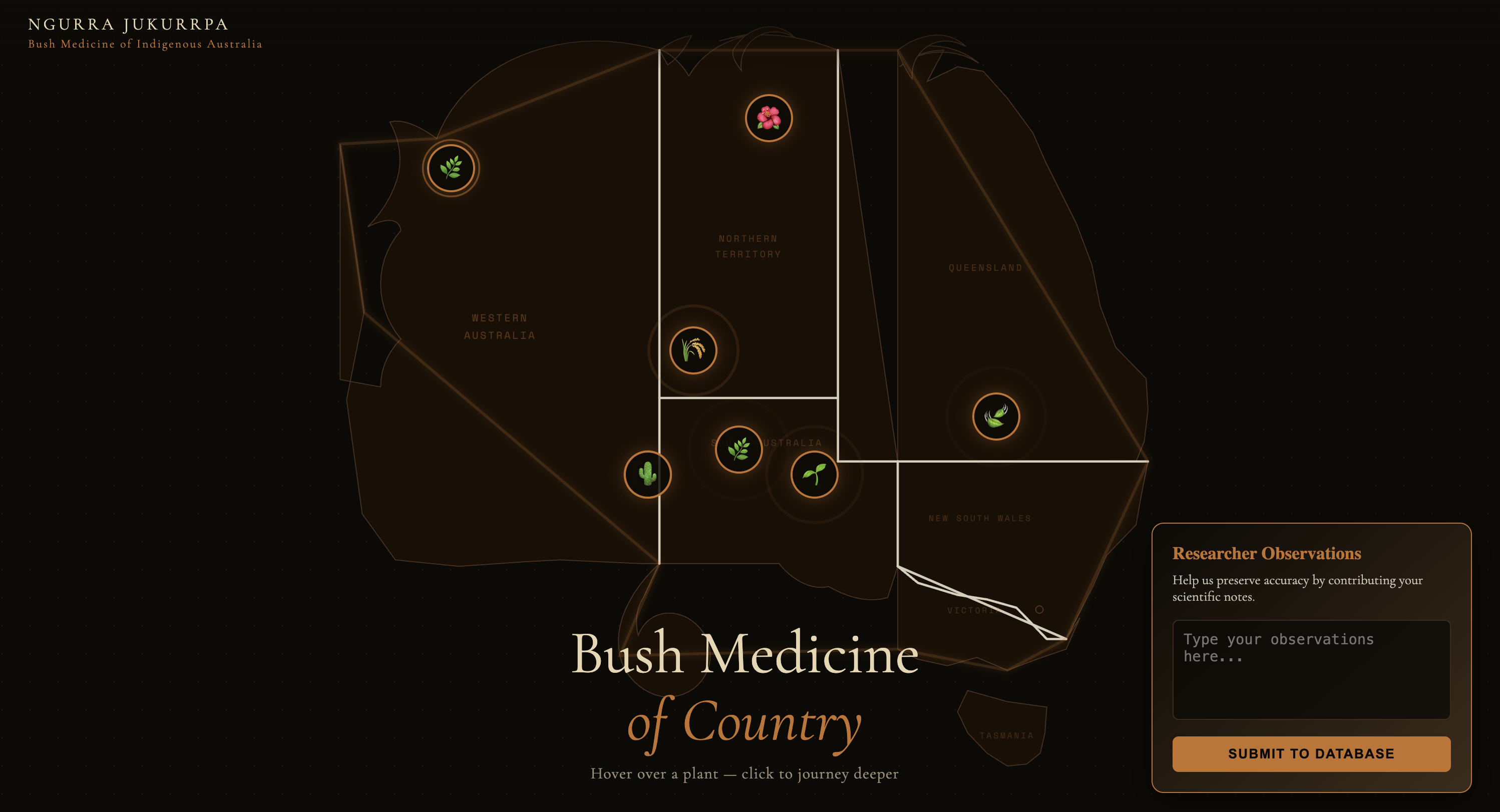
Our website headpage
-
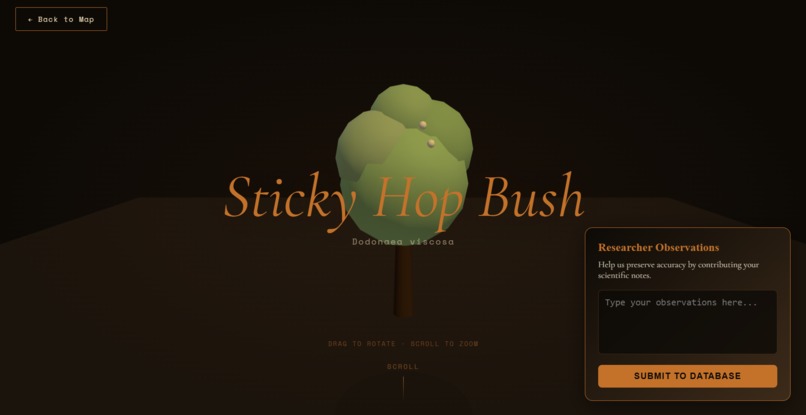
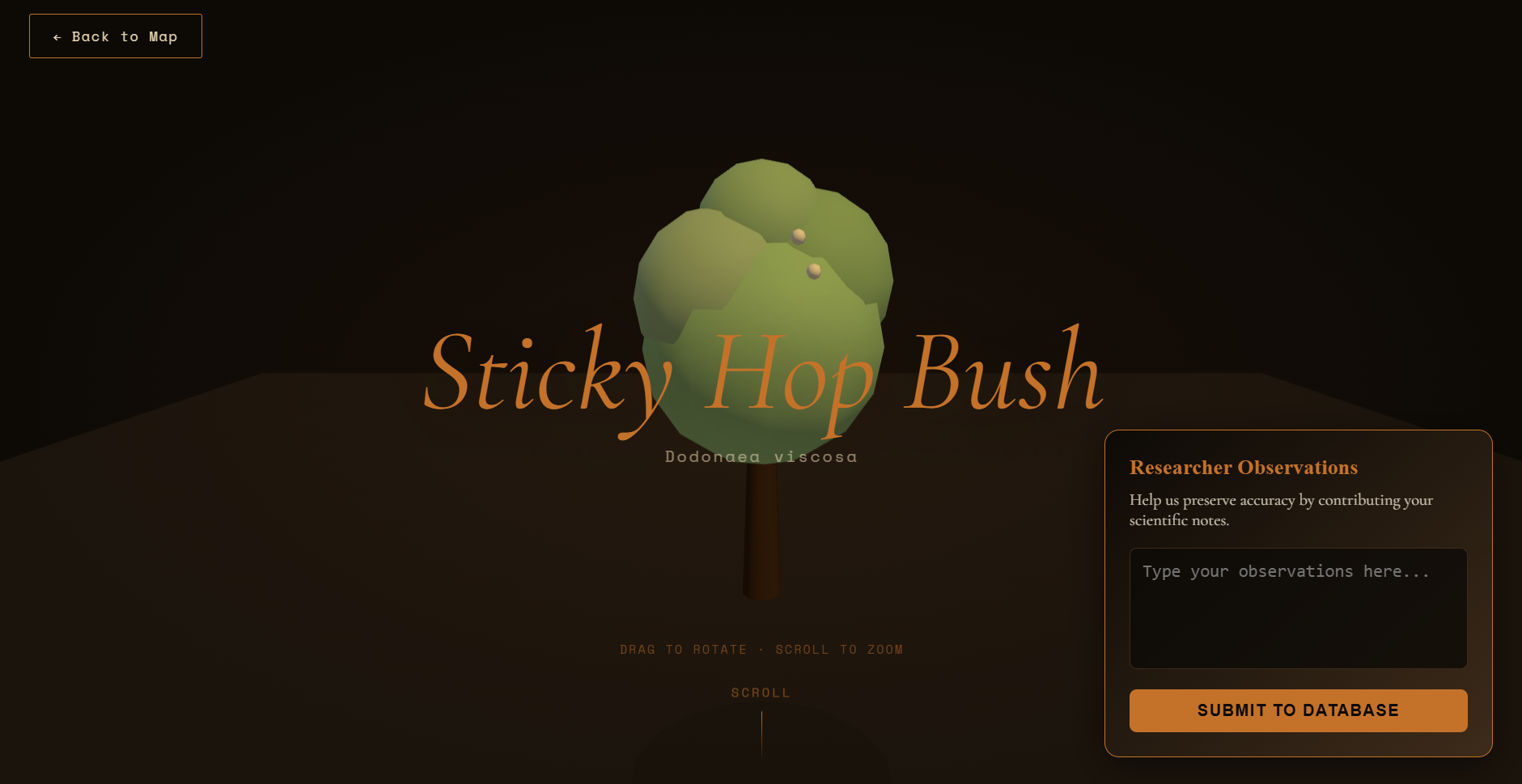
Header for plant description
Inspiration
Australia’s First Nations people have maintained the longest continuous living culture on Earth, underpinned by a sophisticated understanding of botanical science. We were inspired by the concept of "Country as a Pharmacy." We wanted to move away from static textbooks and create a living, interactive map that honors the connection between specific geographic regions, ancestral stories (Jukurrpa), and the practical application of bush medicine.
What it does
Ngurra Jukurrpa is an interactive 3D ethnobotanical atlas. Users navigate a stylized digital map of Australia to discover "Plant Pins." Selecting a pin transports the user into a high-fidelity detail view featuring:
- 3D Botanical Models: Real-time rendered plant structures built with Three.js.
- Traditional Prep Visualizer: A dedicated module explaining how specific parts (bark, leaves, resin) are processed, whether through smoke inhalation, topical salves, or infusions.
- Cultural Records: A fusion of oral histories and documented botanical surveys to provide a holistic view of the plant’s significance.
How we built it
We utilized a modern web stack to ensure the experience felt premium and fast:
- Three.js: To create the immersive, interactive 3D plant models.
- TypeScript: To architect a robust PlantData structure that manages complex medicinal instructions and geographic coordinates.
- SVG Mapping: A custom-traced map of Australia using geographic coordinates to ensure cultural regions were represented accurately.
Challenges we ran into
The biggest challenge is to make sure the links between the typescript files are smooth and make-sense to the reader. We tried our best to deploy our coding skills to present the bush medicine data in a way that is both scientifically accurate and culturally sensitive. Breaking a huge html file into managable typescript components allow later scaling of bush medicine data convenient and accessible. Another challenge is to do in-depth researches of as many bush medicine as possible. While we are ambitious and wanted to create a interactive digital library of mush medicine, we recognised that within the competition time it is better to focus on improving the ways to present the bush medicine information.
Accomplishments that we're proud of
We are particularly proud of modeling these medicines in a fun, abstract, and sculptural way. Rather than using traditional clinical photography, we developed a Three.js-powered visual language that represents each plant’s "essence", consisting of its form, color, and healing energy. We hope that those abstract shapes will evoke curiosity and make Indigenous botanical science feel fresh and approachable for a digital-native generation, like us. Our abstract models focus on the vibrant RGB profiles and unique geometries (like the "paperbark" or "berry-tree" forms). This mirrors the way Jukurrpa (Dreaming) stories often use symbolism to convey deep truths. The ability to rotate, zoom, and interact with these "digital totems" turns a library into an exploration, making the complex preparation methods feel like a rewarding discovery rather than a lecture.
What we learned
We have learned that bush medicine is a philosophy of reciprocity: humans originate from the land, are nurtured by its fruits, and are healed by its chemistry. However, the presence of toxins in these plants serves as a vital reminder of nature’s raw power—the power to both heal and destroy. This duality is what forged the unbreakable bond of respect between Aboriginal tribes and the Mother Land. By digitizing this library, we aren't just archiving data; we are celebrating a 65,000-year-old relationship that teaches us that to heal the person, we must first respect the Country. It is also the first time we tried to use Three.js to create a fun 3D rotating object, and we are loving them.
What's next for Ngurra Jukurrpa - Bush Medicine
- Search function that enables easy search of a plant based on its name, shape, or medical characteristics
- Seasonal Mapping: Updating the map to show which plants are "in season" or ready for harvest based on the six-season Indigenous calendars. of course, 3D interactive modelling will be there to revive the rhythm of natural bush medicine with their growing seasons.
- AR Integration: Allowing users to place the 3D plant models in their real-world environment via WebXR.
- Collaborative Database: Expanding the "Researcher Observations" feature to allow community Elders and botanists to contribute knowledge directly to the platform.
- Incorporate rigorously validated scientific evidence and clearly label connections to Western medical practices, enabling integrated cross‑medical treatment pathways that reduce cultural barriers.
Built With
- github
- googleform
- html
- javascript
- typescript
- vercel
- vscode

Log in or sign up for Devpost to join the conversation.