-
-
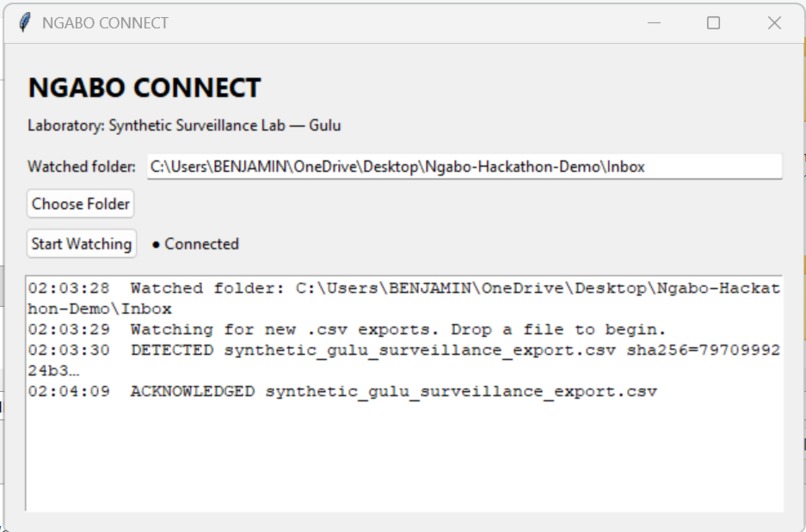
The Desktop Application
-
The Web Dashboard
Inspiration
I’m from Uganda, and while researching antimicrobial resistance (AMR), I became interested in what happens after a microbiology laboratory has already done its job. In 2019, bacterial AMR was estimated to be associated with around 31,000 deaths, with about 7,110 deaths directly attributable to resistance.
Hospitals already generate valuable microbiology results. A laboratory can culture a patient specimen, identify the bacteria present, and test which antibiotics it is susceptible or resistant to. Those results can then contribute to AMR surveillance.
But producing the laboratory result is only the beginning.
Turning routine microbiology data into useful surveillance still involves work across different people and systems: laboratory systems such as ALIS or WHONET, file exports, data-quality checks, analysis, investigation, reporting, email, hospital committees, and national surveillance structures.
What stood out to me was how much of the workflow still depends on people acting as the glue between those steps.
Someone has to make sure new data reaches the surveillance workflow. Data has to be checked and prepared. Surveillance has to be updated. Someone has to notice when a resistance pattern deserves attention. The finding then has to be investigated, supported with evidence, communicated to the right people, and followed up.
That led me to a simple question:
What if routine microbiology could continuously produce surveillance without somebody having to manually push the workflow forward at every step?
That became Ngabo.
What it does
Ngabo is an autonomous antimicrobial-resistance surveillance and coordination system.
The laboratory keeps doing microbiology.
Ngabo starts after the laboratory has produced a governed digital surveillance output.
Once configured, Ngabo can take that workflow forward automatically:
Lab output → Collect → Validate → Monitor → Detect → Investigate → Verify → Coordinate → Acknowledge
When new laboratory surveillance data appears, Ngabo can:
- detect the new data automatically;
- preserve the original source for traceability;
- prevent the same batch from being processed twice;
- validate the incoming data;
- standardize known, approved values;
- quarantine anything it cannot safely understand instead of guessing;
- update the surveillance state;
- monitor for meaningful resistance patterns;
- automatically start an investigation when a qualifying signal appears;
- analyze the underlying records;
- use Google ADK and Gemini where reasoning is useful;
- retrieve approved supporting evidence;
- assemble an investigation package;
- deterministically verify the model’s claims;
- check whether a safe coordination action is allowed;
- send that coordination;
- and confirm that the receiving system actually acknowledged it.
The core design principle is:
High system autonomy. Low model authority.
Gemini can help reason about ambiguity and synthesize evidence, but it cannot decide microbiology truth, diagnose a patient, prescribe treatment, declare an outbreak, or authorize its own actions.
The model proposes. Deterministic code verifies.
For the public hackathon demonstration, Ngabo uses governed synthetic laboratory-surveillance data. It does not use real patient records and does not claim a live hospital or ALIS integration.
How we built it
We built Ngabo as an event-driven system on Google Cloud.
A major architectural decision was to separate the parts of the workflow that benefit from AI reasoning from the parts where the answer should be deterministic.
For scientific and safety-sensitive operations, Ngabo uses deterministic application logic. This includes things such as:
- data validation;
- approved normalization rules;
- duplicate and replay protection;
- resistance-signal calculations;
- freshness checks;
- claim verification;
- action policy;
- idempotency;
- and acknowledgement validation.
For parts of the investigation where structured reasoning is useful, Ngabo uses Google Agent Development Kit (ADK) and Gemini.
The autonomous investigation works roughly like this:
- A deterministic surveillance signal starts the workflow.
- Ngabo runs deterministic investigation branches over the relevant surveillance data.
- Gemini performs bounded triage to determine which approved evidence would be useful.
- Ngabo retrieves that evidence from approved sources.
- Gemini creates a structured investigation-package candidate.
- Deterministic code checks whether the claims are actually supported.
- Ngabo verifies that the underlying surveillance data has not changed.
- Deterministic policy decides whether a safe coordination action is allowed.
- The action is persisted before delivery so retries cannot accidentally create duplicate actions.
- The receiving system returns a machine-verifiable acknowledgement.
- Only then can Ngabo mark the workflow as completed.
For the Connect layer, Ngabo uses a small laboratory-side client to watch for new governed exports, a durable local queue for reliability, authenticated cloud ingestion, Cloud Storage for immutable raw source files, and Firestore for structured surveillance and workflow state.
The goal is that once the laboratory’s normal workflow produces new surveillance data, the data itself becomes the trigger.
Challenges we ran into
One of the hardest challenges was deciding what the AI should not be allowed to do.
It would have been much easier to send microbiology data to Gemini and ask it what was happening.
But in a health-surveillance system, that would give the model too much authority.
So we designed Ngabo around a different principle:
LLM proposes; deterministic machinery verifies whatever can be verified before a claim is allowed to influence autonomous action.
That created several engineering challenges.
We had to make sure the model could not:
- invent evidence references;
- silently change microbiology values;
- describe unsupported claims as facts;
- confirm an outbreak;
- recommend a prescription;
- claim that its own output had been verified;
- or authorize its own external action.
Another difficult problem was retries.
Event-driven systems can receive the same event more than once. If Ngabo simply repeated an external action every time an event was retried, that could be dangerous.
We therefore built deterministic identities, durable action intents, dispatch leases, replay protection, and acknowledgement checks so that retrying a workflow does not mean repeating the real-world action.
A different challenge was understanding the actual AMR surveillance workflow.
Early in the project, it was tempting to simplify the problem into something like “microbiologists manually clean spreadsheets.”
The real workflow is much more nuanced.
Different responsibilities belong to laboratory staff, AMR focal persons, data personnel, facility surveillance structures, reference laboratories, and national coordination teams.
Researching that workflow changed how we designed the product.
Ngabo is not trying to automate microbiology.
It is trying to automate the human glue between routine microbiology output and continuously useful surveillance.
Accomplishments that we're proud of
The part I’m most proud of is that Ngabo is not just a chatbot sitting next to a database.
It is designed as an autonomous workflow.
Once the triggering surveillance data arrives, the system can move through investigation, evidence gathering, verification, safe coordination, and acknowledgement without requiring somebody to continuously prompt it or click “Continue.”
We are also proud of the safety architecture.
Instead of making Gemini the final authority, we built explicit boundaries around it:
Gemini reasons. Deterministic code decides.
Ngabo can reject unsupported claims, block clinical or outbreak-authority language, re-check whether the underlying data is still current, prevent duplicate external actions, and require a verified machine acknowledgement before reporting success.
We also built the system so that the public demonstration uses synthetic data while preserving the same architectural boundaries we would want when working toward real-world deployment.
And perhaps most importantly, Ngabo now connects two problems that are often treated separately:
getting routine laboratory output into surveillance, and turning an important surveillance signal into a safely coordinated investigation.
The result is a single autonomous path from laboratory output toward a verified surveillance response.
What we learned
The biggest lesson was that useful autonomy is not the same thing as giving an AI model more authority.
For Ngabo, the architecture became stronger when we automated more of the workflow while giving the model less control over scientific truth.
Deterministic software is very good at answering questions such as:
- Is this record valid?
- Is this an approved normalization?
- Has this file already been processed?
- Did the surveillance threshold actually fire?
- Does this claim match the underlying evidence?
- Is this action allowed?
- Did the receiving system acknowledge it?
Gemini is much more useful for questions such as:
- What evidence would help us understand this finding?
- How do several pieces of approved evidence relate to one another?
- What hypotheses should investigators consider?
Combining these two forms of intelligence gave us a much better architecture than trying to solve everything with an LLM.
We also learned that agents become much more interesting when they are not waiting for somebody to chat with them.
Ngabo is event-driven.
The goal is that once routine laboratory work produces new surveillance data, nobody has to sit down and tell an AI assistant to begin.
The data itself becomes the trigger.
What's next for Ngabo - Autonomous AMR Surveillance
The hackathon version of Ngabo is a governed synthetic demonstration of the surveillance-to-response architecture.
The next step is not to replace systems such as WHONET, ALIS, LIS/LIMS, or laboratory instruments.
It is to integrate safely downstream of them.
Future work includes:
- validating the workflow with microbiologists, AMR focal persons, and surveillance teams;
- building additional governed source profiles;
- developing authorized integrations with existing laboratory systems;
- improving deployment and device management for laboratory environments;
- strengthening production-grade privacy and security controls;
- expanding surveillance analytics;
- improving interoperability with national AMR infrastructure;
- and evaluating Ngabo in real surveillance workflows with the appropriate institutional approvals.
The long-term idea is simple:
The laboratory keeps doing microbiology. Ngabo takes over the surveillance workflow that follows.
Ultimately, we want routine microbiology to continuously produce useful surveillance — without requiring people to manually hold every step of that workflow together.

Log in or sign up for Devpost to join the conversation.