-
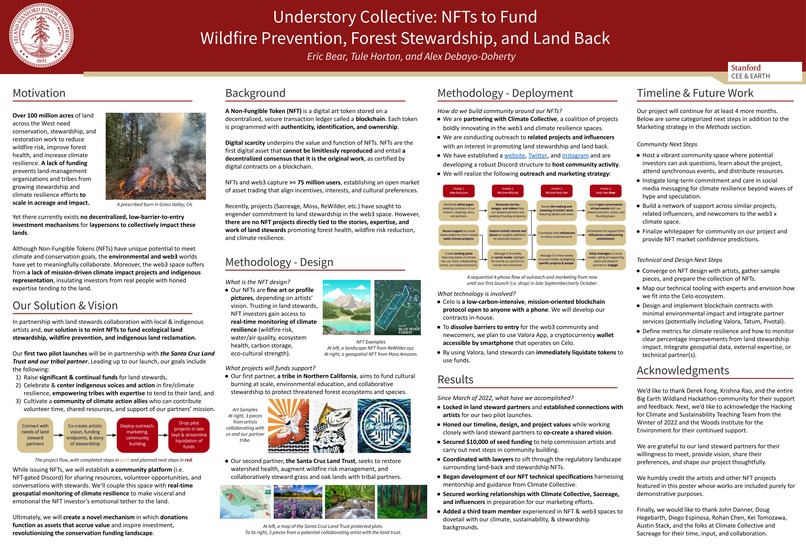
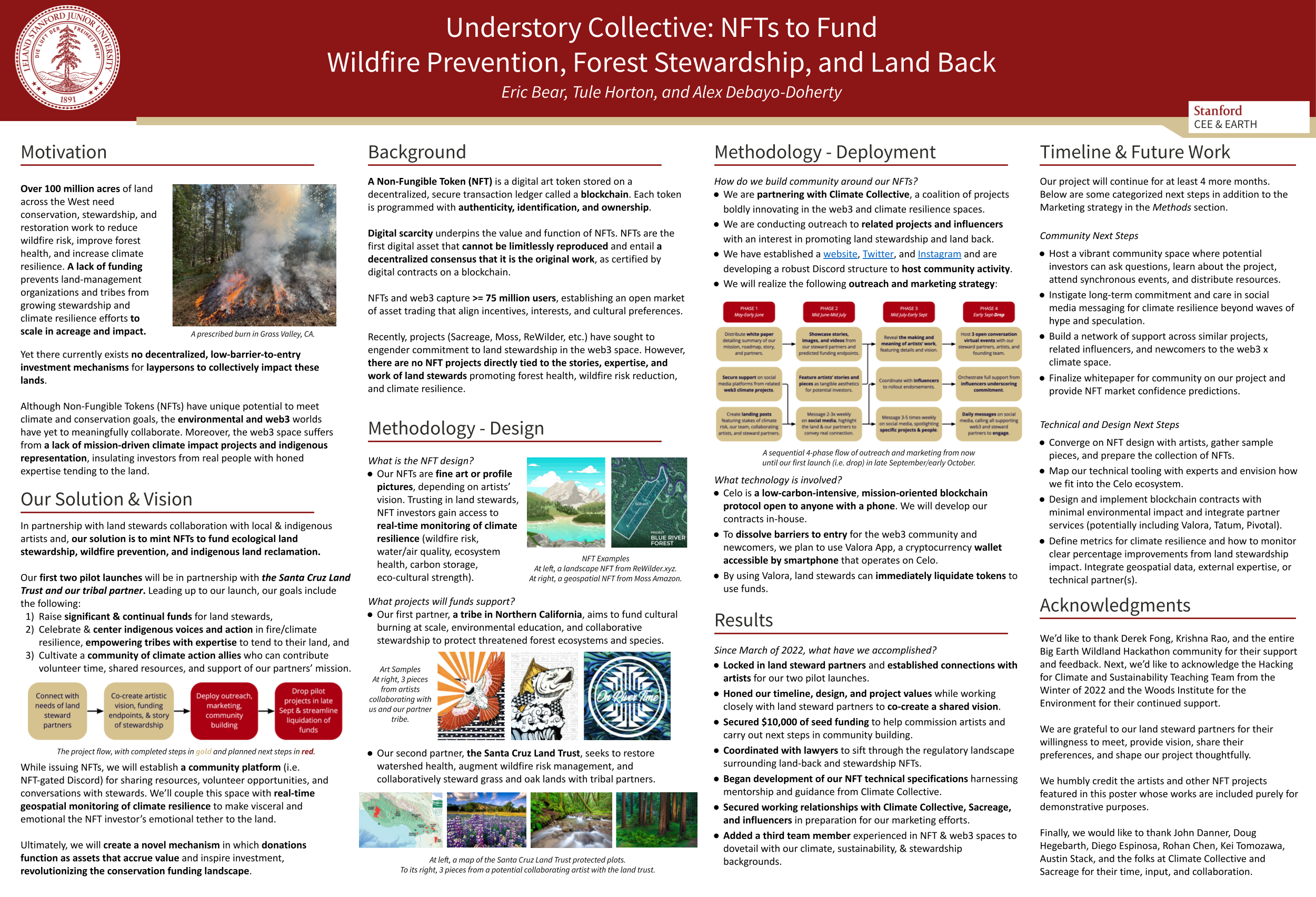
Understory Collective's poster.
Inspiration
In the Winter of 2022, Tule and I were lucky enough to take a deep dive into the challenges preventing an increased pace and scale of prescribed burning across California and the American West. In it, we were fortunate to speak with over 130 key stakeholders working in fire prevention, be they tribal leaders, fire practitioners or professionals, neighborhood resilience planners, fire ecologists, policy experts, or homeowners. As we continued, we recognized a pressing painpoint emerge: funding can limit even the most expert land steward from carrying out their work, and few innovations to bolster capital at stewards’ disposal have been introduced of yet. Enter our position as Stanford students with open ears yearning to help with backgrounds across CEE, Computer Science, Sustainability, and International Relations. In conversations, we began to pitch a novel mechanism for funding land conservation, restoration, and stewardship. And while at first it seemed otherworldly, we soon realized what positive elements of community, interconnectivity, and uplifting land stewards and indigenous voices we’d stumbled into. As such, we created Understory Collective with land steward partners and local/indigenous artist collaborators in mind.
What it does
In partnership with land stewards collaboration with local & indigenous artists and, our solution is to mint NFTs to fund ecological land stewardship, wildfire prevention, and indigenous land reclamation.
Our first two pilot launches will be in partnership with the Santa Cruz Land Trust and our tribal partner. Leading up to our launch, our goals include the following:
- Raise significant & continual funds for land stewards,
- Celebrate & center indigenous voices and action in fire/climate resilience, empowering tribes with expertise to tend to their land, and
- Cultivate a community of climate action allies who can contribute volunteer time, shared resources, and support of our partners’ mission.
While issuing NFTs, we will establish a community platform (i.e. NFT-gated Discord) for sharing resources, volunteer opportunities, and conversations with stewards. We’ll couple this space with real-time geospatial monitoring of climate resilience to make visceral and emotional the NFT investor’s emotional tether to the land.
Ultimately, we will create a novel mechanism in which donations function as assets that accrue value and inspire investment, revolutionizing the conservation funding landscape.
How we built it
To lift our project off the tool, we had to work with a few key components:
First, we needed to secure land steward partners receptive to our novel funding mechanism and co-create a vision for the project. Our first partner, a tribe in Northern California, aims to fund cultural burning at scale, environmental education, and collaborative stewardship to protect threatened forest ecosystems and species. Our second partner, the Santa Cruz Land Trust, seeks to restore watershed health, augment wildfire risk management, and collaboratively steward grass and oak lands with tribal partners. Next, we had to hone our NFT design to establish what kind of art, metadata, and community may accompany such assets. With our partners, we concluded that our NFTs would be fine art or profile pictures, depending on artists’ vision. Trusting in land stewards, NFT investors gain access to real-time monitoring of climate resilience (wildfire risk, water/air quality, ecosystem health, carbon storage, eco-cultural strength). We are conducting outreach to related projects and influencers with an interest in promoting land stewardship and land back. Finally, we have established a website, Twitter, and Instagram and are developing a robust Discord structure to host community activity.
Finally, we outlined and developed a robust marketing, outreach, and community-building strategy (showcased in the poster) to highlight our steward partners, collaborating artists, founding team, community spaces, and mission-driven fundraising work.
Along the way, we honed technical details that will inform our programming implementation in the coming months. For this, we will operate on Celo, a low-carbon-intensive, mission-oriented blockchain protocol open to anyone with a phone. We will develop our smart contracts in-house or in collaboration with Tatum. Finally, we harness Valora, a service that allows web3 community newcomers to create a cryptocurrency wallet with the click of a button on a smartphone. Valora completes our “how” in connecting NFTs to land stewards by allowing our partners to liquidate tokens into disposable funds immediately.
Challenges we ran into
Along the way, we faced hesitation and push back given a novel idea that melds together two unlikely realms: environmental advocacy/stewardship and cryptocurency/web3. Through this, however, we learned to articulate our vision, minimize barriers to entry in understanding NFTs as a technology, and overcome instinctive defenses against a new idea to raise funds. In the process of designing NFTs that are centered around partners and artists, there have been communication backlogs and periods of disconnect. Similarly, with influencers, technical support, and community strategizing, we heard from few to no contacts during some dry spells. Nevertheless, with patience and humility, we returned back to our partners and collaborating artists—after all, they are the reason we are insistent on bringing this project to fruition.
Accomplishments that we're proud of
In the past 9 weeks, we’re proud to have
- Locked in land steward partners and established connections with artists for our two pilot launches.
- Honed our timeline, design, and project values while working closely with land steward partners to co-create a shared vision.
- Secured $10,000 of seed funding to help commission artists and carry out next steps in community building.
- Coordinated with lawyers to sift through the regulatory landscape surrounding land-back and stewardship NFTs.
- Began development of our NFT technical specifications harnessing mentorship and guidance from Climate Collective.
- Secured working relationships with Climate Collective, Sacreage, and influencers in preparation for our marketing efforts.
- Added a third team member experienced in NFT & web3 spaces to dovetail with our climate, sustainability, & stewardship backgrounds.
What we learned
Along the way, we learned great humility and detail-oriented explanations in making land-back and stewardship NFTs tractable. This meant revising our story and narrative to make the project concept approachable and reliable. Moreover, we learned about the web3 space in greater detail, from its community support to technical requirements and marketing/timeline hurdles. We’ve emerged with greater knowledge on how to carry out a successful project and how to lean on incredible advocates, mentors, and supporters along the way. Most of all, we’ve kept a careful pulse on the vision and preferences of our partners.
What's next for NFTs to Fund Fire Prevention, Forest Stewardship & Land Back
As showcased in the poster, next steps are two-fold over the next 4+ months:
Community Next Steps
- Host a vibrant community space where potential investors can ask questions, learn about the project, attend synchronous events, and distribute resources.
- Instigate long-term commitment and care in social media messaging for climate resilience beyond waves of hype and speculation.
- Build a network of support across similar projects, related influencers, and newcomers to the web3 x climate space.
- Finalize whitepaper for community on our project and provide NFT market confidence predictions.
Technical and Design Next Steps
- Converge on NFT design with artists, gather sample pieces, and prepare the collection of NFTs.
- Map our technical tooling with experts and envision how we fit into the Celo ecosystem.
- Design and implement blockchain contracts with minimal environmental impact and integrate partner services (potentially including Valora, Tatum, Pivotal).
- Define metrics for climate resilience and how to monitor clear percentage improvements from land stewardship impact. Integrate geospatial data, external expertise, or technical partner(s).
Built With
- blockchain
- celo
- valora
- web3

Log in or sign up for Devpost to join the conversation.