-
-
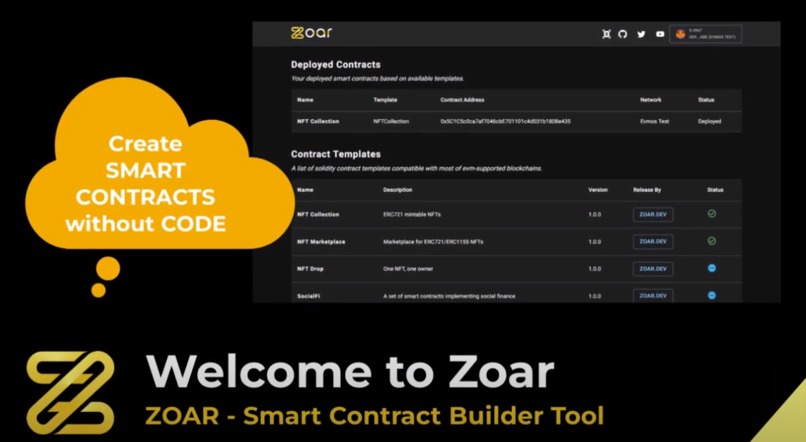
ZOAR - Smart Contract Builder Tool

Overview
While we work with Blockchain platforms and join user communities, we realize:
- The Community has many members who are knowledgeable in professional fields such as NFT, DEFI, and Web3… but there is no programming background to write smart contracts by themselves.
- Users need to find tools for designing their smart contracts.
Zoar is an application that allows users to customize smart contracts according to available templates, then deploy smart contracts on the desired chain by themselves. In addition, Zoar runs on most EVM-enabled chains.
What it does

Based on the idea of providing a tool for users without a programming background, Zoar offers:
- List of smart contract templates.
- Templates conform to specific standards; for example, the NFT collection smart contract template follows ERC-721.
- Allows the user to select the template and change the parameters as desired.
- Will enable users to deploy customized smart contracts to desired evm-supported chains (EVMOS, Polygon, Ethereum).
- Users can display a list of deployed contracts by templates, contract addresses, and deployed network. Currently, Zoar supports the feature on both testnet and mainnet.
How we built it
We use the following popular tech stacks:
- To make smart contract templates, we use OpenZeppelin.
- Build interfaces using NodeJS, NextJS, Typescript, Redux, Redux toolkit, and Ethers JS.
- In charge of UI/UX, we use MUI.
- To compile a smart contract, we use Truffle CLI
- Our login function uses Moralis Auth API.
Challenges we ran into
While building the app, the problems we encountered include:
How to make a feature like Remix IDE able to deploy smart contracts from a web app, but with fewer parameters and simpler. Fortunately, we found a way to use NodeJS, Truffle CLI, and EthersJS to solve it, and users don't need to know about the underlying technologies.
How to design smart contract templates include many useful options but still ensures compliance with popular standards. Specifically, like the NFT Collection smart contract template, we had to consult and learn from many sources before shaking hands and executing. The OpenZeppelin library is also beneficial in this process.
What we learned
Through the development of Zoar, we have gained a deeper understanding of the business of all the smart contracts we intend to write. In addition, we grasped the techniques of building Web3 applications and how to implement a smart contract in terms of coding.
More importantly, we understand more about the difficulty of accessing Blockchain for people without a programming background, thereby creating more motivation for ourselves to continue developing Zoar.
What's next for NFT Tools for DEV
We will not only allow users to design their Smart Contract but also aim to create a feature that will enable the creation of a Smart Contracts' source code. Therefore, users can own a dApp for themselves with the least cost and effort.
Shortly, our roadmap is as follows:
2022 - Q4:
- Complete other templates for NFT, including NFT Marketplace and NFT Drop.
- Complete templates for SocialFi.
- Complete templates for Vote and Donation.
- Audit, Test & Improve coding quality for Smart Contract Templates
2023 - Q1:
- Build the feature to automatically generate dApp source code for smart contract templates related to NFT.
- Build a part to automatically generate dApp source code for Smart contract templates on SocialFi.
Built With
- etherjs
- moralisauthapi
- next.js
- node.js
- openzeppelin
- redux
- reduxtoolkit
- trufflecli
- typescript


Log in or sign up for Devpost to join the conversation.