-
-
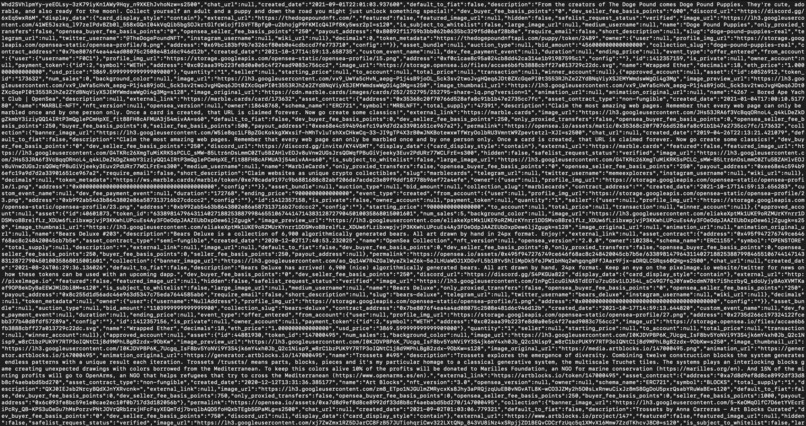
jumbled json mess
-
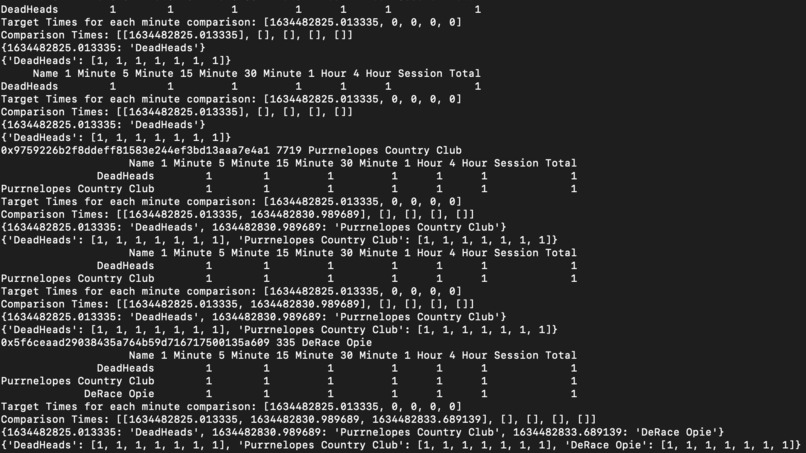
beautiful sorted json
-
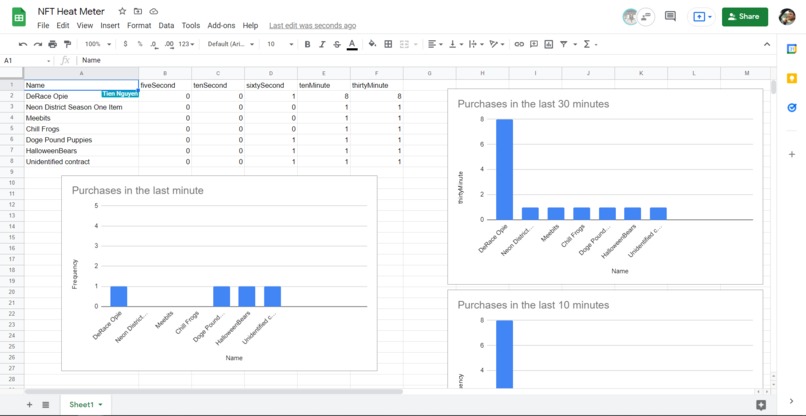
real time data set visual


Inspiration
Our team consist of Blockchain Student Society members who are passionate about crypto, blockchain, and especially NFTs. We have members who hold, trade, and mint NFTs and because of this, our enthusiasm for NFTs led to the inspiration of this project. OpenSea is the world’s first and largest NFT marketplace, yet it doesn’t allow users to easily see real time transactions in a digestible way. It does allow us to view some NFT statistics, but the shortest time frame is just 24 hours. Trying to identify market trends on such a long time horizon in this rapid & volatile space will only guarantee missed opportunities and unnecessary FOMO (fear of missing out).
What it does
We have created an active database of real time OpenSea NFT Sales, otherwise known as The OpenSea NFT Sales Tracker. This program documents every NFT sale that goes through OpenSea in real time and converts them into easily digestible visuals such as tables and graphs to help the user front run the opportunity. We have two examples that demonstrate our program. The csv is a database proof of concept in that it shows how the program pulls real world data from the OpenSea API. It records every NFT sale that goes through OpenSea and the graph represents the total purchases within a time frame per NFT collection. The google sheet is a real time dataset visualization of concept that shows active NFT sales on OpenSea. Values are updated every 5 seconds and the graph represents the top 10 NFT collections by sales within a given time frame. We verified our results by comparing it to OpenSea’s recent transactions history and used block explorers like Etherscan to further clarify some questionable transactions. With this tool, retail consumers can formulate their own short term strategies to front run the opportunity and help them get ahead. This data set is to help users digest large quantities of information to help them strategize their short term NFT investments.
How we built it
We started off the development searching for ways to incorporate the Opensea api into our project dataset. After determining the type of information we began implementing the api into our python project, we used http GET requests in order to query their server and converting the response to a json format. After parsing through the json data for useful information we landed on studying successful sales in nft transactions. We target the successful sales and organized them by collection. We created a function to make many calls per second, checking for a successful transactions, this function used dictionaries in order to keep track of the time they were found and included a counter for how long ago they were found. We formatted the dataset by intervals of time and tested them against the time found in order to decrement upon passing each interval. For the real time data, we remove the instance of the collection counters in order to make room for another to take its place in the visualization. We used pandas in order to create a transferrable dataframe so we could export to many different types of files, including CSV, Excel, and Google Sheets (which is where our real time graph lies).
Challenges we ran into
We had the challenge of excluding certain sales such as ERC-1159, OPENSTORE transactions, and duplicate transaction. However, our largest challenge that was most time consuming was deciding which data from the json responses from the OpenSea API was appropriate to our vision. This was solved through a process of trial and error to determine which data type was appropriate to help the end user have an idea of market momentum.
Accomplishments that we're proud of
We got to experience for the first time using https request to access an API, parsing a json file to access certain information, creating a real time information database, and writing the real time data to multiple platforms for visualization.
What we learned
We learned that developing a general vision as a template for a direction of our project will increase productivity and efficiency. Attempts at figuring out every detail before hand will only slow down processes. We also learned how to translate real time data into a spreadsheet database that will also update as the code runs.
What's next for OpenSea NFT Sales Tracker
Future plans for OpenSea NFT Sales Tracker would be to implement a percent change in sales with color coordination in respect to the positive/negative changes. We would also want to develop a stable webservice where users around the world can connect to and use our program.
Built With
- api
- blockchain
- csv
- databases
- excel
- google-cloud
- opensea
- pandas
- python


Log in or sign up for Devpost to join the conversation.