-
-
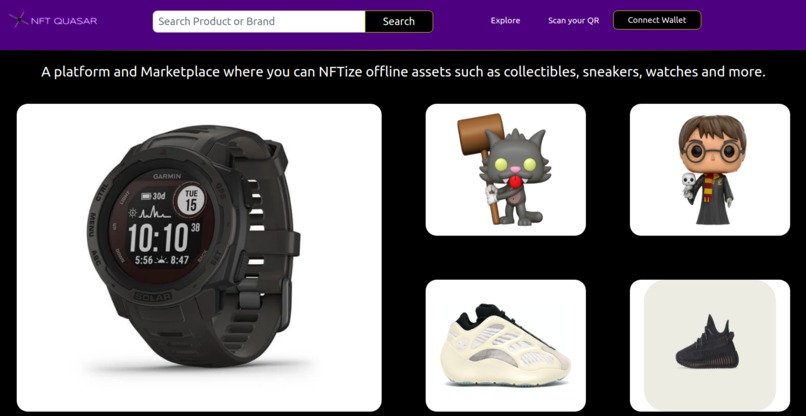
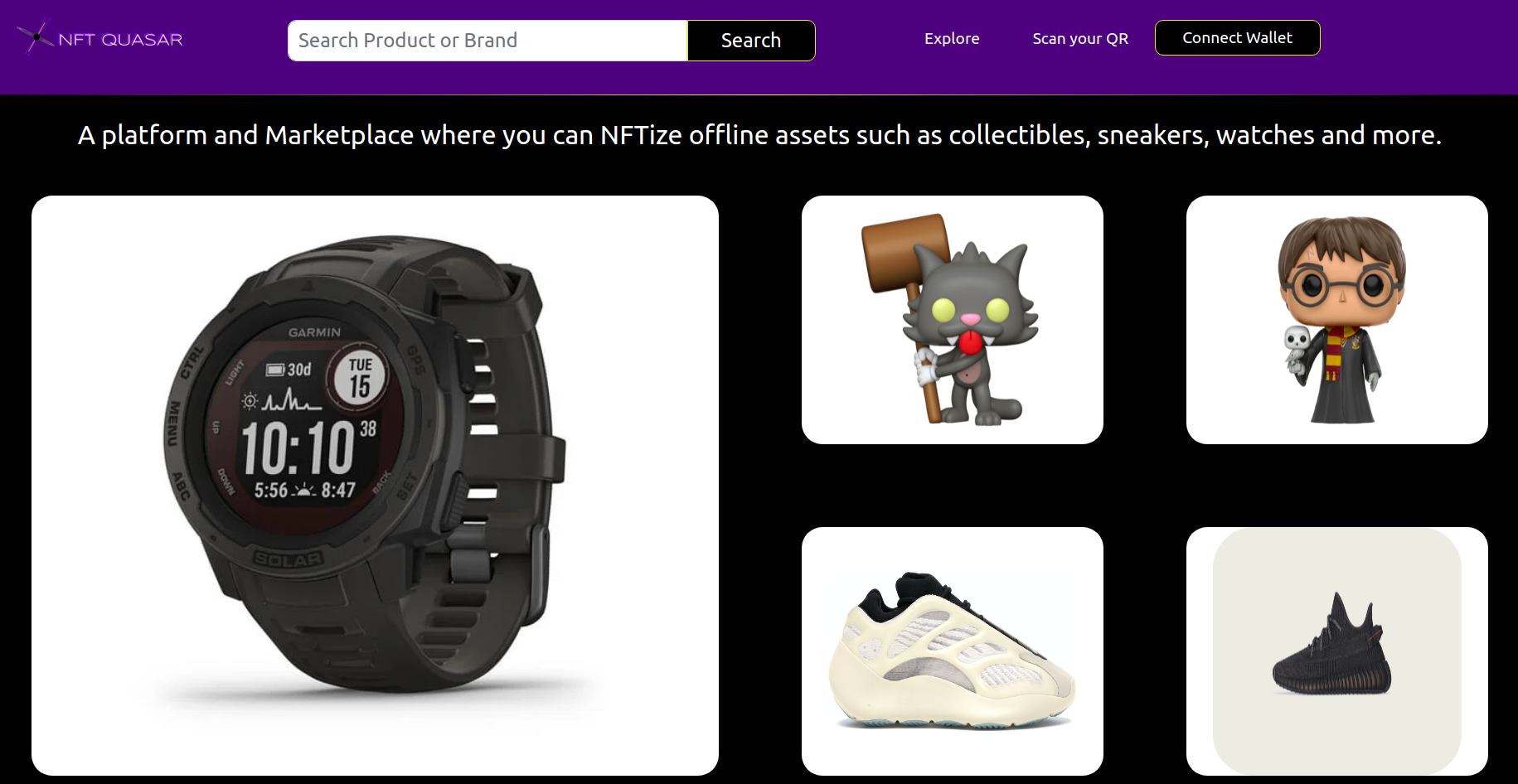
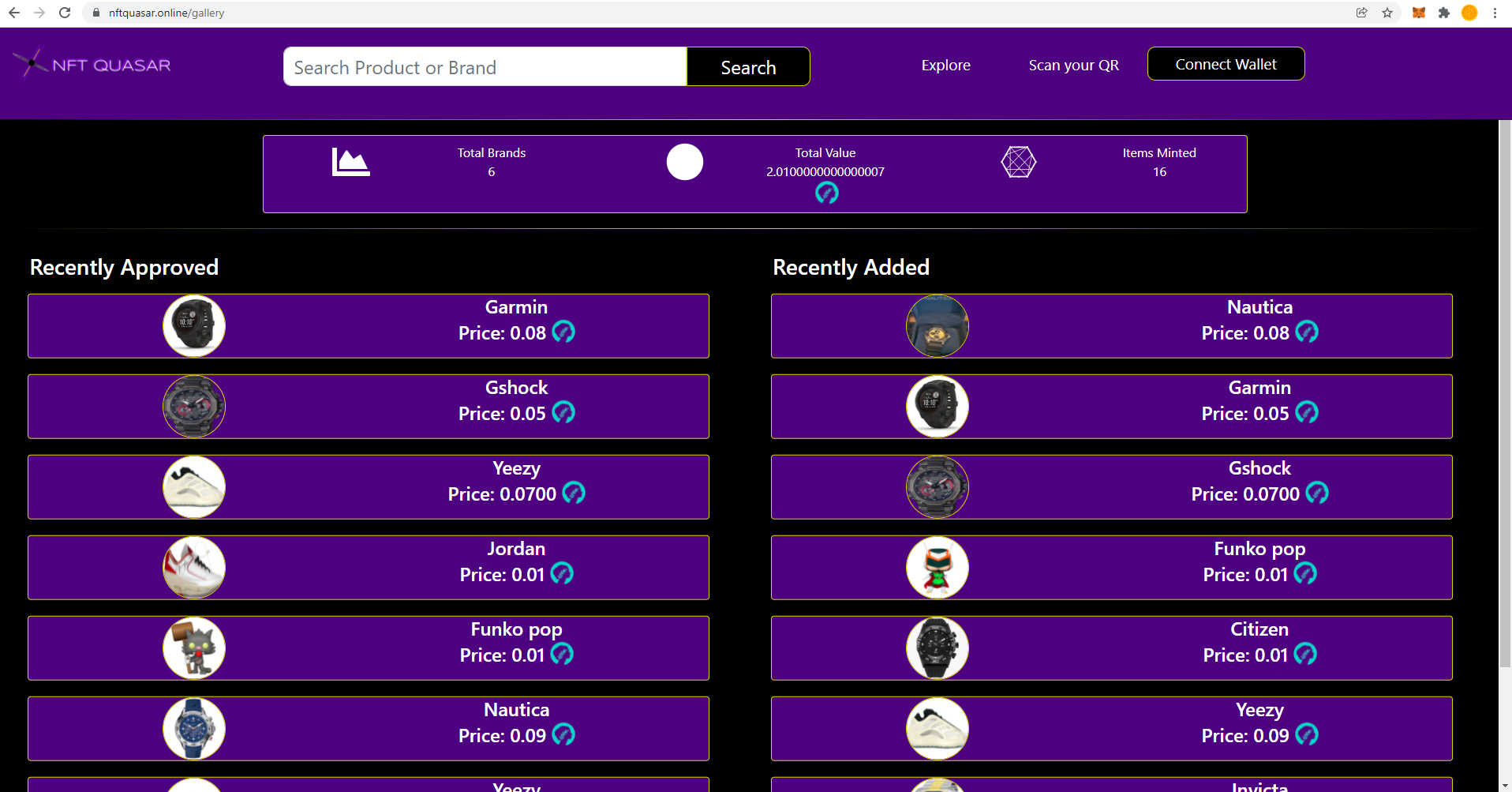
Landing Page top
-
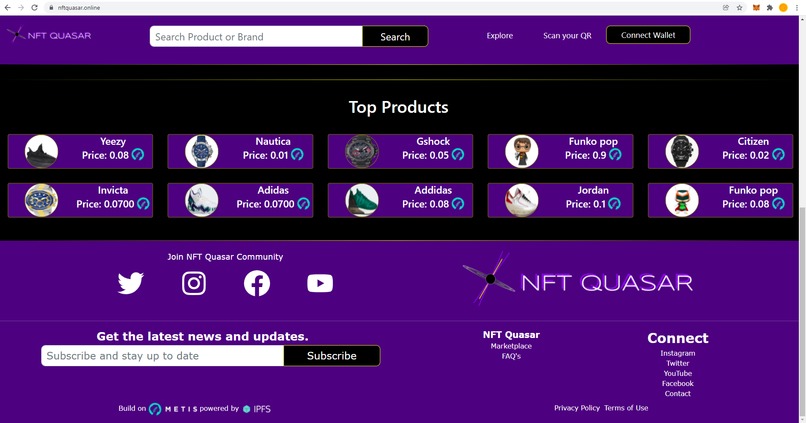
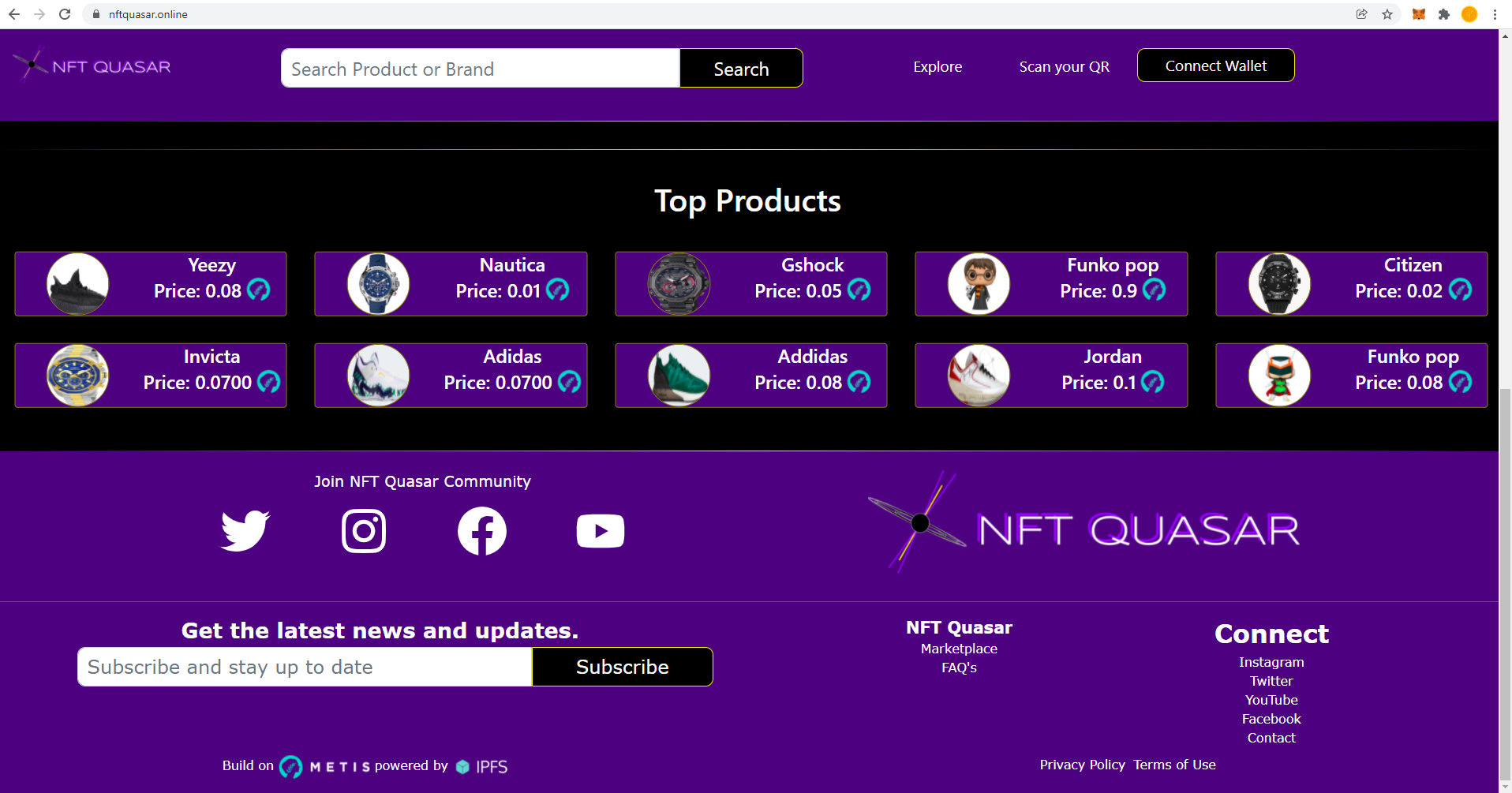
Bottom of the landing page
-
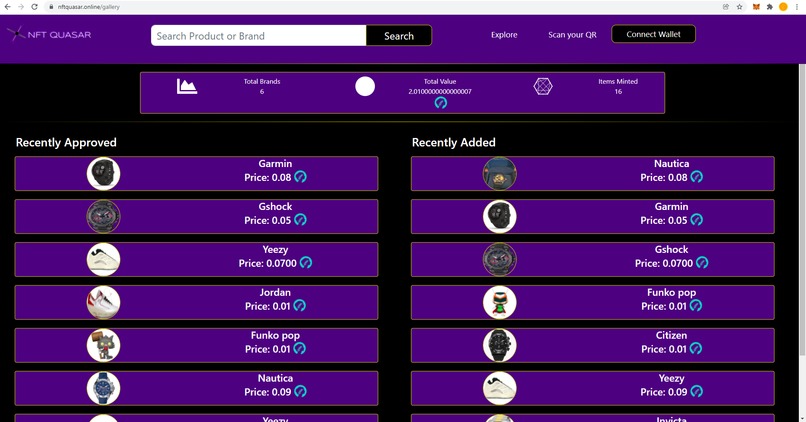
Marketplace
-
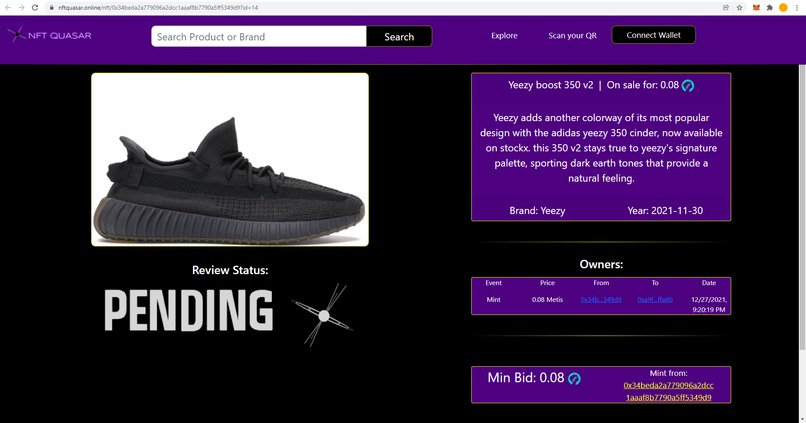
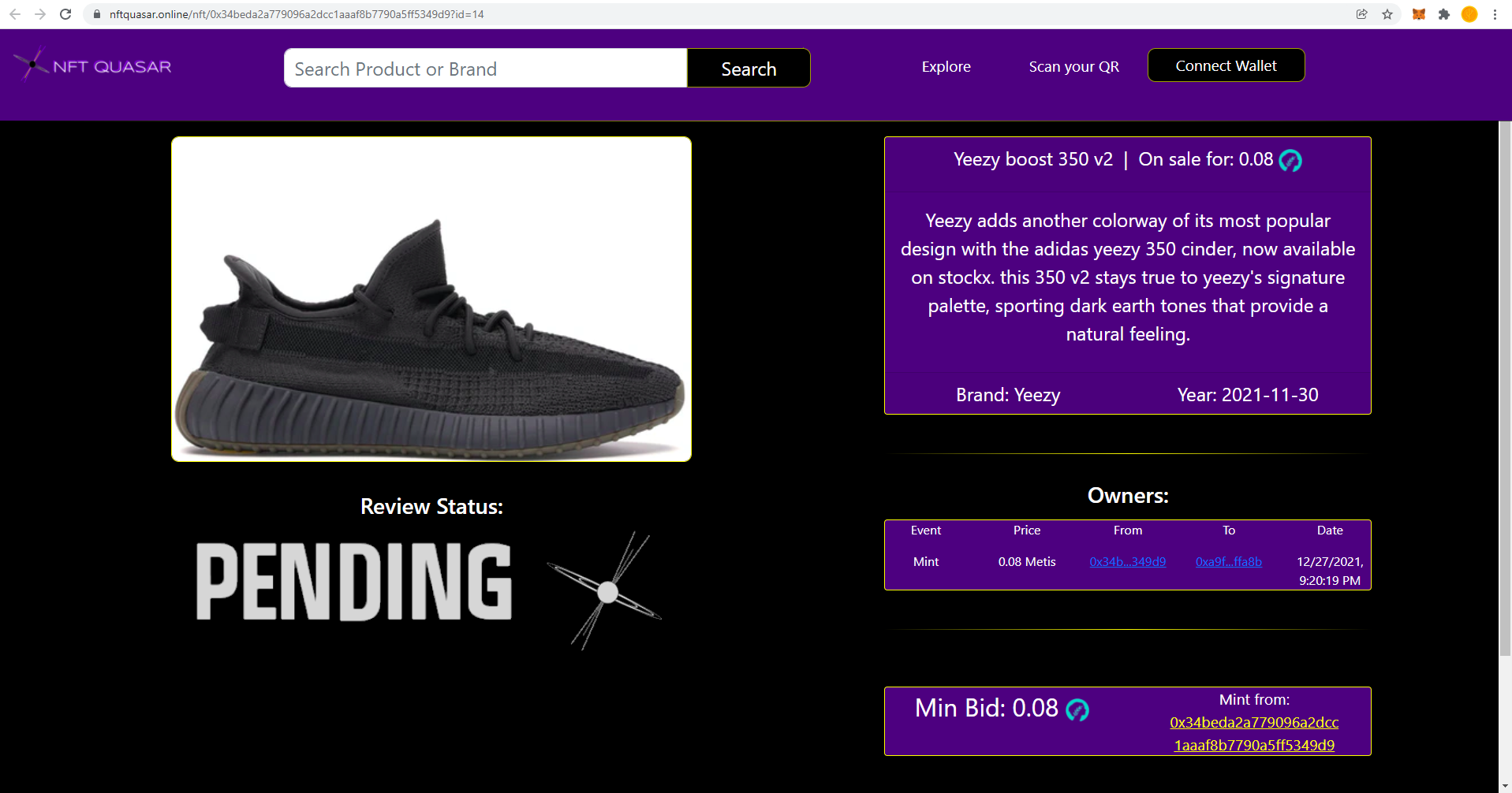
Minted offline asset NFT without approval.
-
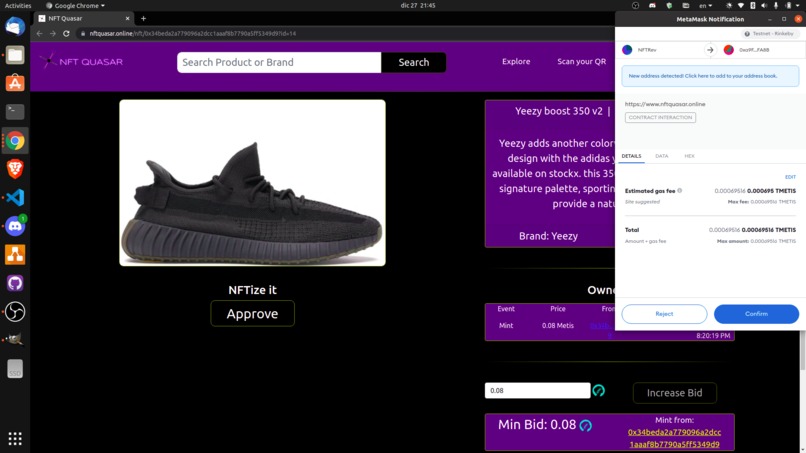
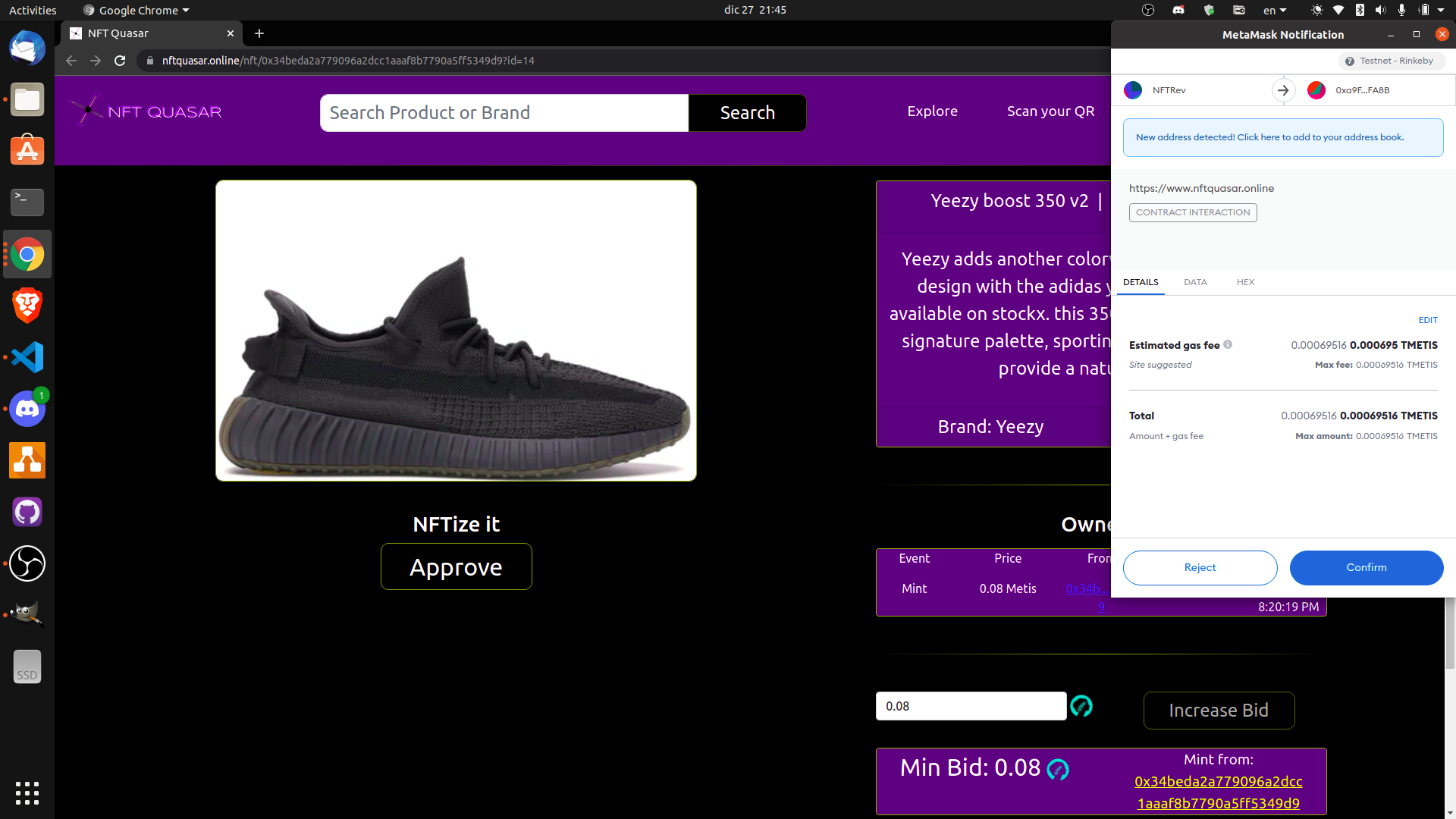
Third party approves!
-
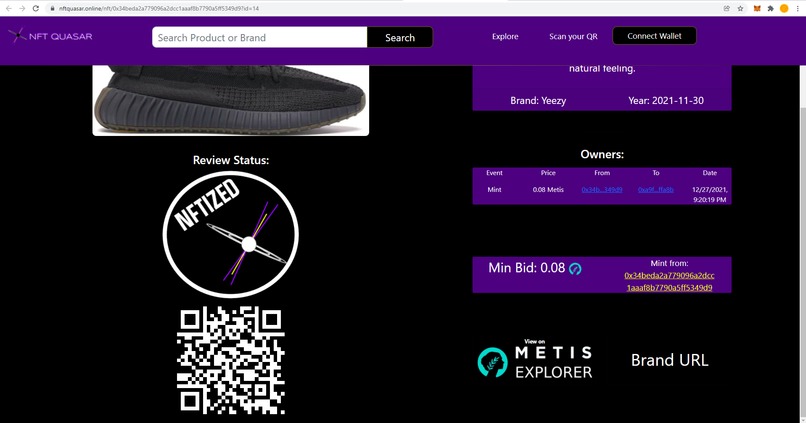
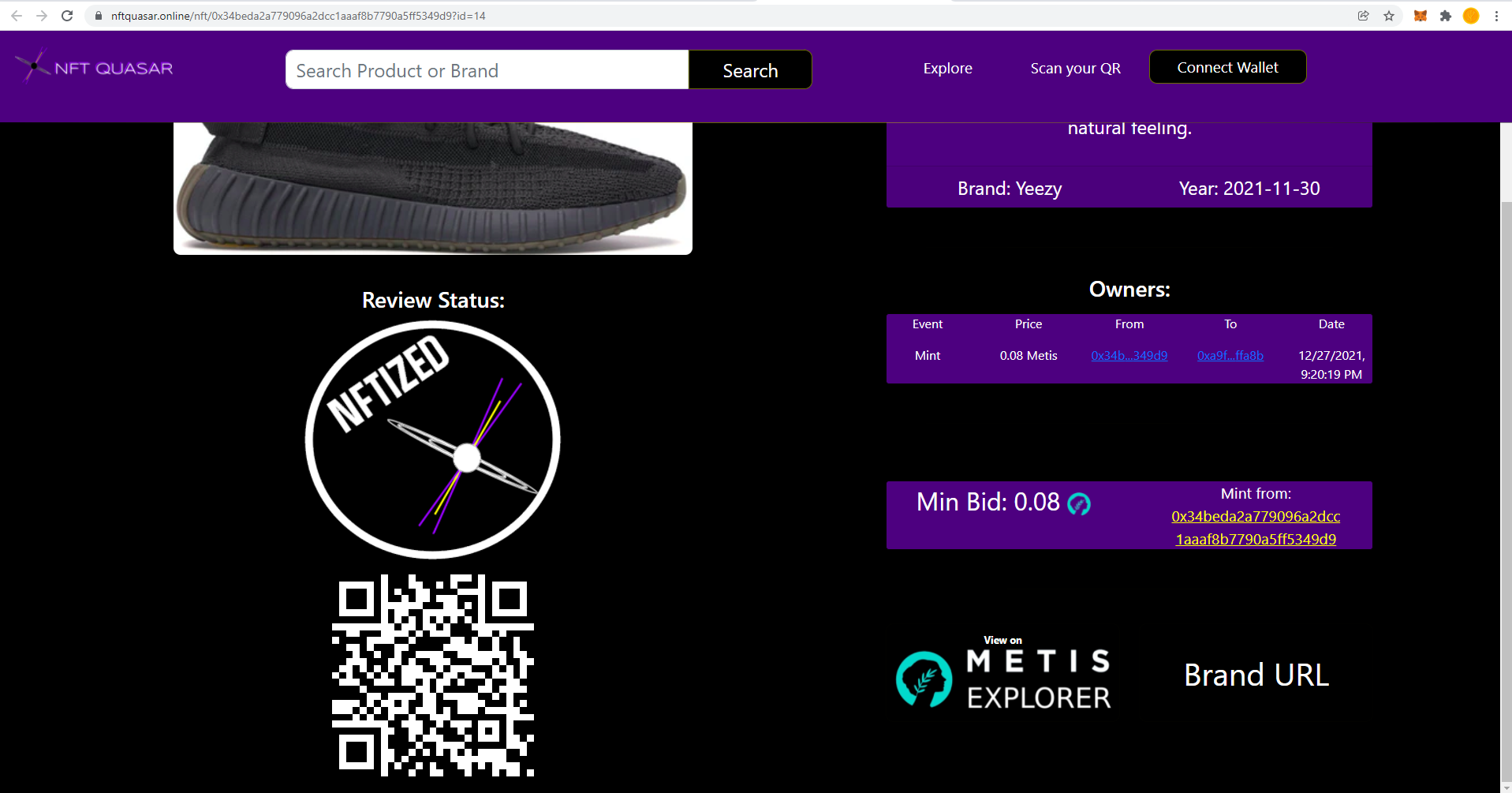
Approved with QR, and can be all checked on the Metis explorer.
Welcome everyone, we are NFT Quasar
A platform and Marketplace where you can NFTize offline assets such as collectibles, sneakers, watches and more.
Problem
The online market for luxury, clothing, sneakers, watches and electronics is huge, and will continue to grow and its assets have really appreciated.
But the number of problems has also grown. Although companies such as Goat and Stockx have gone to great lengths to combat the Fakes market, meaning reproductions sometimes great fake reproductions of a certain asset, they rely on legacy systems and a huge operation to do so.

And the buyer has also become more and more sophisticated, asking for better and better systems.
If only we could use some kind of technology to authenticate and provide non-fungible ownership to those buyers.
Enter NFT Quasar, we NFTize collectibles, sneakers, watches and more providing another layer of security and confidence in that process of buying and selling products.
Solution
How does it work?
An NFT Marketplace but with a twist:
1. Check it out, it is live: https://www.nftquasar.online/


2. Mint your offline asset NFT

3. Wait for it to be approved by a third party.

4. Now you can scan it on the system!

Of course, it is an NFT. So, you'll know in its history, where it has been and who is the real owner!
Here is the system's Architecture:

Our webpage is made on React, the Metis Stardust testnet works as the main focus as it is the manager of smart contracts and EVM compatibility. In turn, the Metis RPC manages its interactions between smartcontracts and webpage, Metamask works as our way of signing said contracts and providing the way to mint NFT's. On the storage side we use IPFS/Filecoin in adition with NFT.storage to store our NFT data securely and resiliently and also we use some of their API's to call the CID back.
Technology stack, description of the technology:
Metis
The Metis RPC is the base for Minting, buying, trading and everything Smart Contracts on our platform. It bring us great EVM compatibility.

IPFS/Filecoin:
We use IPFS for the storage of metadata and NFT image files. This for the process of uploading the image from the website to NFT.storage, which is our main storage service. Apart from that we use it to link to our smart contracts in order to Mint that off-chain real asset.
This is the code on the server to upload the NFT.More details on:
More details at: https://github.com/altaga/NFT-Quasar/blob/main/Server/serverv3.js
    let nft = req.files.nft;
    let my_date = Date.now();
    let dateName = my_date + `.${nft.mimetype.substring(6, nft.mimetype.length)}`;
    await nft.mv('./uploads/' + dateName)
    const file = fs.readFileSync(__dirname + '/uploads/' + dateName);
    let premetadat = {
        name: `${req.headers.name}`,
        external_url: `${req.headers.external_url}`,
        description: `${req.headers.description}`,
        image: new File([file], dateName, { type: `image/${nft.mimetype.substring(6, nft.mimetype.length)}` }),
        attributes: [
        {
            release_date: `${req.headers.release_date}`,
            state: `${req.headers.state}`,
            brand: `${req.headers.brand}`,
            category: `${req.headers.category}`,
        }
        ]
    }
    let metadata = await clientnft.store(premetadat)
To access this data we use a Metis RPC provider, obtaining the NFT IPFS URI directly from the Smart Contract, after that a simple get request will give us the data of the metadata.json.
Here is a Screen shot of our NFT.Storage service

Draft Budget to take it from PoC to Prototype
For the project to become eventually self sufficient after launch it not only needs more features, but as we are dealing with real assets, we need partnerships to feed those assets (companies in this case such as Stockx or Goat, or perhaps some others that need to digitize its assets).
Regarding the main topic, the cost of building an NFT marketplace varies for several reasons. In short, the price range depends on the amount of work to be done. With a ready to install system, or in our case an already working prototype, the cost will be lower.
Of course, we must take into consideration that this is a project with a higher level of complexity than your standard NFT marketplace and it also operates in two fronts.
Thankfully enterprises such a CMARIX (https://www.cmarix.com/) have already done an example of the costs that will be taken for a project of this kind:

From our total of almost $48k USD we can take almost half of that development cost at first, of course because we have already done the heavy lifting during this hackathon! That leaves us at $24,000USd for the finishing touches of the platform depending on the partnerships we can get. That leads us to the cost of getting the first partnerships.
Depending on the reach we want this to have it is imperative to get the first partnerships through a win-win agreement with the other part, whichever company we court. This could be achieved at first by working on-tandem without outsourcing the cost to that partner and by increasing our runway for several months through investment, funding, and grants. If we take an approximate cost of $50K USD as previously discussed, every single partner we get will indeed expand on that cost. For the sake of argument let's say we get three partners, so the operational costs would rise in essence to $200k USD, but that would mean a very advanced product with several replicable features.
So, the plan for the initial phase would be to secure $50k USD whether it is through grants or other types of funding, secure one initial partner for a Beta run and from that one intent and find product market fit. If the test run is positive, we would scale that solution, of course, handling the same costs but exploring on different future business models.
What's Next for NFT Quasar
Developing with Metis was easy enough as its EVM works with all the Ethereum-based channels, APIs and even other blockchains such as IPFS.
We would like to try a beta of this concept with real assets or collectibles in this case, but for that we would need much more support and capital. We thank the Metis team for this opportunity and also the devs for their support on discord.
Built With
- express.js
- ipfs/filecoin
- metis
- nft.storage
- node.js
- react



Log in or sign up for Devpost to join the conversation.