Inspiration
Every SaaS founder and local business needs organic traffic, but manual SEO is a nightmare. Researching keywords, writing content, sourcing images, publishing, and manually requesting indexing takes hours every week. Existing AI tools just act as wrappers where you still have to copy-paste prompts and manage active browser sessions. I wanted to build a true "set it and forget it" autonomous engine that handles the entire pipeline.
What it does
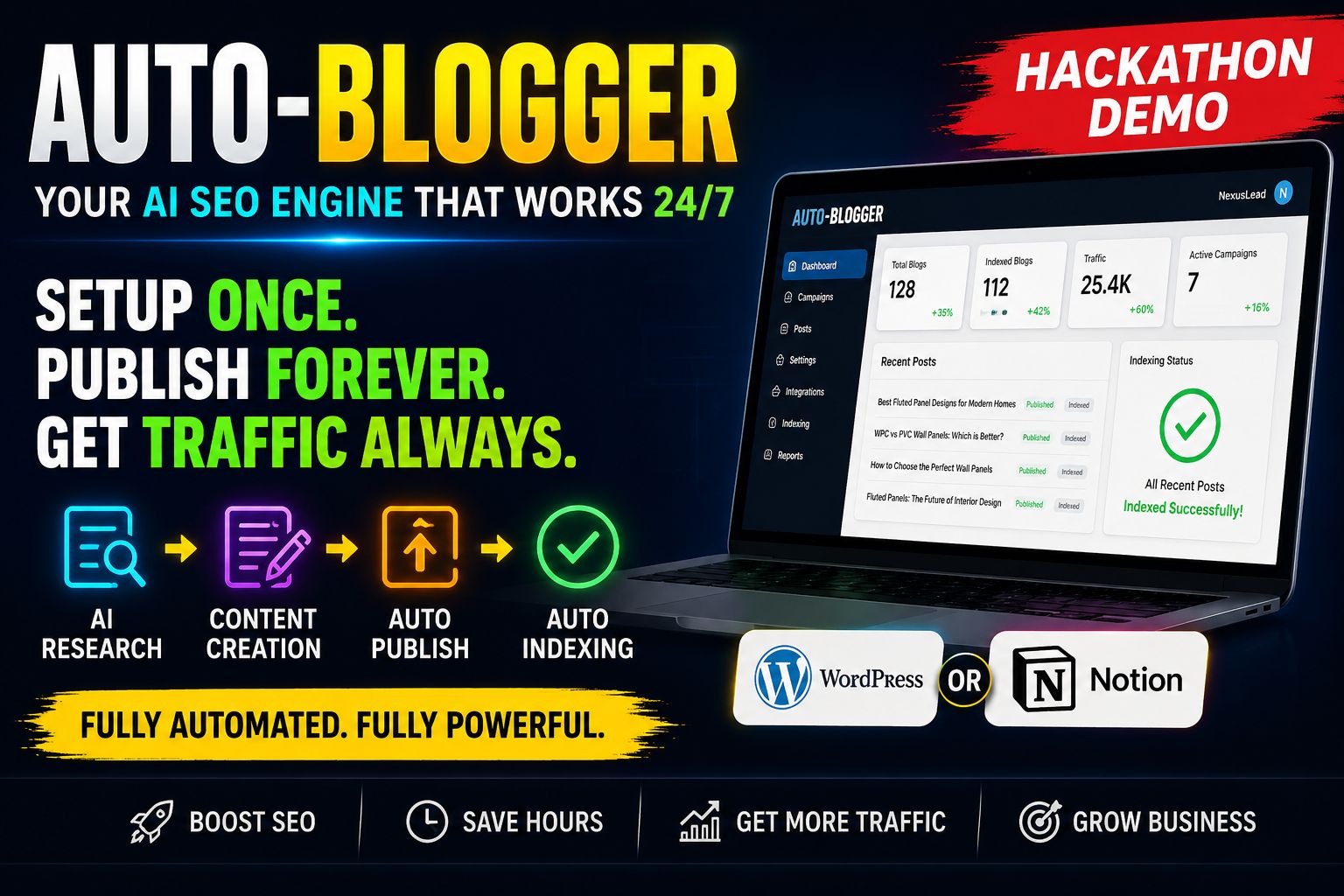
Auto-Blogger (NexusScribe) is a fully autonomous, BYOK (Bring Your Own Key) content marketing agent. You provide your Gemini and Pexels API keys, drop your product URLs, and the system takes over. It crawls your pages (intelligently handling Clerk auth walls by requesting manual descriptions instead of failing), generates highly contextual blogs, embeds relevant images, publishes directly to Notion or WordPress, and instantly pings the Google Indexing API. It runs entirely in the background with a strict limit of 2 posts per day to maintain natural, organic SEO growth.
How we built it
The frontend is built with Next.js (App Router), React, Tailwind CSS, and TypeScript, hosted on Vercel for a seamless, fast UI. For the database and secure key storage, we used Supabase. However, the core automation engine is decoupled. To bypass Vercel's serverless timeouts during heavy AI generation tasks, the background worker is built on Node.js/Express, hosted on Render, and triggered seamlessly by external cron-jobs.
Challenges we ran into
The biggest challenge was the classic serverless execution limit. Complex tasks involving web scraping, deep LLM reasoning, image fetching, and multi-CMS publishing constantly hit the 30-second timeout on Edge environments. We solved this by decoupling the architecture and moving the heavy lifting to Render. Another major issue was network failures during long API chains. We engineered a stateful execution system in Supabase—if the server drops at step 3, it logs the state and resumes exactly from step 3 on the next cron trigger without any data loss.
Accomplishments that we're proud of
Successfully engineering a fault-tolerant, stateful execution loop that completely removes the user from the equation after the initial setup. Getting the Google Cloud Auto-Indexing API to trigger the exact second a post goes live was a massive win for immediate SEO traction.
What we learned
We learned the critical differences between edge computing limitations and long-running background tasks. We also mastered handling multiple external APIs (Gemini, Pexels, WordPress, Notion, Google Cloud) simultaneously while ensuring database consistency through our custom stateful logging mechanism.
What's next for Auto-Blogger
The next step is scaling the architecture to handle thousands of concurrent campaigns without breaking a sweat, and adding direct integrations for auto-repurposing the generated blogs into highly engaging LinkedIn and X (Twitter) threads.
Built With
- cron-jobs
- gemini-api
- google-cloude
- next.js
- notion-api
- pexels-api
- postgresql
- react
- render
- supabase
- typescript
- vercel
- wordpress

Log in or sign up for Devpost to join the conversation.