-
-
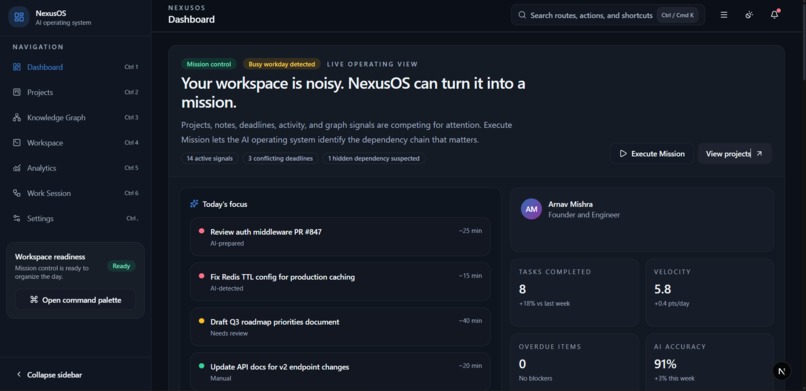
Dashboard
-
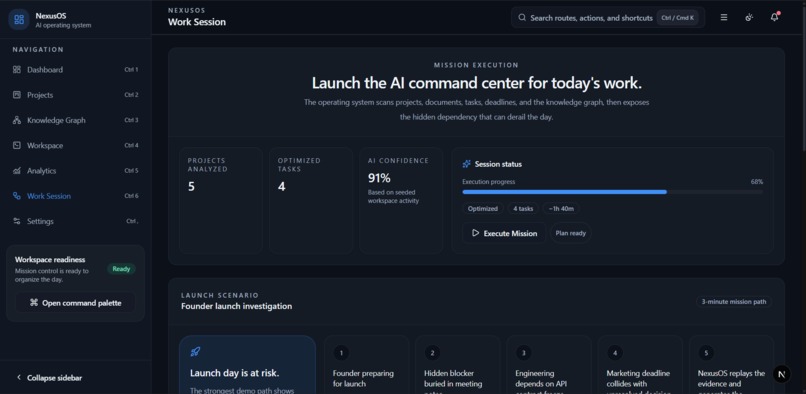
Mission Command Center
-
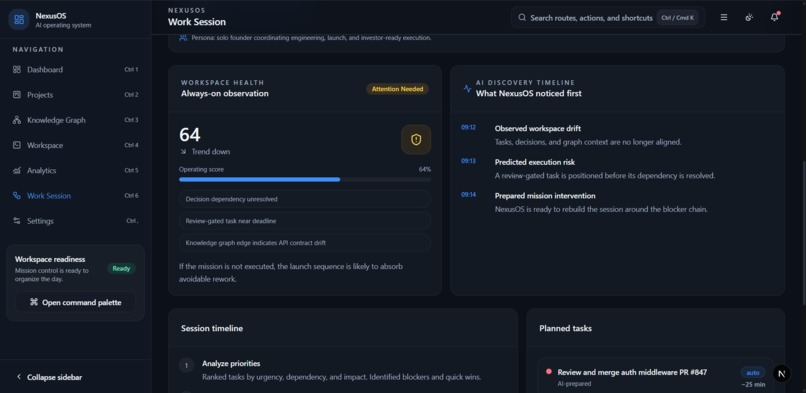
Mission Brief
-
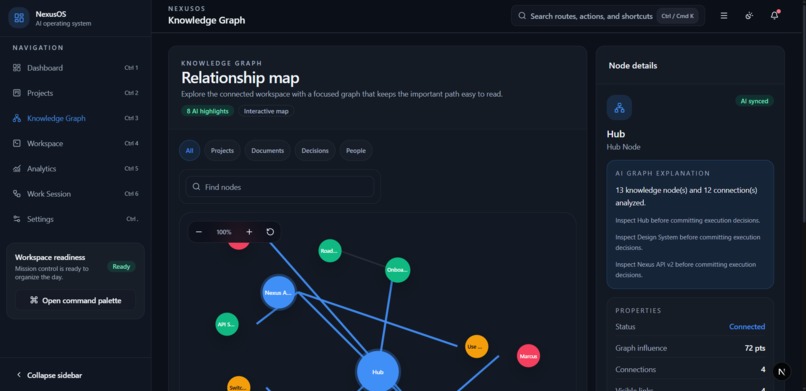
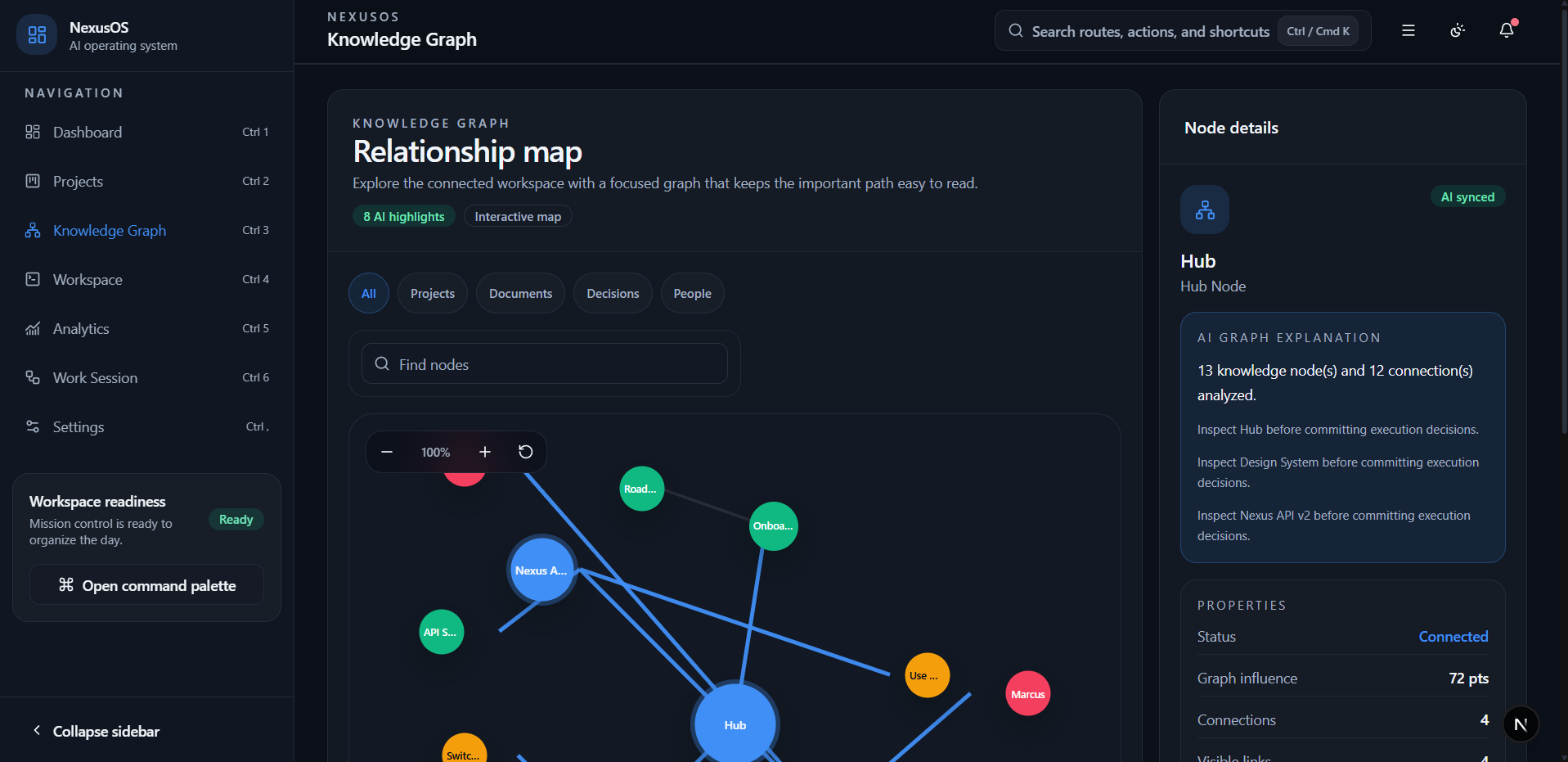
Knowledge Graph
-
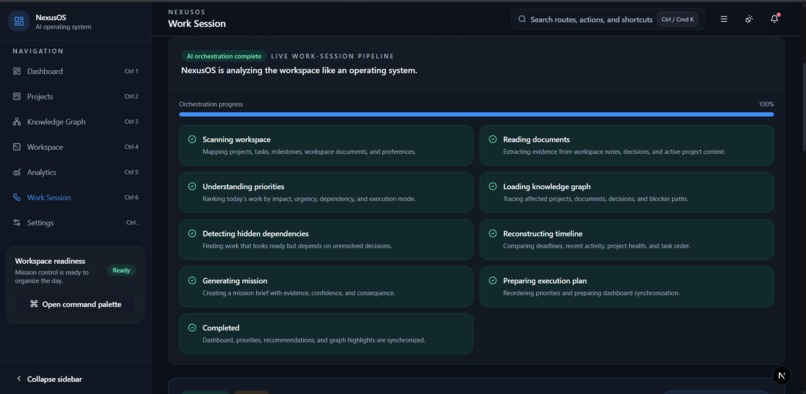
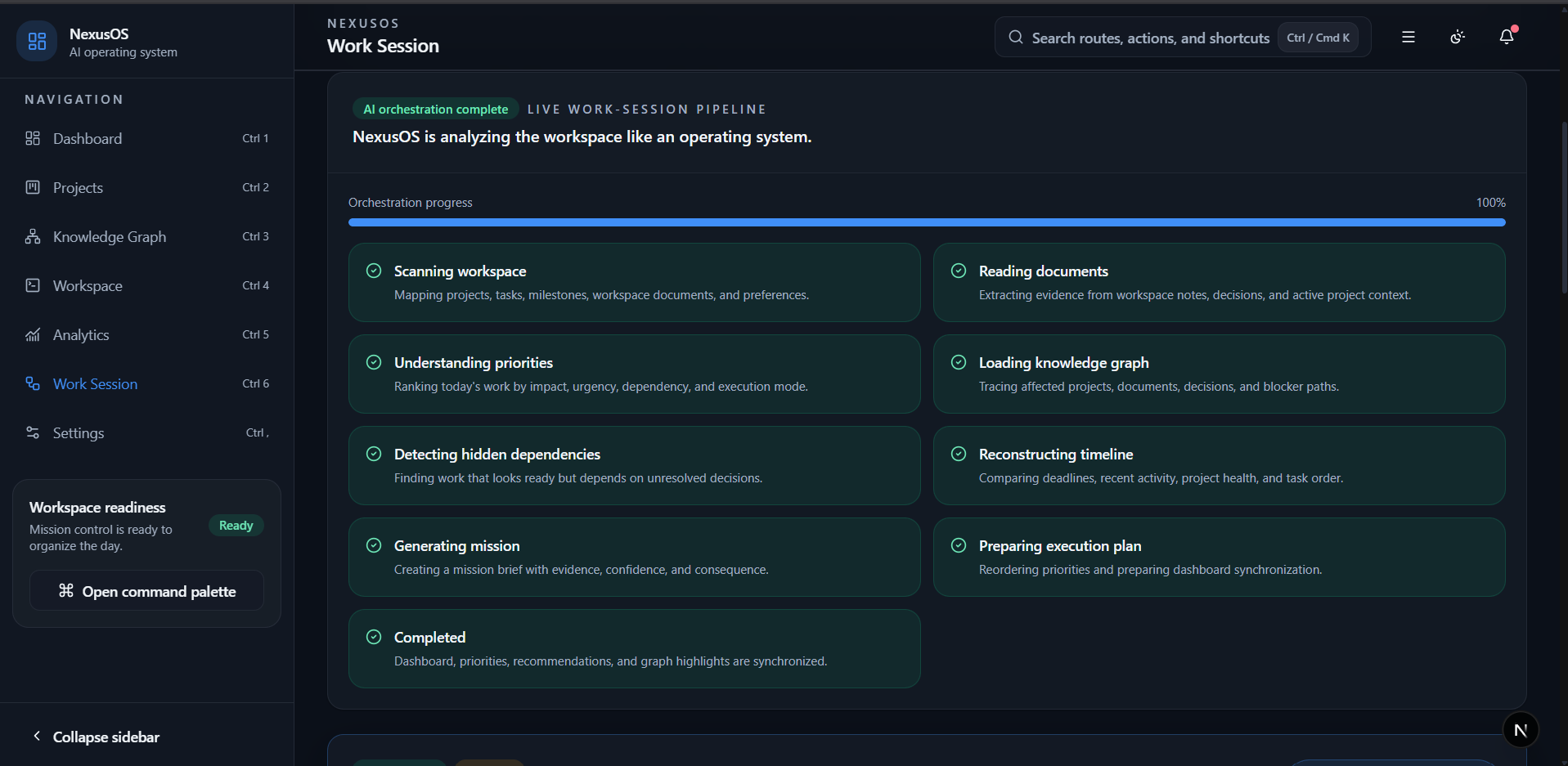
Live Session Work Pipeline
Inspiration
Most productivity tools tell you what's happening. Plenty of AI tools will summarize your notes or chat with your documents. What I kept running into was a different problem: after a few days of work spread across projects, documents, meeting notes, and tasks, I still had to figure out what actually mattered.
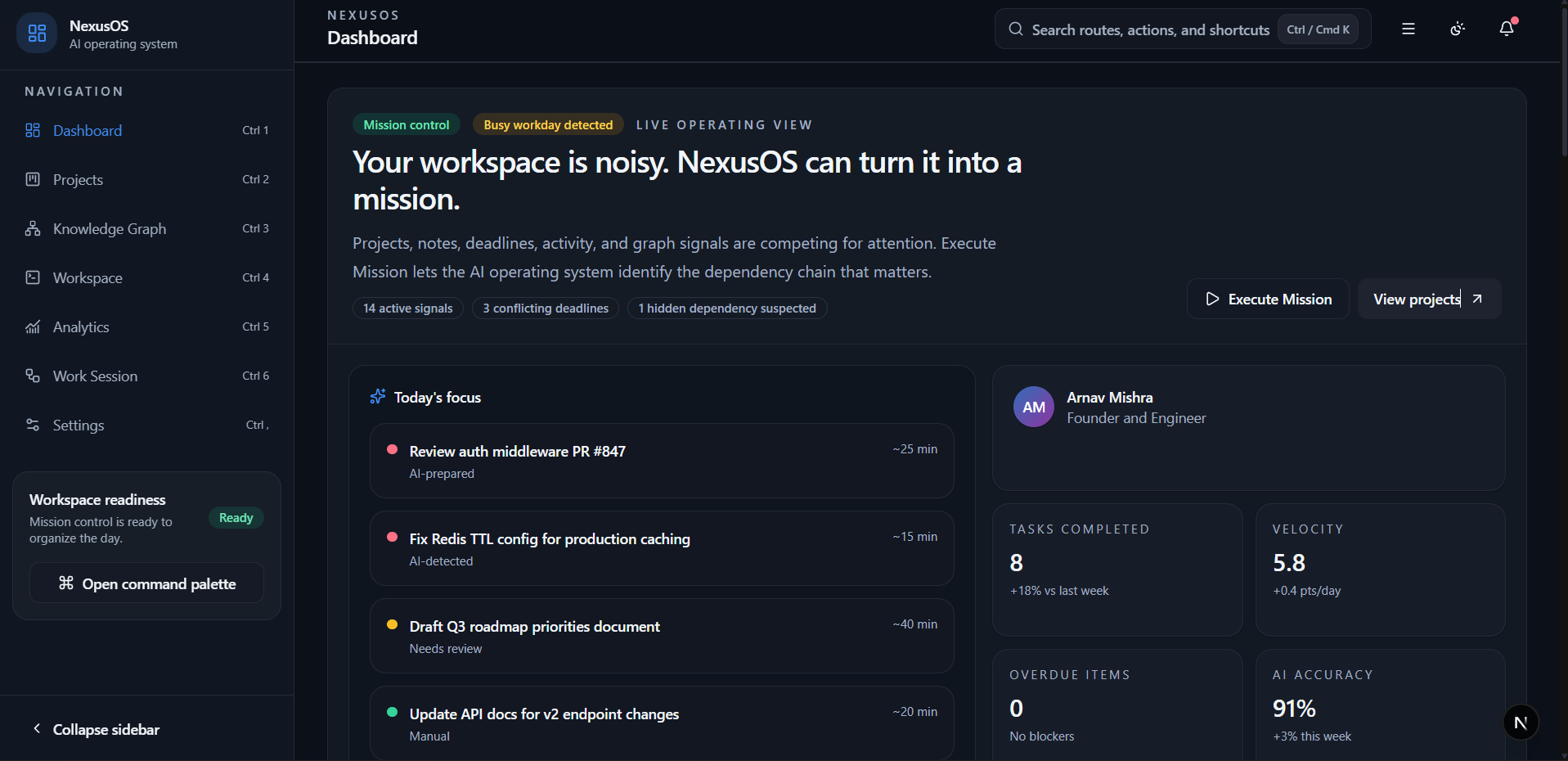
The idea behind NexusOS came from that frustration. I wanted something that could understand the state of my workspace, connect information across different sources, and answer a much more useful question: "Given everything that's going on, what should I do next, and why?" That became the foundation for NexusOS.
What it does
NexusOS is an AI operating system for knowledge work.
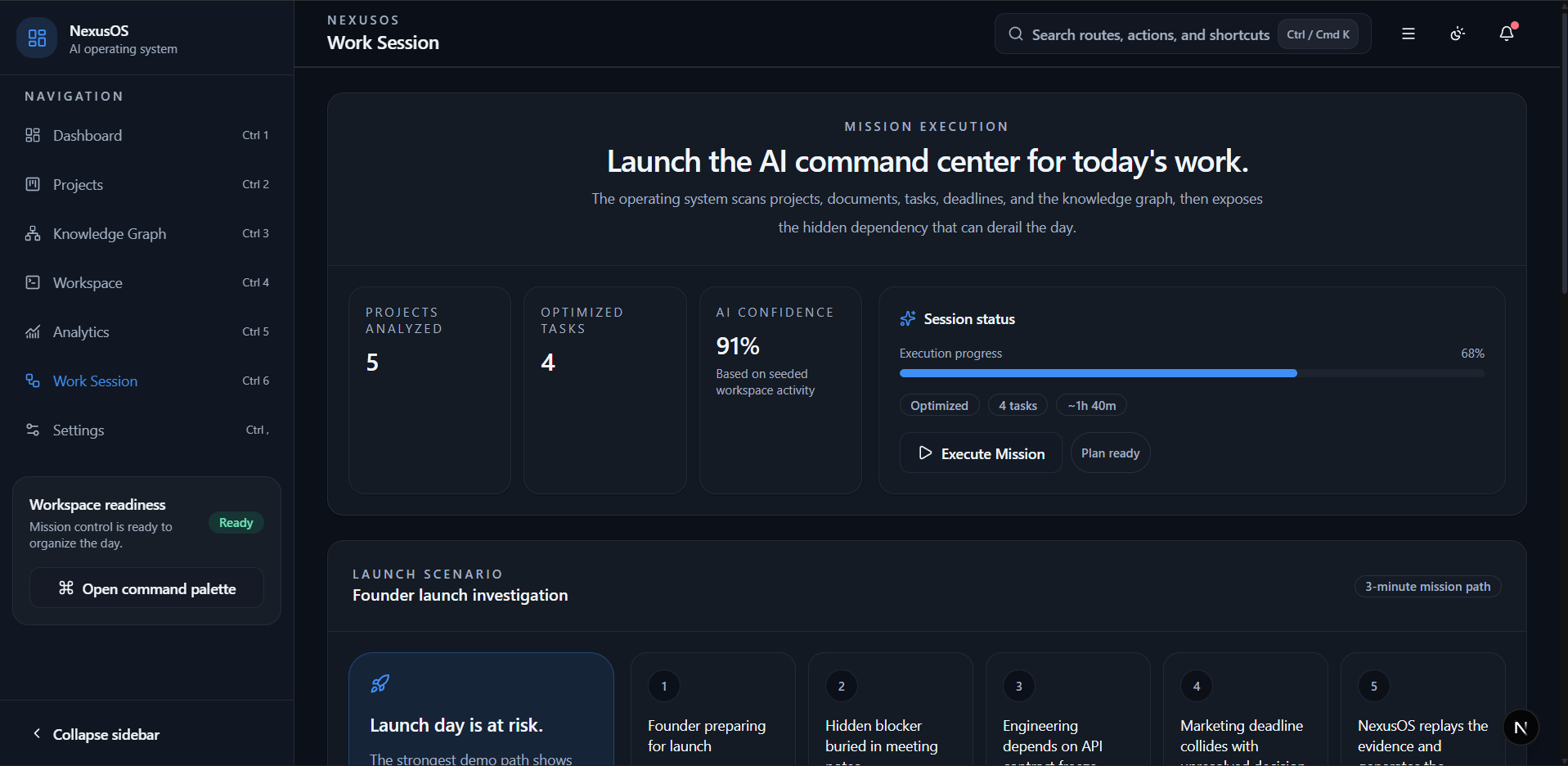
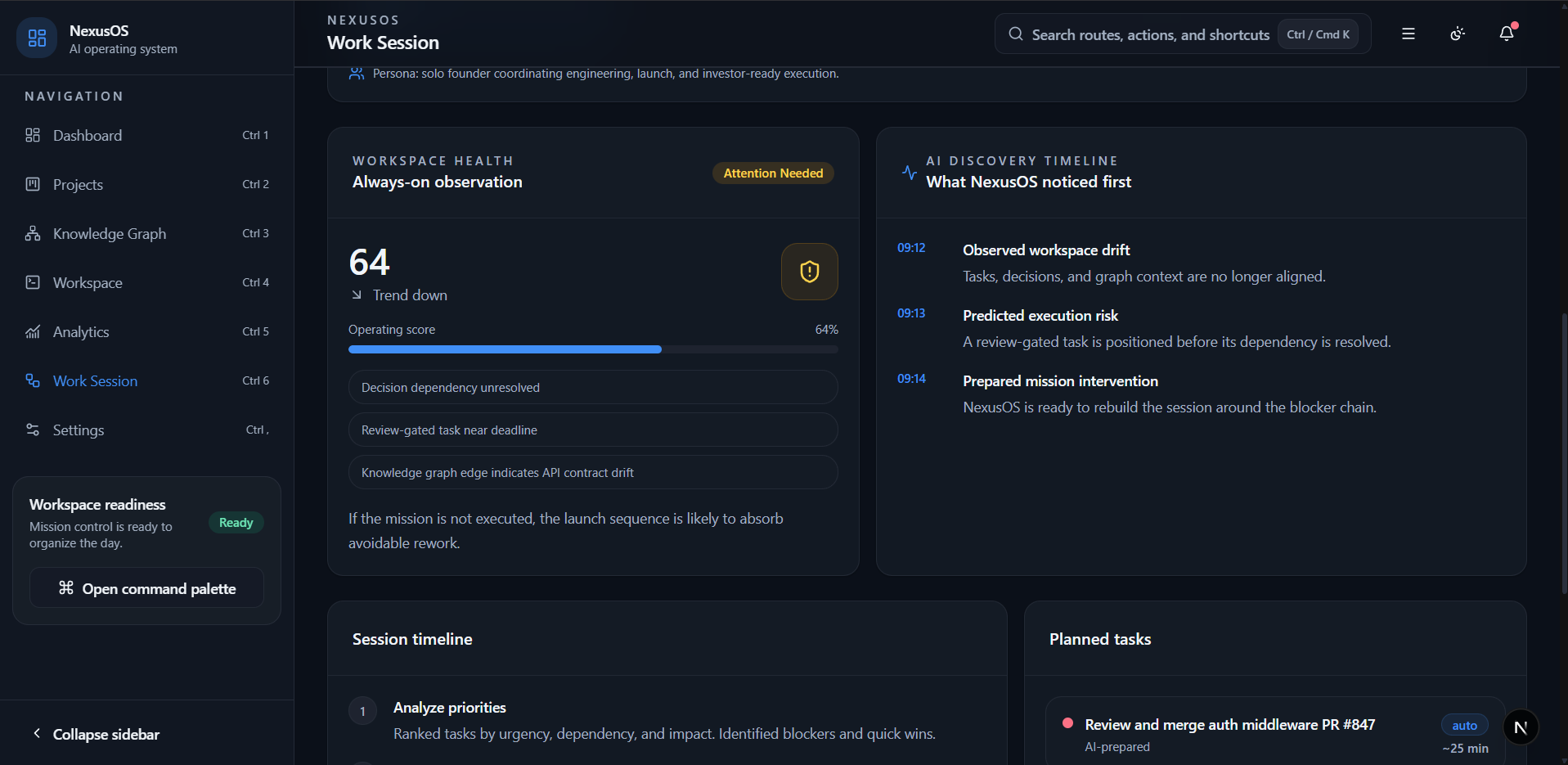
Instead of acting like another chatbot, it observes the current workspace, analyzes projects, tasks, documents, analytics, and relationships inside a knowledge graph, then turns all of that context into an actionable mission. Rather than asking users to trust a black box, every recommendation is backed by evidence. Mission Briefs, Investigation Replay, the Evidence Graph, and the After Action Report all explain what the system found, why it matters, and how it arrived at its recommendation.
How we built it
I built NexusOS as a pnpm monorepo using Next.js, React, TypeScript, Prisma, PostgreSQL, and a shared package architecture.
The AI layer is organized as a set of specialized agents that each focus on a different part of the workspace: project analysis, task prioritization, knowledge analysis, risk detection, execution planning, insight generation, and recommendations. Their outputs are combined into a structured work session instead of a single chat response.
GPT-5.6 is responsible for the reasoning layer through the OpenAI Responses API, using structured outputs so results can be validated before they're shown in the interface. Codex became part of the development process rather than just a coding assistant. It helped scaffold features, review architecture, refactor components, improve testing, organize the repository, strengthen documentation, and prepare the project for release.
Codex was essential for hardening the repository, organizing documentation, improving CI, auditing the workspace, and preparing the project for public release.
Challenges we ran into
The biggest challenge wasn't getting AI to generate recommendations—it was making those recommendations trustworthy.
Early versions felt like a smart task manager, but it wasn't obvious why the AI was suggesting something. That pushed me to redesign the experience around evidence instead of answers. Every important recommendation now points back to supporting context through Investigation Replay, the Evidence Graph, and the Mission Brief.
Another challenge was turning what started as a hackathon project into something that actually felt like a real product. A surprising amount of time went into improving documentation, testing, repository organization, CI, and the overall developer experience.
Accomplishments that we're proud of
I'm most proud that NexusOS doesn't stop at being another AI chat interface.
It brings together a multi-agent reasoning pipeline, explainable recommendations, a polished frontend, a typed backend, structured AI outputs, and a repository that someone else can actually clone and run.
By the end of the project, it felt much closer to a product than a prototype.
What we learned
One lesson stood out more than anything else: People don't trust AI because it gives answers. They trust it when they can understand where those answers came from.
Building features like Investigation Replay and the Evidence Graph reinforced that explainability isn't just a technical feature—it directly changes how confident users feel about acting on AI recommendations.
I also gained a much greater appreciation for release engineering. A clean repository, good documentation, reproducible builds, and a polished README are just as important as writing the code itself.
What's next for NexusOS
The current version focuses on demonstrating the core operating-system experience, but there are several directions I'd like to explore next. The biggest step would be integrating with real productivity tools like GitHub, Google Workspace, Slack, Notion, and Linear so NexusOS can reason over live workspace data instead of seeded examples.
Beyond that, I'd like to add collaborative mission planning, persistent AI session history, richer knowledge graph exploration, stronger evaluation tooling for agent performance, and production deployment. The long-term goal is to move from an AI assistant that responds to requests to an AI system that continuously understands the state of work and helps people make better decisions before problems become blockers.
Built With
- codex
- css
- gpt-5.6
- next.js
- openai
- pnpm
- postgresql
- prisma
- react
- tailwind
- turborepo
- typescript

Log in or sign up for Devpost to join the conversation.