Inspiration
In modern manufacturing, reactive maintenance is a multi-billion dollar problem. When heavy-duty industrial machines—like turbines, CNC mills, or high-capacity motors—fail unexpectedly, it triggers a catastrophic chain reaction of unplanned downtime, disrupted supply chains, and massive repair costs.
We noticed that current "smart" factories often rely on simple threshold-based alerts (e.g., "Alert: Temperature > 90°C"). By the time these alerts trigger, the damage is already done. Engineers are left scrambling to manually diagnose the root cause while the factory floor bleeds money by the minute. We wanted to build something that fundamentally changes this paradigm from reactive panic to proactive, autonomous foresight.
What it does
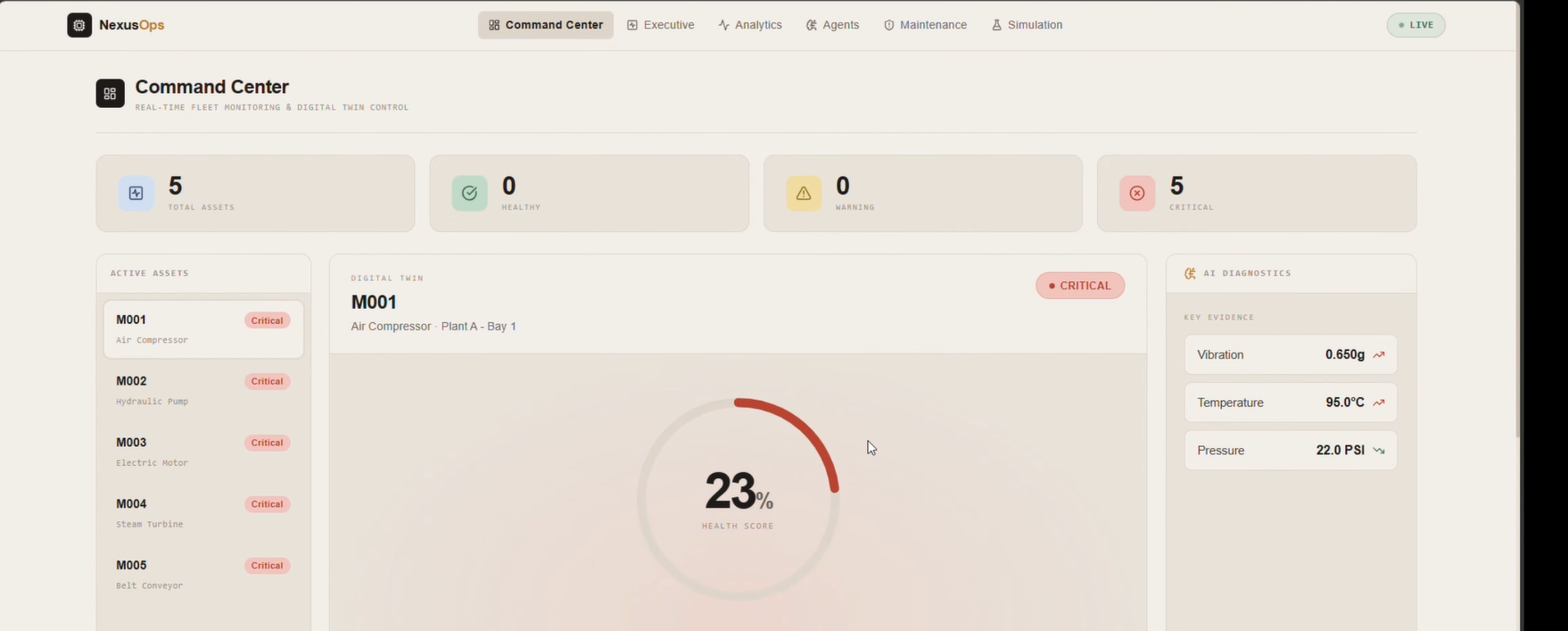
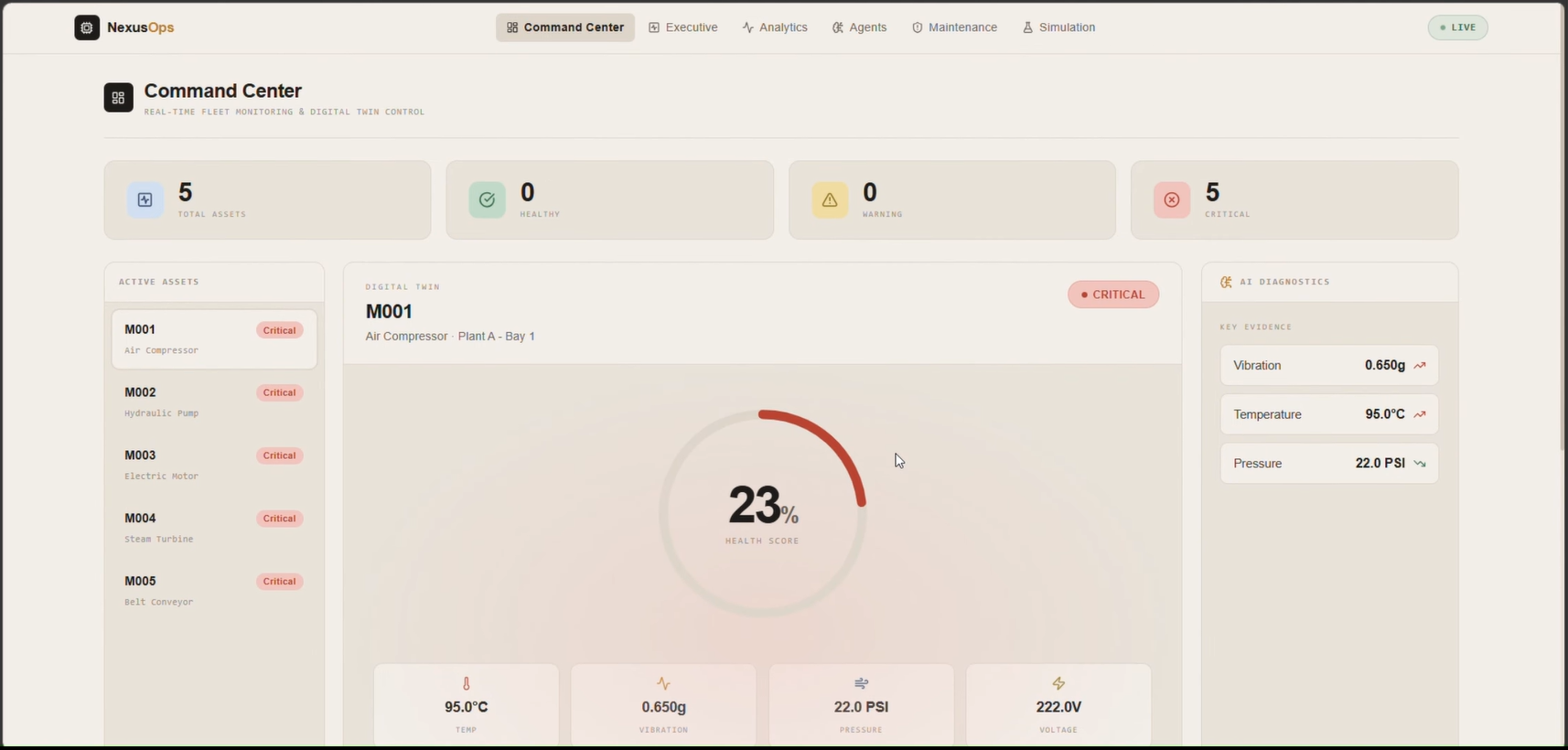
NexusOps transforms industrial monitoring into a proactive, autonomous intelligence platform. By leveraging live-streaming Digital Twins and a Swarm of AI Agents, it doesn't just tell you when a machine is breaking—it predicts the failure before it happens, diagnoses the root cause, calculates the financial impact, and autonomously drafts the repair schedule.
Our multi-agent workflow consists of four specialized AI agents:
- Monitoring Agent: Continuously watches real-time streaming telemetry (vibration, temperature, RPM) to detect statistical anomalies.
- Diagnosis Agent: Correlates anomalies with historical fault patterns (e.g., distinguishing early-stage Bearing Wear from Lubrication Failure).
- Planner Agent: Calculates the financial risk of failure against the cost of early maintenance to propose an optimal repair schedule.
- Approval Agent: Generates a human-readable maintenance ticket and requests executive sign-off.
How we built it
We designed NexusOps to be enterprise-ready, highly scalable, and fully containerized via Docker Compose.
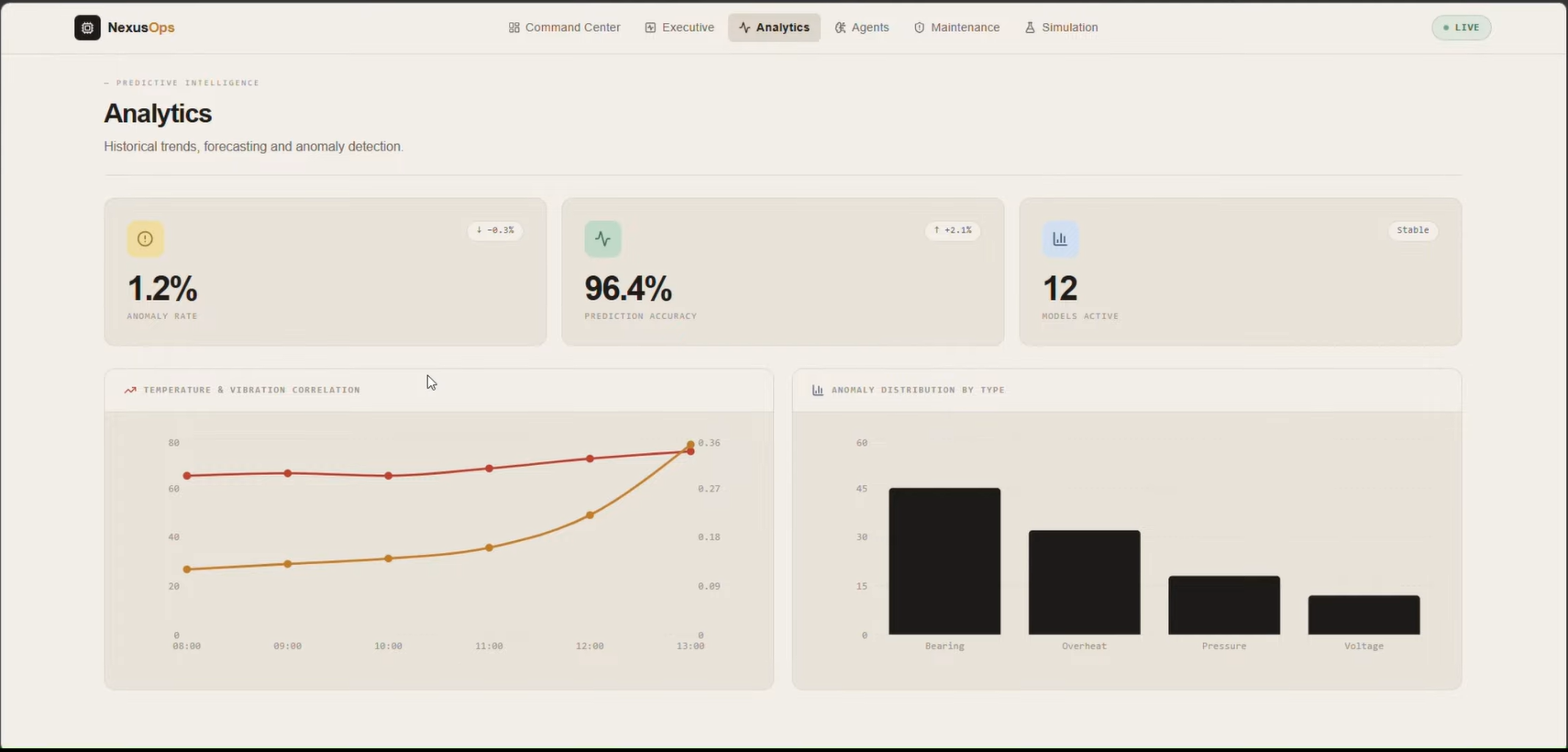
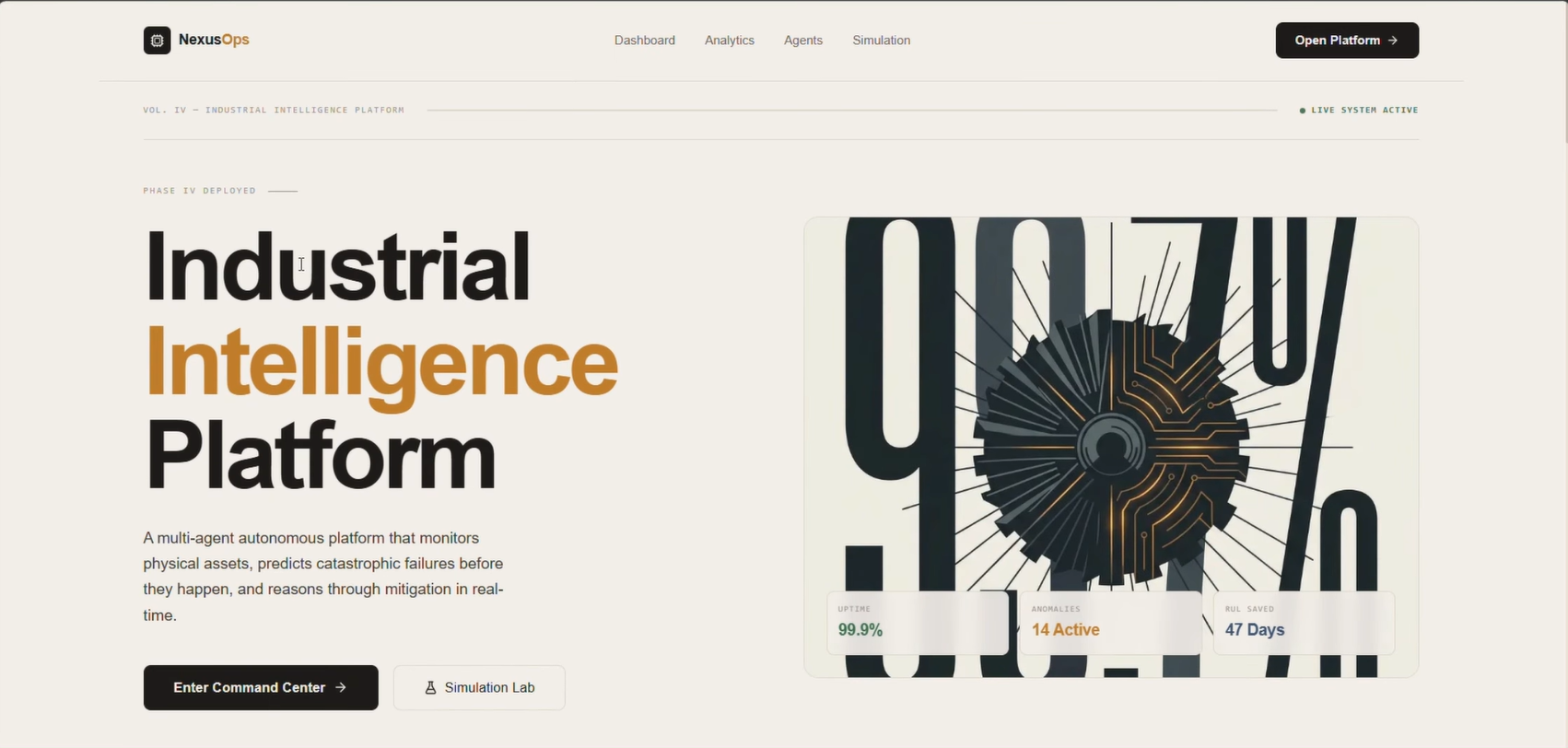
- Frontend: We used Next.js (App Router) for a robust foundation. For styling, we utilized Tailwind CSS v4 to build a sleek, NASA-style command center that maximizes situational awareness. To bring the UI to life, we integrated Framer Motion for micro-animations and Recharts for real-time telemetry visualizations.
- Backend: Our core API and agent logic run on Python and FastAPI, with WebSockets ensuring zero-latency real-time streaming of sensor data.
- Simulation Engine: Because testing on real factory equipment is difficult, we built a detached Python service that generates synthetic baseline and degradation telemetry. This acts as our "Fault Injection Simulation Lab," allowing us to test our agent swarm under various catastrophic scenarios (like pressure leaks or rotor imbalance).
- Data Layer: We use PostgreSQL to persist state, store the reasoning traces of our AI swarm, and manage maintenance tickets.
Challenges we ran into
The most significant challenge was orchestrating the multi-agent swarm in real-time. We had to ensure that the Monitoring Agent could process high-frequency WebSocket data without lagging, while simultaneously passing potential anomalies downstream to the Diagnosis Agent. Synchronizing state across independent agents while keeping the frontend UI perfectly responsive required careful architecture of our WebSocket managers and database locking mechanisms.
Additionally, modeling realistic degradation telemetry for the Simulation Engine required diving deep into industrial physics to make sure our fault injections (like slowly increasing vibration matched with spiking temperature) were realistic enough to truly test the AI.
Accomplishments that we're proud of
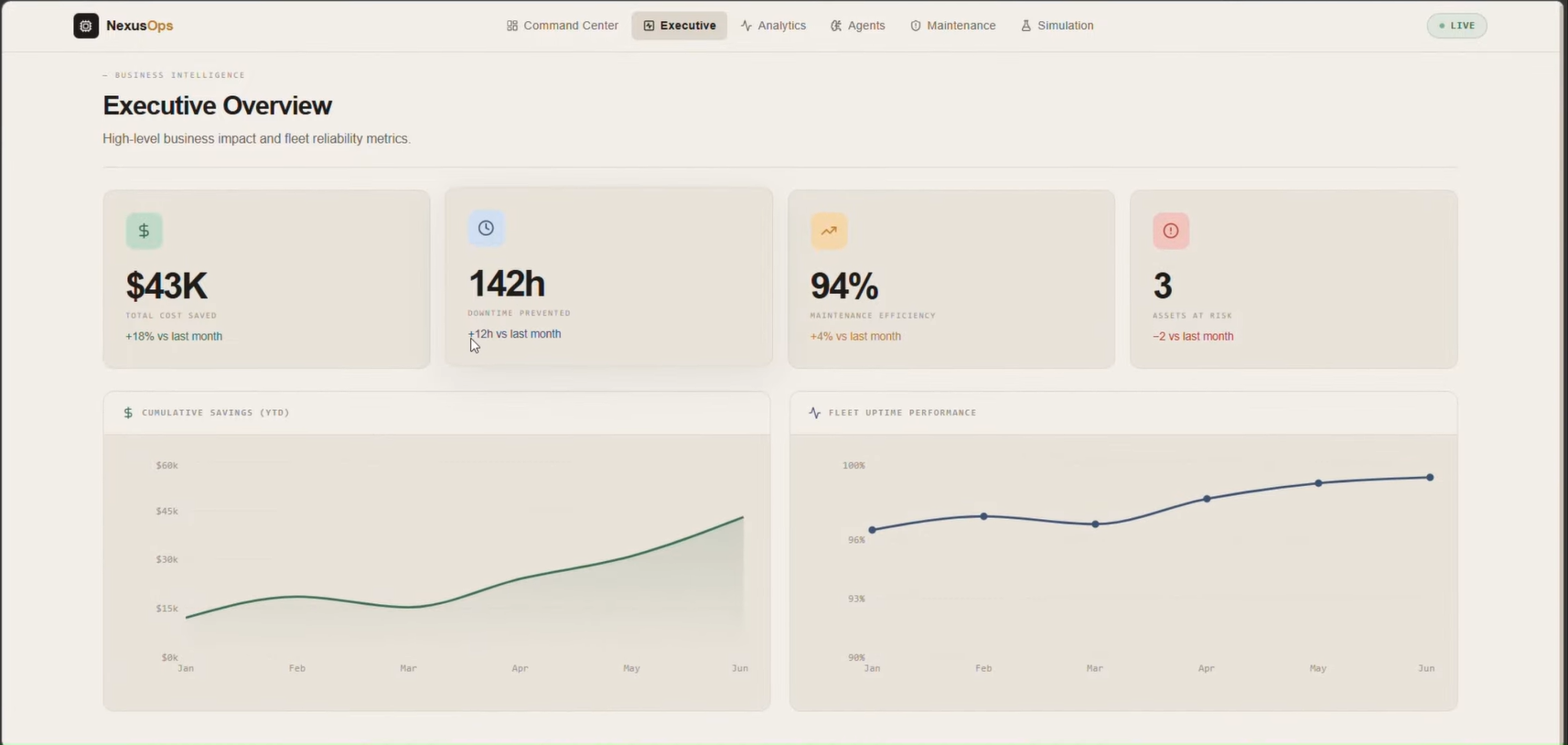
We are incredibly proud of the Executive Impact Dashboard, which bridges the gap between engineering and business. Translating raw vibration anomalies into a metric like "Total Dollars Saved" or "Downtime Prevented" gives executives an immediate, tangible understanding of the AI's value. We're also proud of the Fault Injection Demo Sequence, which automatically walks users through a machine degrading and the entire AI Swarm stepping in to save the day!
What we learned
We learned a tremendous amount about real-time data streaming and WebSocket optimization in FastAPI. We also gained deep insights into designing AI agents that don't just act as chatbots, but as distinct microservices that communicate, share context, and execute sequential logic autonomously. Designing a UI that displays dense industrial data without overwhelming the user taught us a lot about minimalist design and spatial hierarchy.
What's next for NexusOps
We plan to integrate with actual industrial IoT hardware (like Raspberry Pi-based vibration sensors) to move beyond our simulation engine and run NexusOps on physical machines. We also want to introduce federated learning so the AI Swarm can learn from machine failures across different factories while keeping proprietary data localized and secure.
Built With
- docker
- fastapi
- framer-motion
- next.js
- postgresql
- python
- tailwind.css
- websockets

Log in or sign up for Devpost to join the conversation.