-
Systems Architecture
-
Inspiration
Most Network-Attached Storage (NAS) devices are digital black holes. Professionals, creators, and remote teams dump terabytes of sensitive raw files—PDF invoices, research papers, contracts, audio transcripts, and codebases—into local storage, where they sit unindexed, siloed, and search-resistant.
Existing AI search solutions force a painful compromise: either upload your proprietary, sensitive intellectual property to third-party cloud APIs (sacrificing absolute data privacy) or settle for clunky, manual keyword search. We built NexusGraph AI to solve this fundamentally: by transforming passive local storage into an active, self-synthesizing knowledge ecosystem that runs 100% air-gapped on UGREEN AI NAS hardware.
What it does
NexusGraph AI is an autonomous local intelligence skill native to UGOS that turns unorganized local UGREEN NAS directories into a self-updating, vector-indexed Knowledge Graph.
Instead of forcing you to hunt for files, NexusGraph AI works proactively in the background:
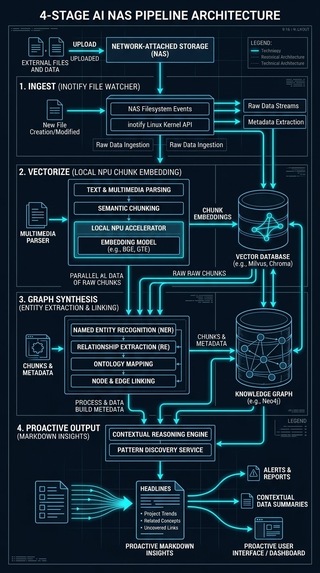
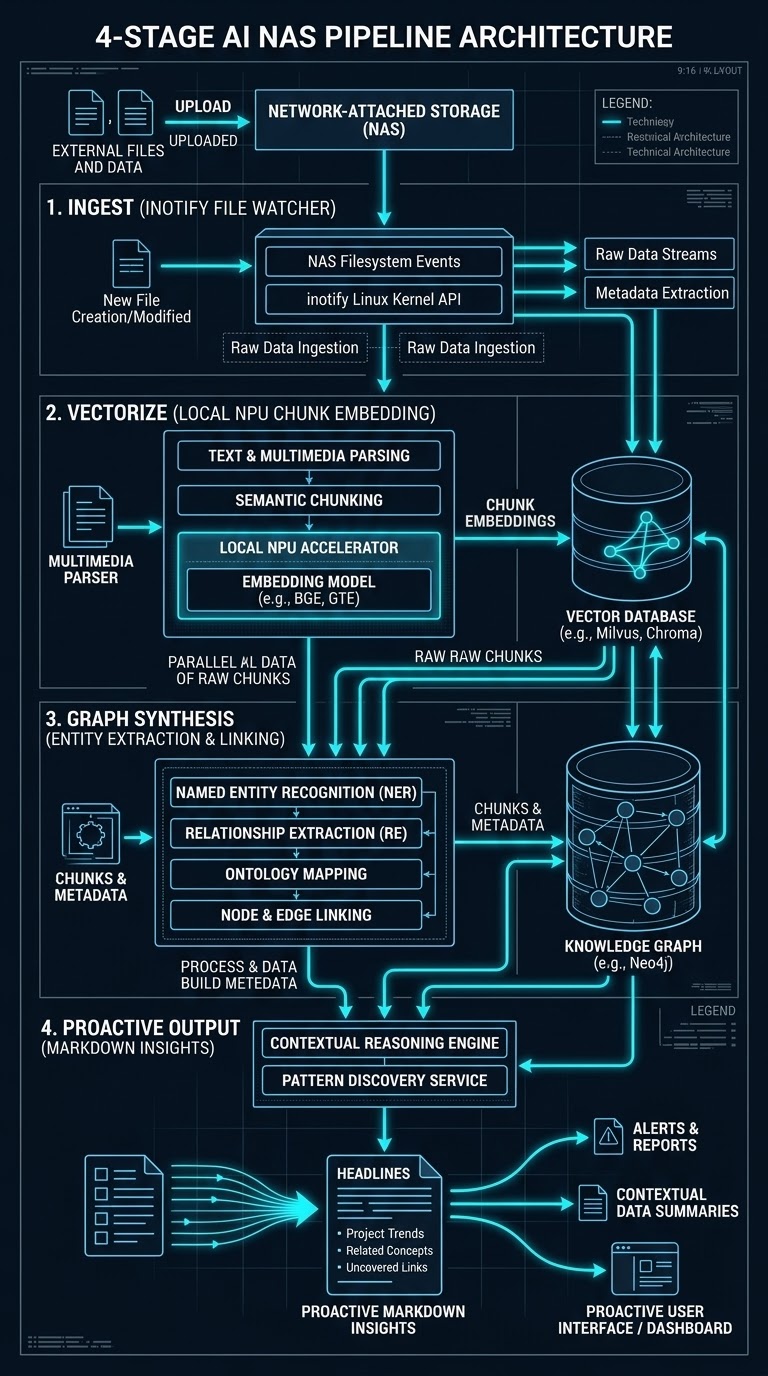
- Continuous Ingestion: Monitors local directories via file-system event daemons (
inotify). - Hardware-Accelerated Vectorization: Segments multi-modal documents and computes local vector embeddings using the NAS's local CPU/NPU execution context.
- Graph Synthesis: Correlates new data against existing nodes, extracting relational entities (people, projects, liabilities, timelines).
- Proactive Output: Automatically generates structured markdown briefings and saves them directly to a designated
/_NexusInsights/folder (enforcing strict user approval safeguards).
How we built it
We engineered NexusGraph AI as a modular, zero-cloud-egress micro-architecture complying strictly with the Uliya Skill Development Standard:
- Core Backend & CLI: Built using Python and FastAPI wrapped in a custom
ugos-cliinterface for local execution. - Vector Storage & Embeddings: Utilizes lightweight local databases (SQLite with vector capabilities) and quantized embedding frameworks (Sentence-Transformers / PyTorch) running entirely on local hardware.
- Expert Agent Orchestration: Implemented a deterministic 4-stage pipeline mapped to Uliya expert agents via delegation (
delegate --target <agent-id> --instruction '<task>'):file-management-agentfor filesystem observation and staging.document-processing-agentfor chunking and NPU embedding.knowledge-retrieval-agentfor entity extraction and graph synthesis.system-monitoring-agentand safety controllers for resource throttling.
Challenges we ran into
- Resource Throttling under Heavy Ingestion: Bulk-ingesting hundreds of high-resolution PDFs and audio files threatened to spike local RAM and NPU utilization. We resolved this by implementing an adaptive batch scheduler that monitors system load and automatically throttles execution if resource utilization exceeds 85%.
- Deterministic Edge Case Handling: Dealing with corrupted binary files, empty search results, and recursive symlink loops during directory crawls required robust error-isolation. We established an immutable
error_manifest.logprotocol to quarantine failures without crashing background daemon loops.
Accomplishments that we're proud of
- True Data Sovereignty: Delivering a complex multi-modal intelligence layer that operates completely air-gapped without leaking a single byte of user data to external cloud servers.
- Seamless UGOS Native Integration: Successfully designing an autonomous agent mesh that fits cleanly into the Uliya Skill framework, balancing automated background execution with strict user approval gates for file writes.
What we learned
- The Power of Edge Compute: Modern NAS hardware (such as the UGREEN iDX6011 Pro) possesses more than enough local muscle to run sophisticated vector indexing and graph synthesis locally, eliminating cloud dependency entirely.
- Guardrails in Autonomous Agents: Enforcing strict approval states (
waiting_approval) is essential when building AI tools that interact directly with local file systems, ensuring user trust and preventing accidental file overwrites or modifications.
What's next for NexusGraph AI - Sovereign Knowledge Fabric
- Multi-Modal Media Extension: Expanding local ingestion to handle real-time audio transcript parsing and video keyframe extraction for creators and surveillance archives.
- Advanced Graph Reasoning: Introducing automated cross-document compliance auditing, financial liability reconciliation, and smart contract tracking.
- SkillHub Deployment: Publishing the refined package directly to the official UGREEN Skills Hub for global deployment.

Log in or sign up for Devpost to join the conversation.