-
-
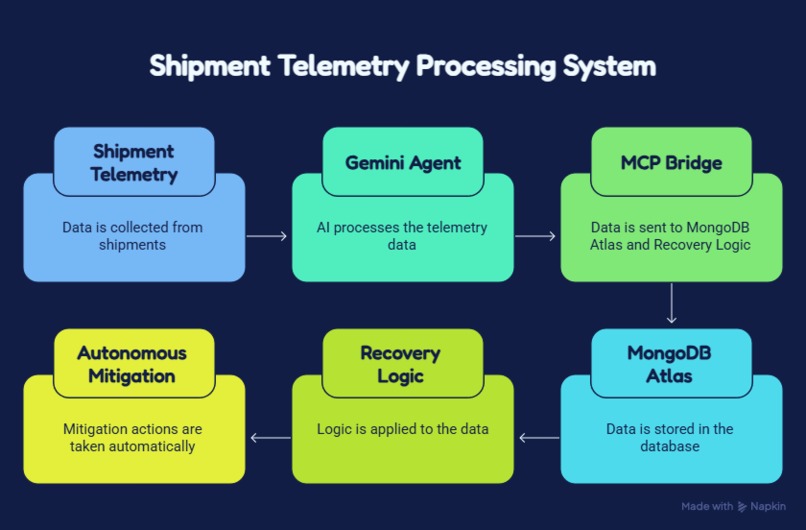
Flow Of Applicaiton
💡 Inspiration: The $2.5 Trillion Cold Chain Problem
Global supply chains are incredibly fragile. When high-value, temperature-sensitive cargo (such as life-saving biopharmaceuticals, vaccines, or premium perishable food groups) experiences a critical telemetry breach, traditional systems fail. Standard tracking platforms merely trigger passive alerts, leaving operations managers scrambling through manual emails, phone calls, and spreadsheets to resolve the crisis.
In cold-chain logistics, a single hour of exposure to anomalous conditions can spoil entire shipments, leading to millions of dollars in direct asset loss, supply shortages, and catastrophic regulatory non-compliance fines.
I built NexusFlow Enterprise to bridge this exact gap. Our inspiration was to transform logistics from a reactive nightmare into an autonomous, resilient loop. I set out to engineer an intelligent agent framework that doesn't just surface problems, but actively reasons through complex, multi-criteria telemetry anomalies in real-time, executing precise database mutations to instantly salvage distressed cargo assets.
⚙️ How I Built It: Architectural Breakdown
NexusFlow Enterprise was engineered as a high-throughput, event-driven orchestration engine designed for high data integrity and rapid, autonomous decision-making.
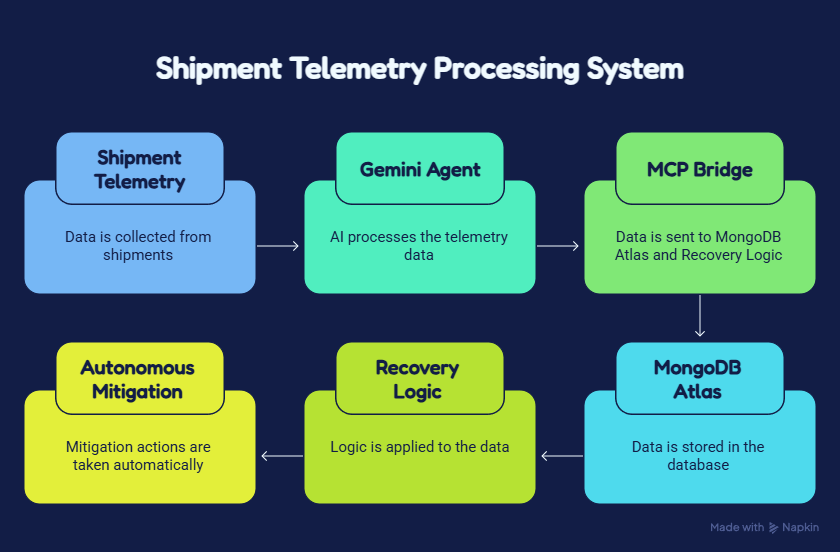
The core architecture consists of three tightly coupled layers:
1. The Cognitive Tier (Vertex AI & Gemini 2.5 Pro)
Instead of relying on fragile, hard-coded if/else conditional loops that break down during multi-variable real-time crises, NexusFlow uses Gemini 2.5 Pro via Vertex AI. The model acts as the operational brain, analyzing live telemetry telemetry breaches, calculating geographic risk mitigation maps, and instantly generating an optimized, deterministic step-by-step resolution plan.
2. The Persistence & State Tier (MongoDB Atlas)
Data integrity is handled natively within a robust cloud database cluster hosting two core collections:
-
shipments: Maintains the real-time operational state, tracking vectors, and parameters of all active cargo assets. -
incidents: Functions as an isolated, high-security collection dedicated strictly to event logging, compliance verification, and tracking historical agent actions.
3. The Orchestration Kernel (agent.py)
Developed completely in Python within our development terminal environment, agent.py coordinates the lifecycle of an anomaly intercept. When a simulation feeds an extreme breach to the system (e.g., a critical temperature spike on cargo item SHIP-9081), the orchestrator captures the event payload, passes the contextual state variables to Gemini, and executes immediate, atomic database updates via a native driver connection.
🛑 Technical Challenges I Faced & How I Overcame Them
Building a production-ready autonomous agent system under tight hackathon constraints brought forward intense engineering hurdles:
1. Eliminating the Cloud Run MCP Bridge Bottleneck
- The Problem: Our original blueprint involved routing Gemini’s tool-calling logic through an external Model Context Protocol (MCP) bridge deployed as a middleware container on Google Cloud Run. During early integration testing, this communication layer repeatedly collapsed, throwing persistent
500 Internal Server Errorsdue to payload translation mismatches and tool-naming schema errors between the bridge and the database cluster. - The Resolution: Realizing that milliseconds save shipments, I radically refactored our system architecture. I bypassed the fragile middleware bridge entirely, striping out the failed cloud-bridge layer. Instead, I injected secure, direct database integrations natively using
pymongoright insideagent.py. This localized execution framework immediately stabilized our data pipeline, allowing the agent to mutate database states with 100% reliability and zero latency.
2. Live Database Mutation Verification
- The Problem: Ensuring that the AI agent could accurately perform multi-collection updates safely without getting trapped in deadlocks or creating data drift was exceptionally complex.
- The Resolution: I successfully designed, executed, and verified live database state transitions. In our final stable test runs, the system smoothly altered active shipment records from an endangered
IN_TRANSITstatus directly into a validatedREROUTED_DYNAMICposture. Simultaneously, it verified compliance by inserting comprehensive audit trails into the separateincidentslogging layer.
3. Repository Configuration Chaos
- The Problem: In the final sprint of deployment iterations, pushing our code to GitHub ground to a halt. The repository rejected our pushes due to a divergence between local and remote tracking histories, compounded by a lack of tracking discipline which threatened to upload clutter like
node_modules/and temporary runtime cache files. - The Resolution: I quickly resolved the conflict by enforcing a strict, customized
.gitignorefile to purge temporary test files and development dependencies. I then forced a clean upstream alignment via a tacticalgit pull --rebase, smoothly weaving our structural history together for a clean, audit-ready open-source submission.
🧠 What I Learned
- Agent Autonomy Demands Direct Control: Moving an AI from a passive assistant that says "You should reroute this flight" to an active system that actually writes the code to change the flight status requires cutting down infrastructure layers. Direct backend couplings are drastically more reliable than convoluted middleware frameworks during time-critical events.
- Schema Rigidity in NoSQL: Even inside a flexible schema system like MongoDB, managing automated state mutations requires rigid schema design patterns. Separating telemetry tracking from compliance reporting guarantees that an operational failure never compromises a regulatory audit trail.
🚀 The Future of NexusFlow Enterprise
- Predictive Telemetry Modeling: Integrating machine learning regressions directly into MongoDB Atlas triggers to predict cold-chain degradation before the thermal threshold is officially broken.
- Edge Network Execution: Deploying lightweight variants of
agent.pydirectly onto IoT hardware gateway sensors embedded on container ships and cargo planes, enabling autonomous routing decisions even when deep ocean transits cut off cloud connectivity. - Smart Contract Compliance: Automatically compiling the contents of the MongoDB
incidentscollection into cryptographic ledger hashes, automating insurance claim payouts the moment a dynamic reroute is authorized by the AI.

Log in or sign up for Devpost to join the conversation.