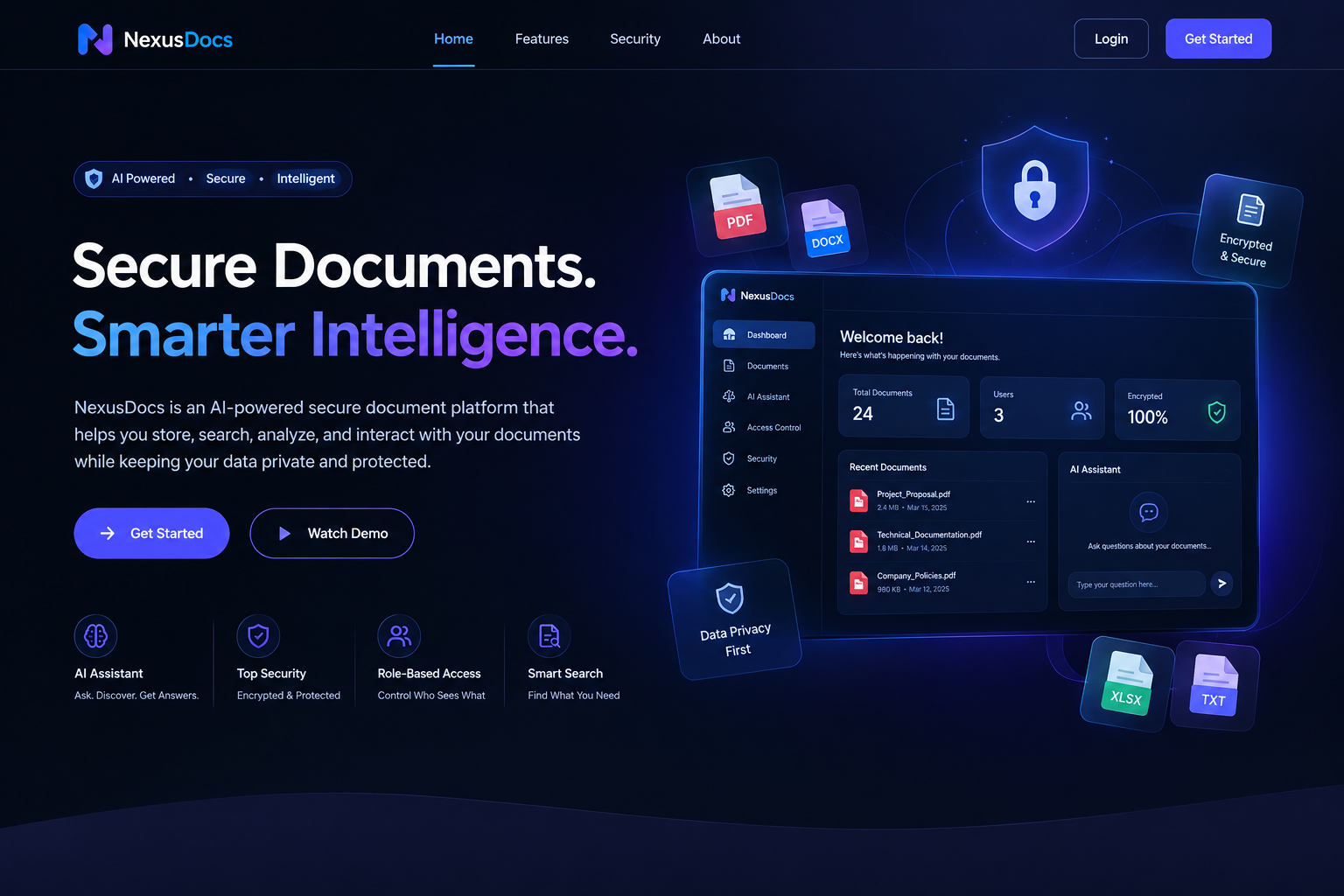
NexusDocs – Secure Enterprise Document Search & AI Assistant
Inspiration
The inspiration behind NexusDocs came from a simple question: Can organizations use AI to understand their confidential documents without putting their sensitive information at risk?
Organizations manage large collections of documents, and finding specific information manually can be time-consuming. Although AI makes information retrieval easier, sharing confidential documents with external AI services creates privacy and security concerns.
I wanted to explore a solution that brings AI-powered document intelligence and cybersecurity together in one platform.
What it does
NexusDocs is a privacy-focused document management platform that allows authenticated users to upload, search, analyze, and interact with their documents using AI.
Its key capabilities include:
- AI Document Assistant: Ask questions and get context-based answers from uploaded documents.
- Hybrid RAG: Combines Google Gemini with a local retrieval fallback.
- Encrypted Storage: Protects uploaded documents using Fernet encryption.
- Role-Based Access Control: Provides separate permissions for Administrators, Standard Users, and Auditors.
- Data Loss Prevention (DLP): Detects and redacts sensitive information before sending document excerpts to external AI services.
- Secure Authentication: Includes bcrypt password hashing, secure session cookies, and login rate limiting.
How we built it
NexusDocs was developed using a Python FastAPI backend and a responsive frontend built with HTML, CSS, JavaScript, and Bootstrap.
The backend handles authentication, document processing, encryption, access permissions, and AI integration.
We implemented Retrieval-Augmented Generation (RAG) to retrieve relevant document information and provide context-aware responses. Google Gemini handles AI-powered generation when enabled, while a local retrieval mechanism provides an alternative when external AI is unavailable.
For security, uploaded files are encrypted before being stored, and a DLP mechanism helps prevent sensitive information from being exposed during external AI processing.
Challenges we faced
One of the biggest challenges was balancing AI functionality with document privacy.
We needed to make sure sensitive information was protected while still allowing the AI assistant to provide useful responses. Implementing document encryption, role-based access control, and sensitive-data redaction required careful backend design.
Another challenge was developing a hybrid AI approach that could support both external AI generation and local document retrieval.
What we learned
Building NexusDocs helped us explore practical applications of artificial intelligence and cybersecurity.
We gained experience with:
- Building REST APIs using FastAPI.
- Understanding and implementing Retrieval-Augmented Generation.
- Integrating external AI services.
- Implementing document encryption and secure authentication.
- Managing role-based permissions.
- Understanding Data Loss Prevention and sensitive information handling.
- Connecting frontend interfaces with backend services.
What's next for NexusDocs?
Our vision is to make NexusDocs a more advanced and scalable secure document intelligence platform.
Future improvements may include more advanced semantic search, enhanced document analytics, stronger audit capabilities, support for additional document formats, and more sophisticated security monitoring.
NexusDocs brings intelligence and security together because accessing information should never mean compromising privacy.
Built With
- artificial-intelligence
- bootstrap
- css3
- cybersecurity
- data-privacy
- document-management
- encryption
- fastapi
- google-gemini
- html5
- javascript
- language
- natural
- python
- rag
- rest-api

Log in or sign up for Devpost to join the conversation.