About This Project
Inspiration
I created AIWoven to address a pain point I personally experienced early in my university studies. Many professors lecture at a rapid pace; as a student who wanted to both listen attentively and capture key points, I found it difficult to keep up with the fast-paced delivery while taking notes, often causing me to miss important explanations.
While there are many AI tools on the market that address parts of this problem—such as generating notes from lecture recordings, creating flashcards, summarizing PDFs, or providing access to various AI models—their drawbacks are evident. Free usage limits are often very strict, and useful features are scattered across different websites, each solving only a piece of the puzzle. Furthermore, advanced features often come with a high price tag, and many services either lack free trials or offer insufficient free allowances. Instead of boosting efficiency, this fragmented experience forces users to constantly switch between multiple platforms—a frustration I know all too well.
My goal with AIWoven was to integrate all these useful features into a single platform, eliminating the need for users to visit multiple sites. I also wanted to make it accessible to students for free whenever possible.
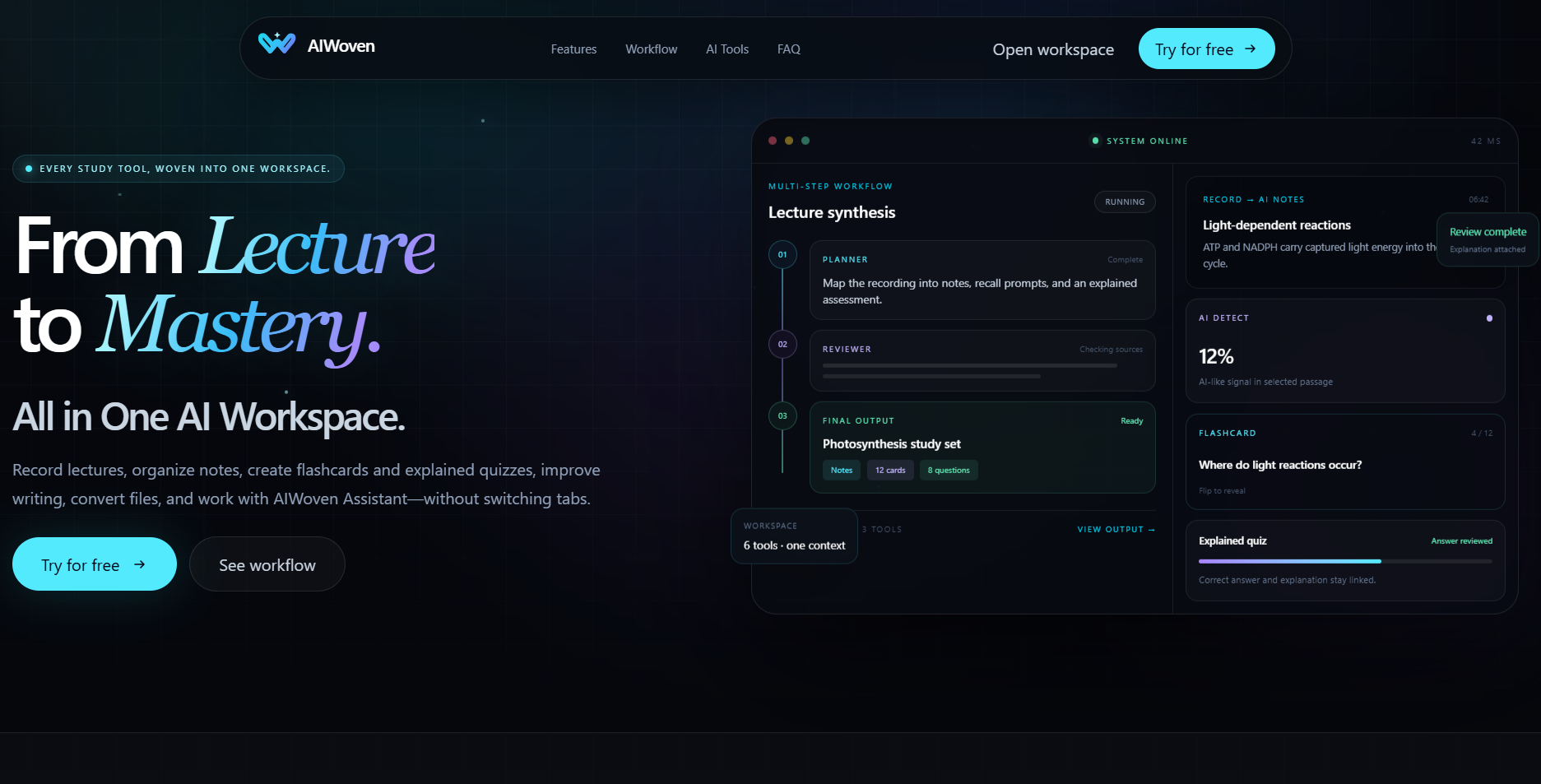
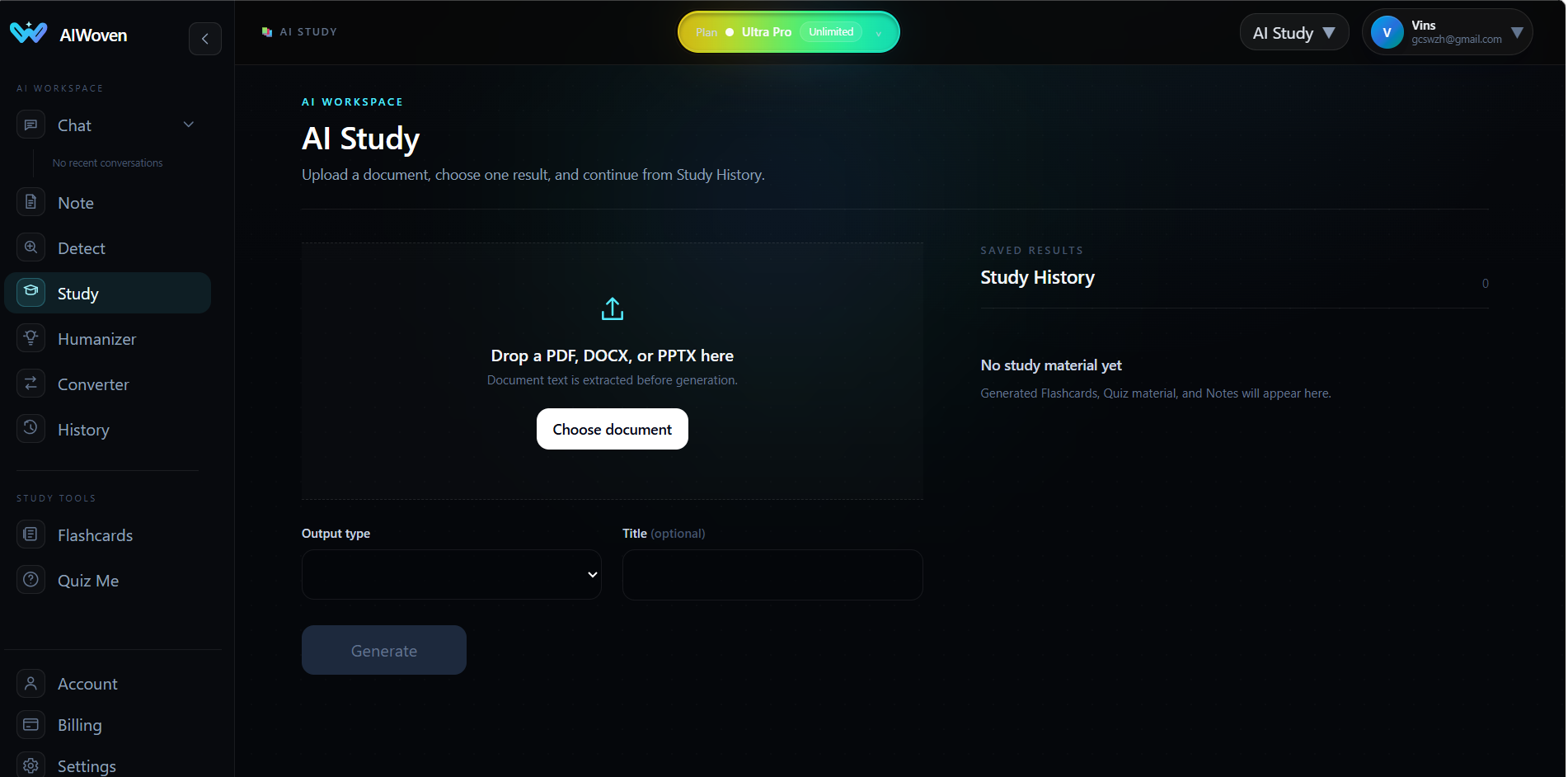
With AIWoven, students simply need to start the AI note-taking feature at the beginning of class. This allows them to focus on the lecture without constantly looking down to take notes, ensuring they don't miss key information. After class, they can stop recording, and the system automatically converts the audio into organized, logically structured notes. These notes (or the professor's slides) can be directly imported into "AI Study" mode, which generates quizzes, flashcards, or study materials tailored to the student's needs.
Ultimately, AIWoven was born out of a desire to solve challenges that both I and many of my classmates faced in our daily studies.
Achievements During OpenAI Build Week
AIWoven was already my primary project prior to OpenAI Build Week, but the event provided an opportunity to significantly enhance the product using GPT-5.6 and Codex.
I engaged in in-depth natural language dialogues with GPT-5.6 to outline specific product adjustments—covering areas such as user experience, modular management, and UI layout. I prompted GPT-5.6 to ask follow-up questions to ensure a full understanding of my requirements, ultimately tasking it with generating high-value, clearly structured prompts for Codex—a process commonly known as prompt engineering.
Leveraging this workflow, I redesigned core components of the application, including unified workspace navigation, an AI note-taking assistant, AI-driven learning flows, flashcards, a "Quiz Me" feature, and numerous UI/UX improvements across the platform. Codex accelerated code implementation, debugging, refactoring, browser testing, and the execution of repetitive engineering tasks; meanwhile, I continuously reviewed the generated code, refined requirements, and validated features before integrating them into the product.
I viewed AI not as an "autopilot" tool, but as an engineering collaborator. This approach allowed me to drastically accelerate iteration speeds while maintaining firm control over product design, architecture, and software quality.
My Build Process
AIWoven is a full-stack AI workspace built using Next.js, TypeScript, Prisma, PostgreSQL, and multiple LLM providers.
Rather than relying on a single AI model, the platform integrates multiple models through a unified interface. Each model plays a specific role—from generating suggestions to formulating actionable plans—and they cross-verify one another to ensure high-quality output. It offers workflows designed specifically for learning, note-taking, research, writing, and AI-assisted productivity.
One of my top priorities was ensuring a seamless flow between features:
Lecture recordings are converted into notes.
Notes are transformed into study materials.
Study materials are turned into quizzes and flashcards.
AIWoven is more than just a standalone AI tool; it creates a comprehensive learning workflow.
Challenges
The most difficult part of the project was building the AI note-taking assistant feature.
Unlike standard chatbot interactions, processing lecture recordings is a time-consuming task. A typical university lecture lasts one to three hours and generates a massive amount of audio data.
Initially, recordings were uploaded as single, large files. This quickly revealed several engineering issues:
Timeout errors during transcription
Excessive memory consumption
Upload failures due to unstable network connections
High API costs caused by long recordings
Database strain from oversized requests
Excessive processing times that severely impacted user experience
As an independent student developer with limited resources and funding, these issues posed the greatest challenges to the project.
To address these problems, I redesigned the recording process.
Instead of uploading massive recording files after class, AIWoven now continuously saves audio segments during the recording session. Once recording ends, these segments are merged into a complete transcript, ultimately generating structured notes. I also implemented automatic silence detection; recording stops automatically when no speech is detected, reducing unnecessary API usage—thereby lowering costs while improving reliability and user experience.
This redesign significantly reduced infrastructure costs and improved stability during actual classroom use. ---
My Takeaways
Developing AIWoven taught me that creating AI products involves far more than simply connecting APIs.
The real challenge lies in building robust systems.
Built With
- codex
- git
- javascript
- next.js
- node.js
- postgresql
- prisma
- stripe
- typescript
- vercel


Log in or sign up for Devpost to join the conversation.