-
-
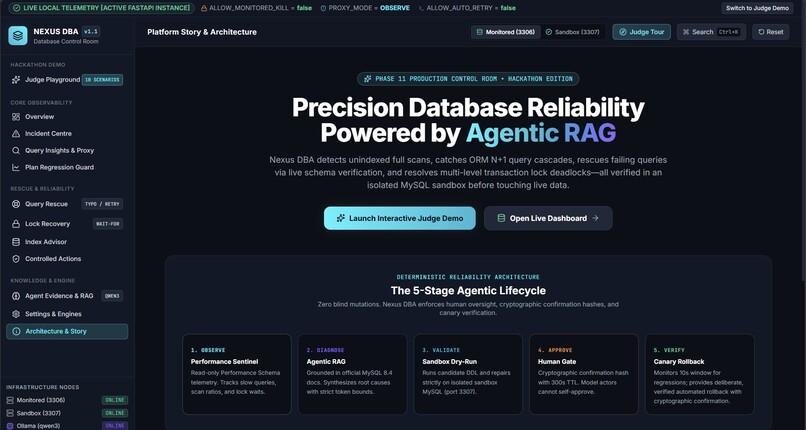
NexusDBA dashboard providing a unified view of database health, query analysis, and AI-assisted optimization
-
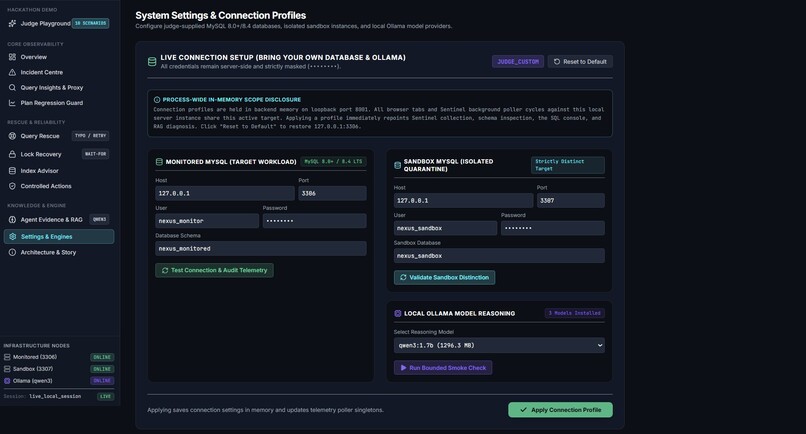
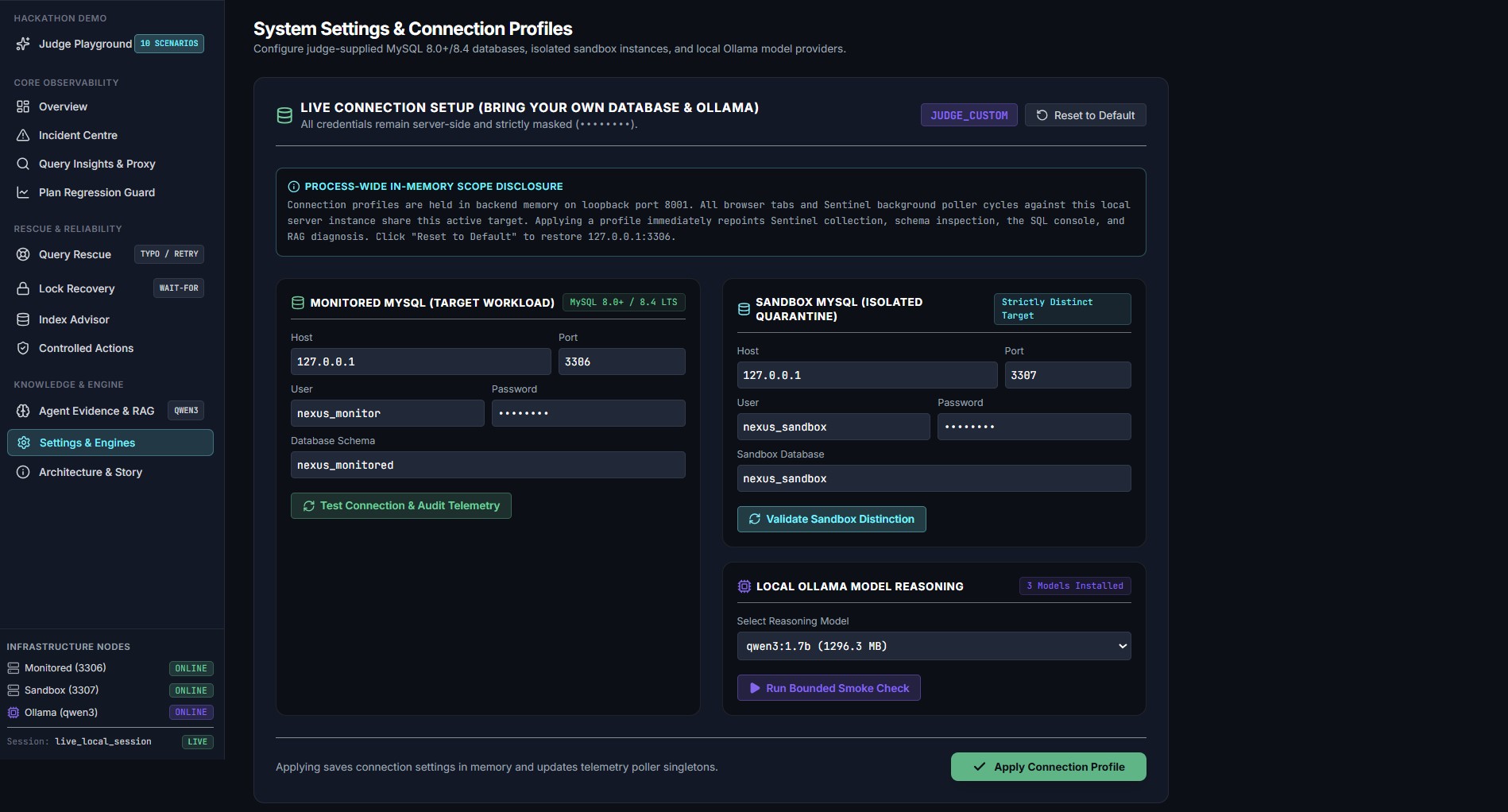
Configure the database connection and choose a locally available AI model for the NexusDBA agent workflow
-
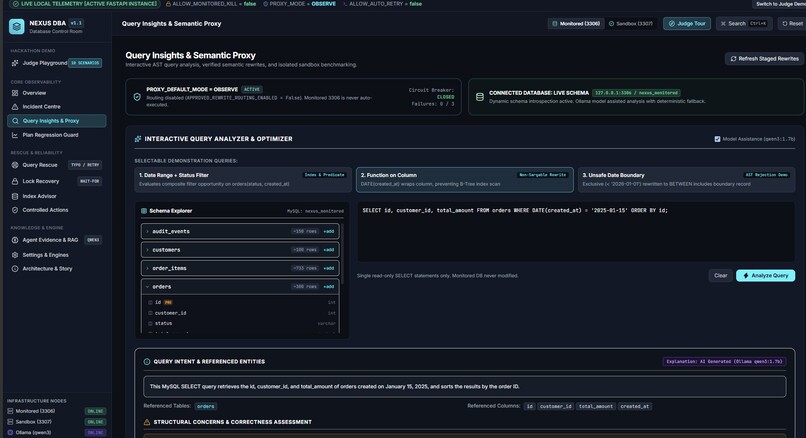
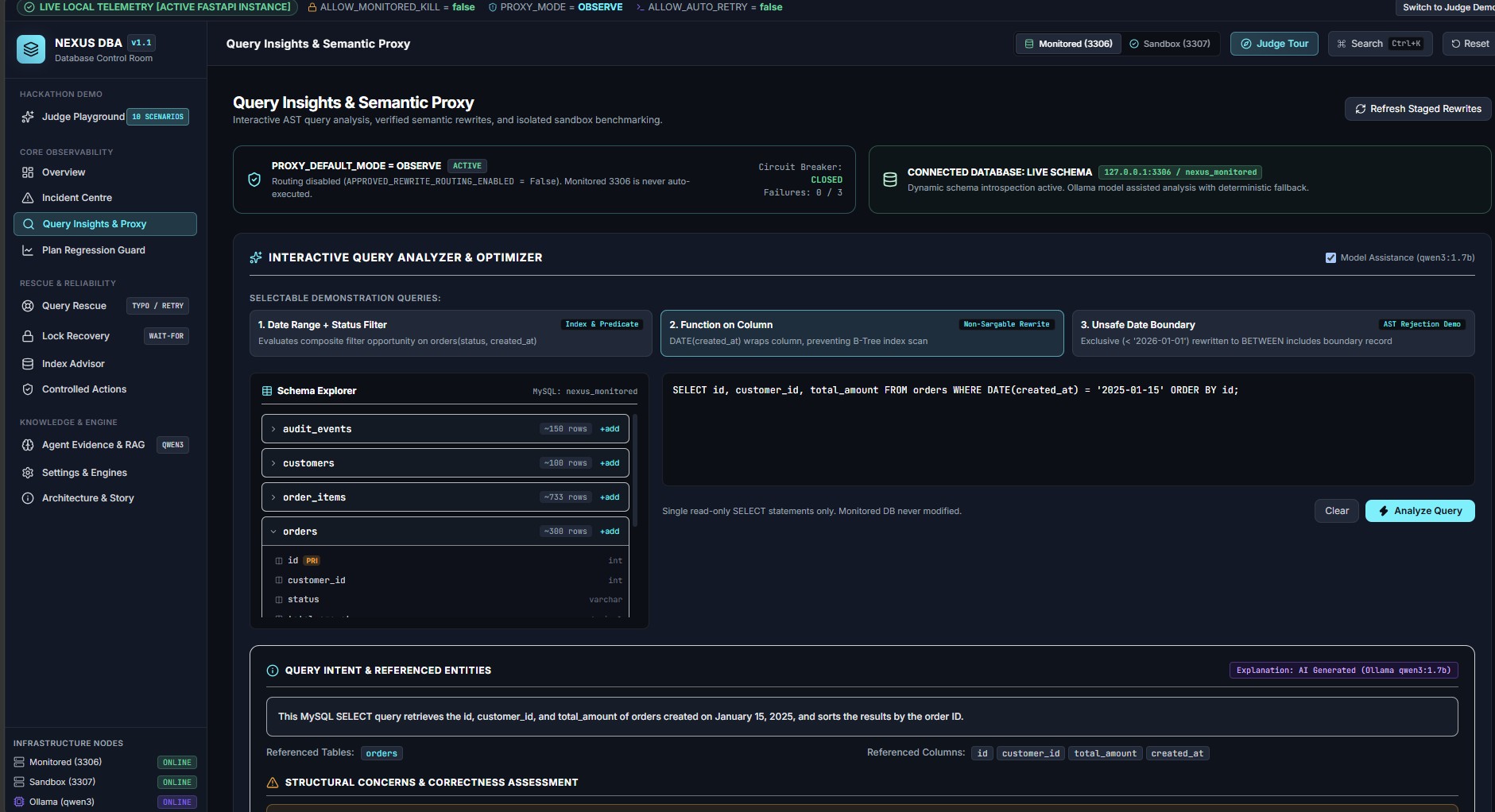
NexusDBA analyzes SQL queries, explains their behavior, and identifies possible performance bottlenecks.
-
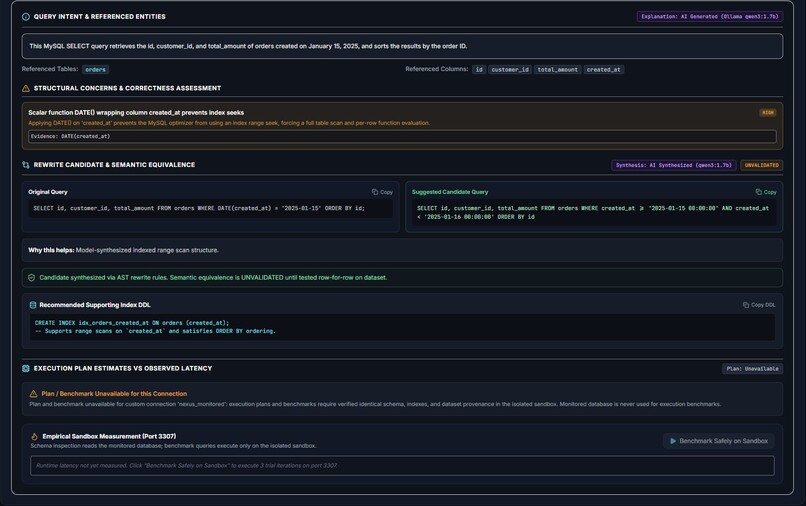
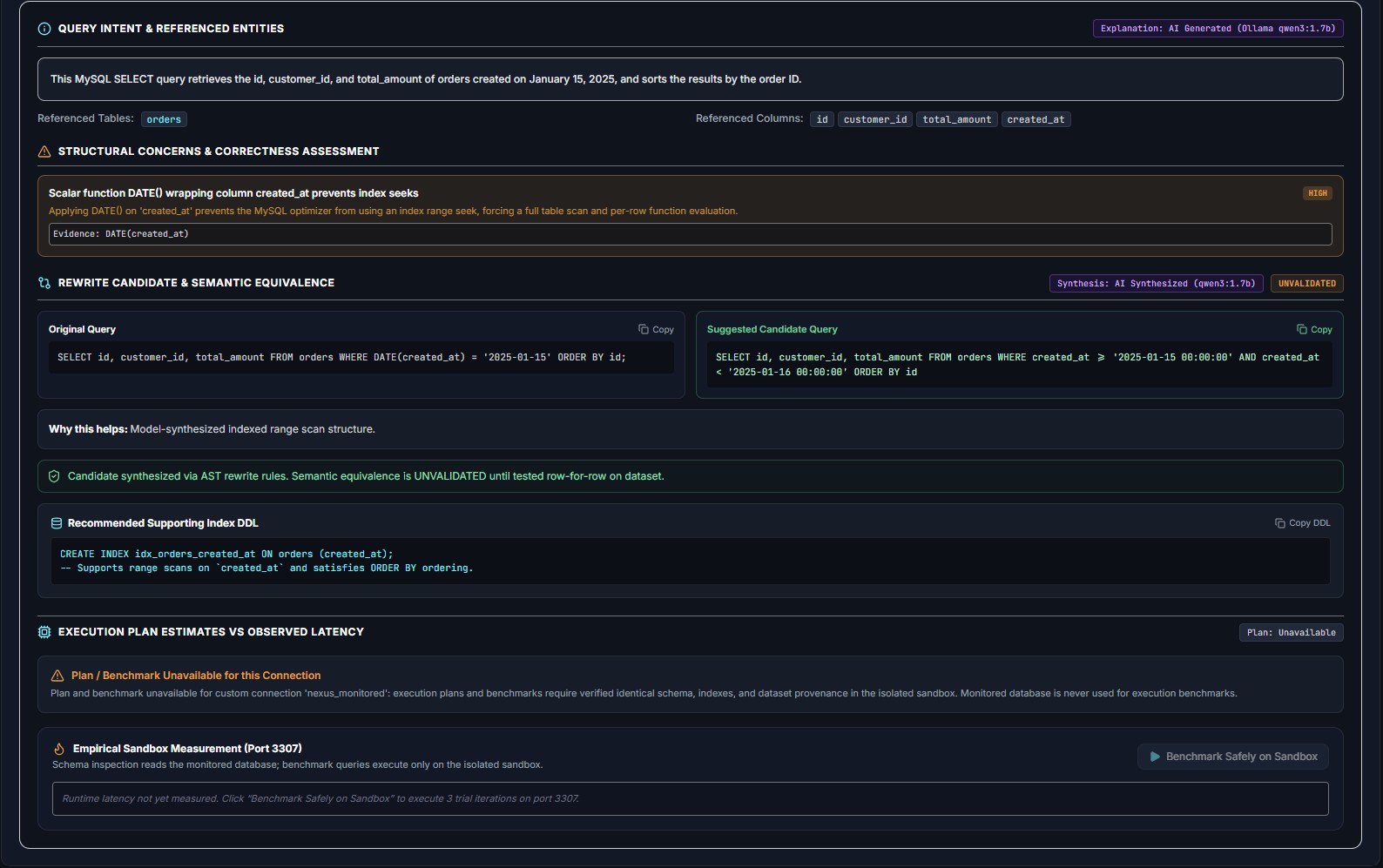
Side-by-side comparison of the original SQL query and the AI-generated optimized version
-
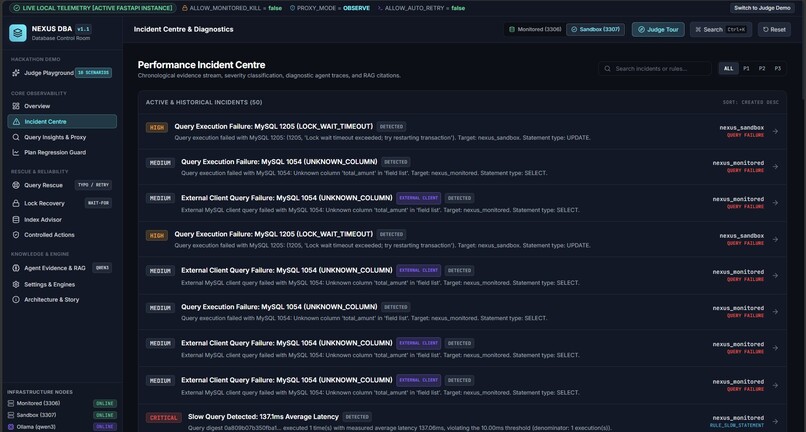
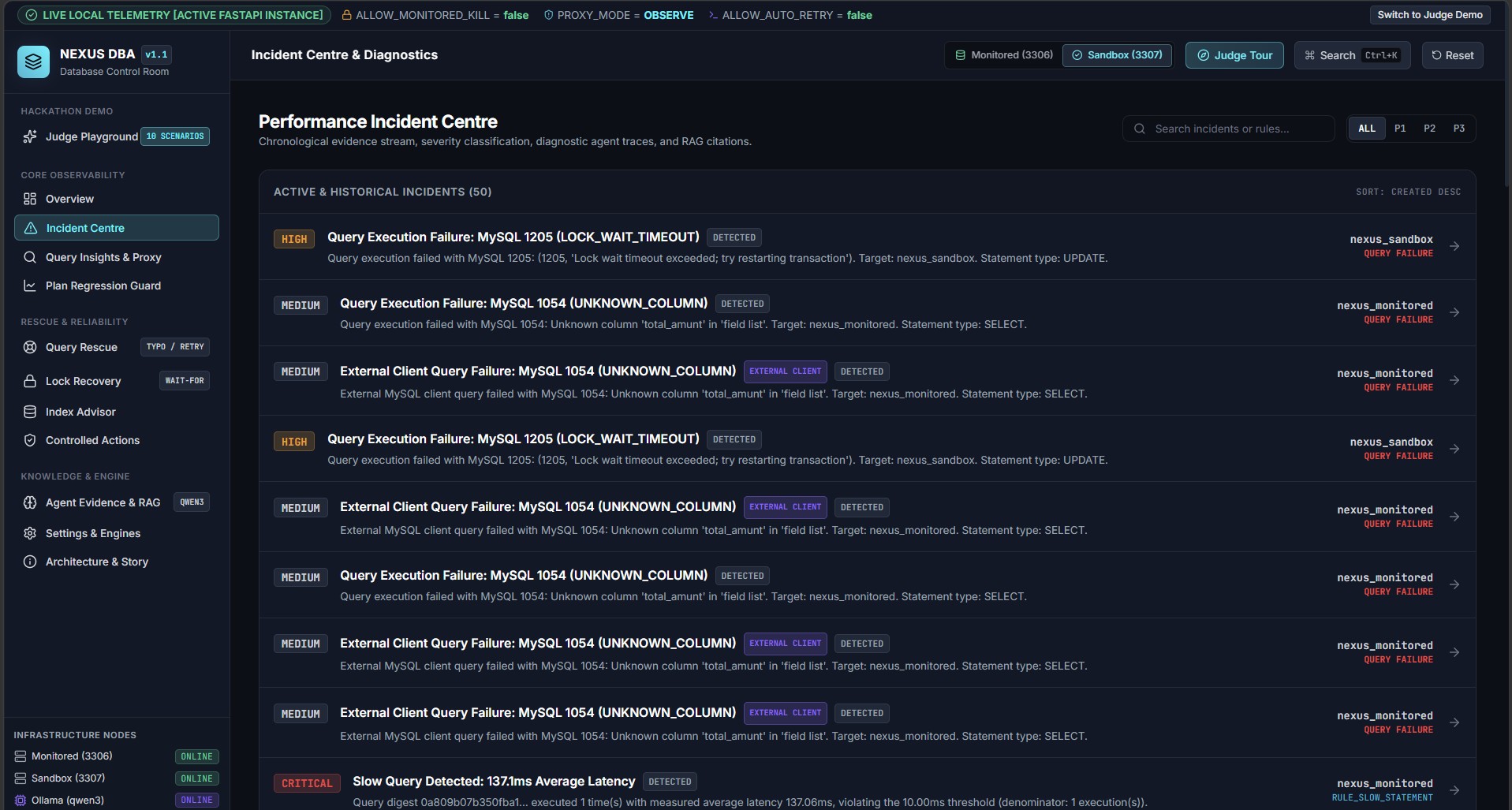
Continuous monitoring helps identify slow or problematic database operations and surface them for remediation
-
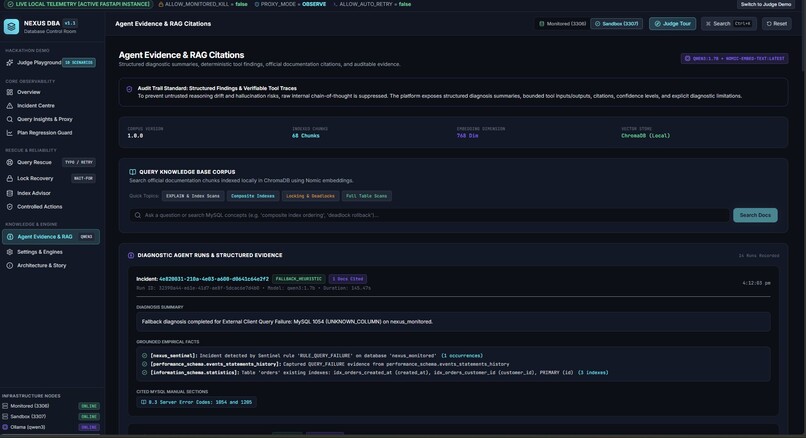
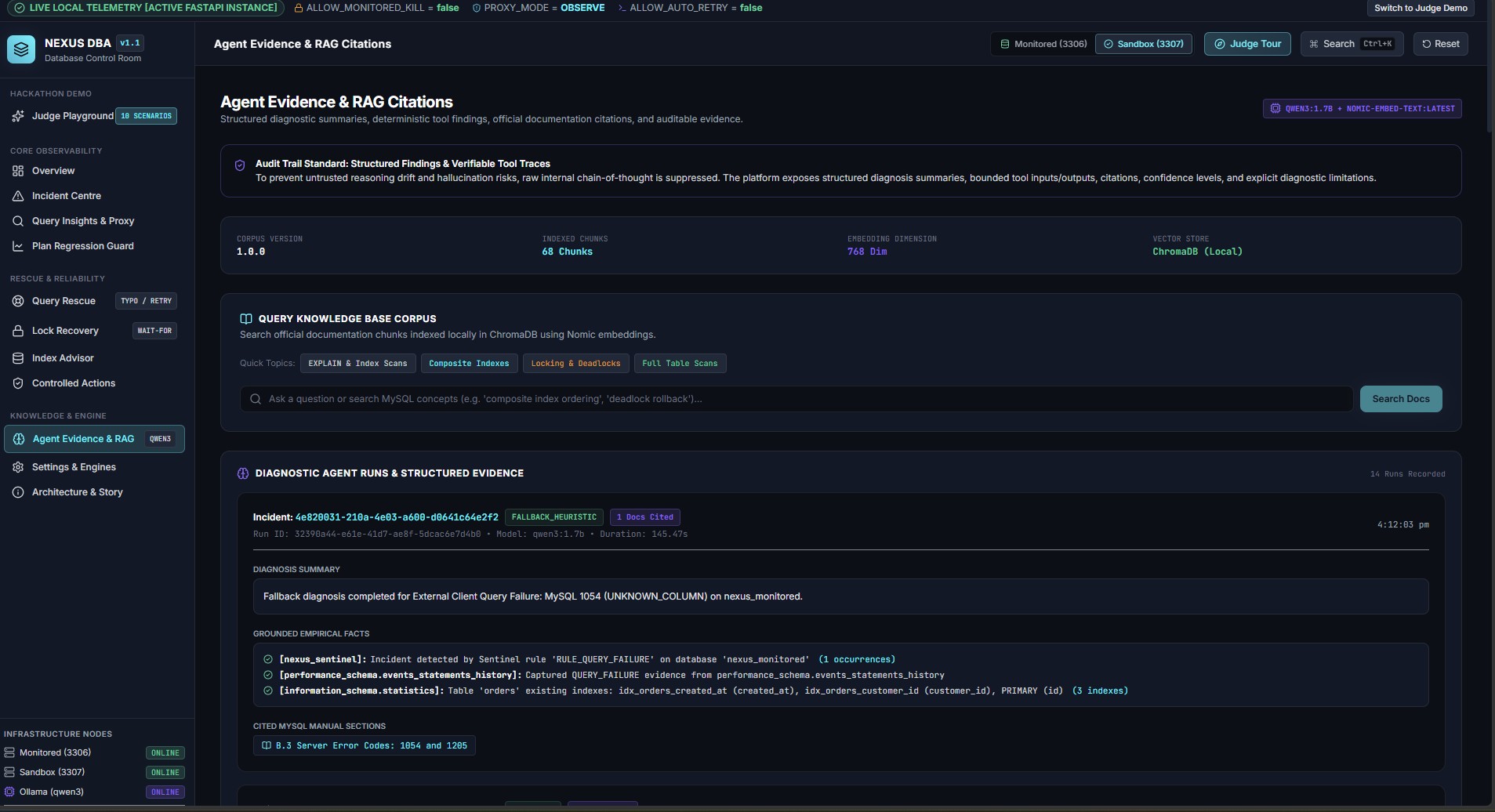
RAG-powered retrieval brings relevant database administration knowledge into the optimization process.
-
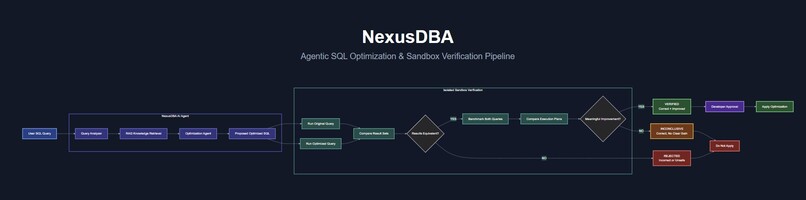
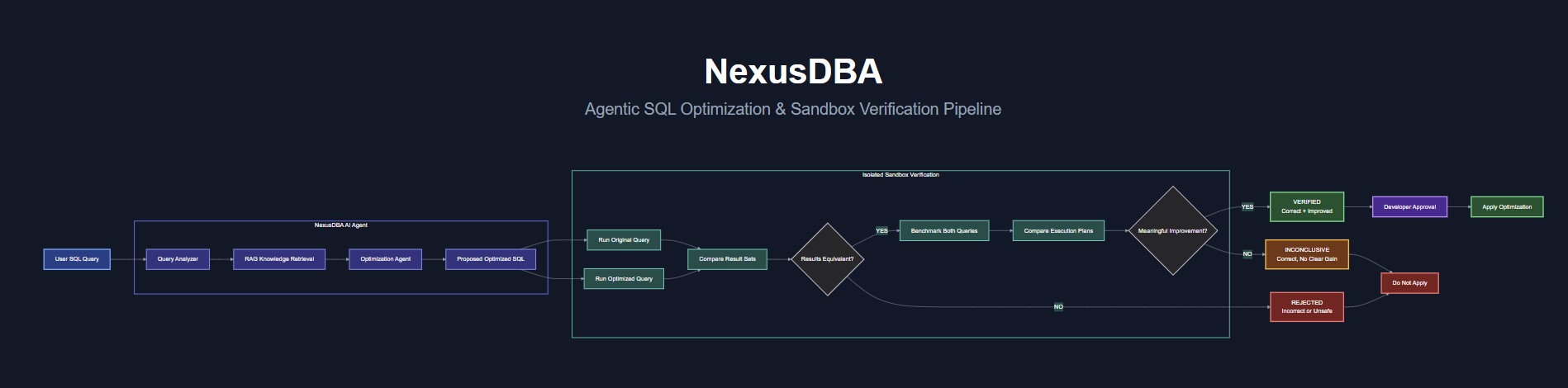
NexusDBA architecture linking the UI, LangGraph agent, MySQL, ChromaDB, local LLM, and sandbox verification.
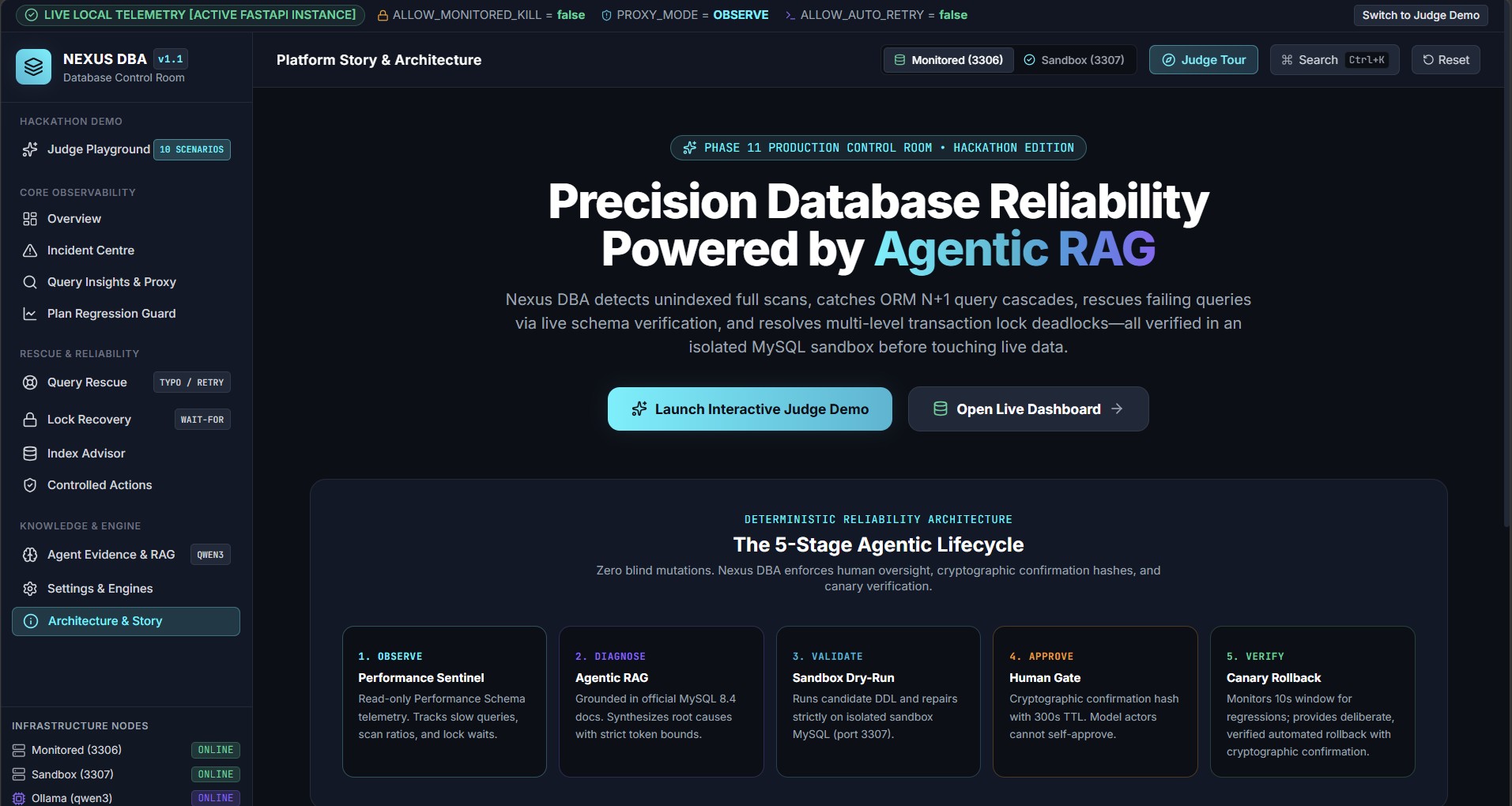
Inspiration
Database performance issues are often discovered only after users start noticing that an application has become slow.
A single inefficient SQL query, a missing index, or a poorly written filter can create a bottleneck. The difficult part is not only finding the problem, but deciding how to fix it safely. Developers usually have to inspect execution plans, search documentation, test different queries, and make sure an optimization does not change the expected result.
I wanted to explore a different approach: what if an AI agent could act like a database performance assistant?
That idea became NexusDBA — an agentic database optimization system that can analyze database problems, retrieve relevant DBA knowledge, propose fixes, and verify those fixes before they are trusted.
What it does
NexusDBA helps developers investigate and optimize SQL performance through one workflow.
A user can connect a database and configure an available AI model. From there, NexusDBA can inspect SQL queries and explain what they are doing in understandable language.
When a potentially inefficient query is found, NexusDBA analyzes the problem and generates an optimization strategy. This can include:
- Rewriting inefficient SQL
- Suggesting better filtering strategies
- Identifying possible missing indexes
- Explaining why a query may be slow
- Retrieving relevant database optimization knowledge using RAG
- Comparing the original and optimized query
- Testing proposed changes in a separate sandbox environment
- Checking whether both queries return equivalent results
- Benchmarking their performance before recommending a change
One of the most important ideas behind NexusDBA is that an AI-generated fix should not automatically be considered correct.
Instead, the system follows a propose → test → verify workflow.
For example, if NexusDBA rewrites a date-filtering query, it can execute both versions inside the sandbox, compare their returned rows and execution information, and only then present the optimization to the developer.
The project also includes monitoring-oriented functionality designed around detecting slow or problematic database operations and helping developers investigate them through the same agentic workflow.
How I built it
I built NexusDBA by combining traditional database tooling with an agentic AI architecture.
MySQL is used as the primary database in the current implementation. I use database metadata, execution information, and performance-related information to understand how queries behave.
The AI workflow is built using Python, LangChain, and LangGraph.
LangGraph allows me to structure the system as multiple reasoning steps rather than treating the application as a simple chatbot. Different stages can handle tasks such as analyzing a query, retrieving supporting information, generating a possible optimization, and validating the proposed result.
For the knowledge layer, I use RAG (Retrieval-Augmented Generation) with ChromaDB.
Instead of asking the model to rely entirely on its existing knowledge, NexusDBA can retrieve relevant database administration and SQL optimization information from its local knowledge base and use that context while generating recommendations.
I also created a sandbox database environment for testing.
This was important because executing AI-generated database changes directly against a real database would be risky. NexusDBA can test an original query and its proposed replacement separately, compare the results, and gather performance information before a recommendation is accepted.
I also designed the architecture so that the AI layer is not permanently tied to one model. A locally available model can be configured for the agent workflow, making the system more flexible and allowing much of the workflow to remain local.
Challenges I ran into
One of the biggest challenges was making the project more than an AI wrapper around SQL.
Generating a rewritten query is relatively easy. Determining whether that query is actually better and safe is much harder.
I had to think about questions such as:
- Does the optimized query return the same result?
- Is an apparent performance improvement actually meaningful?
- Should the system trust execution-plan estimates or measured execution time?
- What happens when two queries execute so quickly that their timing difference is insignificant?
- How should potentially dangerous database changes be isolated?
This led me to introduce the sandbox verification workflow rather than blindly applying AI suggestions.
Another challenge was integrating multiple components — MySQL, the agent workflow, retrieval, local models, query analysis, and the frontend — into a system that still felt simple to use.
I also learned that database performance measurements can vary between executions because of caching and other database behavior. Because of this, NexusDBA avoids presenting every tiny timing difference as a major optimization.
Accomplishments that I'm proud of
I am especially proud that NexusDBA does not simply respond with:
"Here is a better SQL query."
Instead, it tries to build evidence around that recommendation.
The system can analyze the original SQL, explain the issue, retrieve relevant DBA knowledge, generate a candidate fix, test it inside a sandbox, compare the output, and show the developer what actually changed.
I am also proud of combining agentic AI, RAG, and real database tooling in a project where the AI has a clear technical role rather than being added only as a chatbot interface.
Building a working demonstration where database configuration, query analysis, optimization, and verification could all be shown through the same application was another major milestone for me.
What I learned
The biggest thing I learned is that using AI for infrastructure is very different from using AI for normal text generation.
When an AI system interacts with a database, reliability matters much more than simply generating a convincing answer.
A recommendation needs evidence.
I learned that agentic systems become much more useful when traditional software checks are placed around the model. SQL execution, result comparison, sandbox environments, database statistics, and benchmarking can act as verification layers around AI reasoning.
I also gained experience working with:
- Agentic workflows using LangGraph
- Retrieval-Augmented Generation
- Vector databases
- Local language models
- MySQL performance analysis
- SQL optimization
- Safe AI-assisted database operations
- Full-stack integration
What's next for NexusDBA
My long-term goal is to turn NexusDBA from a query optimization prototype into a broader self-healing database reliability agent.
Future versions could include deeper monitoring of database performance, automatic detection of recurring bottlenecks, stronger rollback mechanisms, approval policies for different levels of database changes, and historical tracking of optimizations.
I also want to expand the architecture beyond the current MySQL-focused implementation so additional database engines can use their own monitoring and optimization adapters.
Another major direction is continuous learning from previous incidents. If NexusDBA encounters a similar performance problem again, it could retrieve previous successful remediation strategies and use them as additional context.
Ultimately, NexusDBA explores a simple idea:
AI should not just tell developers how to fix a database problem — it should help investigate the problem, test the solution, and provide evidence that the fix actually works.

Log in or sign up for Devpost to join the conversation.