-
-
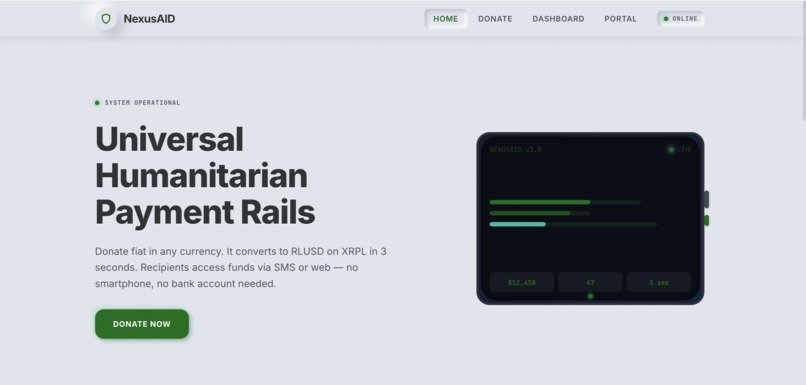
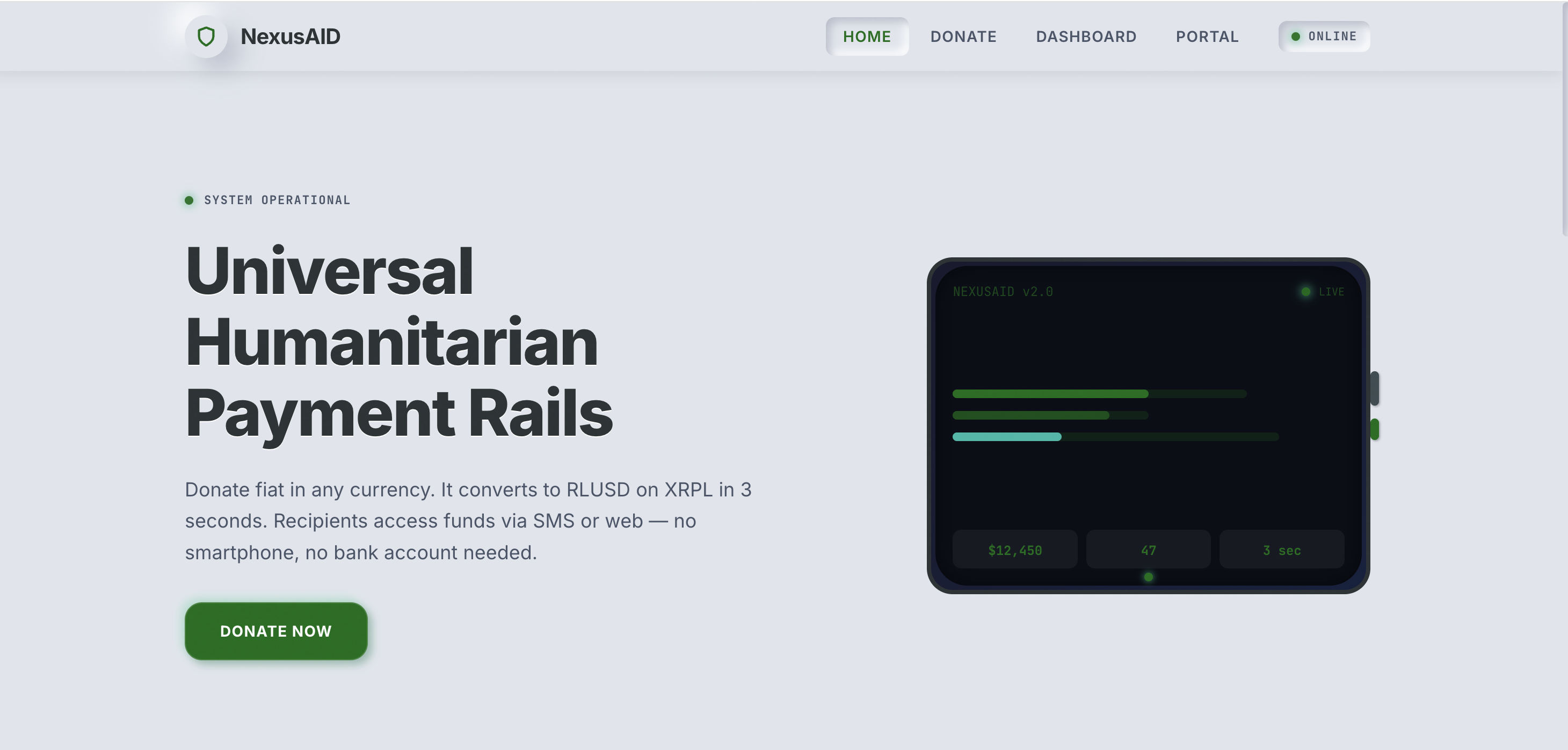
Landing Page
-
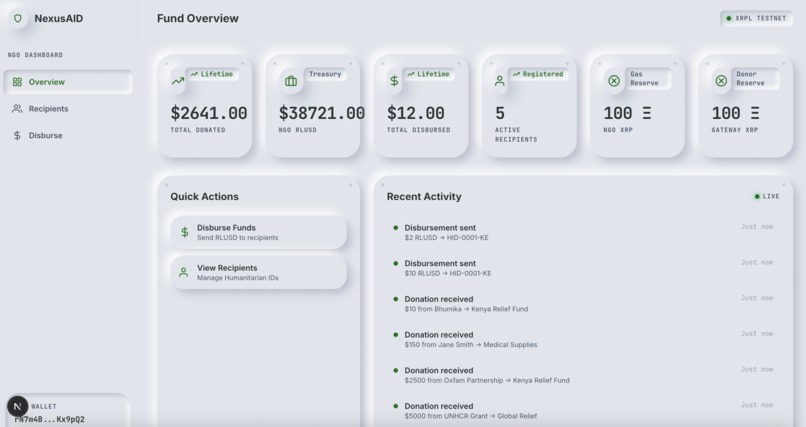
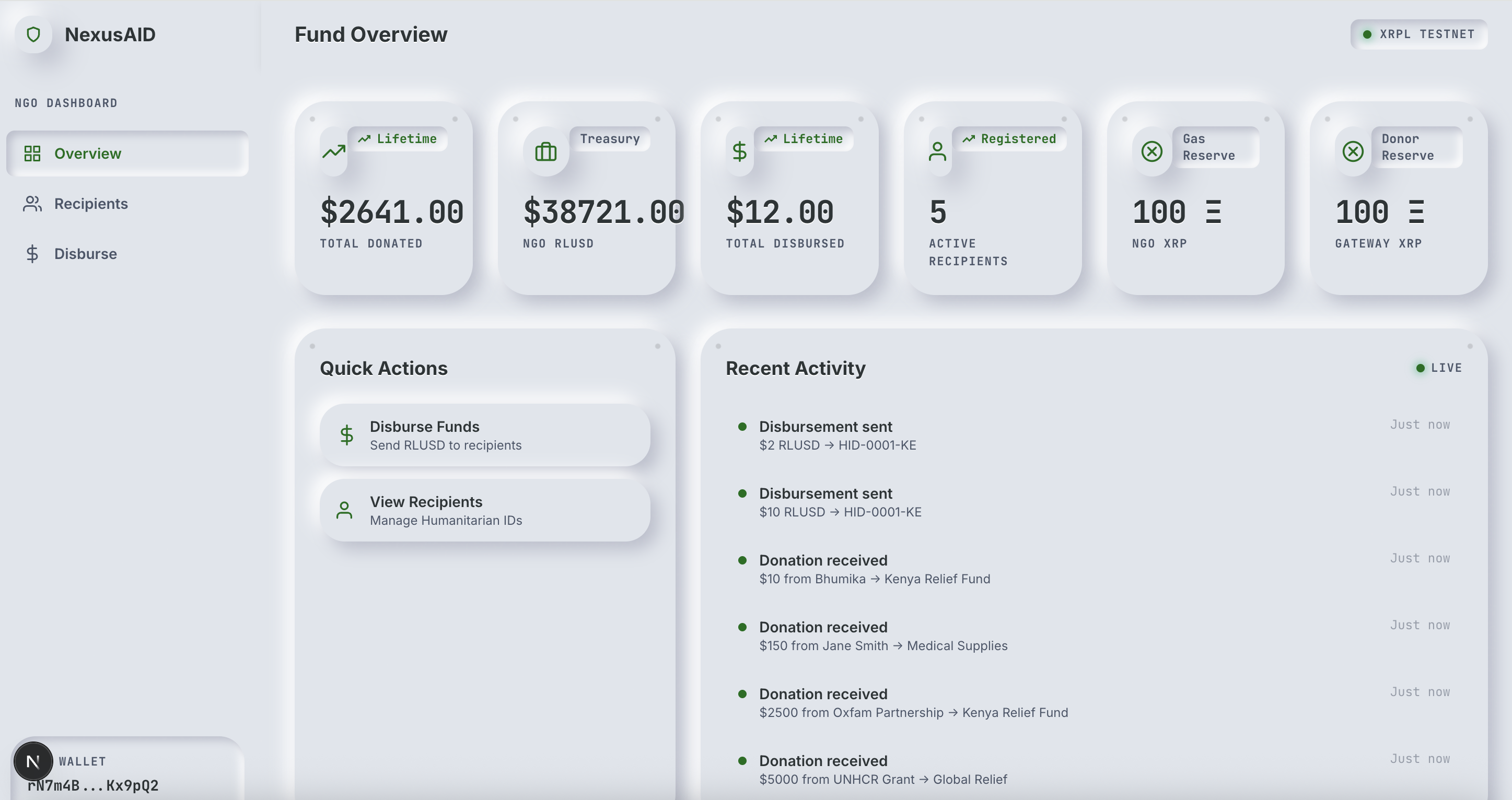
Disbursement Dashboard
Inspiration
In crisis zones and developing nations, millions of humanitarian aid dollars are lost to high banking fees, bureaucratic delays, and complex logistics—the so-called "last-mile problem." Traditional banks take days to settle cross-border funds and take huge cuts, and many disaster victims don’t even possess bank accounts to receive the money. We were inspired to build a system that guarantees 100% of a donor's contribution natively and instantly reaches the victim using the power of the XRP Ledger, while completely abstracting away the complexity of "crypto" from the everyday user.
What it does
NexusAID is an end-to-end humanitarian aid tracker and disbursement platform. It bridges the gap between traditional donor fiat and decentralized finance, allowing NGOs to rapidly deploy stablecoins across borders with near-zero fees.
Our application serves three distinct users:
- The Donor: Donates seamlessly using fiat via a simulated Stripe connection. They receive a live tracking link that matches their contribution to real, verified XRPL transaction hashes as the fiat is tokenized into stablecoins.
- The NGO: Empowered with a real-time, enterprise-grade Dashboard. NGOs can monitor treasury operations, register recipients via Humanitarian IDs (HIDs), and execute mass disbursements of RLUSD stablecoins instantly.
- The Recipient: Beneficiaries log into a lightweight web portal using only a 4-digit PIN. They can view their balances in real-time, see conversions to local fiat equivalents (like KES), and even transfer funds to local merchants or family. Crucially, if they lack internet access, our built-in phone carrier email gateway lets them check balances and send funds entirely via SMS.
How we built it
Frontend: We built a sleek, dynamic web app using Next.js, React, and Tailwind CSS. The app implements a glassmorphic, industrial aesthetic that looks extremely premium and natively responsive. Backend Infrastructure: The core server is written in Node.js/Express, utilizing Socket.IO for real-time, live-updating components on the NGO dashboard. Blockchain Integration: We natively integrated the XRP Ledger (xrpl). Our backend simulates a real on-ramp gateway holding fiat and automatically minting Custom Issued Currencies (IOUs)—which we branded as RLUSD—straight onto the XRPL Testnet. SMS System: We used the email gateways, bridging legacy telecom networks with the XRPL for offline users.
Challenges we ran into
A major hurdle was figuring out how to abstract the crypto wallet experience. Non-technical users in disaster zones cannot be expected to write down 12-word seed phrases or manage gas fees. We overcame this by having the server automatically provision secure wallets mapped to Human-readable Humanitarian IDs (HIDs). The NGO's "Gas Reserve" wallet covers all micro-fees in native XRP, meaning the user only ever sees and interacts with clean RLUSD stablecoin numbers.
Accomplishments that we're proud of
We successfully built a true stablecoin-issuer architecture directly on the XRPL. Instead of just sending raw XRP around, we set up a Gateway Wallet with the DefaultRipple flag enabled, allowing it to seamlessly mint RLUSD backed by the mock fiat deposits. Seeing the "View tx" links map to actual Testnet Ledgers proving the instant, low-fee settlement was incredibly rewarding.
What we learned
We learned the massive architectural differences between building traditional, centralized financial systems and navigating the nuances of decentralized ledgers. We gained deep, hands-on experience structuring XRPL trustlines and mastering the concept of "Custom Issued Currencies"—realizing that the XRP Ledger ecosystem natively solves cross-border settlement issues right natively out of the box. Additionally, successfully bridging the Web2 telephony infrastructure (Twilio) with Web3 backends taught us how pivotal "low-fi" offline fallbacks are when designing real-world UX for developing nations.
What's next for NexusAid
Implement real Web3 multi-sig setups so the Vault is decentralized instead of server-controlled. Expand the SMS parser to include an auto-swap feature, allowing recipients to execute XRPL DEX trades via text message (e.g., swapping RLUSD for local stablecoins). Move away from a mock on-ramp to integrate a live payment processor hook.
Built With
- express.js
- javascript
- nextjs
- node.js
- rlusd
- xrpl


Log in or sign up for Devpost to join the conversation.