-
-
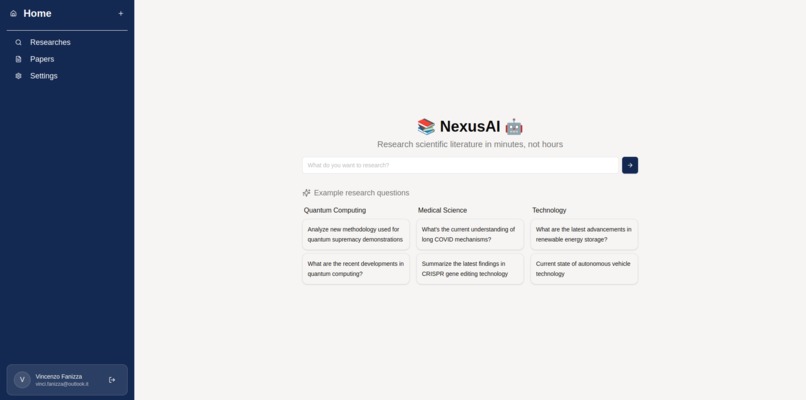
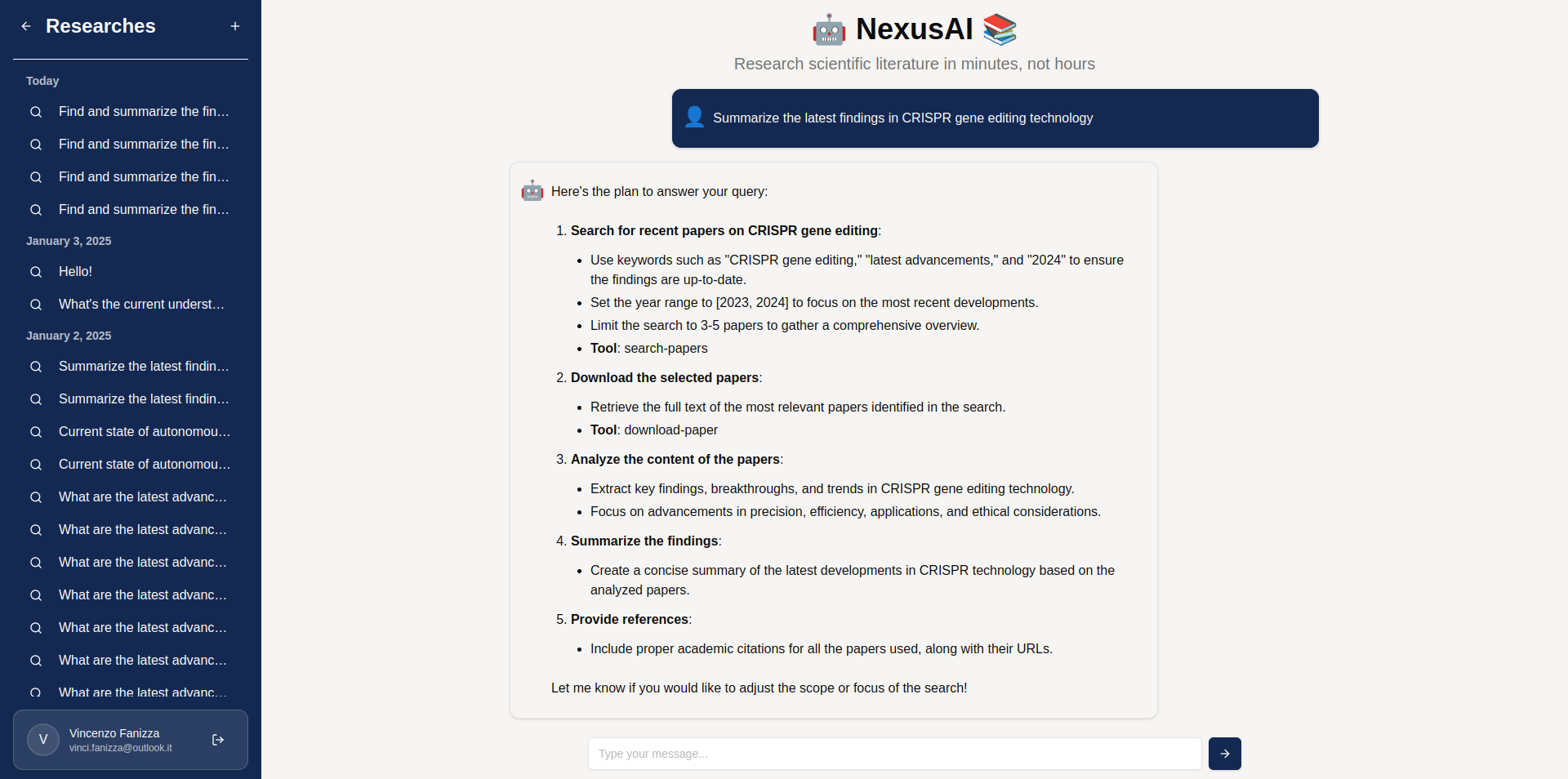
Start automating your research by asking any question you have in mind
-
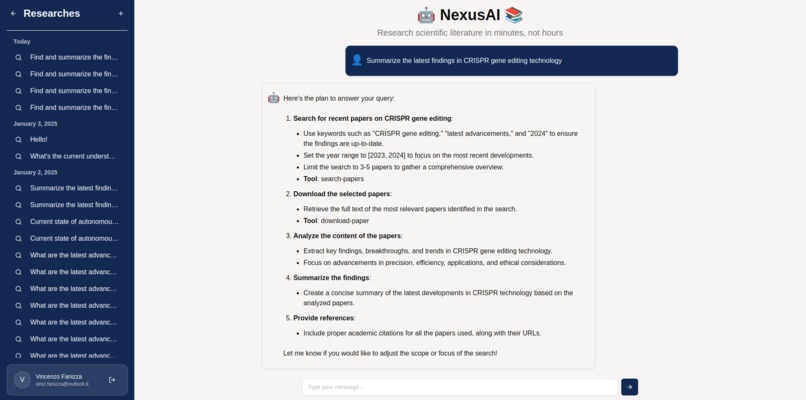
The agent will come up with a plan to give you the most accurate answer
-
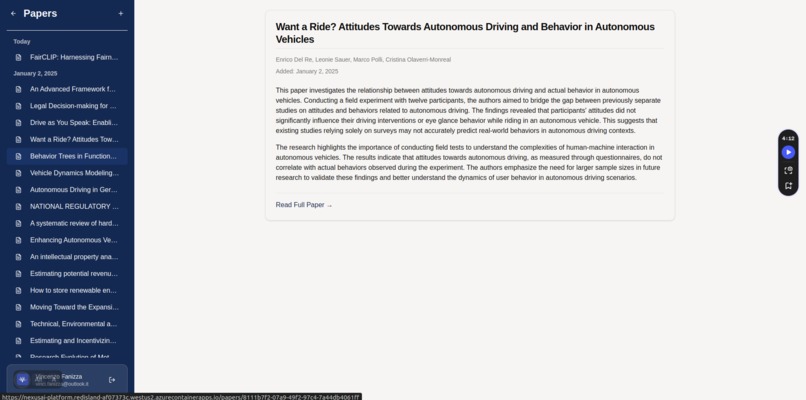
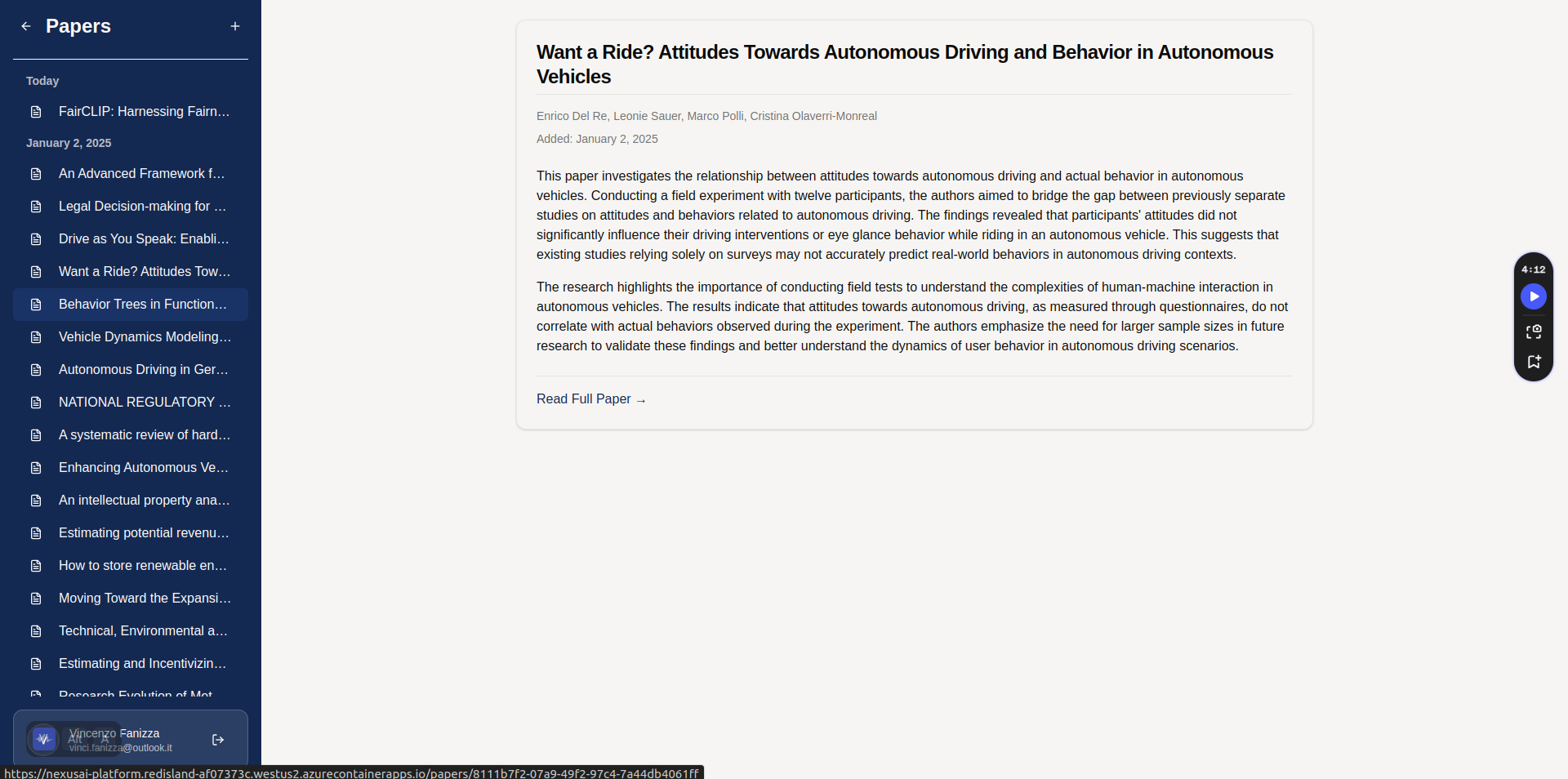
All relevant papers found are saved for further reading
-

You can register with your email/password or Microsoft account

NexusAI: A New Era of AI-Assisted Research
Inspiration
As a PhD student in Computer Vision at the University of Zurich, I was drowning in research papers. The frustration of spending 40% of my research time trying to stay current with literature was overwhelming. This challenge became even more apparent during conversations with Vincenzo, who also experienced this issue during his Master's thesis. We both recognized that while the volume of scientific publications was exploding - over 2 million new papers annually according to the National Science Board - tools for managing this information overload weren't evolving fast enough.
What really drove us was the vision of creating something that could understand the nuances of academic research - not just a search engine, but an intelligent assistant that could think like a researcher. We wanted to build a system to help others avoid the countless hours we spent trying to connect dots across multiple papers and research domains.
What it does
NexusAI is an AI agent that transforms how researchers interact with academic literature. Users can research their niche of interest, collect all relevant papers for future readings, and set system-level custom instructions to guide the agent according to their preferences. Here's a summary of its main features:
Core Agent Capabilities:
- Dual processing modes for optimized query handling (research workflow or direct paper processing)
- Dynamic research planning using multi-LLM approach (gpt-4o-mini/gpt-4o)
- Comprehensive search across multiple providers (arXiv, CORE, Bing, and Serp APIs)
- RAG-powered smart document processing with configurable dimension embeddings
- Self-assessment system with iterative quality control
Platform Features:
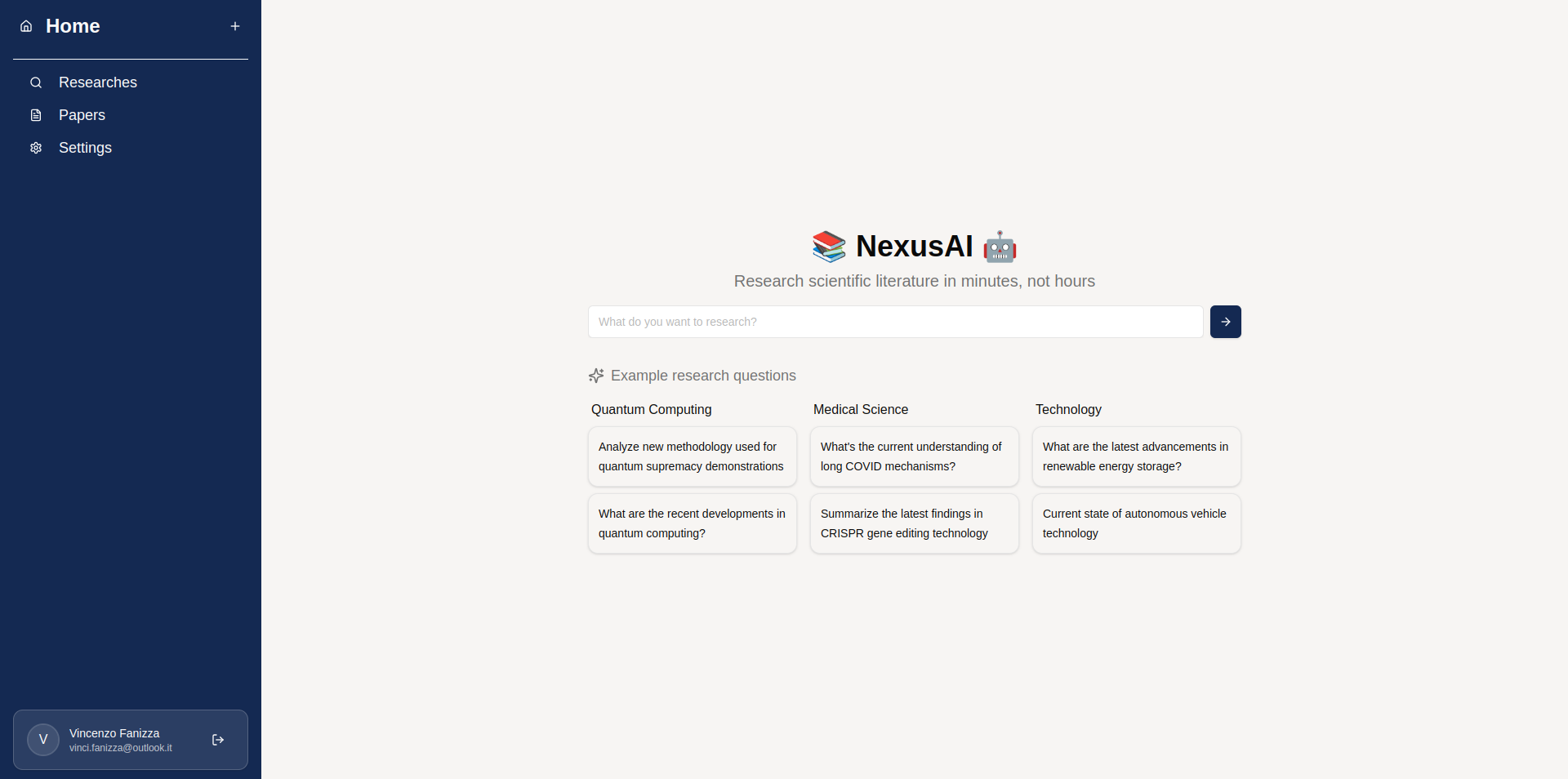
- Intuitive chat-like research interface with curated example questions
- PostgreSQL-powered research history and paper collections management
- Redis-based caching system for optimized performance
- Real-time updates via WebSocket streaming
- Enterprise-grade security with NextAuth authentication
How we built it
We used GitHub Copilot throughout the project. It was particularly helpful in integrating new features by passing the relevant files in the codebase, such as user authentication or PDF processing. The resulting system is a modular architecture with three core components:
Backend: Built with Python and LangChain. It hosts the core agent and paper summarization capabilities and interacts with the Redis caching layer.
Platform: Next.js app that builds the entire platform around the agent. It includes the UI and database layer.
Infrastructure: The application heavily relies on Azure services.
- The backend and platform services are deployed through Azure Container Apps.
- The caching layer is powered by Azure Cache for Redis.
- The PostgreSQL database is hosted on Azure Database for PostgreSQL.
- Azure AD is used to enable Microsoft authentication.
- Azure OpenAI is used as the preferred LLM provider.
- Azure's Bing search API is one of the search providers, along with arXiv, CORE, and Serp.
Challenges we ran into
PDF Processing Complexity: We had to develop a robust retry mechanism, implement mock browser headers to avoid unauthorized access errors, and add in-memory RAG to handle large files.
Self-Assessment: Ensuring consistent, high-quality responses required developing an innovative judging node system that provides iterative feedback.
Performance Optimization: Balancing response quality with speed was a constant challenge, leading to our implementation of parallel tool executions, caching, and combining faster with more capable models in the research workflow.
Language Barriers: Making the system truly accessible to international researchers required extensive testing and validation with queries in multiple languages.
Visual Content Analysis: Processing figures and graphs in research papers remains an ongoing challenge we're actively working to solve.
Accomplishments that we're proud of
- Designed a general-purpose agentic workflow that can be used beyond academic research
- Consistently generate literature reviews that better comply with academic standards than existing solutions like Perplexity
- Developed a transparent research process with real-time streaming of intermediate steps
- Reduced latency and API costs by implementing an efficient caching system using Azure Cache for Redis
- Enabled users to have a personalized research experience through our custom instruction layer
- Fully leveraged Azure services to build a scalable and secure system
- Made research accessible to more people through our multilingual system
What we learned
Architectural Insights: We learned that building a research assistant isn't just about having a powerful language model - it's about creating a thoughtful architecture that can handle the complexities of academic research.
Model Selection: Through extensive testing of different language models (Llama3.1, Gemini 1.5 Flash), we gained valuable insights into the trade-offs between power, latency, and structured output support.
Research Workflow Understanding: We deepened our understanding of how researchers work, which informed every feature we built.
Technical Skills: Gained extensive experience in:
- AI-agent development with Langgraph
- Integrate systems with Azure services
- Build reliable API integrations and PDF processing pipelines
What's next for NexusAI
Enhanced Visual Processing: Integrate vision-language models to better analyze figures, graphs, and tables in scientific papers.
Improved Document Processing: Developing more robust parsing capabilities for complex document structures, especially mathematical equations.
Papers Chat: Enable users to chat with their papers and ask questions about them.
Collaborative Features: Building tools for research teams to share insights and collaborate through NexusAI.
The journey of building NexusAI has reinforced our belief that AI can be a powerful tool for advancing scientific research. As researchers ourselves, we're committed to continuing its development to better serve the academic community.
Built With
- arxiv-api
- azure
- bing-search-api
- core-api
- langchain
- langgraph
- next-auth
- next.js
- postgresql
- prisma
- pydantic
- python
- redis
- serp-api


Log in or sign up for Devpost to join the conversation.