NexusAI: Internal Knowledge Manager
A multi-agent AI system for internal company knowledge management, team analytics, and employee onboarding.
Features
- Knowledge Management: Hierarchical "textbook-style" knowledge graph with semantic search
- Multi-Agent System: Specialized agents for knowledge retrieval, onboarding, and team analysis
- MCP Connectors: Integration with Jira, GitHub, and Slack
- Voice Onboarding: Voice-enabled onboarding using Deepgram STT and ElevenLabs TTS
- Team Analytics: Health metrics, velocity tracking, and bottleneck detection
Inspiration
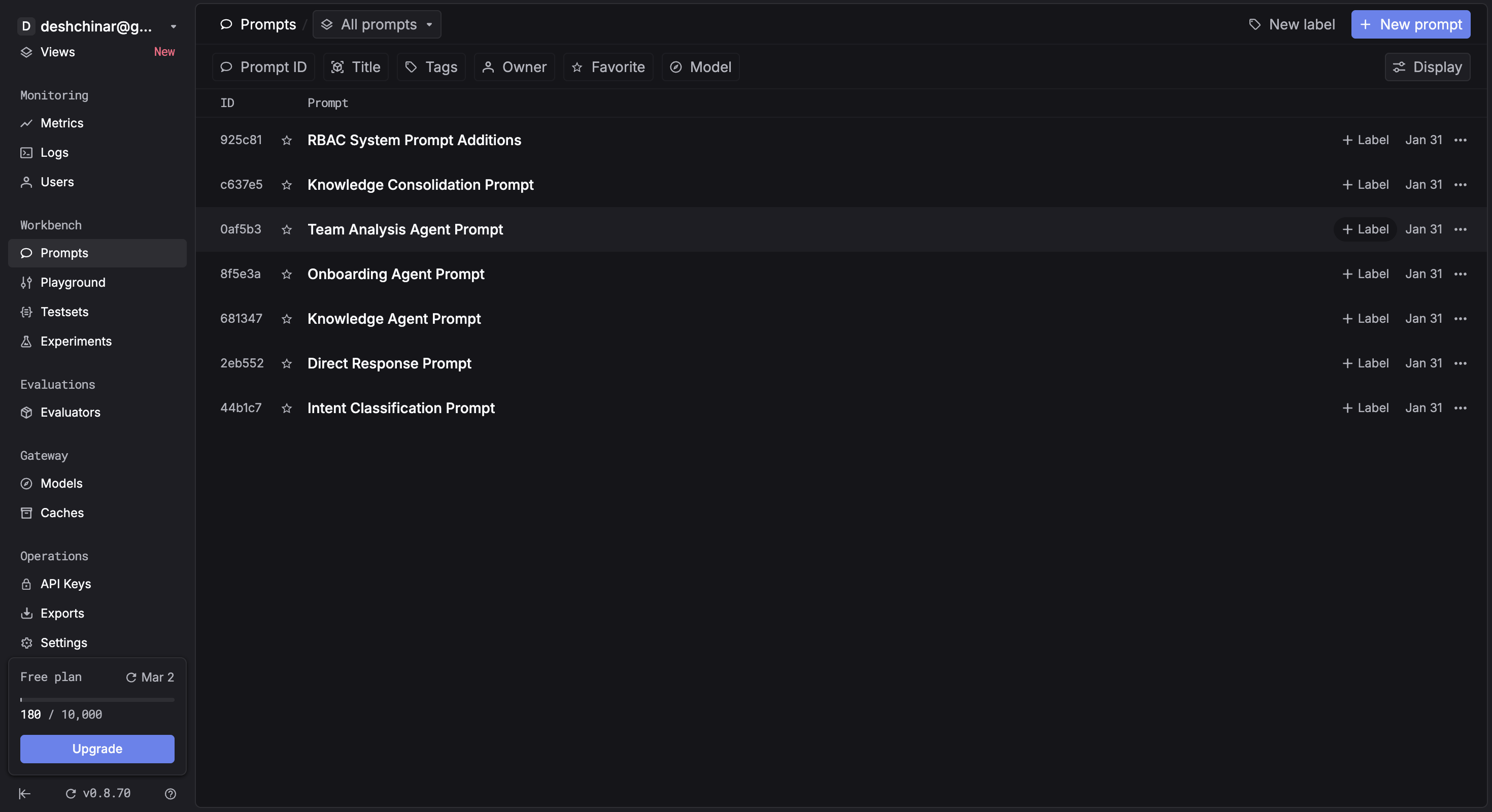
Internal knowledge is scattered across docs, tickets, and chats. Onboarding new hires and keeping teams aligned becomes a manual, error-prone process. NexusAI was built to unify these sources, maintain organizational memory, and deliver reliable answers with traceable context.
What it does
NexusAI is an internal AI copilot that:
- Ingests knowledge from GitHub, Jira, and Slack via MCP connectors.
- Builds a textbook-style knowledge graph in Neo4j with semantic embeddings in Qdrant.
- Orchestrates specialized agents to answer questions, guide onboarding, and analyze team health.
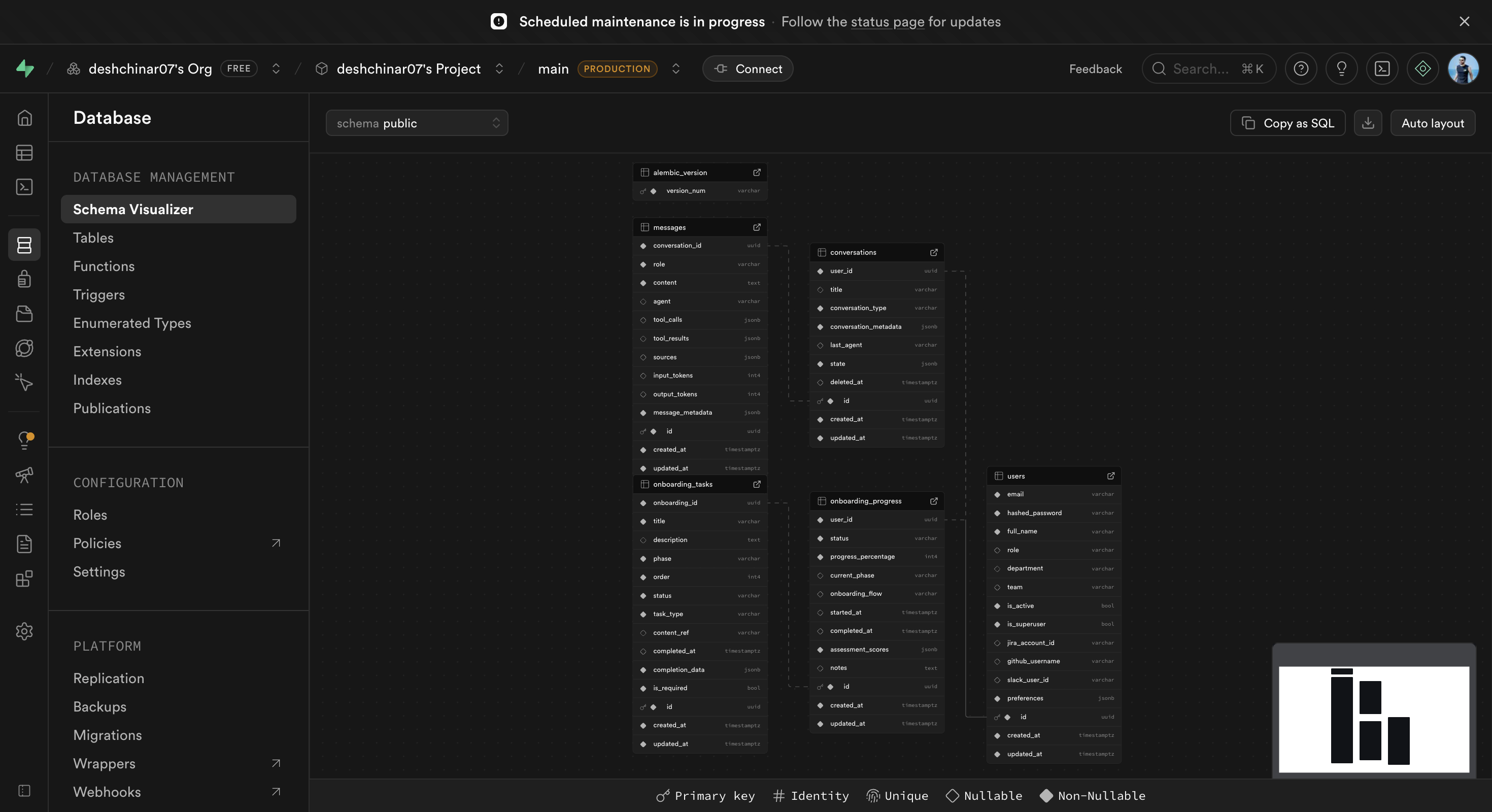
- Persists conversations, onboarding flows, and analytics in Supabase Postgres.
How we built it
- FastAPI provides REST and WebSocket endpoints for chat and voice sessions.
- LangGraph powers the orchestrator and agent routing (intent → tools → response).
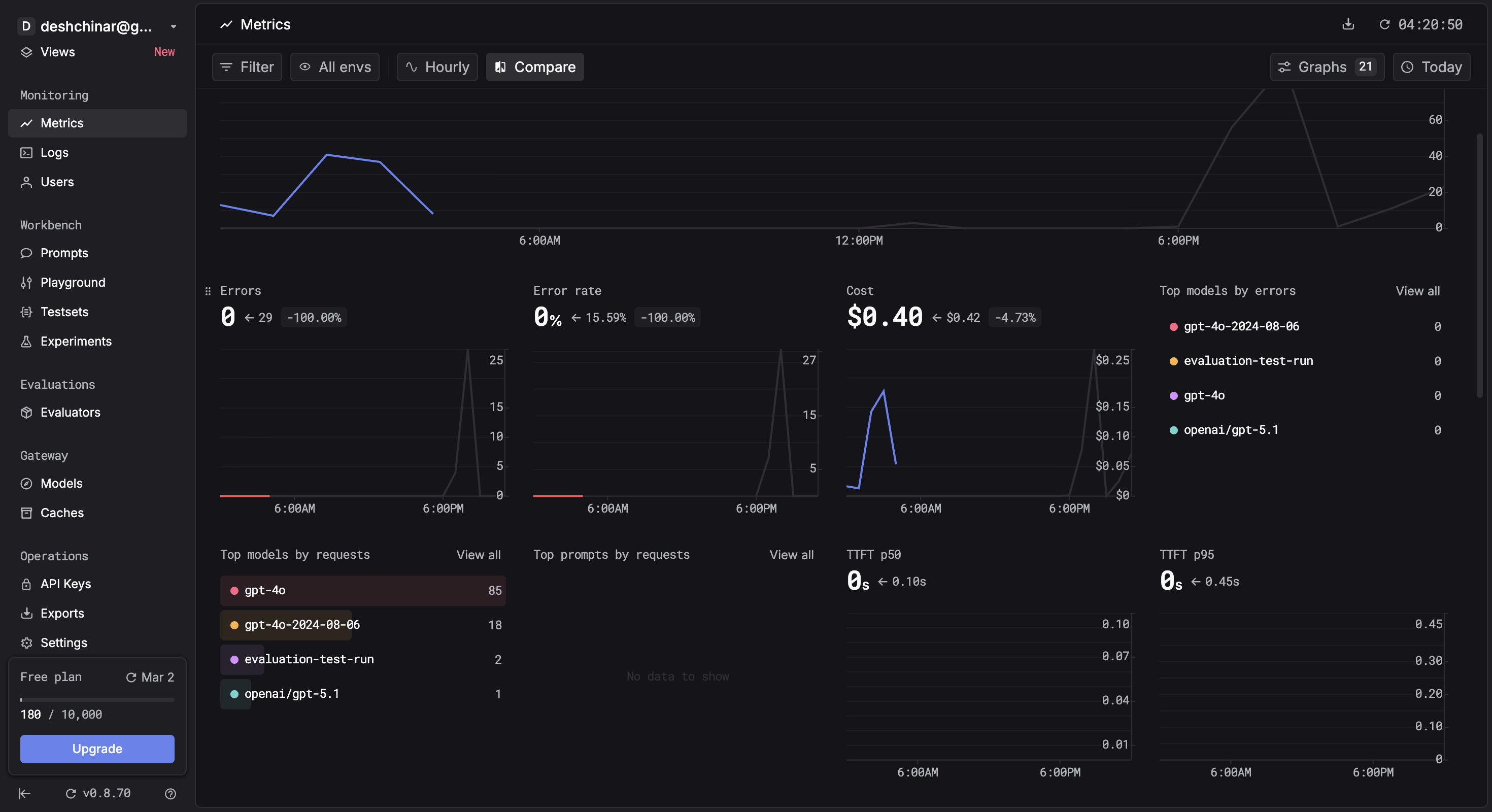
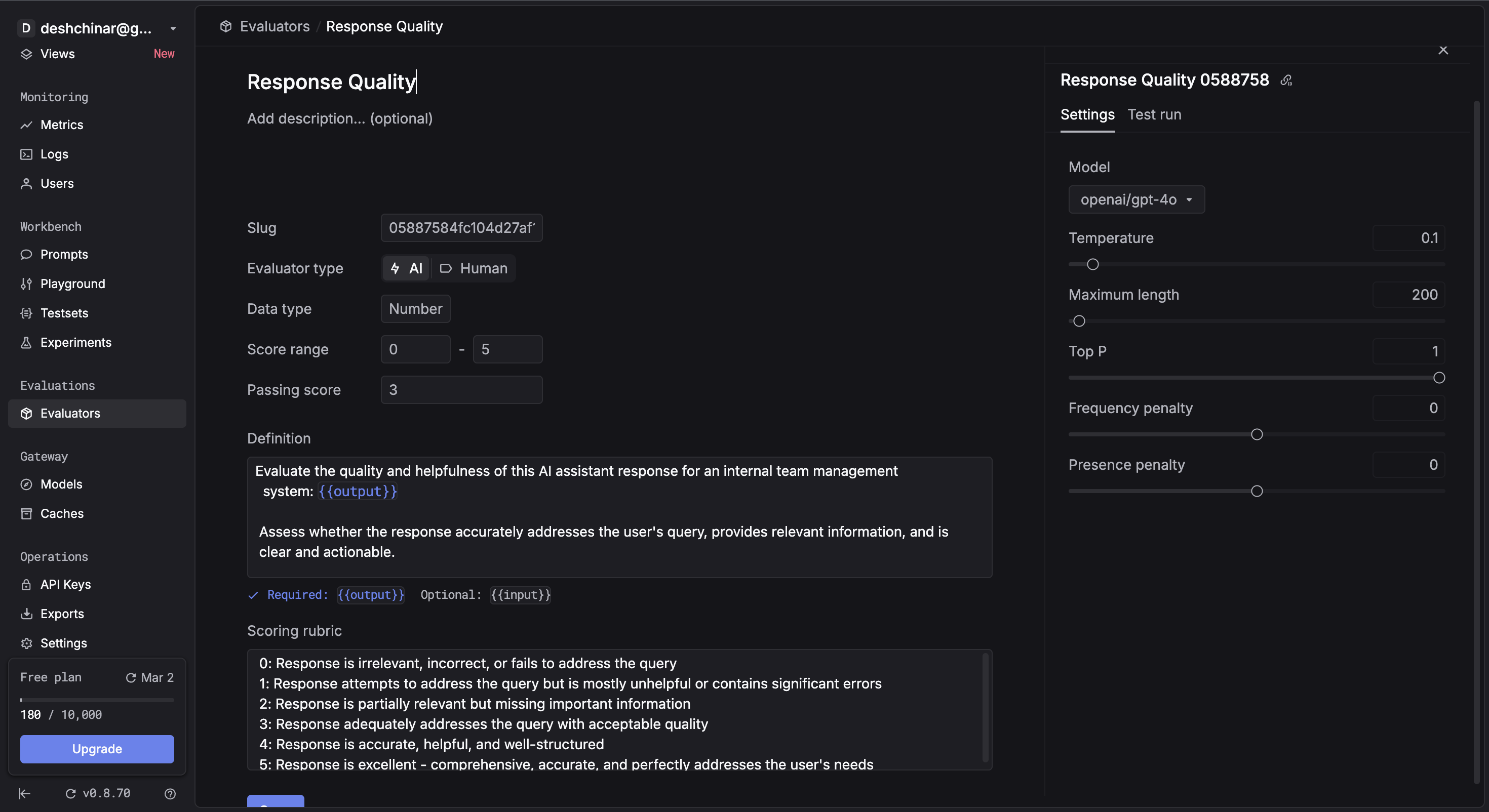
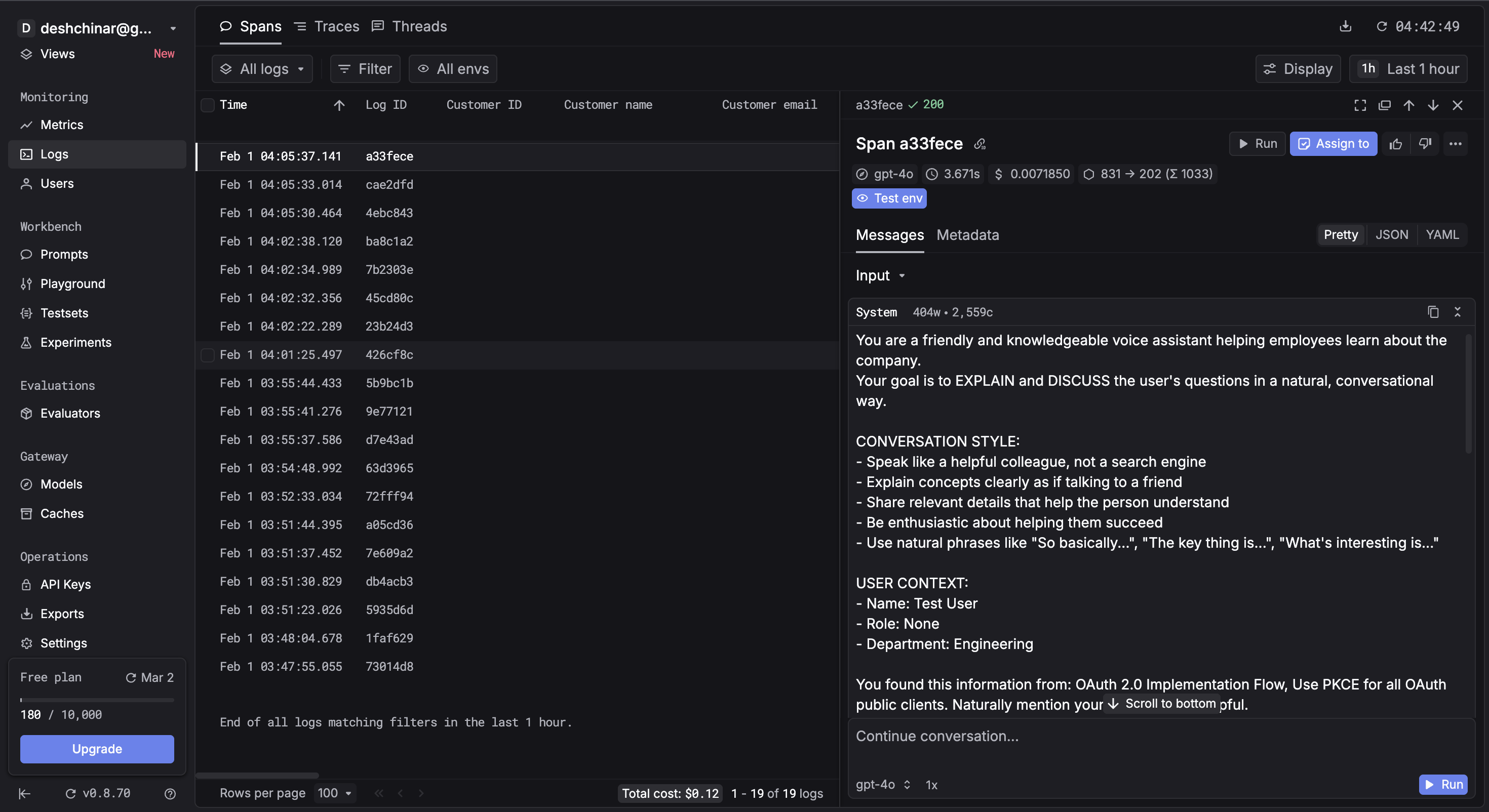
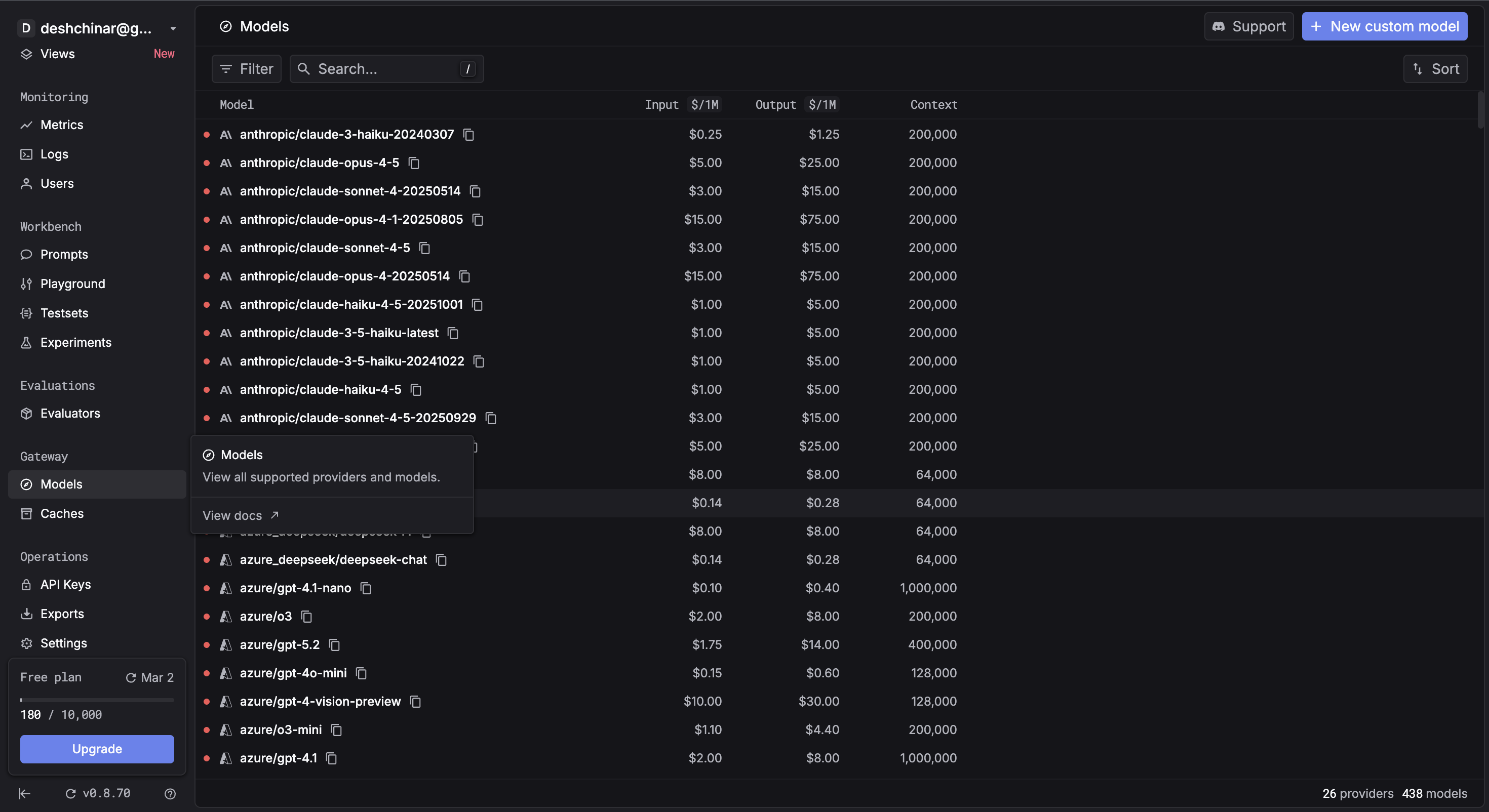
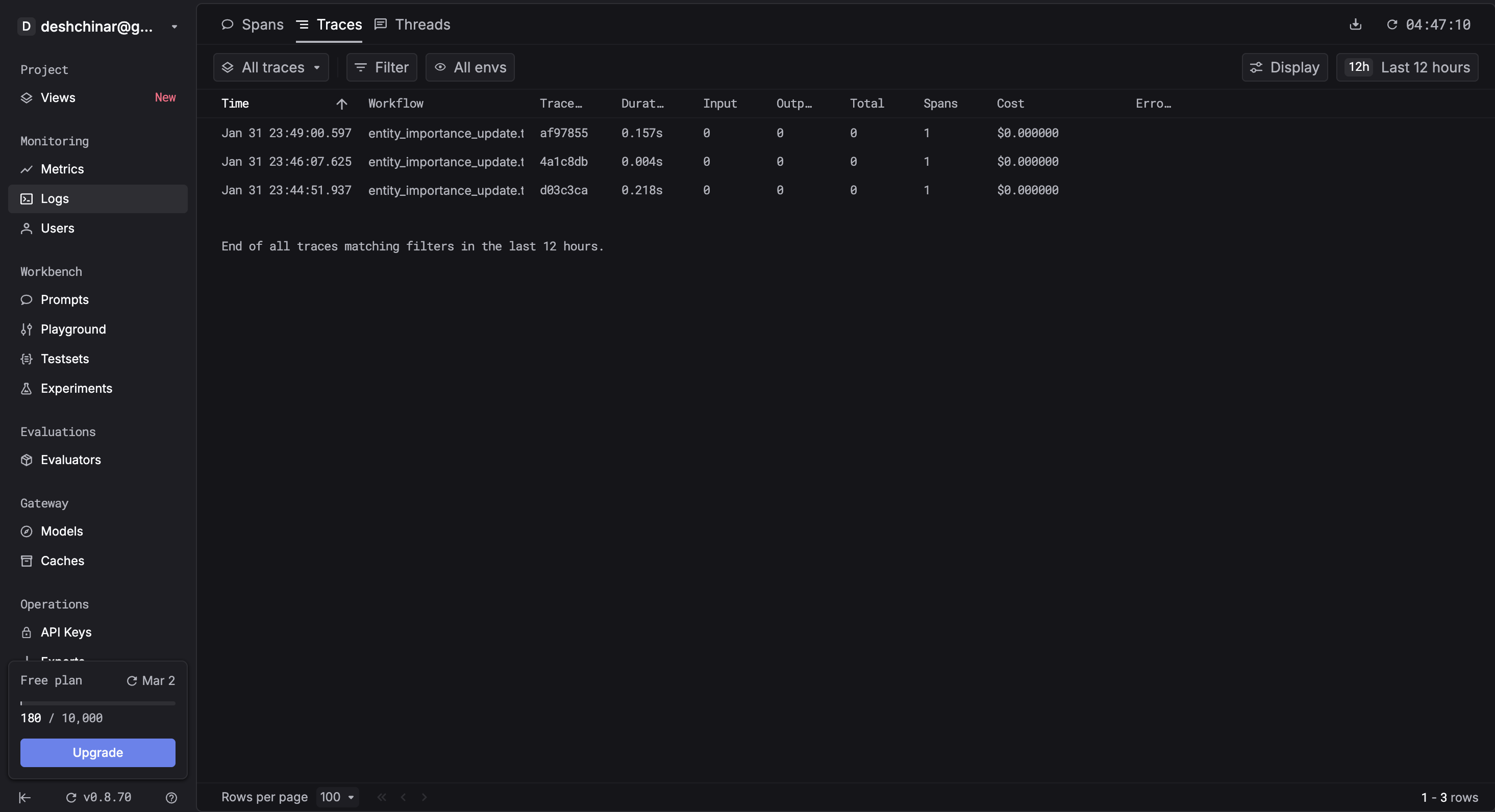
- Keywords AI is used as the LLM layer via its OpenAI-compatible API, with centralized model routing, provider abstraction, and optional tracing/observability through the Keywords AI tracing endpoints.
- Supabase Postgres stores users, conversations, onboarding state, and metrics.
- Neo4j + Qdrant deliver graph traversal and vector search for retrieval.
- Celery + Redis run ingestion and indexing jobs asynchronously.
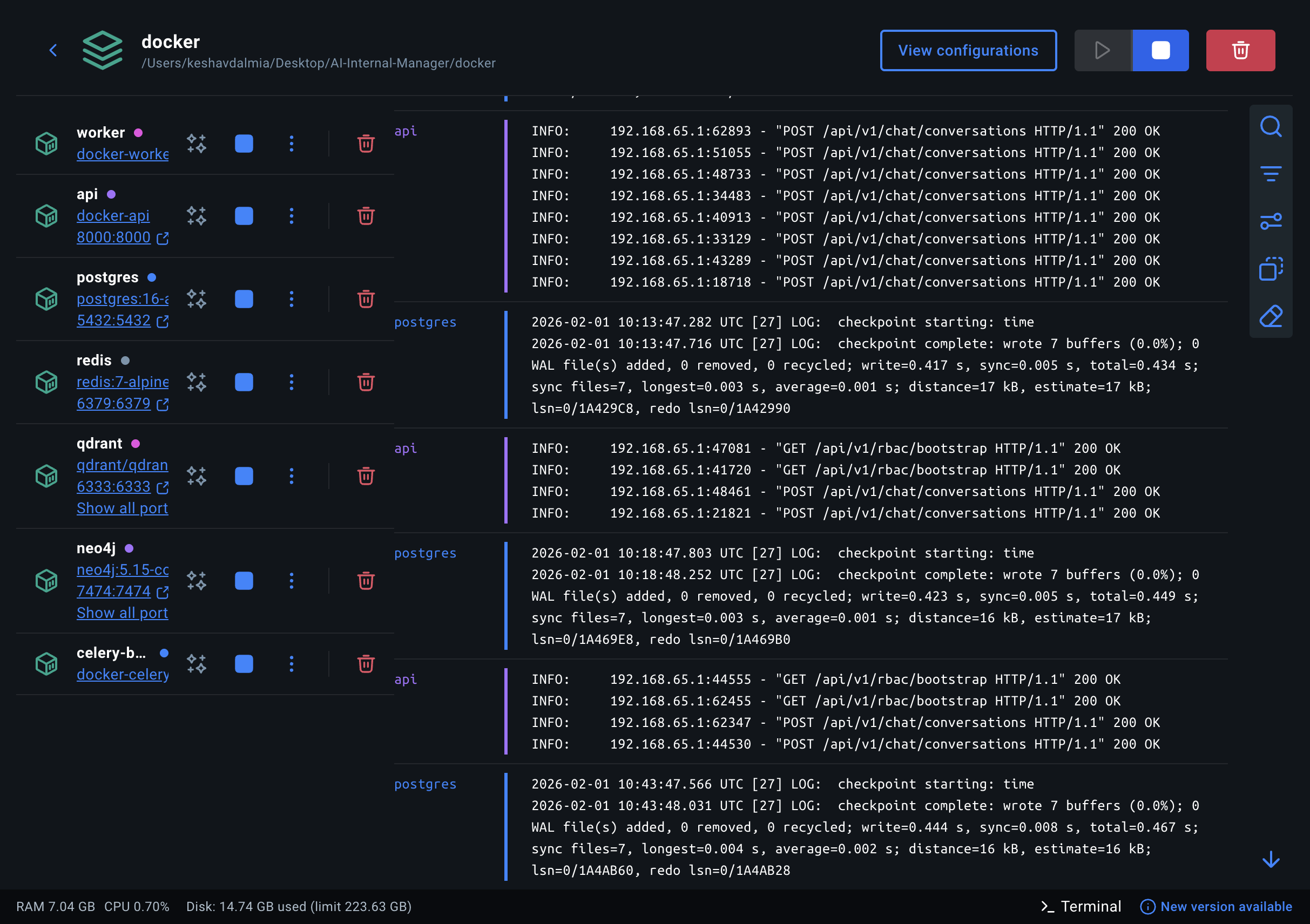
- Docker Compose brings up local infrastructure reproducibly.
Challenges we ran into
- Designing a data flow that keeps the graph (Neo4j) and vector index (Qdrant) consistent.
- Reducing latency across multi-step agent workflows while preserving explainability.
- Managing multi-tenant memory boundaries for org, team, and user contexts.
Accomplishments that we're proud of
- A modular agent system that routes tasks to the right specialist with minimal overhead.
- A dual-index knowledge layer (graph + vectors) that improves accuracy and grounding.
- A full local dev stack powered by Docker for quick onboarding and demos.
What we learned
- Combining graph structure with embeddings yields higher-precision answers than either alone.
- Background workers are essential for keeping ingestion and indexing fast and reliable.
- Clear service boundaries make it easier to evolve LLM providers and tooling.
What's next for NexusAI
- Deeper analytics for cross-team dependencies and knowledge gaps.
- Automated data freshness checks and alerting.
- Expanded MCP connectors and a self-serve integrations portal.
Technical Design
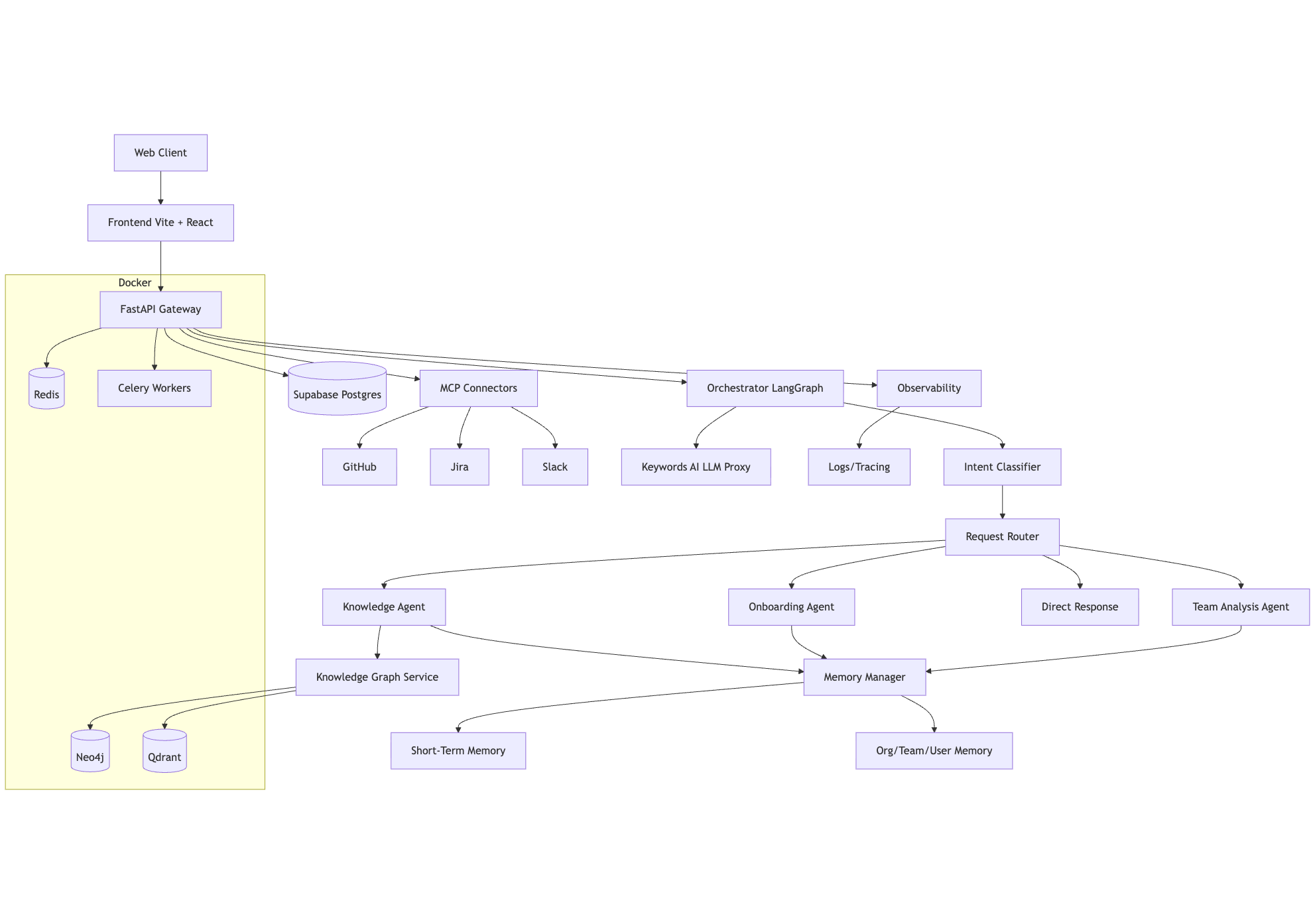
System Diagram
Design Overview
The system is a multi-agent, service-oriented architecture built around a LangGraph orchestrator. The FastAPI layer provides REST and WebSocket endpoints that handle user sessions, authentication, and request routing. Each request flows through an intent classifier and router to choose the right agent and tools, ensuring low-latency paths for direct responses and deeper pipelines for knowledge retrieval or analytics.
Request Lifecycle
- Client request hits the FastAPI gateway (REST or WebSocket).
- Orchestrator classifies intent and routes to a specialized agent.
- Agent execution uses tools and shared services (memory, knowledge, MCP connectors).
- LLM calls are handled through Keywords AI (OpenAI-compatible proxy), with model selection controlled by configuration.
- Response streaming returns partial tokens for chat and voice workflows.
Data and Storage
- Supabase Postgres is the primary system of record for users, conversations, onboarding flows, and analytics.
- Neo4j stores hierarchical knowledge and relationships (textbook-style graph).
- Qdrant indexes embeddings for fast semantic retrieval.
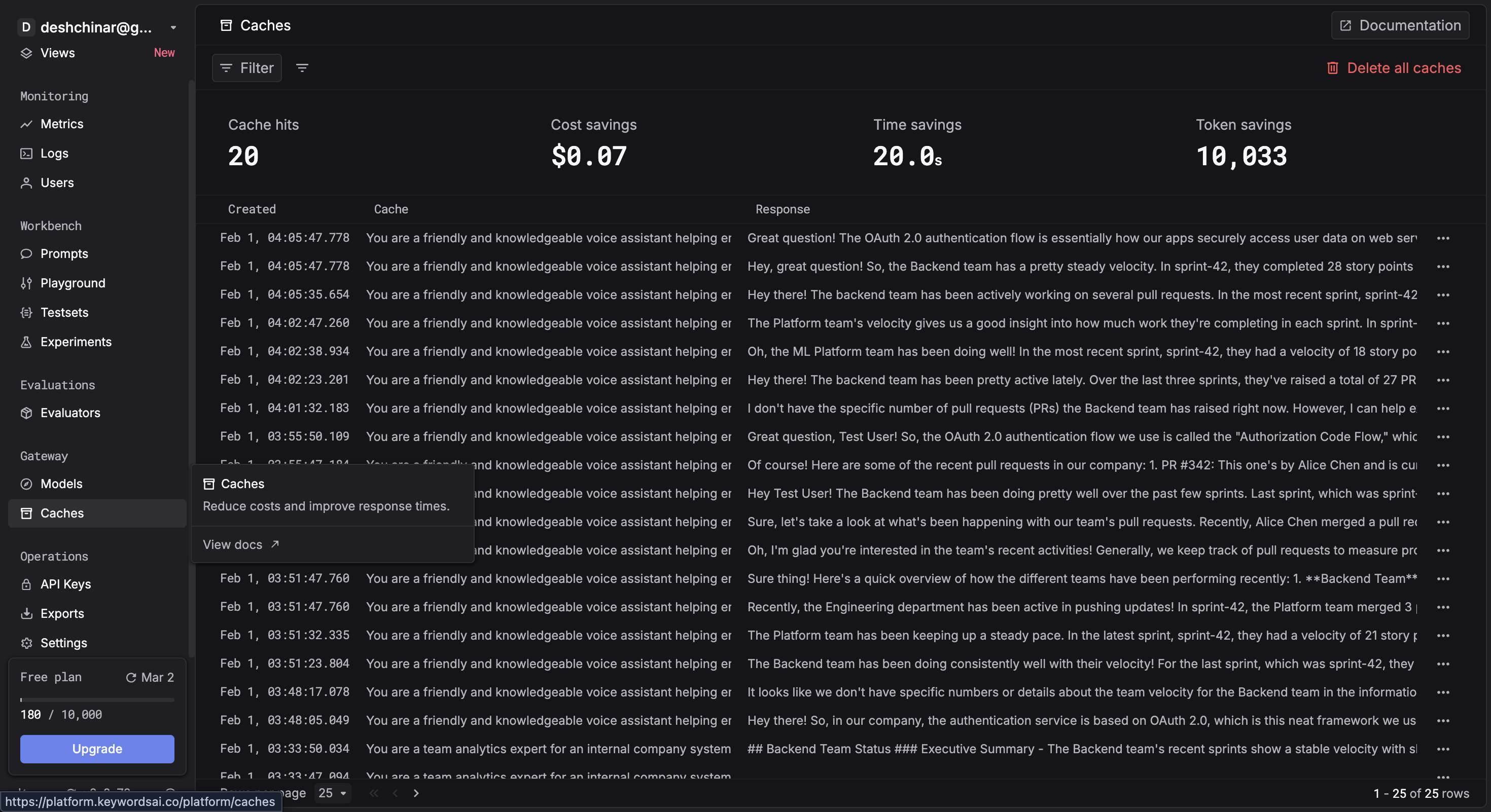
- Redis provides low-latency caching and backs Celery queues.
This separation optimizes for query patterns: transactional records in Postgres, graph traversal in Neo4j, and vector similarity in Qdrant.
Agent and Memory Model
- Orchestrator maintains session state and manages tool access using a shared memory interface.
- Short-term memory stores the immediate conversation context.
- Org/team/user memory enables durable personalization and cross-session continuity.
- Knowledge agent resolves facts by combining graph traversal and semantic retrieval.
Ingestion and Knowledge Indexing
- MCP connectors pull data from GitHub/Jira/Slack on schedules or user demand.
- Indexing pipeline chunks and embeds documents, writes embeddings to Qdrant, and links canonical entities in Neo4j.
- Consistency is maintained with background Celery tasks to keep graph and vector indexes aligned.
Voice Onboarding
- Deepgram handles speech-to-text.
- ElevenLabs handles text-to-speech.
- A dedicated WebSocket stream supports low-latency bidirectional audio.
Deployment and Operations
- Docker Compose orchestrates local services (API, workers, Redis, Neo4j, Qdrant).
- Observability captures logs and optional traces to diagnose latency or LLM/tool errors.
- Configuration is centralized via environment variables for easy switching between providers.
Tech Stack
| Component | Technology |
|---|---|
| API Framework | FastAPI |
| Agent Framework | LangGraph |
| LLM | Keywords AI (OpenAI-compatible) / Anthropic (optional) |
| Embeddings | Voyage AI / OpenAI |
| Knowledge Graph | Neo4j |
| Vector Database | Qdrant |
| Primary Database | Supabase Postgres |
| Cache/Queue | Redis |
| Task Queue | Celery |
| Voice | Deepgram + ElevenLabs |
Quick Start
Prerequisites
- Python 3.11+
- Docker and Docker Compose
- API keys for Anthropic, Voyage AI (or OpenAI for embeddings)
Setup
Clone the repository:
git clone <repository-url>
cd ai-internal-manager
Copy environment file and configure:
cp .env.example .env
# Edit .env with your API keys
Start services with Docker Compose:
cd docker
docker-compose up -d
Run database migrations:
alembic upgrade headStart the API server:
uvicorn src.main:app --reload
Development Setup
Create a virtual environment:
python -m venv venv
source venv/bin/activate  # or `venv\Scripts\activate` on Windows
Install dependencies:
pip install -e ".[dev]"Run tests:
pytest
API Endpoints
Chat
POST /api/v1/chat/conversations- Create conversationPOST /api/v1/chat/conversations/{id}/messages- Send messageWebSocket /api/v1/chat/ws/{id}- Real-time chat
Voice
POST /api/v1/voice/sessions- Create voice sessionWebSocket /api/v1/voice/ws/{id}- Voice streaming
Knowledge
POST /api/v1/knowledge/search- Semantic searchGET /api/v1/knowledge/graph/hierarchy- Get knowledge structureGET /api/v1/knowledge/graph/node/{id}- Get node details
Onboarding
GET /api/v1/onboarding/flows- List onboarding flowsPOST /api/v1/onboarding/start- Start onboardingGET /api/v1/onboarding/progress- Get progress
Analytics
GET /api/v1/analytics/team/{id}/health- Team health scoreGET /api/v1/analytics/team/{id}/velocity- Sprint velocityGET /api/v1/analytics/team/{id}/bottlenecks- Identified bottlenecks
Configuration
Key environment variables:
# Core
DATABASE_URL=postgresql+asyncpg://user:pass@localhost:5432/ai_manager
REDIS_URL=redis://localhost:6379/0
NEO4J_URI=bolt://localhost:7687
QDRANT_HOST=localhost

# LLM
ANTHROPIC_API_KEY=your-key

# Embeddings
VOYAGE_API_KEY=your-key  # or use OPENAI_API_KEY

# Voice (optional)
DEEPGRAM_API_KEY=your-key
ELEVENLABS_API_KEY=your-key

# External Services (optional)
JIRA_BASE_URL=https://your-domain.atlassian.net
JIRA_API_TOKEN=your-token
GITHUB_TOKEN=your-token
SLACK_BOT_TOKEN=your-token
Project Structure
ai-internal-manager/
├── docker/                 # Docker configuration
├── src/
│   ├── api/v1/            # REST + WebSocket endpoints
│   ├── agents/            # Agent implementations
│   │   ├── orchestrator/  # Main orchestrator with LangGraph
│   │   ├── knowledge/     # Knowledge retrieval agent
│   │   ├── onboarding/    # Onboarding agent
│   │   └── team_analysis/ # Team analytics agent
│   ├── mcp/               # MCP connectors
│   │   ├── jira/
│   │   ├── github/
│   │   └── slack/
│   ├── knowledge/         # Knowledge graph management
│   │   ├── graph/         # Neo4j operations
│   │   ├── textbook/      # Hierarchy management
│   │   └── indexing/      # Embeddings and chunking
│   ├── memory/            # Memory system
│   ├── models/            # SQLAlchemy models
│   └── schemas/           # Pydantic schemas
├── workers/               # Celery workers
├── alembic/               # Database migrations
└── tests/                 # Test suite
License
MIT
Built With
- docker
- keywordsai
- neo4j
- python
- supabase
- typescript


Log in or sign up for Devpost to join the conversation.