Inspiration
Modern development workflows require switching between various disconnected platforms like GitLab, terminal environments, and code editors, creating significant cognitive overhead and friction. We wanted to build an intelligent system that bridges this gap—allowing developers to express their high-level intent in plain language and letting a unified, multi-agent orchestrator handle the execution details across separate tools natively.
What it does
NexusAI is an intelligent multi-agent orchestration framework designed to automate and streamline software development operations. Built with a main orchestrator configuration (agent.yaml), it intelligently routes user tasks to highly specialized sub-agents:
- MainOrchestrator: Parses complex user requests, maintains the core reasoning loop, and delegates responsibilities.
- SystemsPlanner: Breaks down high-level prompts into structured execution strategies.
- AgentDeveloper: Interacts directly with workspaces to handle actual implementation tasks.
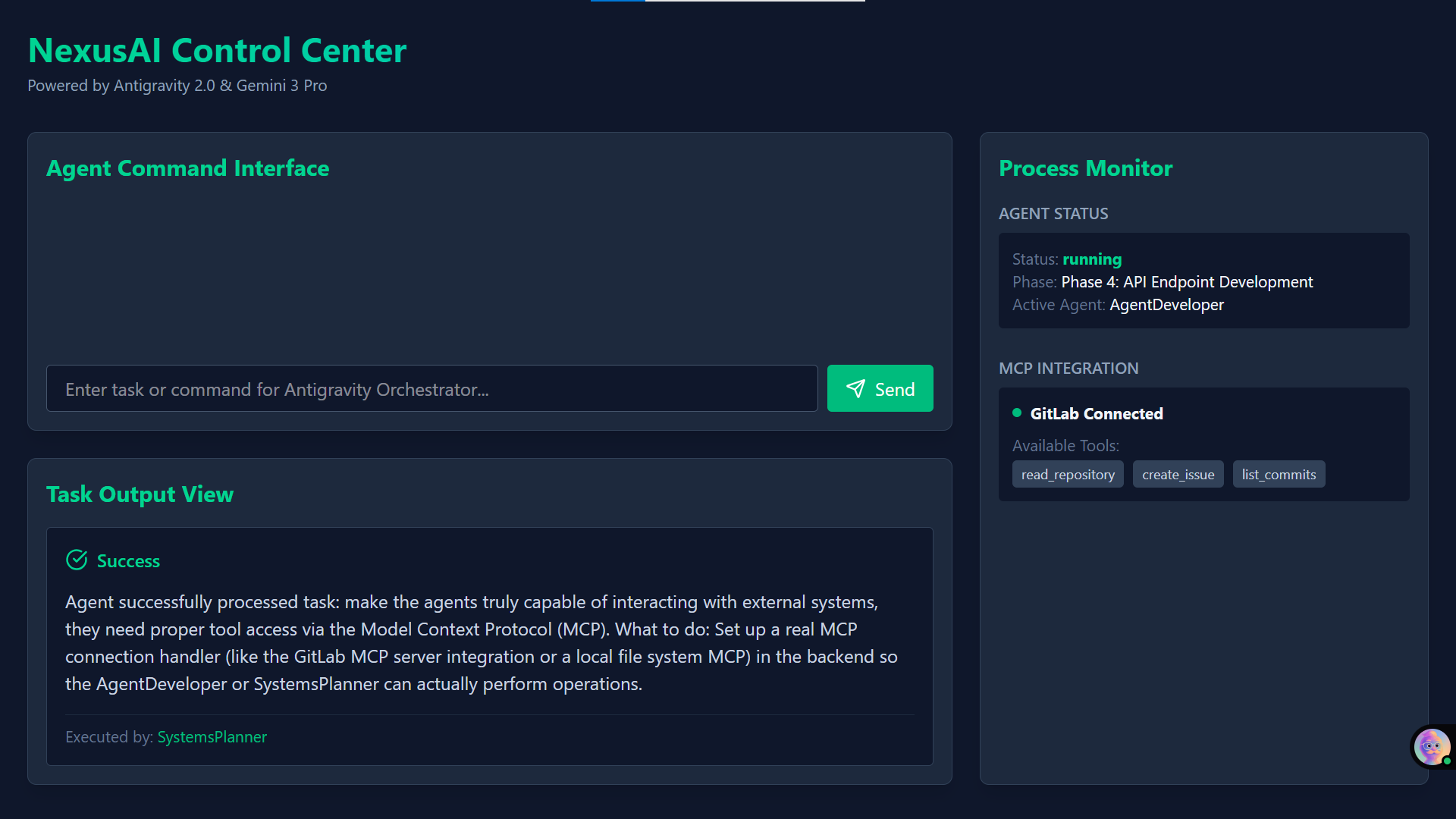
The application exposes real-time status tracking for tasks and live Model Context Protocol (MCP) tool integrations, allowing the agent system to perform repository operations like reading codebases, creating issues, and listing commits seamlessly.
How we built it
The project is built using a decoupled full-stack architecture:
- Backend: Built using Node.js and Express to manage agent configurations, parse YAML data, and scaffold API endpoints for agent communication.
- Frontend: A responsive, real-time user interface engineered with React, Vite, and CSS for task monitoring, output logs, and chat interactions.
- Agent Infrastructure: Leverages YAML configurations to define distinct sub-agent profiles and models, laying out the baseline foundation for tool-binding and continuous reasoning execution loops.
Challenges we ran into
One of our primary hurdles was defining a structured environment for robust sub-agent routing without creating cyclical execution errors or infinite feedback loops during complex tasks. Designing an intuitive schema layout via agent.yaml required multiple iterations to ensure config files load gracefully while scaling fallback error paths safely when direct components are missing or uninitialized.
Accomplishments that we're proud of
- Successfully engineered a clear, modular framework blueprint that bridges specialized external tools (like GitLab repositories) straight to unified agent states.
- Built an interactive, component-driven React frontend displaying live phase transitions, task statuses, and connection monitors smoothly.
- Created clean, predictable api contracts allowing the application backend and UI views to scale concurrently without tight coupling dependencies.
What we learned
We gained critical experience designing decoupled agent logic systems using Model Context Protocol abstractions. We realized how important clean state scoping is when handling multiple sub-agents under a master orchestrator, ensuring execution parameters, security permissions, and target operations remain deterministic and isolated.
What's next for NexusAI
- Moving past structural scaffolding to bind live model configurations natively using the Antigravity 2.0 SDK.
- Fully executing live tool environments (
browser,code_editor,terminal) directly inside sandbox developer environments. - Adding secure, bi-directional authentication pipelines for multi-platform MCP configurations, expanding integrations to platforms beyond GitLab.

Log in or sign up for Devpost to join the conversation.