-
-
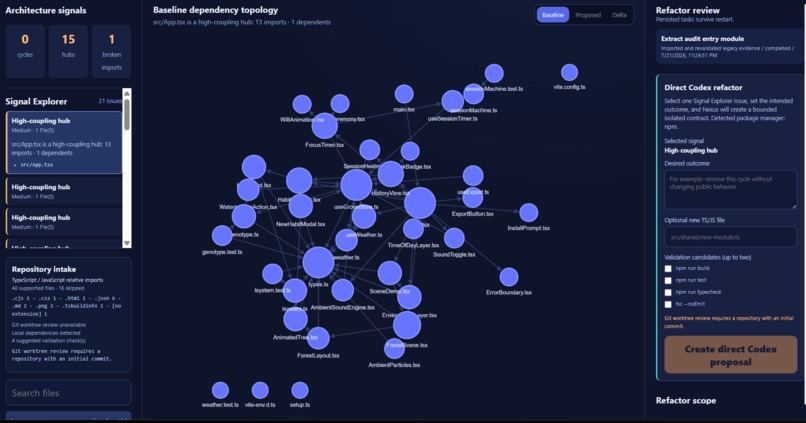
nexus app overview
Inspiration
Codex can make focused code changes quickly, but I kept returning to the same developer question: how do I know an AI-generated refactor stayed inside scope, improved the architecture, and is genuinely safe to merge?
Nexus was built to make that decision visible. Instead of treating a completed Codex run as proof, it gives developers evidence before they merge.
What it does
Nexus is a local Windows desktop workspace for safe, reviewable Codex refactors. It maps TypeScript/JavaScript file dependencies, identifies architecture risks such as cycles and hubs, turns one issue into a bounded refactor contract, and evaluates the proposal in an isolated Git worktree.
Its core experience is before → proposed → impact:
- inspect the current architecture;
- create a bounded, isolated proposal;
- review the diff, validation evidence, signal changes, and scope compliance before manually merging.
How I built it
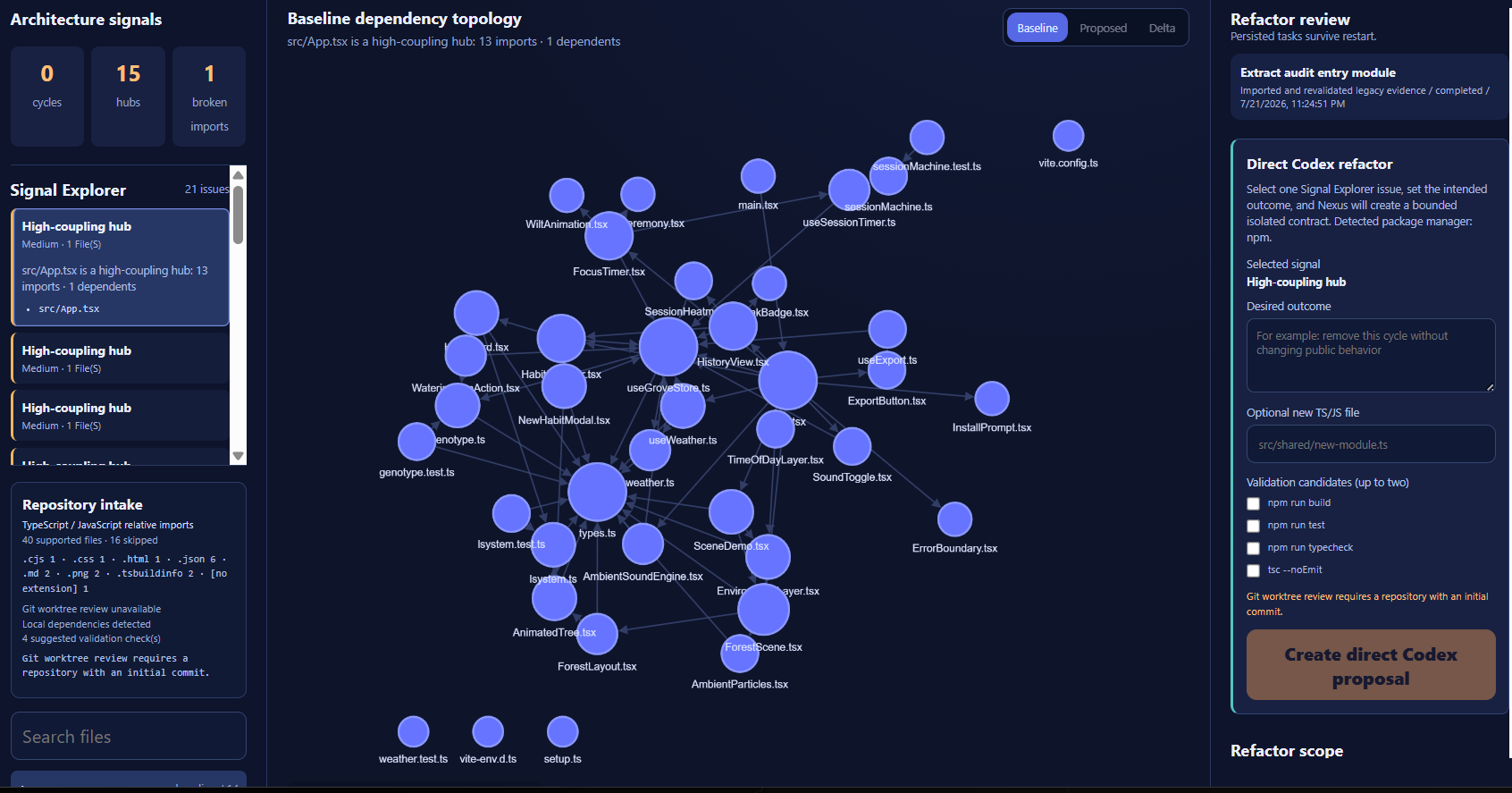
I built Nexus as an Electron and React desktop app with TypeScript and Cytoscape.js. The Electron main process handles local repository analysis, Git worktrees, file watching, validation, and optional Codex CLI execution. The React renderer presents the graph, Signal Explorer, runbook timeline, proposal-health proof, and diff review.
I used Codex with GPT-5.6 throughout Build Week to refine the product direction, implement the workflow, debug the worktree and validation pipeline, and test the evidence gate.
At runtime, Nexus can optionally invoke a locally authenticated Codex CLI in workspace-write sandboxing inside an isolated worktree. It never uses approval-bypass flags, automatic commits, or automatic merges.
Challenges and what I learned
The hard part was not drawing a dependency graph—it was turning a powerful coding agent into a trustworthy developer workflow. I learned that a completed agent run is not enough. Nexus needs deterministic checks around changed-file scope, architecture-signal deltas, current validation evidence, and worktree isolation.
I also learned to keep the MVP honest: TypeScript/JavaScript relative-import analysis is deliberately supported, while aliases, multi-language parsing, package-resolution graphs, and monorepo-specific semantics remain outside scope.
What judges can test
The bundled guided demo starts with a single audit.ts ↔ audit-store.ts cycle. Judges can inspect the issue, create a bounded proposal, review the isolated diff, see the cycle resolve, confirm validation evidence, and verify that the primary checkout remains untouched.
Built With
- codex
- cytoscape.js
- electron
- git
- gpt-5.6
- node.js
- react
- typescript

Log in or sign up for Devpost to join the conversation.