Inspiration
I didn’t come up with the idea in the shower or during some eureka moment. It came from frustration. During a group project last semester, I watched my teammates spend 45 minutes searching Google, switching between tabs, cross-referencing Reddit threads, just to answer one question for our project report. And I thought: we’re literally studying information technology, and this is how we’re still working? That moment stuck with me. When the hackathon brief dropped and mentioned intelligent agents that could “redefine the workplace,” I knew exactly what I wanted to build something that collapses all of that overhead into a single conversation. I’d been reading about how large language models could be extended with tool use, and the idea of giving an AI agent access to live web search felt like the missing piece. Not a static chatbot that’s frozen in time, but an agent that actually knows what’s happening right now. That’s where Nexus came from.
What it does
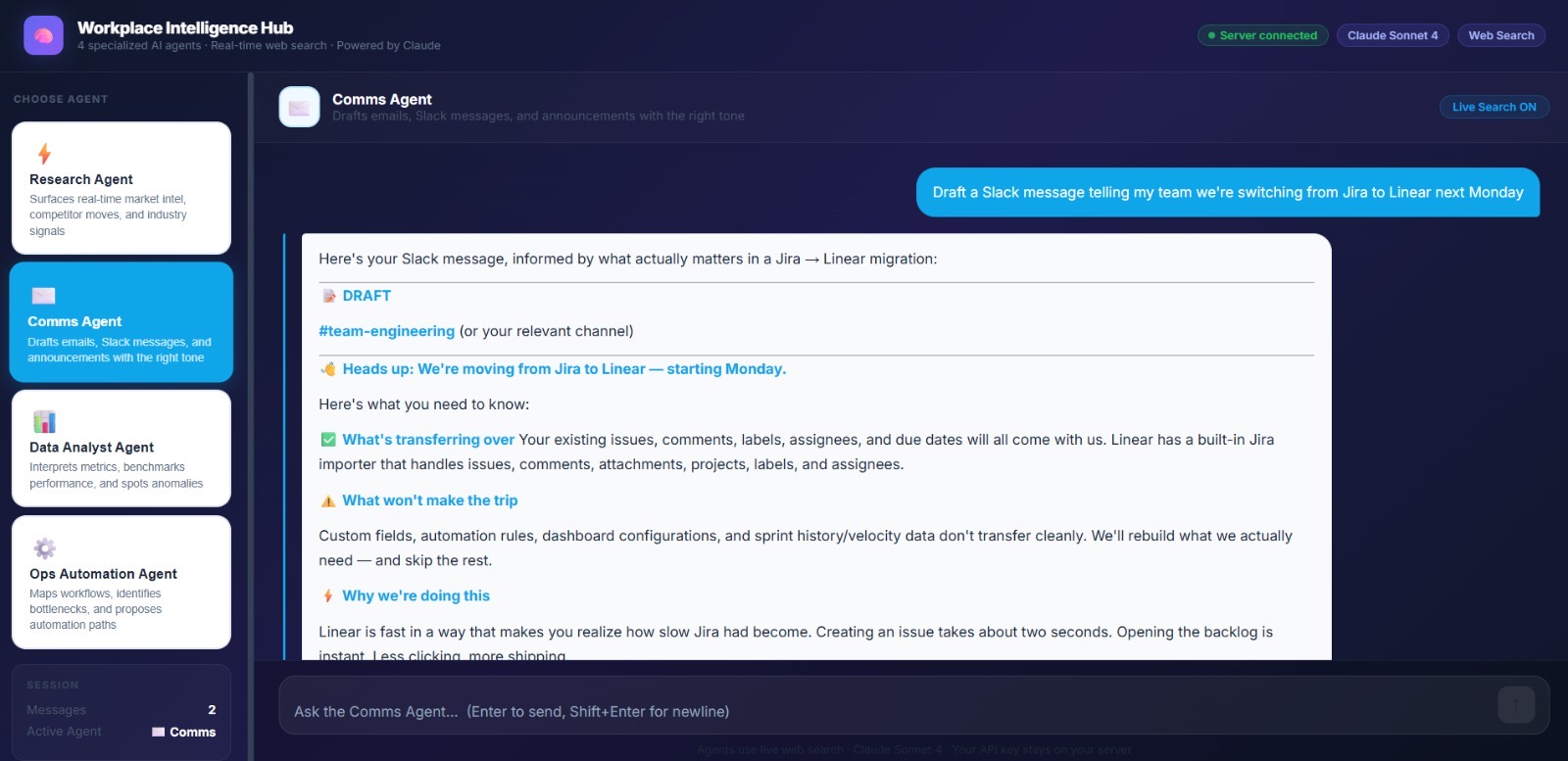
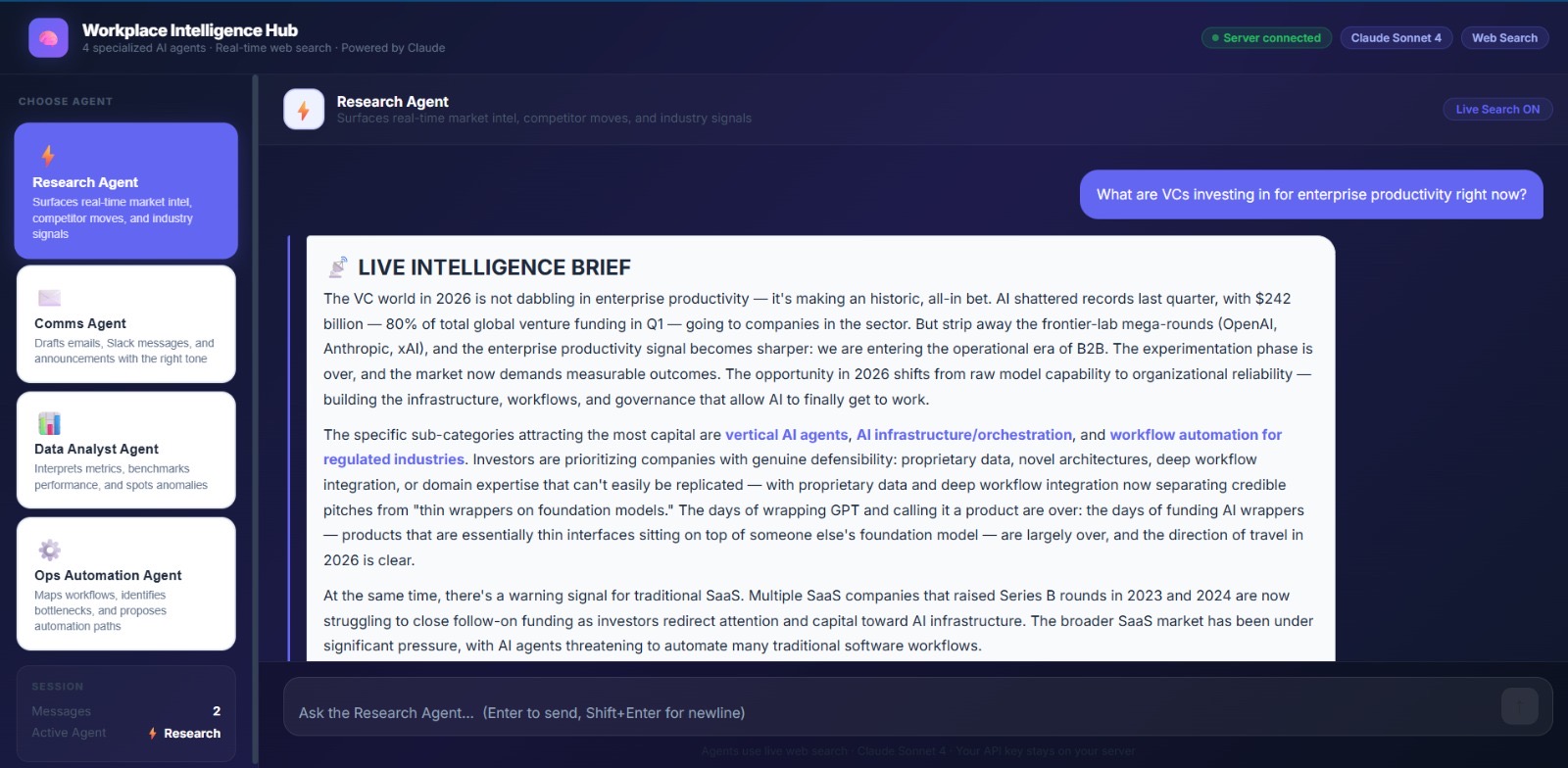
The platform addresses one of the most persistent challenges in the modern workplace: fragmentation. Teams today juggle dozens of tools, context-switch constantly, and spend significant time on low-leverage tasks — drafting routine communications, pulling together status updates, benchmarking performance metrics, and mapping out processes that could be automated. Nexus consolidates these pain points into a single intelligent command centre, where employees can describe what they need in natural language and have an AI agent handle the heavy lifting.
How we built it
The stack I chose was deliberately familiar. React on the frontend, Node.js and Express on the backend, and the Anthropic API doing the heavy lifting in the middle. I built a simple Express proxy server that sits between the React frontend and the Anthropic API. Each agent is defined by three things: a persona, a system prompt, and a structured output contract. The output contract is what made the difference, instead of letting the model respond however it wanted, I engineered each prompt to always return the same sections. The UI was the last thing I built and the most fun. Dark background, colour-coded agents, a typing indicator while the model is thinking. Small details, but they make it feel like a real product rather than a university project.
Challenges
First time running the frontend and backend together, every API call failed with a CORS error. Additionally, the Anthropic API returns a mixed array of content blocks when the model uses tools and midway through I started getting model not found errors.
Accomplishments that we're proud of
What we learned
Prompt engineering is real engineering. I rewrote the system prompts for each agent probably six or seven times. The difference between a vague prompt and a precise one is the difference between a response you’d actually use and one you’d ignore. Structuring outputs with explicit section headers, tone guidance, and output contracts changed everything.
Latency matters more than you think. When the model is searching the web and reasoning, responses can take 8–12 seconds. Without a typing indicator and status message, that silence feels broken. I learned that perceived performance is just as important as actual performance.
What's next for Nexus-workplace intel hub
Honestly? I’m not ready to let this project die after the hackathon.
Most of the things I build for university live on my laptop for a semester and then get archived. Nexus feels different.

Log in or sign up for Devpost to join the conversation.