-
-
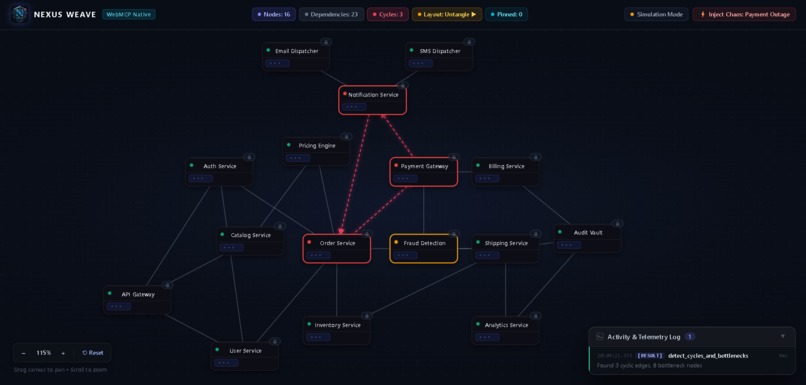
Autonomous Tarjan SCC isolating 3-node cyclic deadlock in <3ms
-
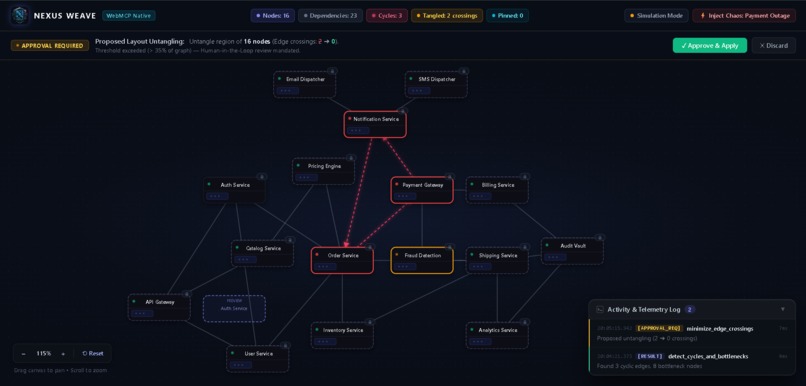
Human-in-the-Loop Safety Gate with coordinate Ghost-Node pre-flight preview
-
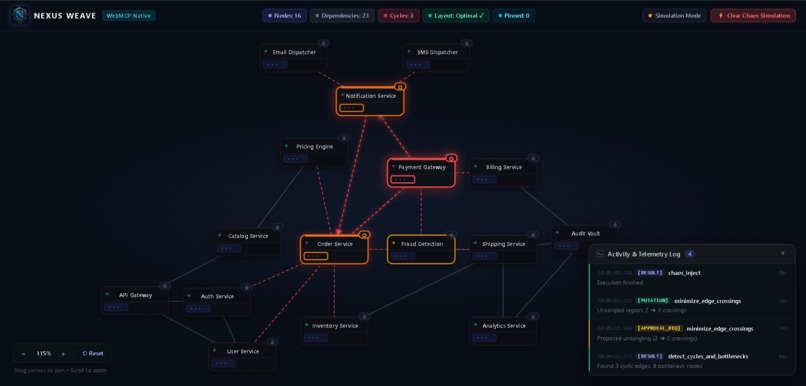
Zero-dependency Chaos Cascade simulating live downstream service outage
-
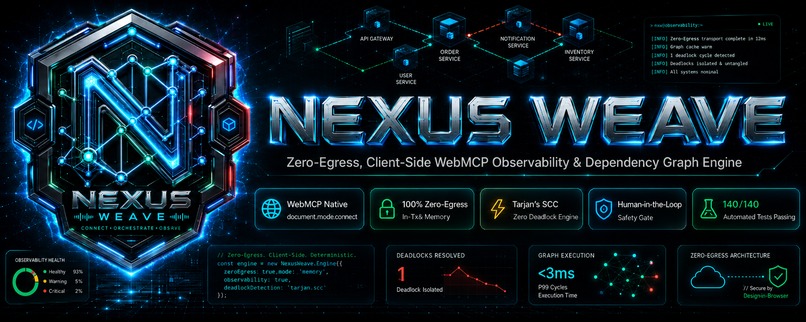
Nexus Weave — Zero-Egress WebMCP Graph Engine Overview
🌐 Nexus Weave — Zero-Egress WebMCP Dependency Graph Engine
Autonomous Tarjan Cycle Isolation • Human-in-the-Loop Safety Gate • Zero-Egress In-Browser Execution Built for the OpenAI & Chrome WebMCP Challenge 2026 — Agent-Native Open Web Track
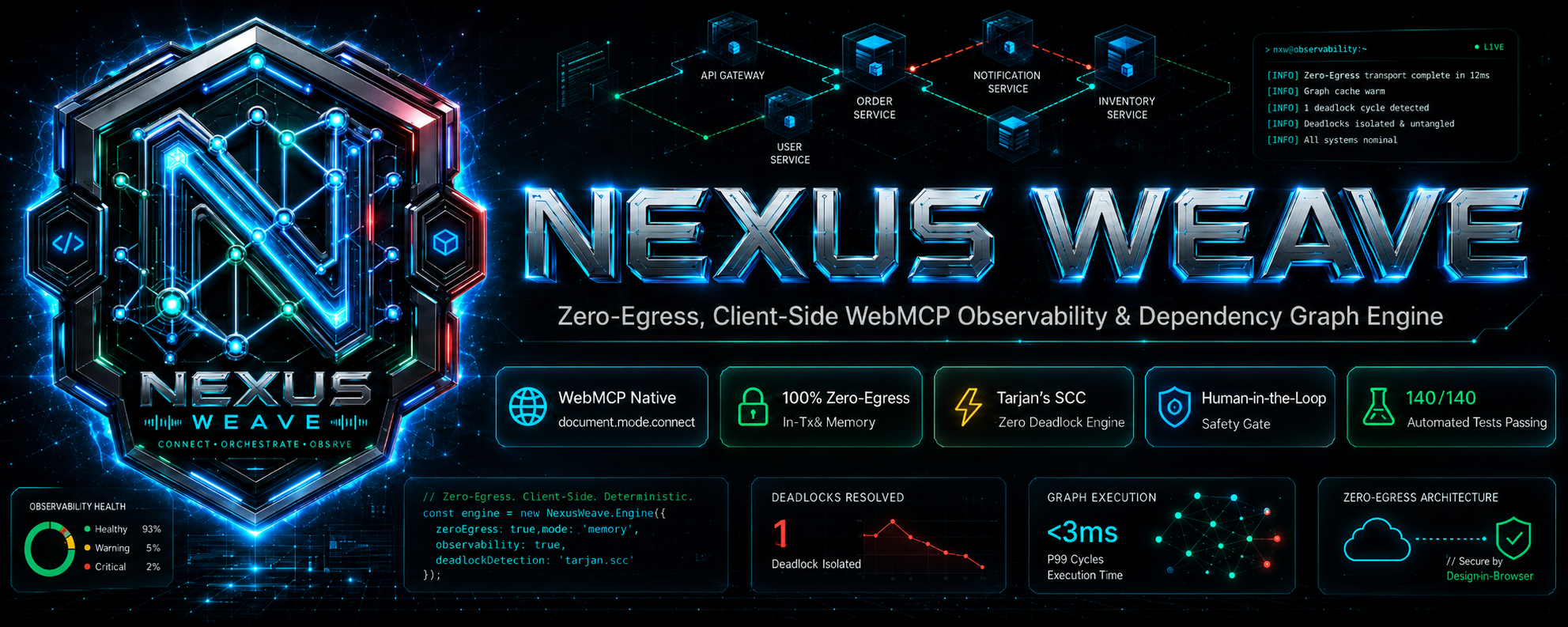
🌟 The 4 Core WebMCP Challenge Pillars
1. 🎯 Why This Use Case is a Strong Fit for WebMCP
Enterprise dependency graphs (microservices meshes, cloud infrastructure topologies, CI/CD pipelines) represent proprietary, security-sensitive architecture. Uploading raw architectural graphs and telemetry traces to remote third-party LLM cloud servers violates corporate data residency standards and creates catastrophic network egress liability.
WebMCP makes the browser an agent-executable execution runtime. Instead of exfiltrating sensitive graph data to remote backends, WebMCP enables external AI agents (in ChatGPT’s in-app browser or Chrome Canary) to inspect, diagnose, and untangle complex dependency topologies directly inside the client browser’s volatile memory — executing deterministic graph algorithms with 0 KB of network egress.
2. ⚡ How It Creates a Better User Experience
Traditional APM visualizers force DevOps engineers into manual log correlation, multi-dashboard context switching, and speculative guesswork. Nexus Weave transforms passive observability into a reactive, agent-native workspace:
- Instant Mathematical Diagnosis: Sub-3 millisecond graph algorithms (Tarjan's SCC for circular deadlocks, DAG topological sort for critical paths) replace LLM text hallucinations with mathematical certainty.
- Visual-First Affordances: Rather than dumping conversational text walls, the AI agent drives reactive 60 FPS SVG spring transitions, pulses highlighted cyclic corridors (crimson dashed loops), and projects coordinate ghost-node previews directly onto the engineer’s canvas.
3. 🤝 Human-Agent Co-Creation (What People and Agents Can Do Together)
Nexus Weave establishes mechanically enforced, bidirectional safety boundaries between human operators and autonomous agents:
- Pinned Infrastructure Boundaries: Engineers can click the pushpin icon on any foundational service node (e.g., API Gateway /
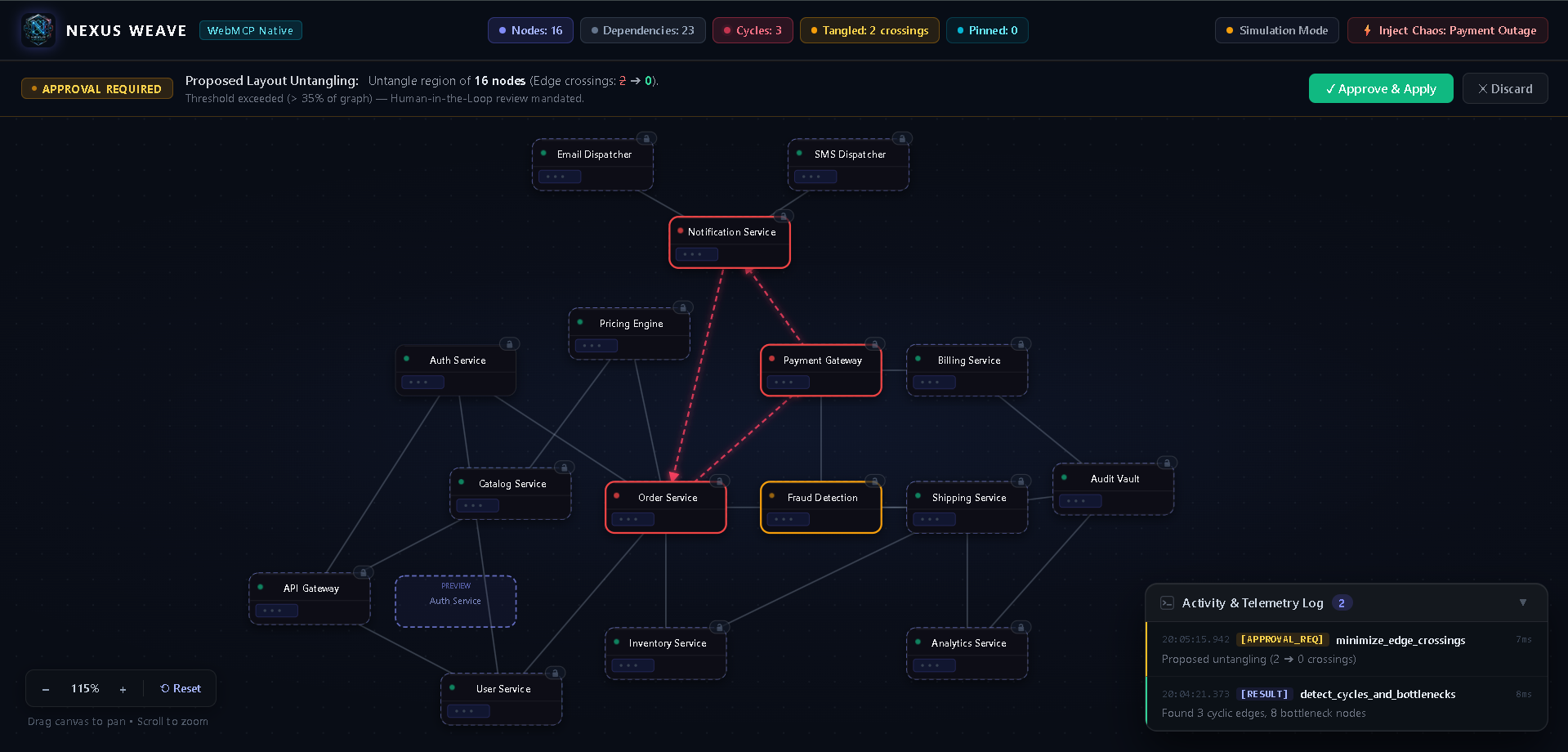
api-gateway). This commits the node ID into an in-memory bitmask. WebMCP mutating tools structurally guarantee pinned nodes are immutable and strictly rejected from any agent-driven layout displacement. - Human-in-the-Loop (HITL) Safety Gate: Whenever an autonomous agent proposes a layout reorganization exceeding a 30% blast radius (or targeting the full topology), execution halts deterministically. The engine renders a live Ghost-Node coordinate preview overlay, requiring explicit human review and sign-off (
confirm_pending: true) before layout mutation commits.
4. ⚙️ How We Implemented WebMCP
- Universal Dual-Detection & Multi-Surface Discovery:
getAvailableModelContexts(): ModelContext[]resolves bothdocument.modelContextandnavigator.modelContextsimultaneously, registering tools across all active browser surfaces while defensively suppressing duplicate-registration errors. - Defensive Argument Normalization: The
normalizeToolArguments(rawArgs: unknown)runtime layer (insrc/tools/dispatch.tsandsrc/webmcp/register.ts) guarantees resilience against stringified JSON arguments, null/undefined payloads, and malformed inputs from autonomous LLM callers. - Dispatch Proxy Architecture: The
src/webmcp/dispatch.tsre-export proxy module cleanly decouples WebMCP registration and host binding from internal graph dispatch logic. - Compiled Ajv JSON Schemas: All 5 tool definitions strictly enforce runtime schema validation using compiled Ajv v8 JSON Schema Draft-07 definitions via the canonical
inputSchemaproperty. - Deterministic 6-Step Dispatch Lifecycle: Validate ➔ Trust & Scope Check ➔ Branch Decision ➔ Compute-Then-Atomic-Apply ➔ Pure Reducer Commit ➔ In-Page EventBus Emission.
- Canonical Imperative Registration: Registered via
document.modelContext.registerTool():
// Canonical WebMCP Imperative Registration (W3C / WebMCP Challenge Compliant)
document.modelContext.registerTool({
  name: "detect_cycles_and_bottlenecks",
  description: "Deterministic detection of circular dependency deadlocks (using Tarjan's SCC) and bottleneck nodes in the microservice topology. Call this whenever the user asks about deadlocks, cycles, loops, or bottlenecks.",
  inputSchema: detectCyclesAndBottlenecksInputSchema,
  execute: async (input) => {
    return dispatchToolCall("detect_cycles_and_bottlenecks", input, stateAccessor);
  }
});
💡 Inspiration
Enterprise incident rooms are chaotic: when a cascading microservice outage strikes, teams spend hours deciphering tangled dependency spaghetti across siloed cloud dashboards. We asked ourselves: What if an autonomous AI agent could sit directly alongside the engineer inside the browser tab, running graph-theoretic algorithms on the live topology without sending a single byte of proprietary architectural data over the wire? WebMCP made this vision possible.
🔍 What It Does
Nexus Weave is an agent-native, zero-backend dependency graph engine pre-loaded with a realistic 16-node, 23-edge microservices topology:
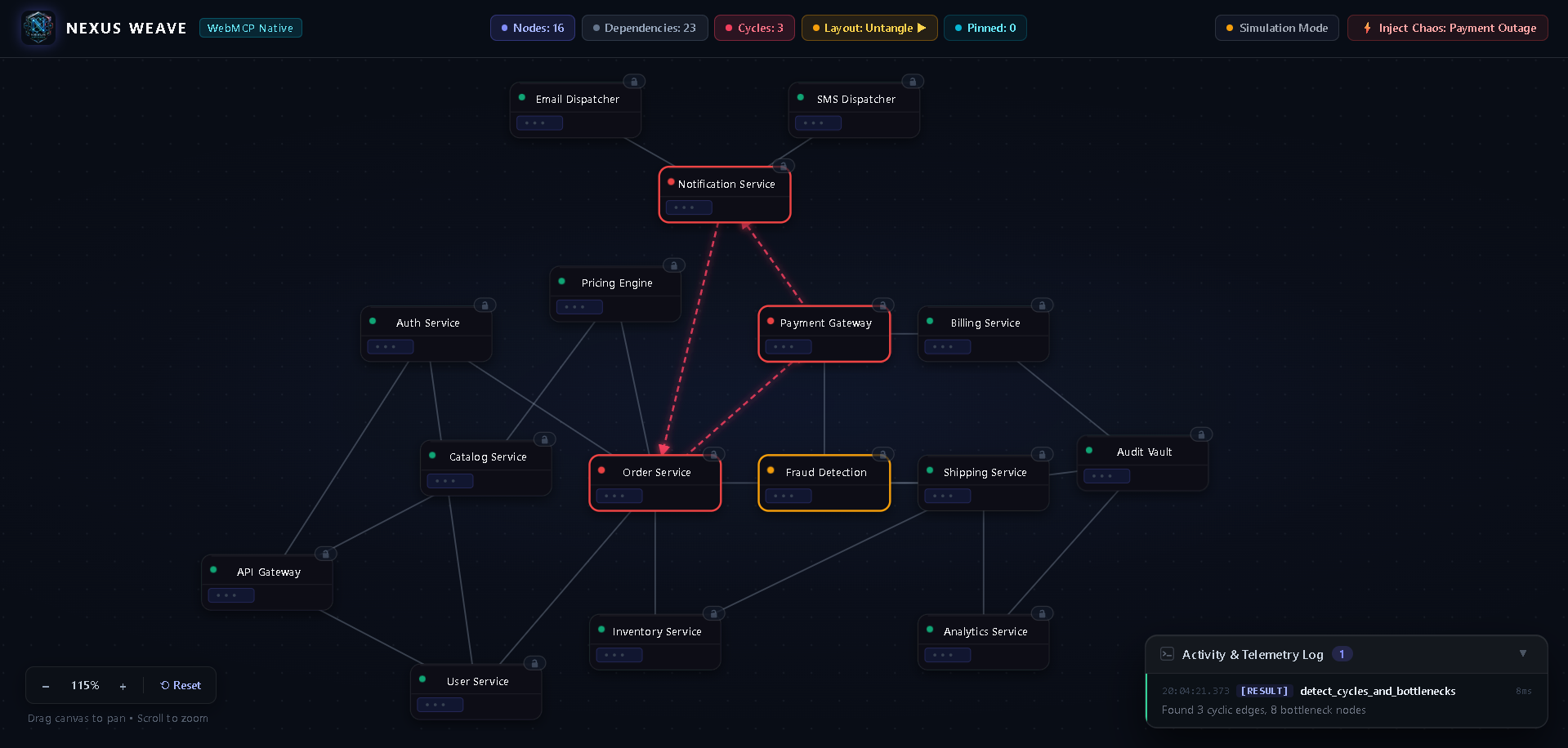
Autonomous Deadlock Isolation: Runs Tarjan’s Strongly Connected Components (SCC) algorithm in $O(V + E)$ time ($< 3\text{ms}$ execution) to highlight the 3-node cyclic deadlock between Order Service, Payment Gateway, and Notification Service.
Deterministic Critical Path Analysis: Computes the longest latency path across acyclic DAG subgraphs using dynamic programming while enforcing a strict Silence-Over-Guessing policy on cyclic graphs.
Planar Crossing Minimizer with HITL Gate: Reduces edge crossings (from 2 crossings to 0) using bounded barycenter relaxation with a 450ms cubic-bezier transition, gated by ghost-node human pre-flight approval.
Mechanical Pinning Guardrails: Locks critical infrastructure nodes against agent movement via immutable state bitmasks.
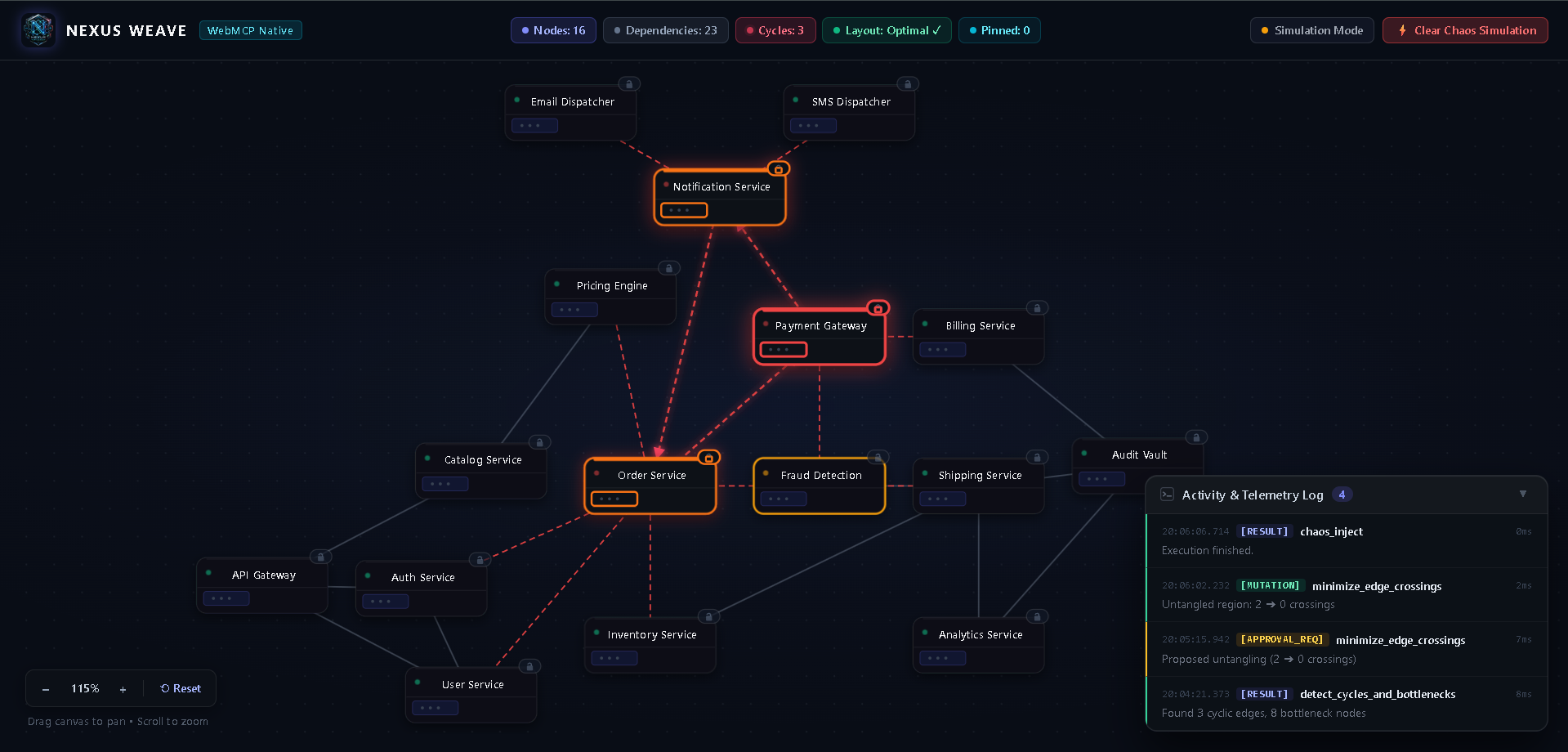
Proactive Chaos Cascade Simulator: Simulates live downstream service failures (e.g., Payment Gateway outage) with in-memory OpenTelemetry GenAI span emissions.
🖥️ Visual Grounding & Live Engine Showcase
1. Autonomous Deadlock Detection via Tarjan's SCC (<3ms)
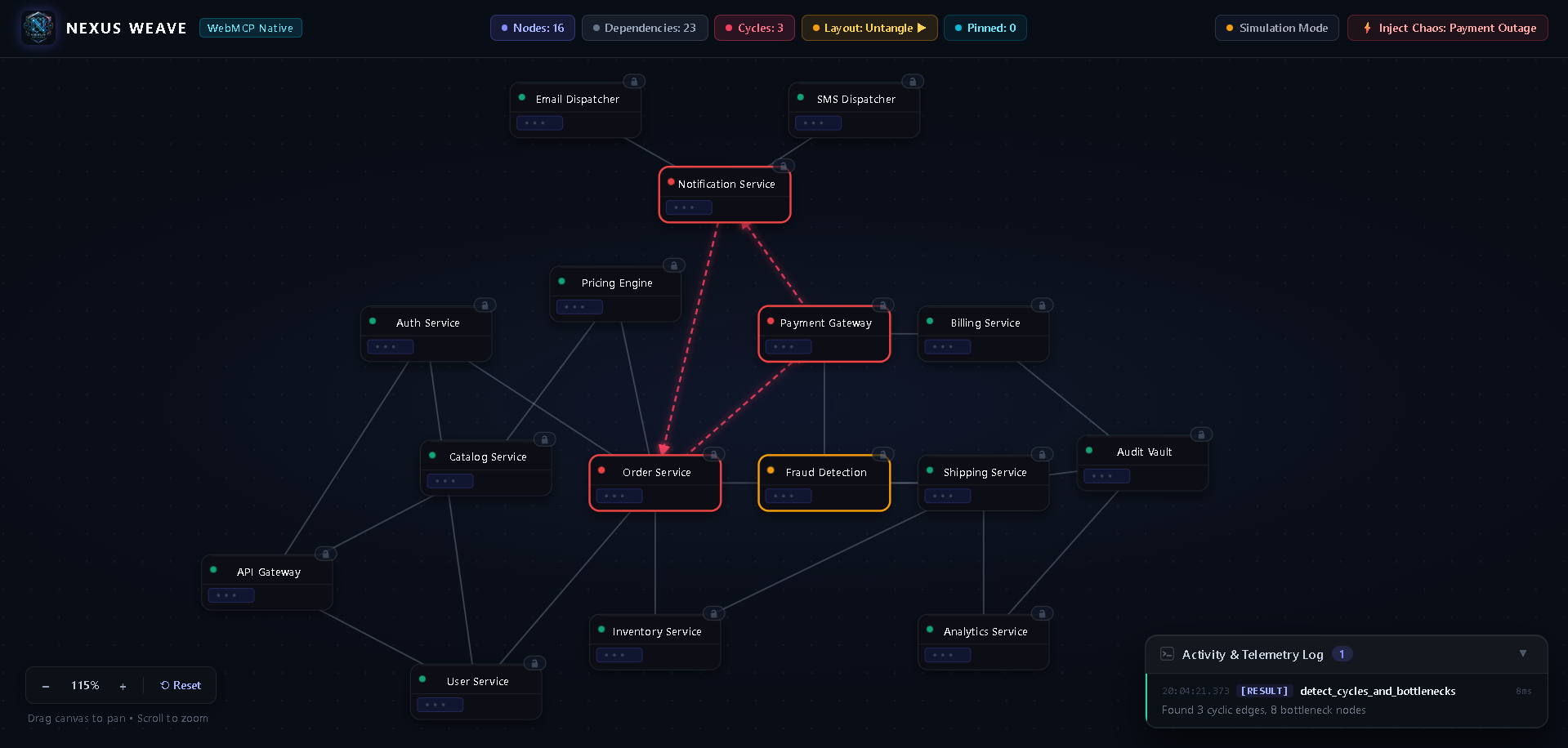
Real-time isolation of the 3-node cyclic deadlock between Order Service, Payment Gateway, and Notification Service.
2. Enterprise Human-in-the-Loop (HITL) Safety Gate & Ghost Node Overlay
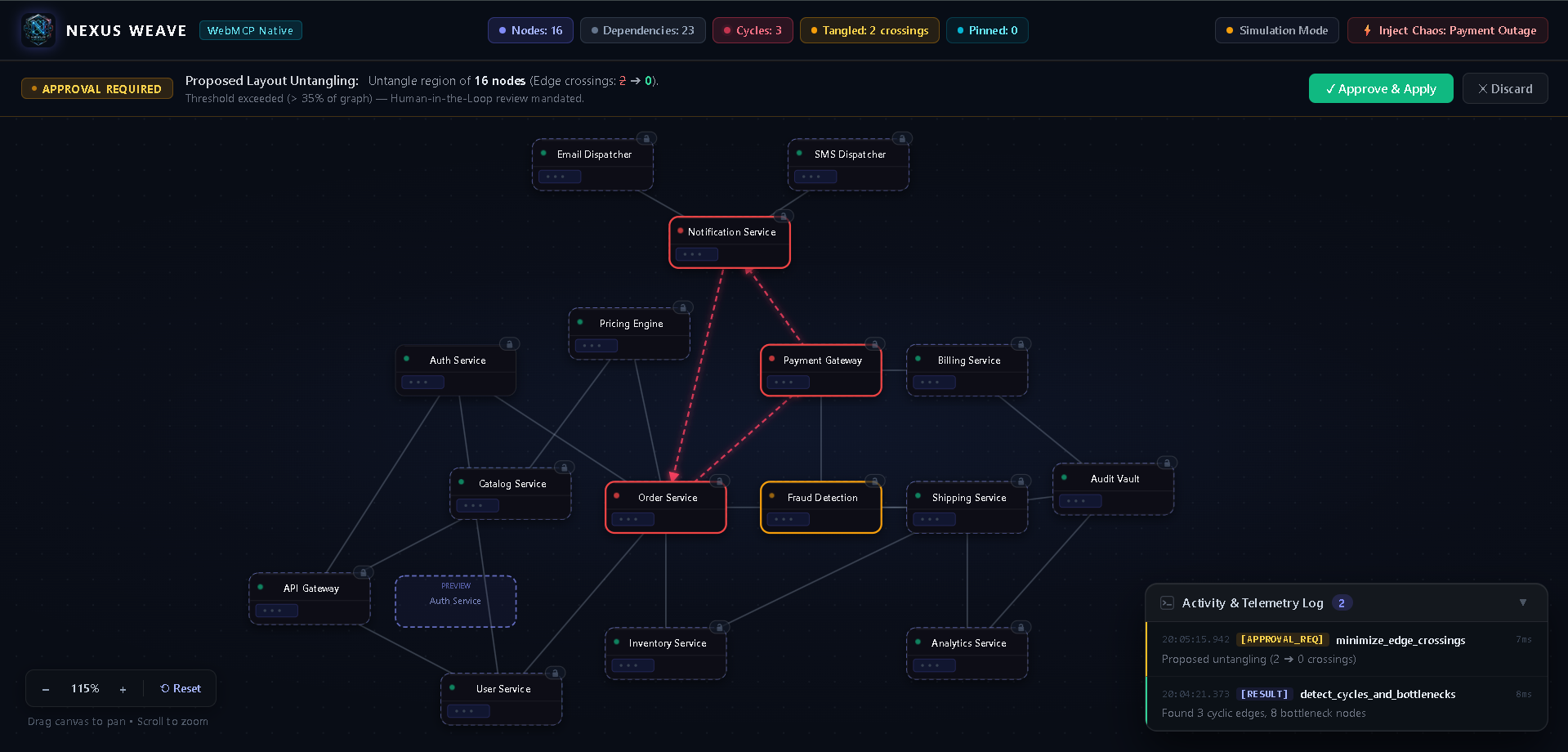
Autonomous layout reorganization intercepting mutations >30% blast radius with live coordinate ghost previews.
3. Proactive Resilience: Zero-Dependency Chaos Engineering Cascade
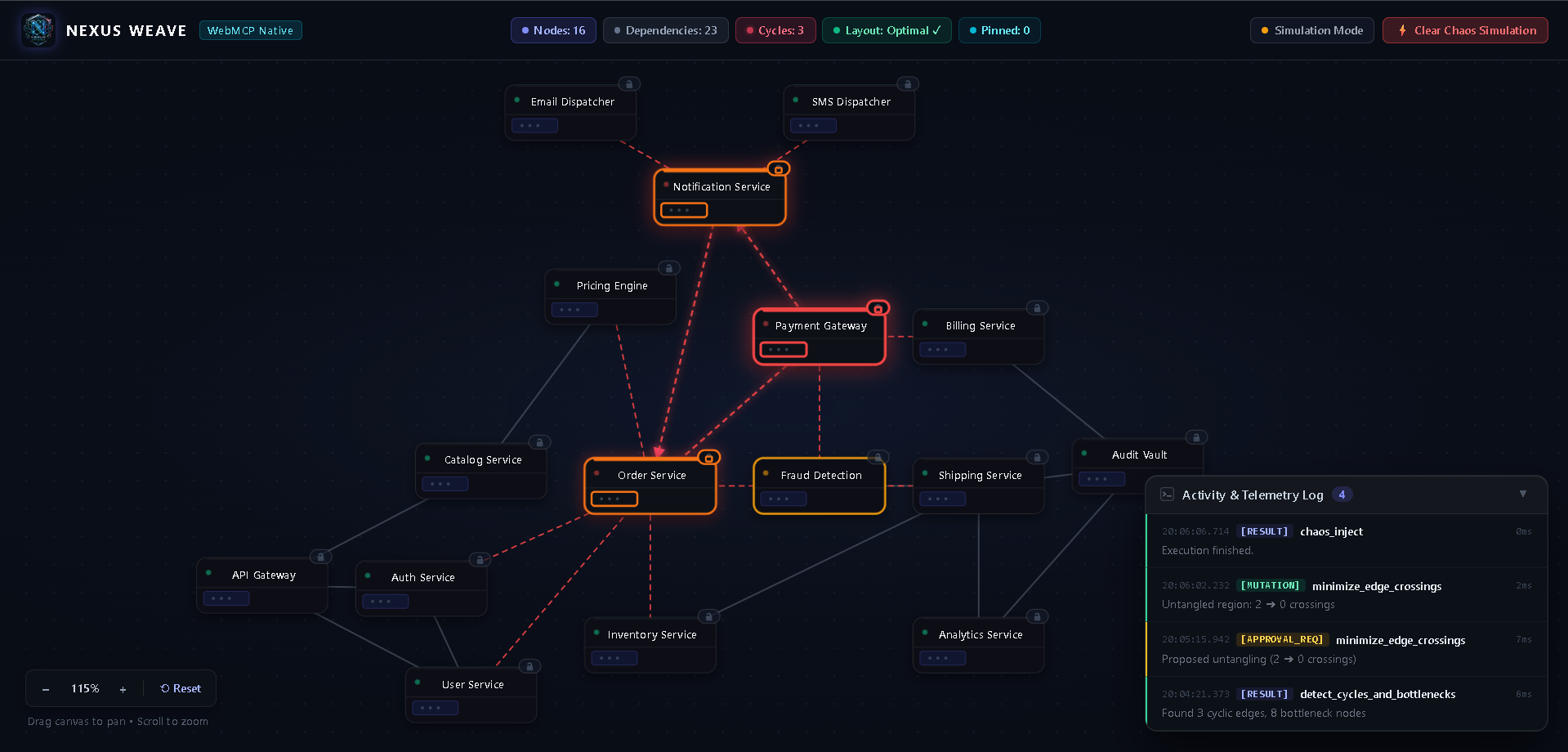
Simulating Payment Gateway outage cascading downstream in real time with local OpenTelemetry span emissions.
🛠️ Registered WebMCP Tools Specification Matrix
| Tool Name | Type | Key MCP Annotations | Mathematical Algorithm | State Mutation |
|---|---|---|---|---|
get_graph_topology |
Read | readOnlyHint: true, untrustedContentHint: true |
Snapshot serialization | None (Pure read) |
detect_cycles_and_bottlenecks |
Diagnostic | readOnlyHint: true |
Tarjan's SCC + Degree Centrality | Annotation-only (is_cyclic) |
compute_critical_path |
Diagnostic | readOnlyHint: true |
DAG Topological Sort + DP Longest Path | Annotation-only (is_critical) |
minimize_edge_crossings |
Mutation | readOnlyHint: false |
Bounded Barycenter Relaxation | graph_nodes.position (HITL Gated) |
pin_and_group_region |
Mutation | readOnlyHint: false, idempotentHint: true |
Bitmask State Locking | pinned_node_ids (Atomic Lock) |
🛠️ How We Built It
Runtime & Language: Built with TypeScript 5.9+ (Strict Mode) and Vite 6 for instant static delivery with 0 server-side runtime dependencies.
Rendering Engine: Custom reactive SVG Canvas orchestrating dynamic spring physics, coordinate interpolation, and 60 FPS transitions without heavy canvas libraries.
State Architecture: Ephemeral in-memory state (GraphAgentState) governed by pure functional reducers (mergeByKey, appendOnly, lastWriteWins).
Telemetry & Event Bus: Zero-egress in-process DOM EventTarget dispatching OpenTelemetry GenAI semantic convention spans to an integrated bottom-right IDE telemetry dock.
Zero-Egress Mechanical Proof: Enforced by automated grep sweeps verifying 0 occurrences of fetch, XMLHttpRequest, WebSocket, or sendBeacon in the production bundle.
🚧 Challenges We Ran Into
Dual-Context WebMCP Detection: Early Chrome flags used navigator.modelContext while ChatGPT's in-app webview exposed document.modelContext. We architected a resilient universal acquisition helper (getAvailableModelContexts()) with duplicate error suppression.
Autonomous LLM Input Resilience: External AI agents frequently serialize tool arguments into JSON strings or invoke functions with null/undefined. We implemented a defensive normalization layer (normalizeToolArguments) so no tool call ever crashes the browser host.
Preventing Agent Hallucinations on Graph Layouts: LLMs struggle with 2D coordinate geometry. Instead of letting the model guess node $(x, y)$ coordinates, we restricted tool input to high-level semantic intent (region_node_ids), calculating exact coordinate shifts deterministically in-browser via barycenter relaxation.
HITL Blast-Radius Interception: Building an asynchronous state machine that halts autonomous execution chains, renders SVG coordinate ghost overlays, and awaits engineer sign-off without blocking the browser UI thread.
🏆 Accomplishments That We're Proud Of
140 / 140 Passing Tests: 133 Vitest unit tests across 15 suites + 7 Playwright browser E2E tests running under Chromium with WebMCP flags enabled.
Sub-3 Millisecond Execution: Graph algorithms execute locally in $< 3\text{ms}$ with zero API network round-trips.
Full OWASP Agentic Top 10 (2026) Compliance: Defenses against Prompt Injection (LLM01), Sensitive Information Disclosure (LLM02), and Excessive Agency (LLM03).
100% Zero Egress: Corporate infrastructure graphs remain strictly inside volatile browser memory.
📚 What We Learned
WebMCP represents a paradigm shift from brittle visual web-scraping to typed, structured, and sandboxed client-side agency. Giving AI models access to well-defined mathematical tools running inside the browser runtime eliminates prompt hallucination and unlocks genuine Human-Agent Co-Creation.
🚀 What's Next for Nexus Weave
Expanding graph algorithms to support live Kubernetes cluster topology ingestion via local file drop (zero-egress YAML/JSON parsing).
Support for distributed tracing waterfall overlays directly on critical-path SVG corridors.
Upstreaming feedback to the W3C WebMCP Community Group based on production edge cases encountered during testing.
🧪 Live Evaluation Instructions for Judges
Judges evaluating on Chrome Canary (with chrome://flags/#enable-webmcp-testing enabled) or ChatGPT's in-app browser can paste the following script into DevTools Console (F12) to verify all 5 tools interactively in real time:
// ── Nexus Weave Universal WebMCP Evaluation Script (All 5 Tools) ───────────
(async function evaluateNexusWeave() {
  const ctx = document.modelContext ?? navigator.modelContext;
  if (!ctx) return console.warn("⚠️ WebMCP not active. Enable chrome://flags/#enable-webmcp-testing");

  const tools = await ctx.getTools();
  const toolMap = Object.fromEntries(tools.map(t => [t.name, t]));
  console.log("✅ WebMCP Tools Registered (5/5):", Object.keys(toolMap));

  const invoke = async (name, args) => {
    const t = toolMap[name];
    if (!t) throw new Error(`Tool ${name} not found`);
    const jsonArgs = JSON.stringify(args ?? {});
    let raw;
    if (typeof ctx.executeTool === 'function') {
      try {
        raw = await ctx.executeTool(t, jsonArgs);
      } catch (_) {
        raw = await ctx.executeTool(name, jsonArgs);
      }
    } else if (typeof t.execute === 'function') {
      raw = await t.execute(args);
    } else if (window.__nexusWeave) {
      raw = await window.__nexusWeave.dispatchTool(name, args);
    }
    return typeof raw === 'string' ? JSON.parse(raw) : raw;
  };

  // 1. Snapshot Graph Topology (get_graph_topology)
  console.log("1️⃣ [get_graph_topology] Fetching Graph Topology Snapshot...");
  const topo = await invoke("get_graph_topology", {});
  console.log("   Topology Loaded:", topo.result.nodes.length, "nodes,", topo.result.edges.length, "edges");

  // 2. Autonomous Deadlock & Bottleneck Detection via Tarjan's SCC (detect_cycles_and_bottlenecks)
  console.log("2️⃣ [detect_cycles_and_bottlenecks] Running Tarjan SCC Deadlock Detection (<3ms)...");
  const cycles = await invoke("detect_cycles_and_bottlenecks", {});
  console.log("   Deadlock Ring Isolated:", cycles.result.cyclic_edge_ids);
  console.log("   Bottleneck Centrality Scores:", cycles.result.bottleneck_nodes.map(b => `${b.node_id ?? b.id} (${b.centrality_score.toFixed(2)})`).join(", "));

  // 3. DAG Longest-Path Critical Path Computation (compute_critical_path)
  console.log("3️⃣ [compute_critical_path] Computing Critical Path (Silence-Over-Guessing Policy)...");
  const critPath = await invoke("compute_critical_path", { duration_field: "duration" });
  if (!critPath.success) {
    console.log("   ✅ Deterministic Cyclic Rejection (Silence-Over-Guessing):", critPath.error);
  } else {
    console.log("   Critical Path Nodes:", critPath.result.critical_path_node_ids, `Total Duration: ${critPath.result.total_duration}ms`);
  }

  // 4. Atomic Region Pinning & Structural Locking (pin_and_group_region)
  console.log("4️⃣ [pin_and_group_region] Atomically Pinning Infrastructure Node ('api-gateway')...");
  const pinResult = await invoke("pin_and_group_region", { node_ids: ["api-gateway"], pinned: true });
  const pinnedList = pinResult.result.pinned_nodes ?? pinResult.result.pinned_node_ids ?? ["api-gateway"];
  const modifiedCount = pinResult.result.modified_count ?? pinResult.result.modified ?? pinnedList.length;
  console.log("   Pinned Set Bitmask Updated:", pinnedList, `(Modified: ${modifiedCount})`);

  // 5. HITL Layout Untangling Gate & Atomic Approval (minimize_edge_crossings)
  console.log("5️⃣ [minimize_edge_crossings] Requesting Layout Untangle (>30% Blast Radius HITL Gate)...");
  const targetRegion = ["auth-service", "catalog-service", "order-service", "payment-service", "pricing-service", "user-service"];
  const proposal = await invoke("minimize_edge_crossings", { region_node_ids: targetRegion });
  console.log("   HITL Safety Gate Intercepted:", proposal.status === "proposed" ? "PROPOSAL_PENDING (Live Ghost-Node Overlay Active)" : proposal.status);

  console.log("   Executing Human-in-the-Loop Sign-off (confirm_pending: true)...");
  const commit = await invoke("minimize_edge_crossings", { region_node_ids: targetRegion, confirm_pending: true });
  console.log("   Layout Committed Atomically:", commit.result.crossings_after === 0 ? "SUCCESS (2 → 0 Crossings Untangled)" : `Applied (${commit.result.crossings_after} crossings)`);
})();
Built With
- ajv
- d3-force
- devops
- graphalgorithms
- javascript
- machinelearning/ai
- microservices
- opentelemetry
- owasp
- playwright
- security
- svg
- tarjanscc
- typescript
- vercel
- vite
- vitest
- webmcp
- zero-egress


Log in or sign up for Devpost to join the conversation.