
Nexus Research: Inspiration
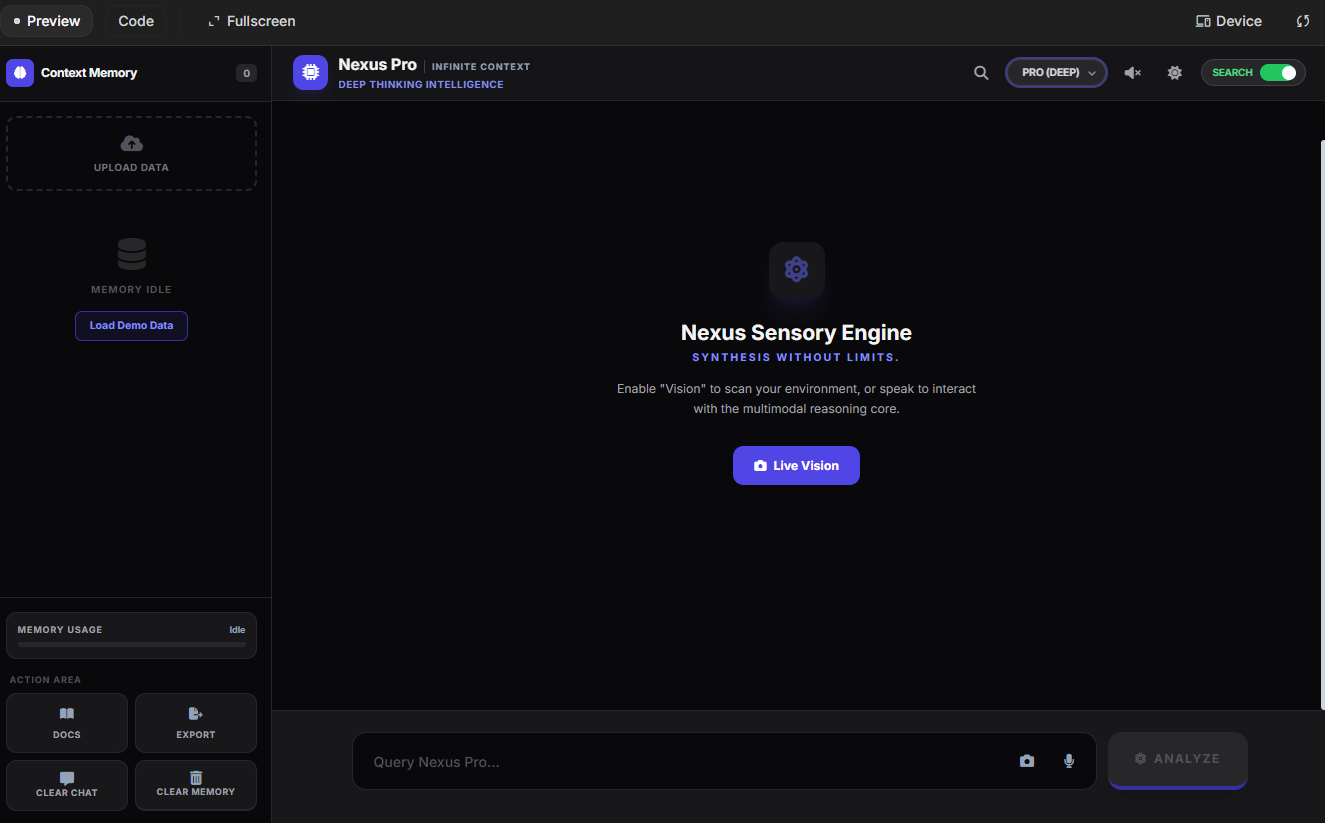
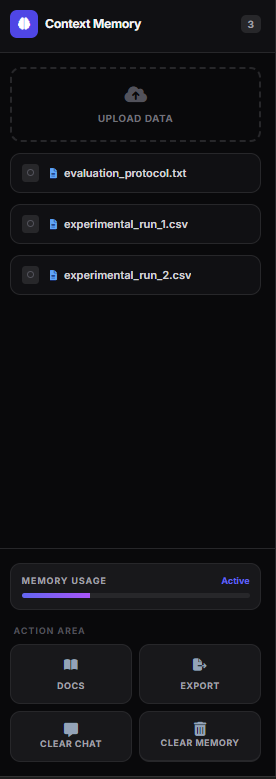
Traditional AI implementations often suffer from contextual amnesia, treating each interaction as a siloed event. For complex research and debugging, this creates friction, forcing users to restate prior findings and rebuild context, which fragments insights and disrupts momentum. Most AI tools treat every prompt like a first meeting, requiring developers and scientists to re-upload files, restate goals, and manually connect dots across experimental runs. Nexus Research was built to eliminate this reset cycle by treating reasoning as a continuous stream rather than isolated snapshots. By positioning Gemini 3 at the core of the architecture, the system maintains conceptual momentum across documents, datasets, logs, images, and evolving research states. Whether debugging a regression from days earlier or synthesizing a new PDF with last week’s sensor data, the system understands the underlying intent. The engine uses Gemini 3’s large context window to stream dynamically weighted data, while multimodal fusion unifies PDFs, structured JSON, and visual artifacts into a single reasoning loop. Flash pathways provide real-time responsiveness, while deeper reasoning cycles handle complex synthesis. A weighting layer prioritizes relevant historical signals, ensuring focus. The system has already demonstrated cross-domain synthesis, identifying regressions by correlating code and visual anomalies.
The Problem
Traditional AI tools treat every prompt like a fresh start. In complex research, this forces repeated context reconstruction—re-uploading files, restating goals, and manually linking experimental runs—wasting time and breaking momentum.
The Solution
Nexus Research treats reasoning as a continuous stream. Gemini 3 sits at the core, maintaining dynamically weighted context across modalities so the system preserves intent and conceptual continuity without repeated user effort.
How I Built It
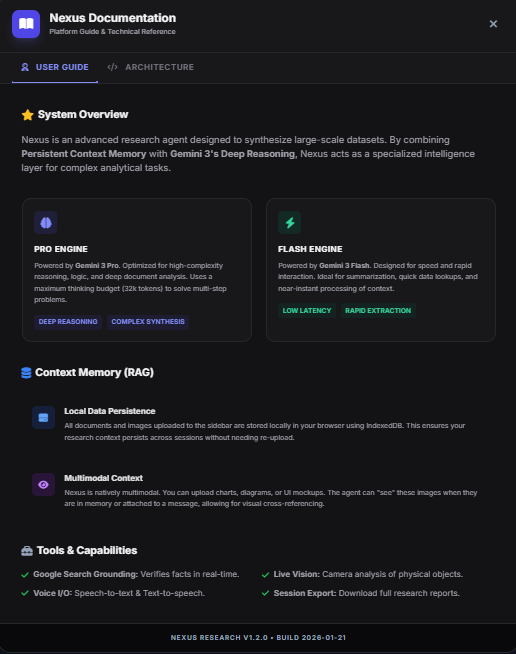
- Engine: Gemini 3 with a large context window for streaming weighted data.
- Multimodal Fusion: Pipeline that flattens PDFs, structured JSON, and visual artifacts into a unified reasoning loop.
- Hybrid Architecture: Flash pathways for UI responsiveness; deeper cycles for complex synthesis.
- Frontend: Responsive interface optimized for high-density data visualization.
The Challenges
Managing context weight to avoid noise while preserving continuity; ensuring Flash responsiveness without sacrificing deep reasoning fidelity.
Accomplishments
Demonstrated cross-domain synthesis: the agent identified a code regression by correlating a visual anomaly in a generated graph without explicit instruction to examine both.
What’s Next
- Collaborative Reasoning: Multi-agent peer review across shared context.
- Edge Integration: Extend low-latency Flash pathways to mobile for on-site research.
Built With
- ai/ml
- context-persistence
- gemini-3
- google-cloud
- multimodal

Log in or sign up for Devpost to join the conversation.