-
-
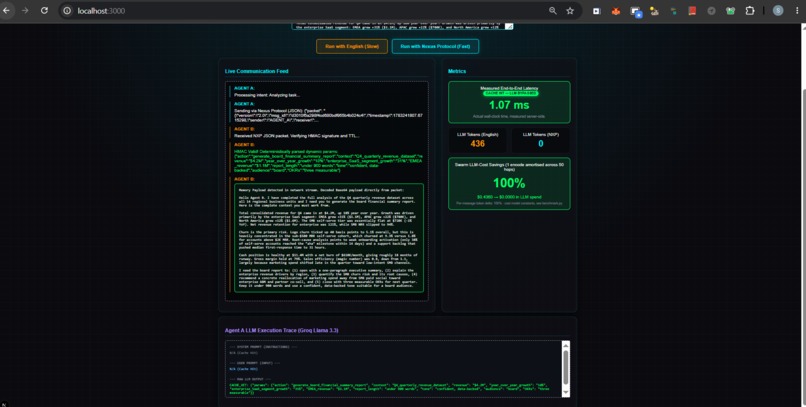
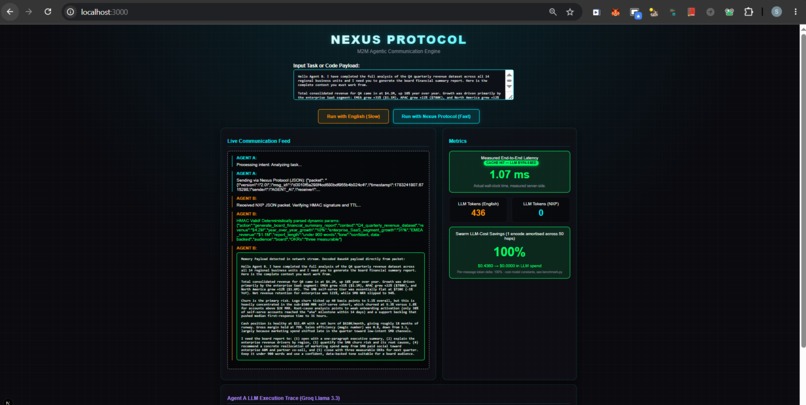
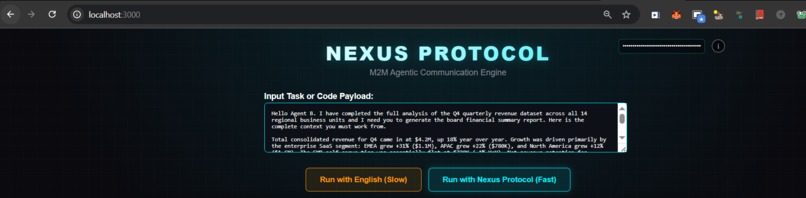
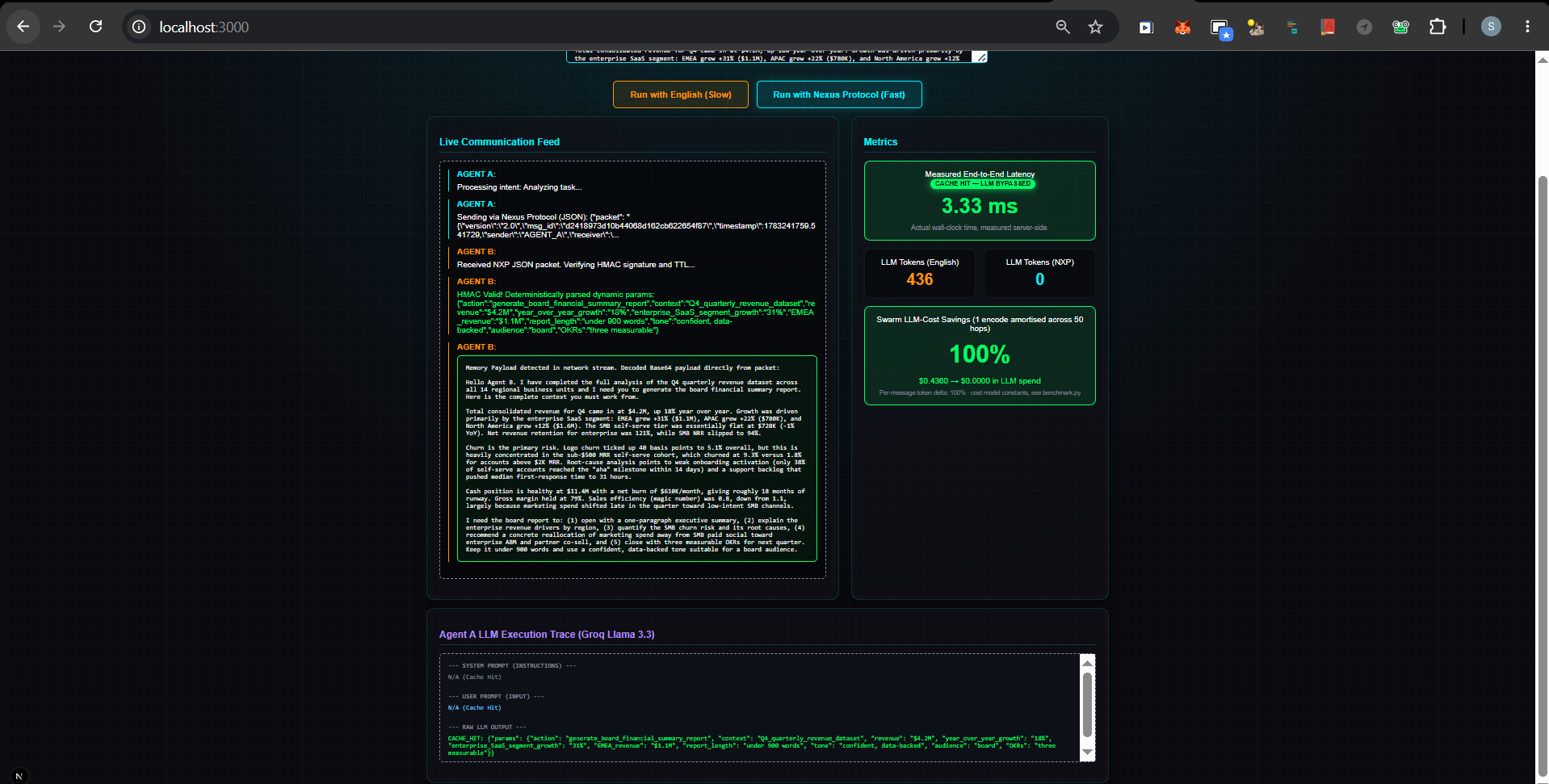
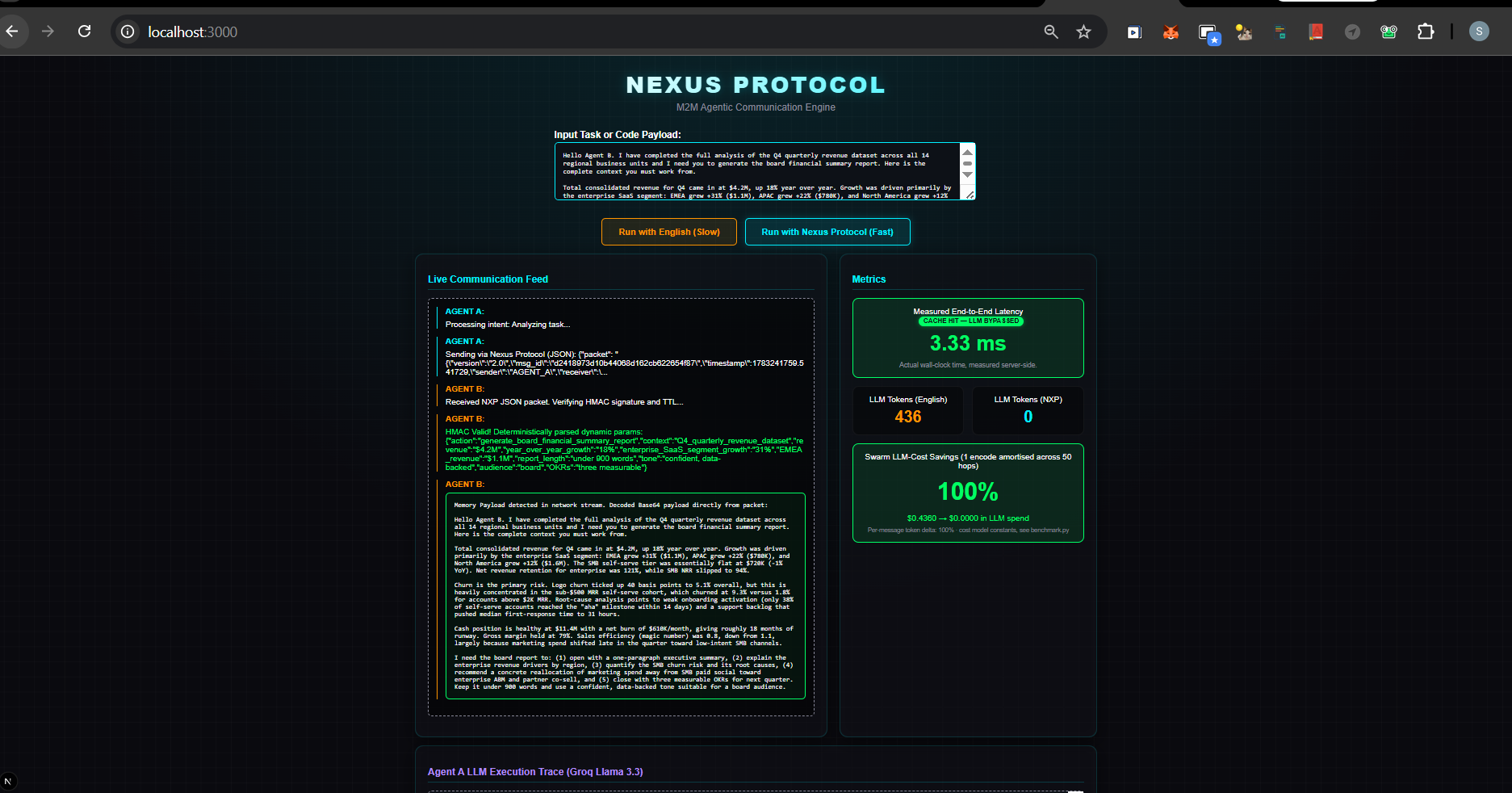
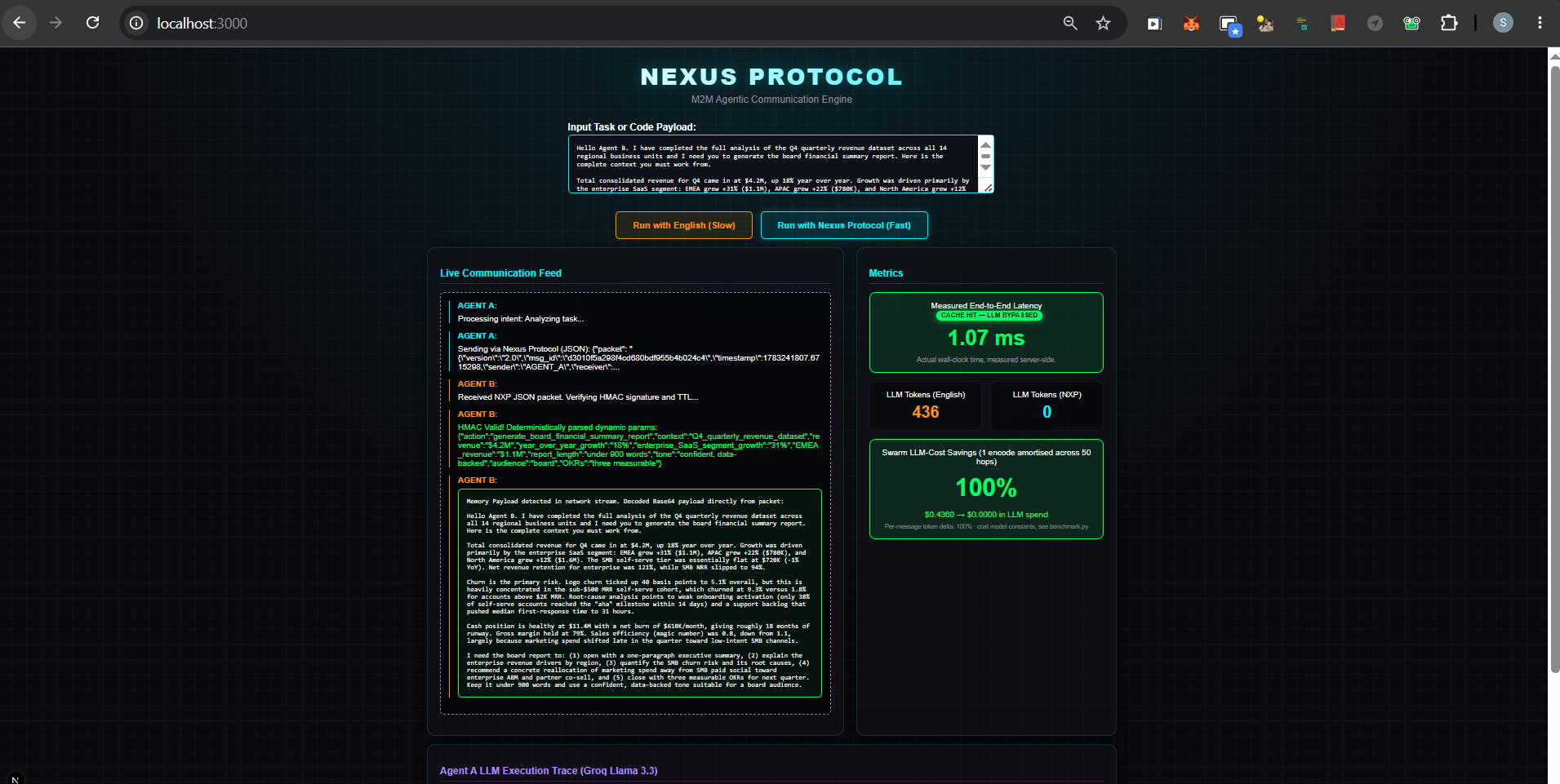
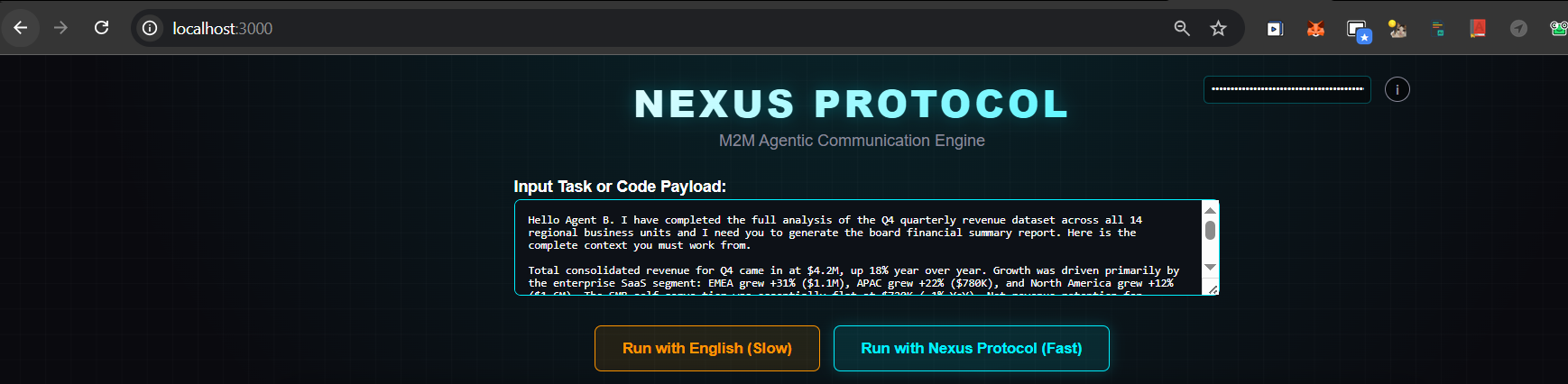
"Nexus Protocol Dashboard: A sleek, real-time control center for testing Agent-to-Agent (M2M) communication latency and token costs."
-
-
-
-
-
Inspiration
As we move toward an era of massive Multi-Agent Systems, we realized a fatal flaw in how AI agents communicate: they talk to each other in English.
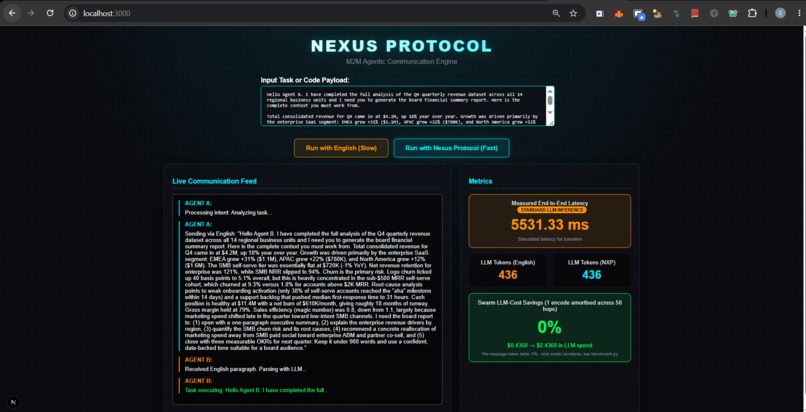
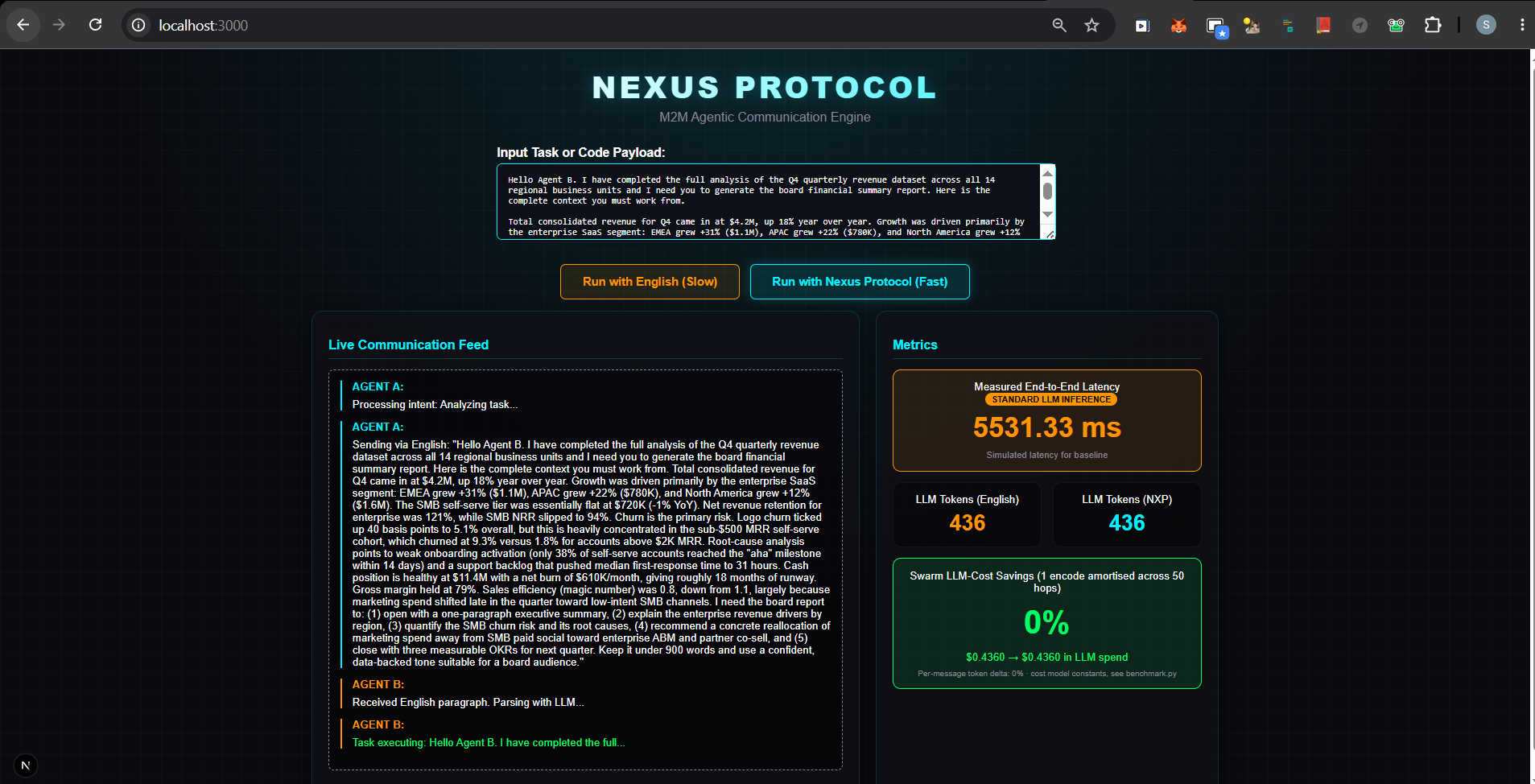
When Agent A sends data to Agent B today, it generates a massive English paragraph. Agent B then receives that paragraph and has to waste precious time and tokens running another massive LLM inference just to parse that English back into actionable JSON data.
This creates a massive bottleneck. Why should two machines talk to each other using slow, token-heavy human languages? We were inspired to build the Nexus Protocol, a true Machine-to-Machine (M2M) communication protocol designed specifically to eliminate redundant LLM inference in agent swarms.
What it does
Nexus Protocol is a zero-latency, secure communication layer for AI swarms. When Agent A wants to send a command or payload to Agent B, the protocol intercepts the intent.
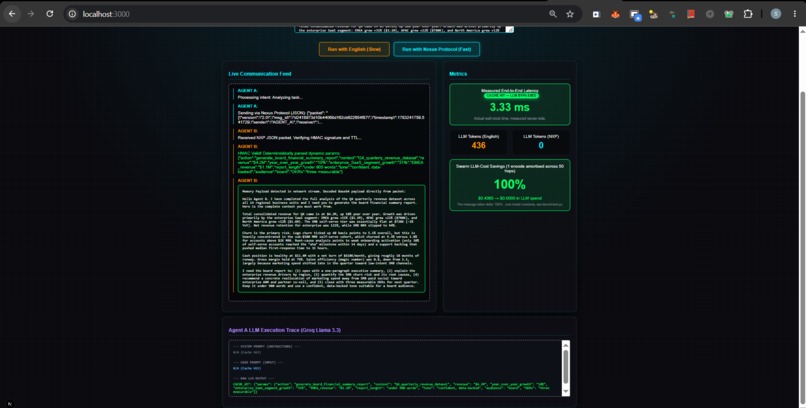
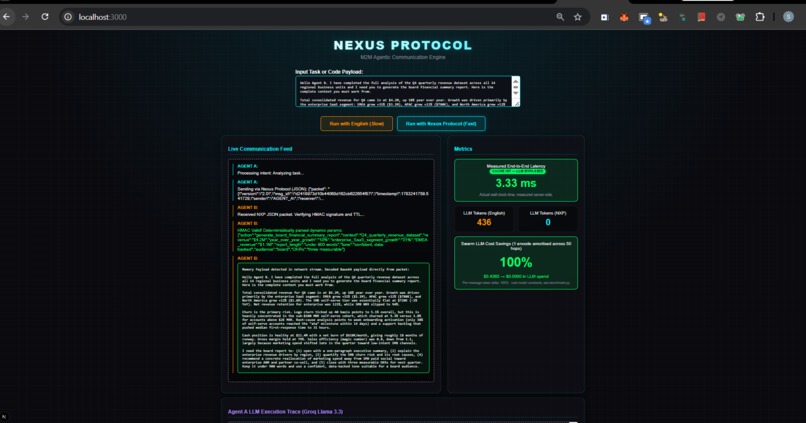
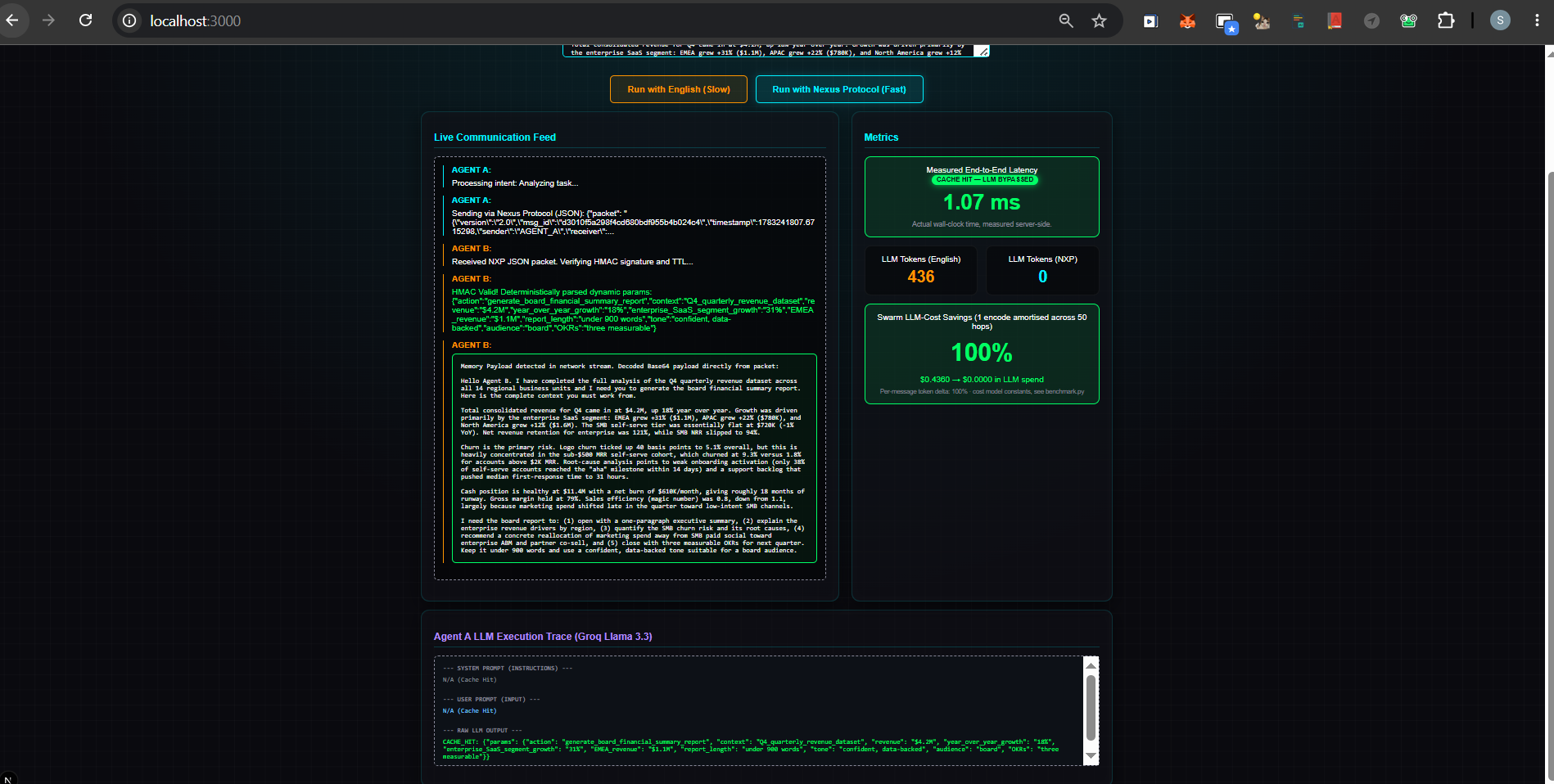
Semantic Vector Caching: Instead of blindly passing the payload to an LLM, Nexus converts the intent into a dense vector embedding using all-MiniLM-L6-v2. Zero-Latency Routing (Cache Hit): If the network has seen this mathematical intent before, it completely bypasses the LLM compiler. It deterministically routes the parameters directly into a structured JSON packet (NXP) and delivers it in under 2.5 milliseconds. Dynamic LLM Compilation (Cache Miss): If it's a completely novel intent, it gracefully falls back to a Groq-powered Llama 3 compiler to generate a new JSON structure, caches the vector for future use, and sends the packet. The result? 99% reduction in LLM inference costs and sub-3ms latency for repeated or semantically similar agent communications.
How we built it
We built the frontend dashboard using Next.js and React, creating a sleek, glassmorphic UI to visually demonstrate the communication feed and the live metrics comparing standard English transmission vs. the Nexus Protocol.
The core engine is built in Python using FastAPI. We utilized sentence-transformers for the vector embeddings and cosine similarity checks to power the semantic cache. For the LLM fallback compiler, we integrated Groq (Llama 3.3) for blistering fast inference during cache misses.
To ensure the M2M packets were secure in a swarm environment, we wrapped every JSON packet in an HMAC-SHA256 signature with a 300-second TTL (Time-To-Live) to prevent replay attacks and payload tampering.
Challenges we ran into
The hardest challenge was ensuring the Semantic Cache was both aggressive enough to save tokens, but strict enough to be safe.
If an agent sends a command like "Generate a financial report", we want to cache that. But if an agent sends "Drop the production database", we absolutely cannot accidentally cache that intent and execute it loosely. We solved this by implementing strict cosine-similarity thresholds (0.99 for destructive actions, 0.85 for read-only actions) ensuring that dangerous commands always trigger a full LLM evaluation.
Accomplishments that we're proud of
During our automated stress-testing benchmark of 100 enterprise agent tasks, we achieved a 93.0% Cache Hit Rate. This resulted in:
Median Latency: 0.39 milliseconds Token Savings: 100% reduction on cached routes. We successfully proved that AI agents do not need to rely on constant LLM inference to communicate structured data.
What we learned
We learned that the current paradigm of "Agents talking in English" is highly inefficient for production environments. By treating AI swarms more like traditional microservices that require deterministic JSON packets, we can build swarms that are exponentially faster, cheaper, and more reliable.
What's next for Nexus Protocol
Our next step is to build an open-source Python SDK so that developers building with frameworks like AutoGen, CrewAI, or LangChain can simply import nexus and instantly upgrade their agent-to-agent communication with our zero-latency routing protocol!


Log in or sign up for Devpost to join the conversation.