Inspiration
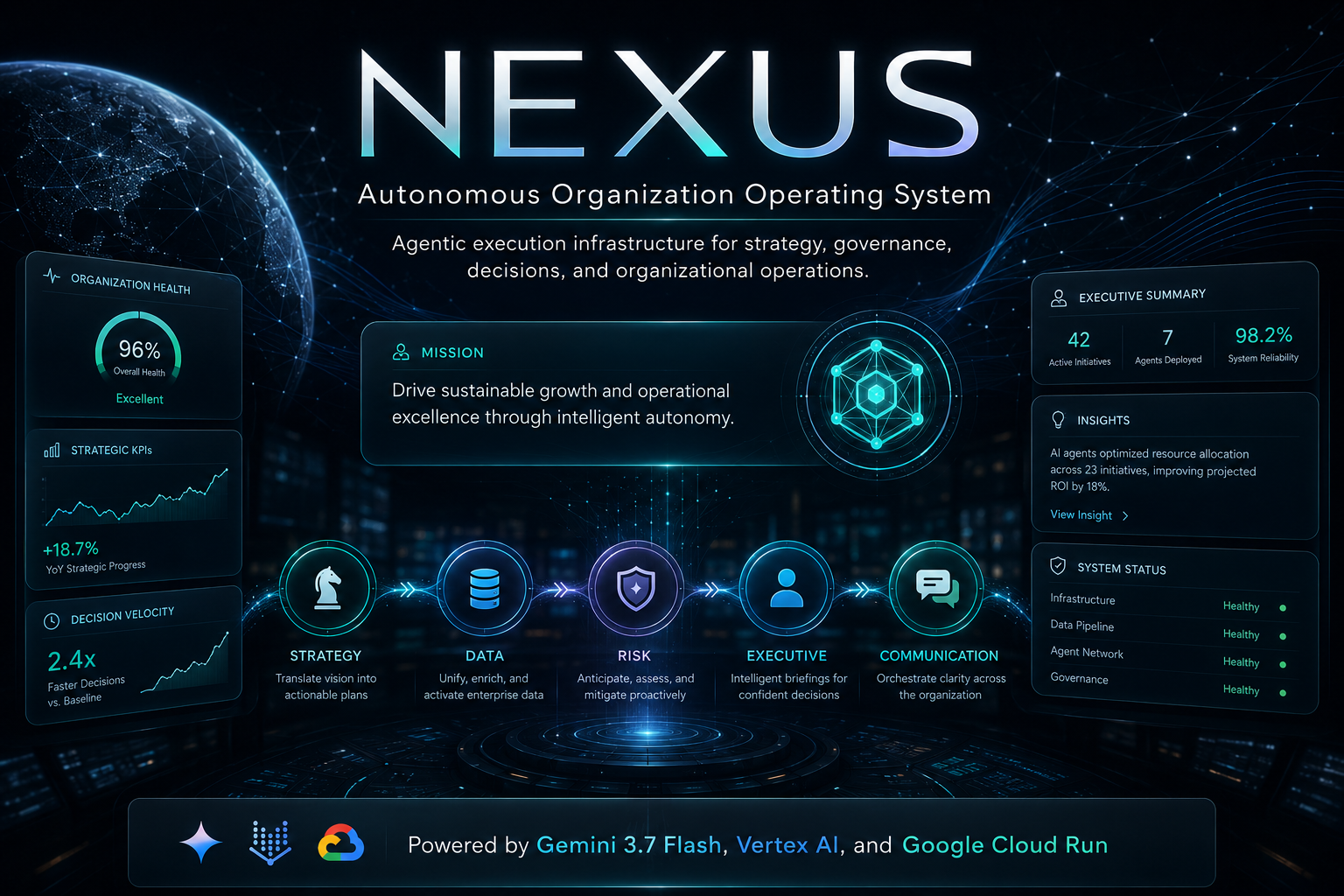
Organizations rarely suffer from a shortage of plans, reports, or meetings. The deeper problem is the gap between intent and execution: fragmented ownership, delayed decisions, disconnected evidence, and weak follow-through. NEXUS was conceived as an autonomous execution layer that connects strategic direction with disciplined organizational action.
What it does
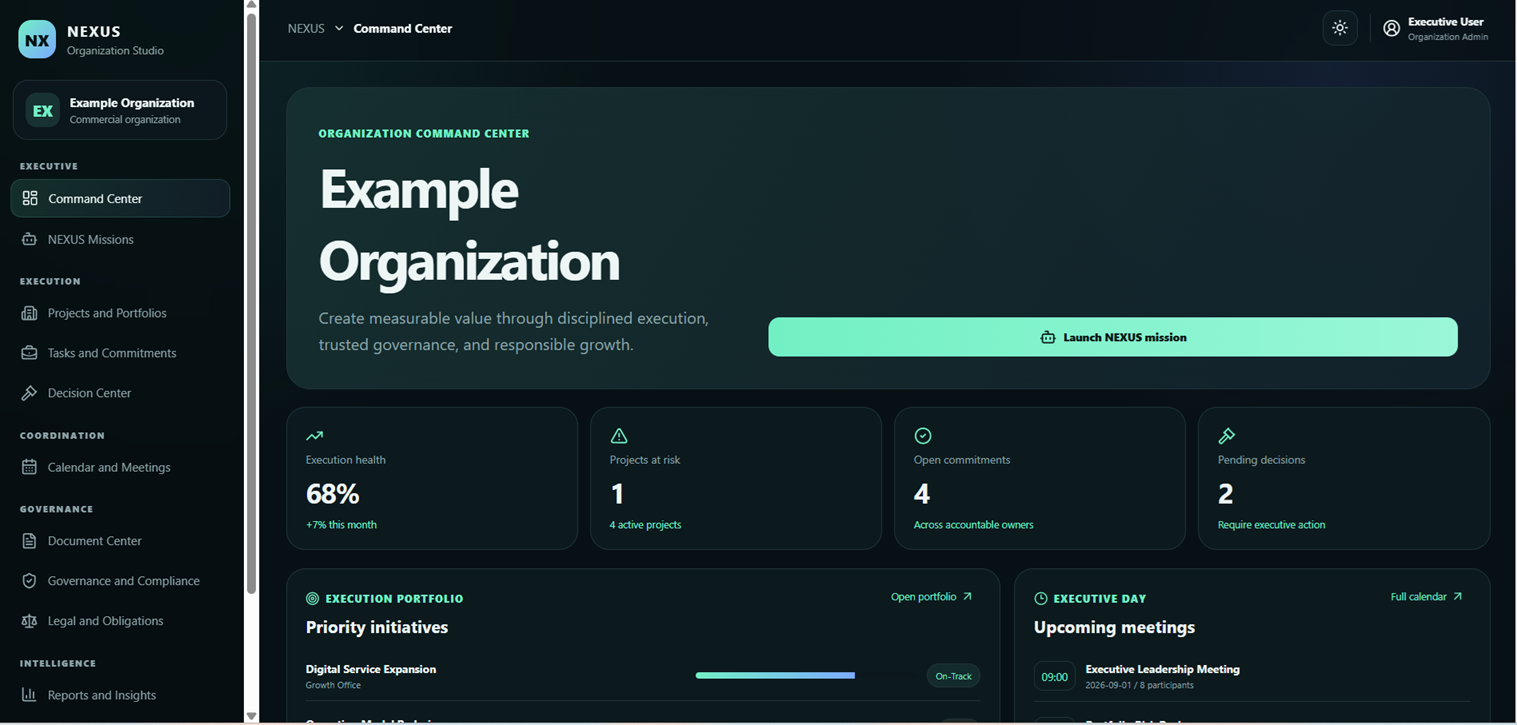
NEXUS decomposes the mission, evaluates evidence and constraints, challenges risks, reconciles competing findings, and produces a decision-ready executive brief while maintaining a structured audit trail of the full execution process. The platform extends this agentic layer into an Organization Studio covering projects, tasks, decisions, meetings, governance, documents, reports, stakeholders, and executive operations, making the same architecture applicable to both commercial and nonprofit organizations.
.
How we built it
NEXUS uses a modular multi-agent architecture built with Python and FastAPI. A central orchestrator coordinates five specialized agents—Strategy, Data, Risk, Executive, and Communication—while Gemini 3.7 Flash operates through Google’s GenAI SDK on Vertex AI. The application runtime is deployed on Google Cloud Run.
The institutional interface is built with React, TypeScript, and Vite. A multi-stage Docker build packages the frontend and backend into a unified Cloud Run service, while structured mission states and audit events preserve execution traceability across the agent workflow.
Challenges we ran into
The main challenge was designing genuine separation of responsibility between agents rather than reproducing a single-model workflow under multiple labels. A second challenge was generalizing an executive-office concept into an organization-neutral platform without embedded assumptions about language, geography, sector, or institutional structure.
Production deployment also required unifying a React frontend, Python backend, Vertex AI integration, and Cloud Run runtime into a coherent architecture with a single operational endpoint.
Accomplishments that we're proud of
NEXUS evolved from a multi-agent execution engine into a complete organizational operating environment. The deployed system integrates a live institutional interface, specialized agent fleet, structured mission lifecycle, Vertex AI reasoning, and auditability within one Google Cloud application.
What we learned
Effective agentic systems depend less on the number of agents than on clear boundaries, delegation rules, state transitions, and information flow between specialized roles. Institutional intelligence becomes substantially more useful when agents operate within organizational constructs such as decisions, projects, risks, governance, and commitments. The project also reinforced the importance of treating deployment identity, model access, execution state, and auditability as elements of the architecture rather than secondary infrastructure concerns.
What's next for NEXUS Organization Studio
Our long-term direction is to make agentic infrastructure the layer between what a human intends and what the world actually executes—across work, organizations, services, decisions, and eventually everyday life. The ambition is not to build another assistant, but to establish an operating model in which intention becomes executable by default.
Built With
- agentic
- docker
- fastapi
- flash
- gemini
- genai
- google-cloud
- multi-agent
- python
- react
- sdk
- systems
- typescript
- vertex
- vite
Log in or sign up for Devpost to join the conversation.