-
-
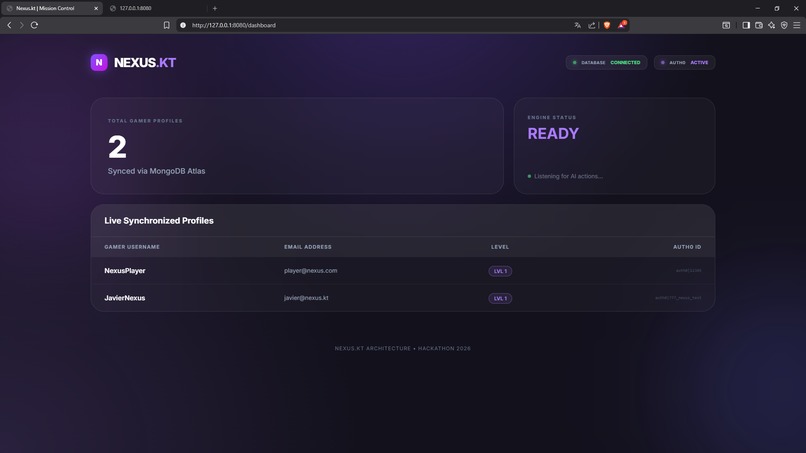
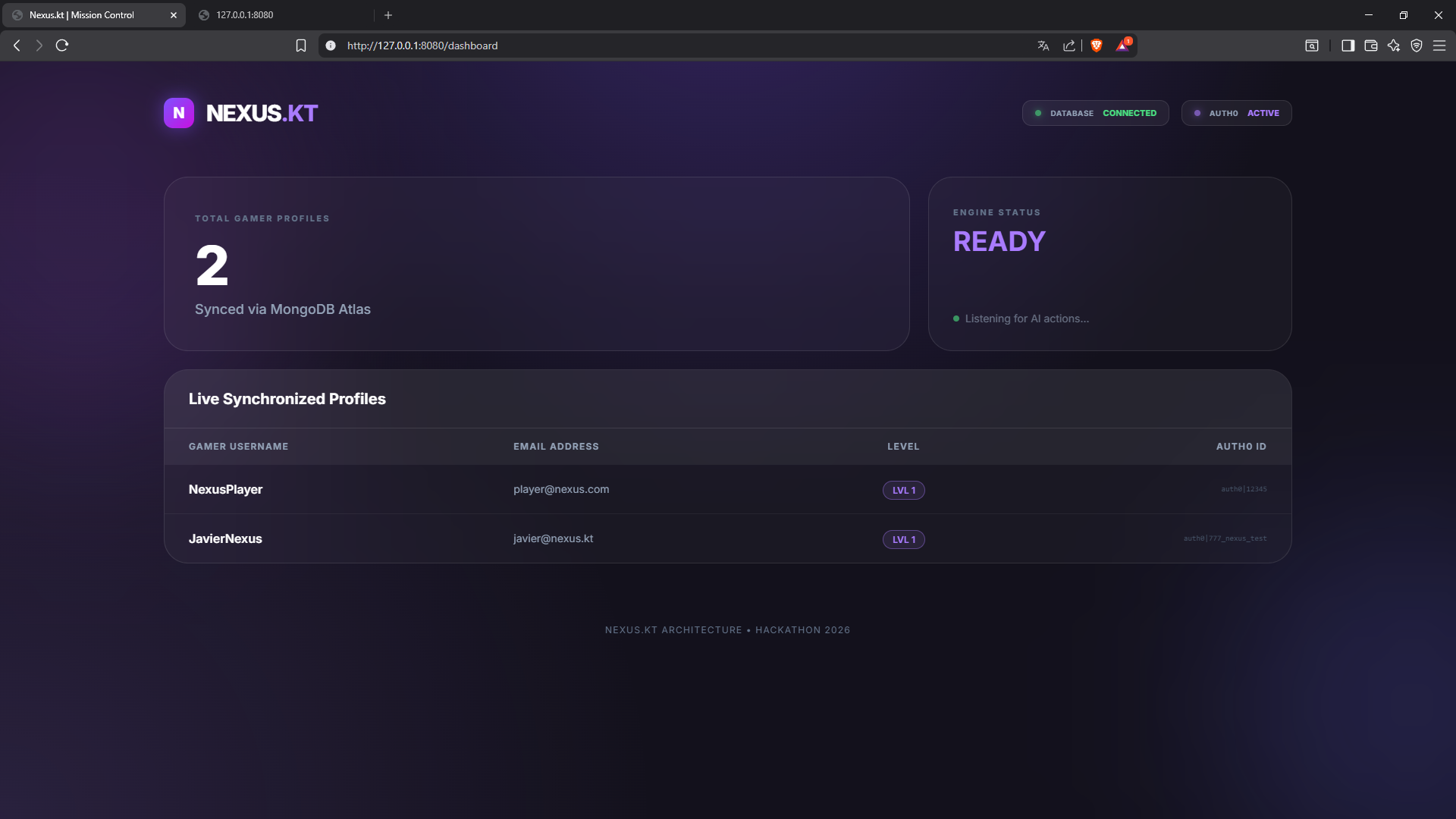
Screenshot of the dashboard ui
💡 Inspiration
The rise of "Sovereign AI" is transforming our digital autonomy. Users are increasingly deploying local agents on private hardware to ensure data privacy. However, these agents often face a paradox: they are "safe but isolated." To act on the world, they need API keys, but giving a local LLM full access to master keys creates a massive security surface.
We asked ourselves: How can a private local AI execute authenticated actions without ever touching the user’s long-lived credentials?
🤖 What it does: Nexus.kt
Nexus.kt is a Secure Identity Bridge and Token Vault. It acts as an intermediary layer that empowers restricted local AI agents to perform authorized tasks—such as syncing gaming libraries or managing wishlists—without local credential exposure.
By leveraging Auth0 for AI Agents, Nexus.kt implements a "Zero-Trust" request flow:
- The local agent requests an action (e.g., "Check my Steam wishlist").
- Nexus.kt validates the intent and fetches a scoped, short-lived delegated token from the Auth0 Vault.
- The action is executed server-side, and only the result is returned to the agent. The result: Sensitive secrets never leave the secure vault, and the local AI operates on a "Need-to-Know" basis.
🛠️ How we built it
- Language: Kotlin 2.1.0, utilizing structured concurrency with Coroutines for high-performance, non-blocking I/O.
- Backend: Ktor 3.0, chosen for its lightweight asynchronous nature to build the "Capabilities API."
- Identity & Security: Auth0 is the backbone. We implemented the Client Credentials Flow and explored Token Vaulting to manage OAuth handshakes and secret custody.
- Database: MongoDB Atlas, providing a scalable cloud layer for persisting agent configurations and metadata.
- Protocol: A custom Bridge Pattern that maps high-level AI intents to secure, vaulted API calls.
🚧 Challenges we ran into
- Architecting the "Double-Hop": The biggest hurdle was ensuring the "Identity Handshake" between the local requester and the Auth0 Vault was seamless. We had to ensure that the $Token_{request}$ from the AI triggered a secure $Token_{exchange}$ in the backend without any leak.
- SRV & DNS Resolution: During the final stages, we faced complex SRV record resolution issues with MongoDB Atlas in the Ktor environment, which required deep-diving into JVM network properties and HOCON configuration.
- Academic Balancing Act: Developing a production-grade identity architecture while completing my Software Development (DAM) degree meant every hour of the hackathon had to be optimized for "Identity-first" features.
🏆 Accomplishments that we're proud of
- Zero-Secret Architecture: We successfully decoupled the AI's logic from the User's secrets. Neither the developer nor the AI agent ever handles raw, long-lived API tokens.
- Type-Safe Security: Leveraging Kotlin’s expressive syntax to create a security layer that is easy to read but hard to break.
- End-to-End Integration: Seeing a local request travel through our Ktor bridge, authorize via Auth0, fetch data from the cloud, and update a real-time Dashboard.
🧠 What we learned
- Identity is the New Perimeter: In the age of autonomous agents, security isn't a firewall; it's granular, time-bound authorization.
- The Power of Vaulting: Using Auth0 taught us how much overhead is removed when secret encryption, rotation, and OAuth flows are handled by a specialized identity provider.
- Developer Velocity: How a modern stack (Kotlin + Ktor) allows a solo developer to move from "Hello World" to a secure M2M (Machine-to-Machine) architecture in days.
🚀 What's next for Nexus.kt
- Granular Capability Scopes: Implementing even tighter scopes so an agent can "Read" a wishlist but requires a Step-up Authentication (MFA) to "Purchase."
- Sidecar Deployment: Packaging the Nexus Bridge as a lightweight Docker sidecar for local LLM stacks (like Ollama or OpenClaw).
- Biometric Guardrails: Integrating WebAuthn for critical agent actions, ensuring a human-in-the-loop for high-risk operations.
Bonus Blog Post: Securing the Future of Sovereign AI
When I started the Nexus.kt project, I had a clear vision: local AI is the ultimate frontier for privacy, but it is currently crippled by isolation. As a developer, I faced a dilemma. To make an agent useful, I had to give it "keys to the kingdom" (API tokens), but doing so locally felt like a security nightmare.
My journey through this hackathon was a deep dive into the philosophy of "Identity as the Perimeter." Integrating Auth0 for AI Agents was the turning point. I initially struggled with the "Double-Hop" architecture—how to ensure a local request could trigger a cloud-based token exchange without the local environment ever seeing a secret. The technical hurdle was real: mapping Ktor’s asynchronous calls to the Auth0 Token Vault while maintaining a low-latency response for the AI agent.
The "Aha!" moment came when I successfully implemented the Token Vaulting logic. Seeing the Auth0 dashboard authorize a request and then watching the Nexus Dashboard update in real-time—knowing that no long-lived secrets were stored on the agent's side—was incredibly rewarding.
This project taught me that the future of AI isn't just about better models; it's about secure orchestration. Building this during my Software Development (DAM) degree has been a masterclass in modern security patterns. Nexus.kt is more than a bridge; it’s a blueprint for how we can finally let our private AI agents act on our behalf without compromising our digital safety.
Built With
- kotlin
- ktor
- mongodb

Log in or sign up for Devpost to join the conversation.