-
-
1_orchestrator_pipeline
-
2_mission_input
-
3_scenarios_and_agents
-
4_seven_agents
-
5_home_screen
-
6_lead_model_and_mission
-
-
-
-
-
-
Nexus Impact AI
Multi-agent humanitarian AI on NVIDIA Nemotron, built to keep working where cloud access doesn't reach
Built by: Dr. Fetlework Workineh Asress | Location: Amhara, Ethiopia | Track: Apps & Agents Live demo: https://nexus-impact-nebius-ai.onrender.com Source code: https://github.com/fetleepi-oss/Nexus-Impact-Nebius-ai
1. Who I Am and the Problem I Want to Solve
I am a public health researcher, engineer, sexual and reproductive health (SRH) practitioner, and humanitarian responder working in Ethiopia. I am also an NSK AI Ambassador and a mentor, and I build with AI-assisted ("vibe") coding, which is how I can move from field problem to working prototype quickly.
In my work, frontline teams, small NGOs, and researchers have to turn scattered information into board-ready or donor-ready documents under extreme time pressure: a 72-hour emergency plan, an outbreak profile, a multi-donor grant. General chatbots don't know the standards these teams are held to, and they assume stable internet and a paid account. Nexus is the tool I wished I had.
2. What Nexus Impact AI Does
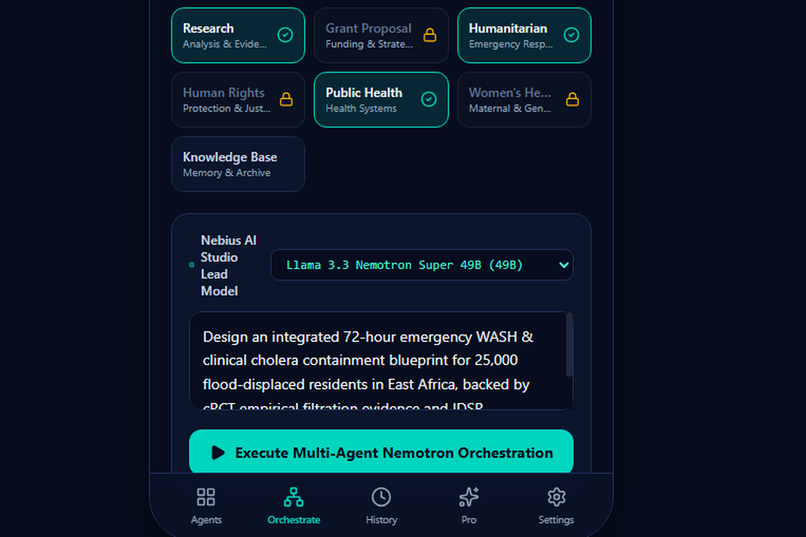
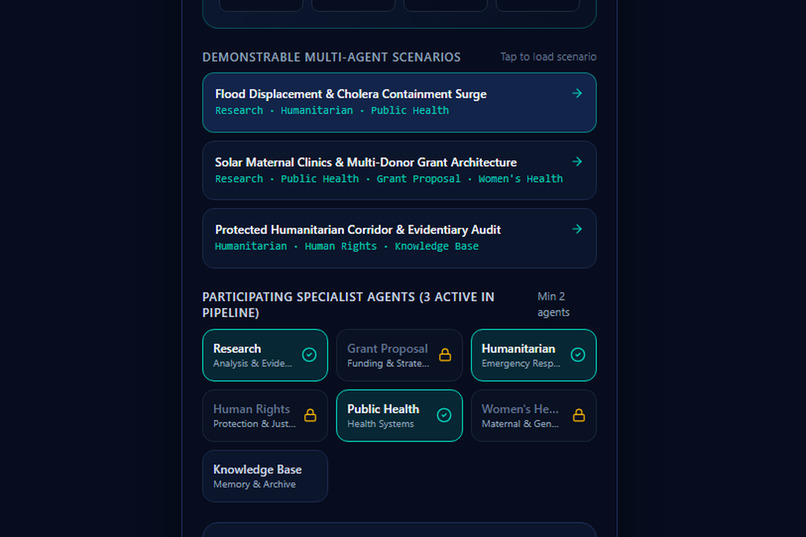
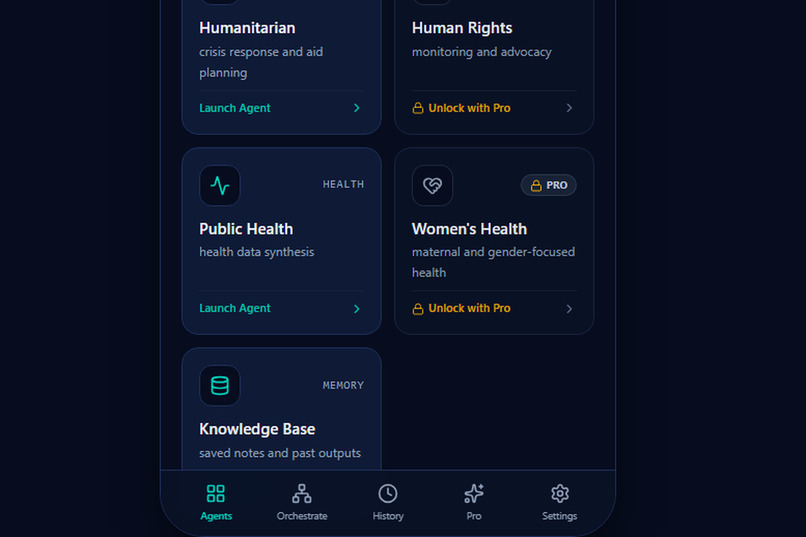
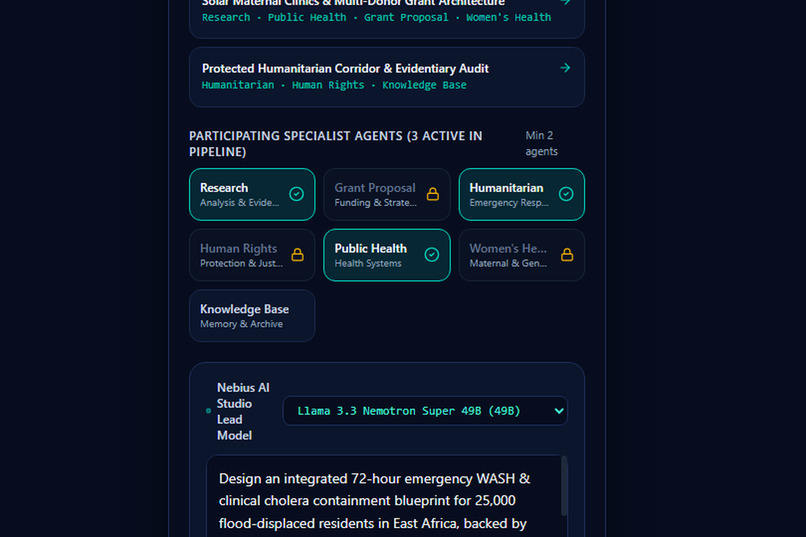
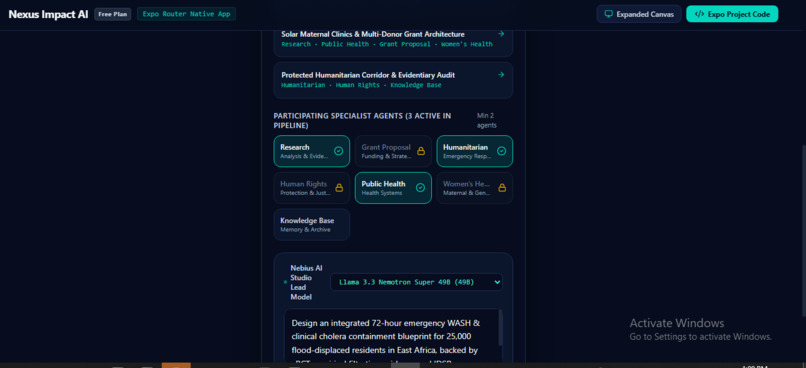
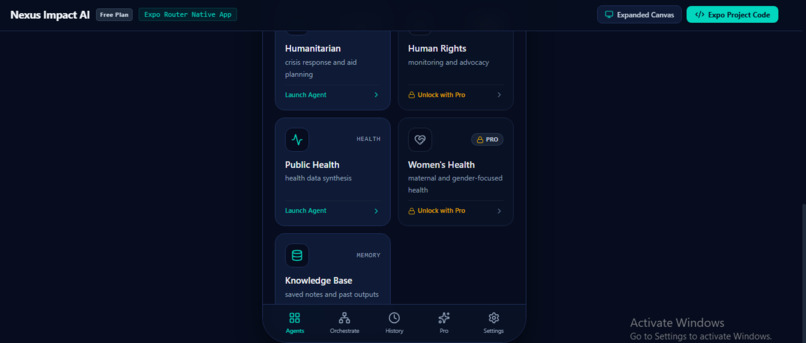
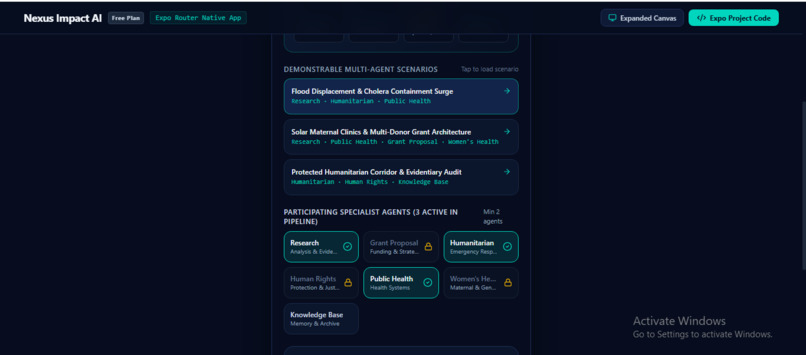
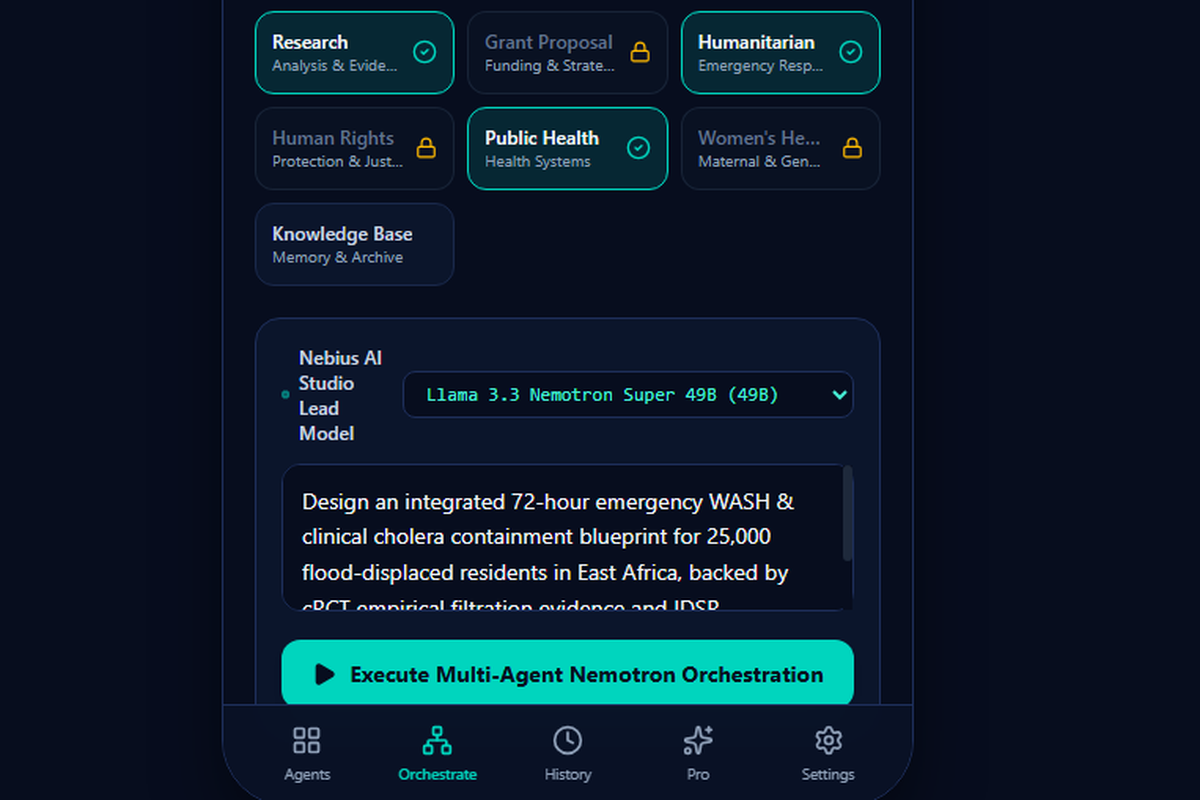
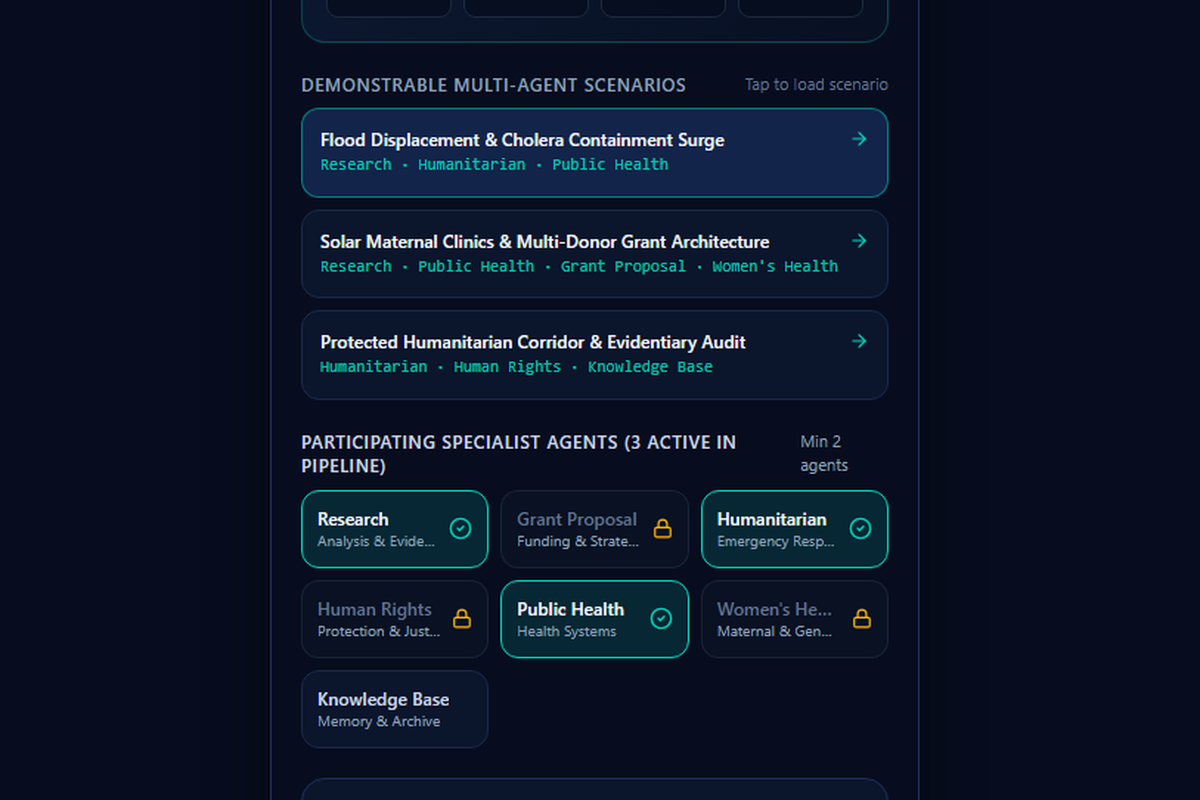
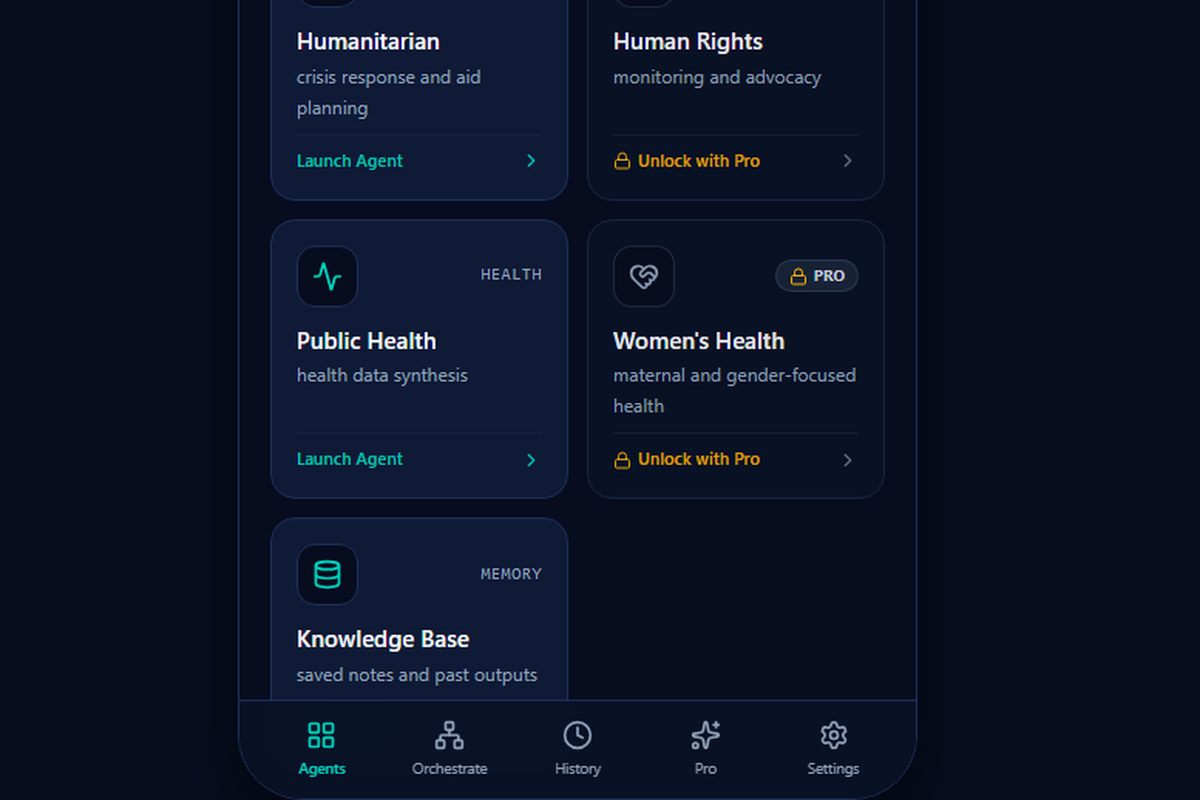
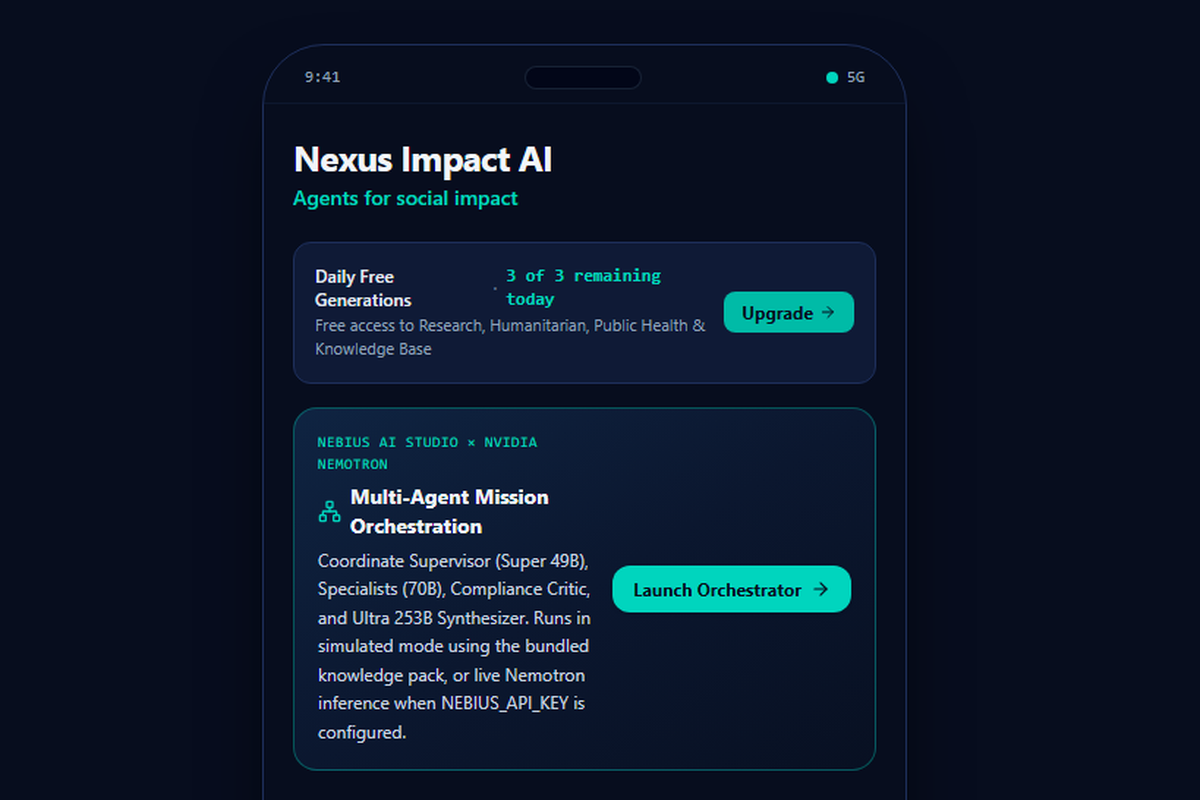
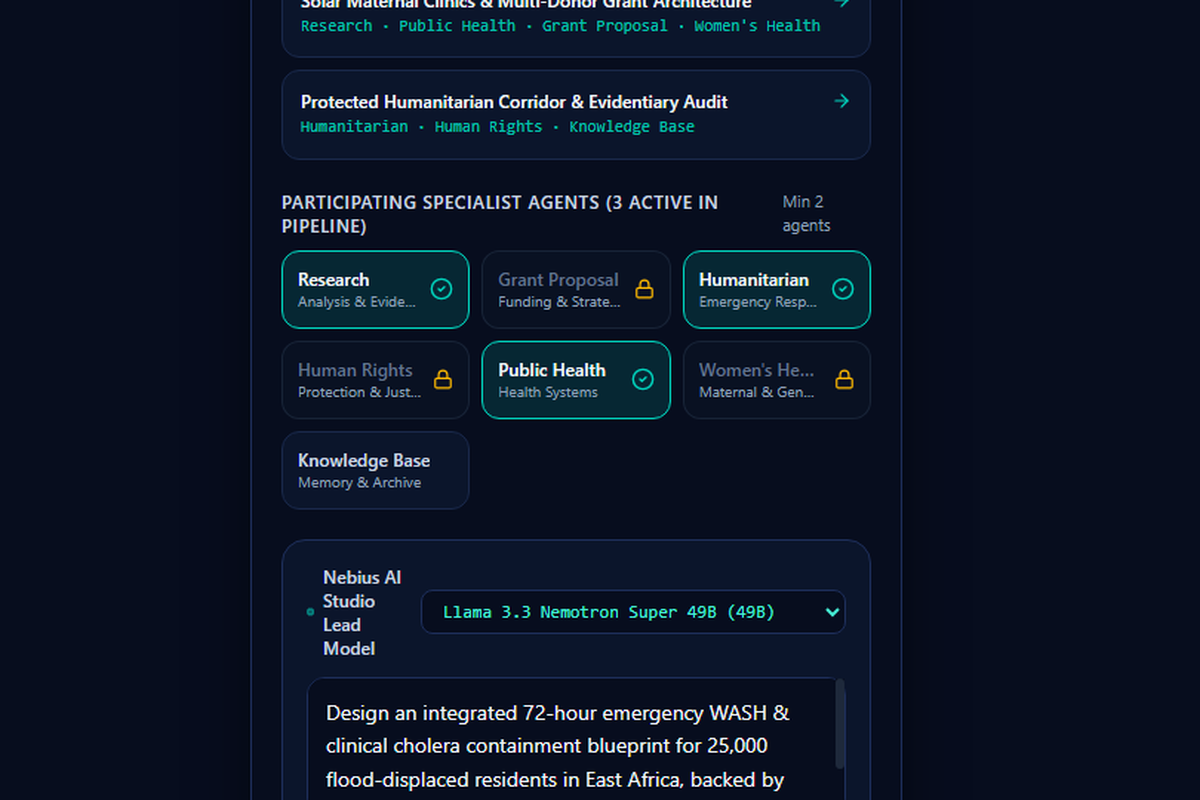
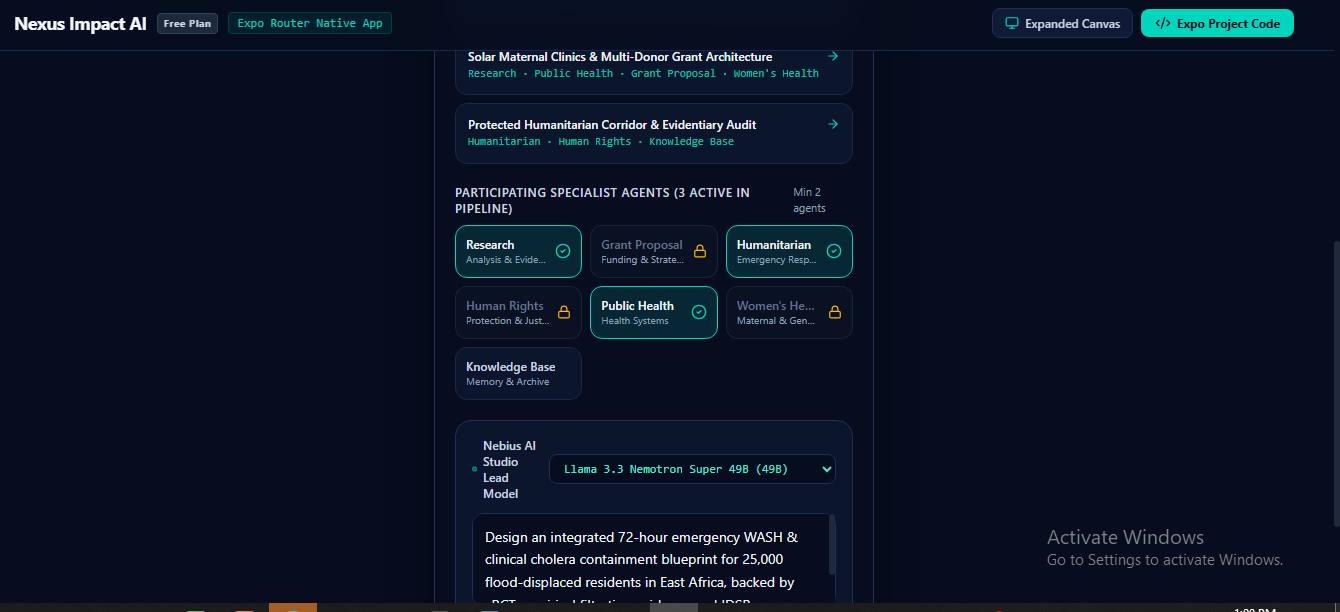
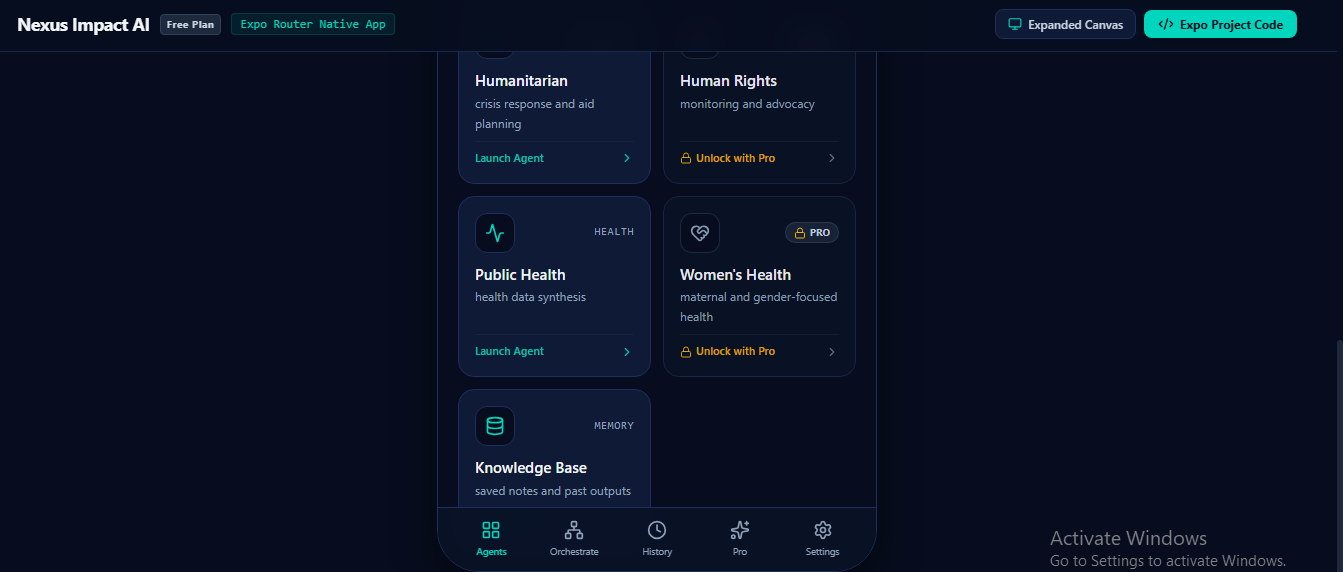
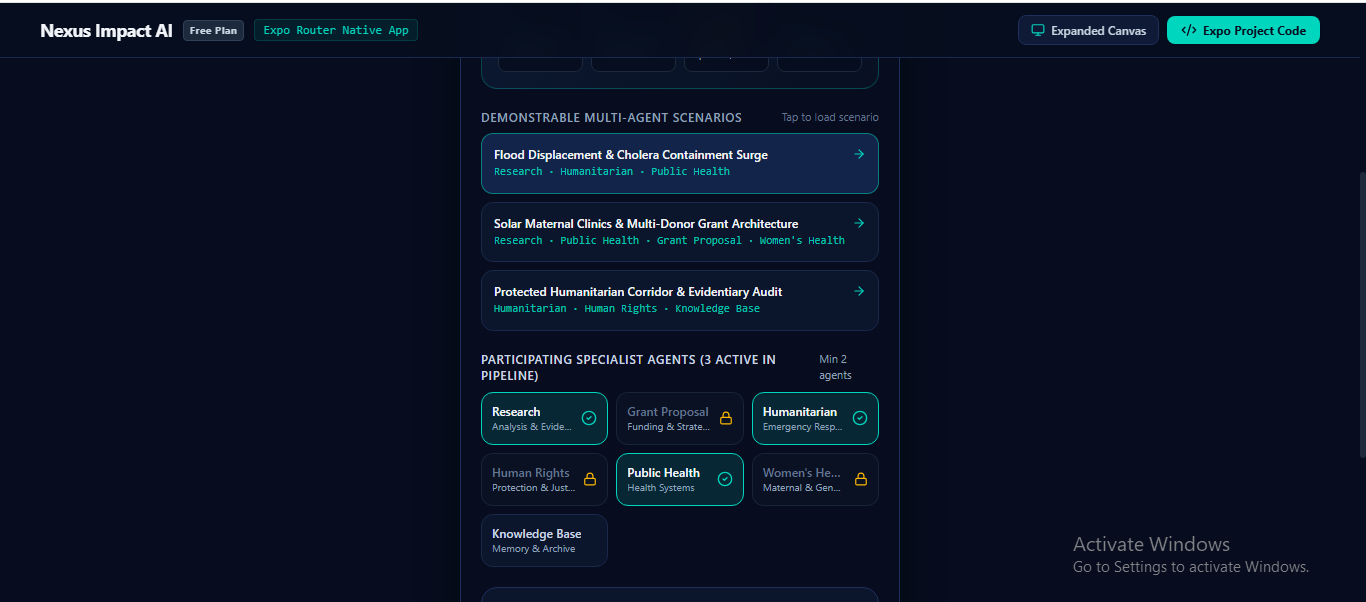
Nexus is a mobile-first workspace of seven specialist agents, each with its own mandate and structured outputs:
- Research: literature synthesis, methodological critique, and evidence matrices.
- Humanitarian: 72-hour triage protocols aligned to Sphere standards.
- Public Health: outbreak dynamics, surveillance profiles, and cold-chain modelling.
- Knowledge Base: saved dossiers and reusable templates.
- Grant Proposal, Human Rights, and Women's Health: Pro-tier agents for donor proposals, Berkeley Protocol evidence chains, and maternal and gender-focused health pathways.
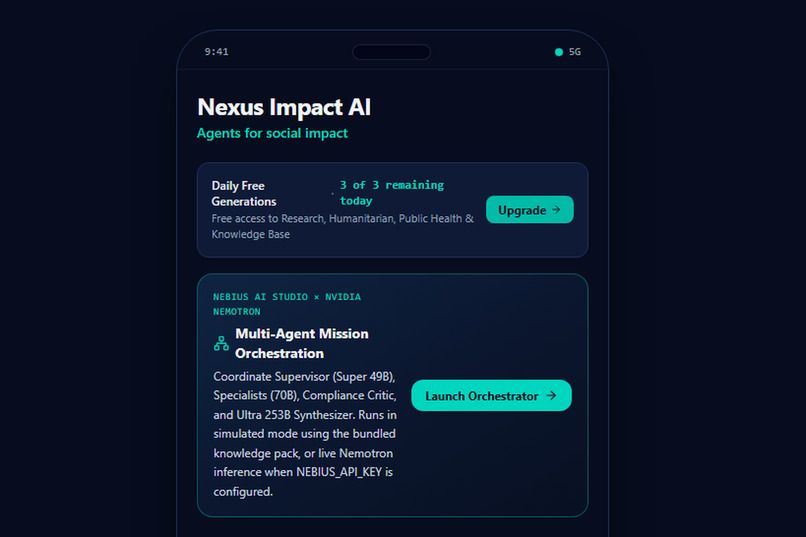
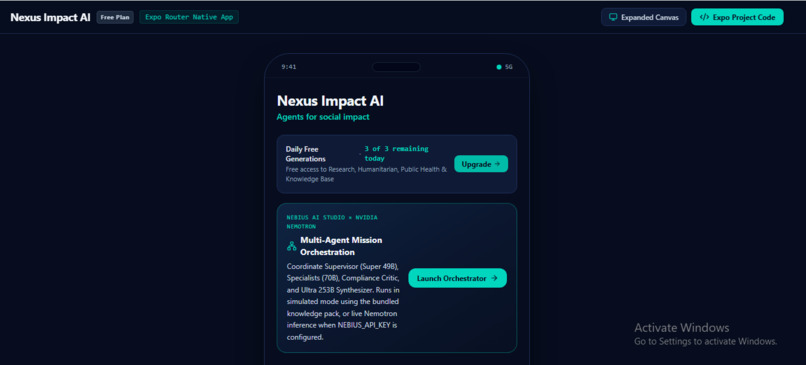
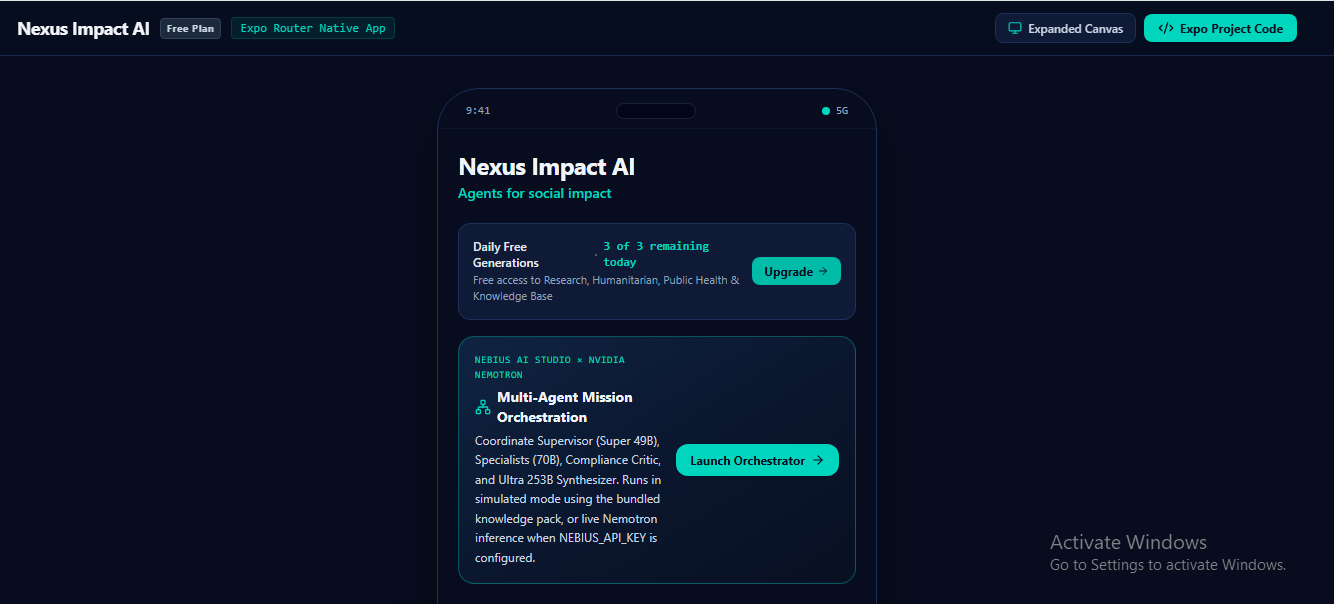
A free tier gives access to four agents with daily generations.
3. Multi-Agent Orchestration on Nemotron
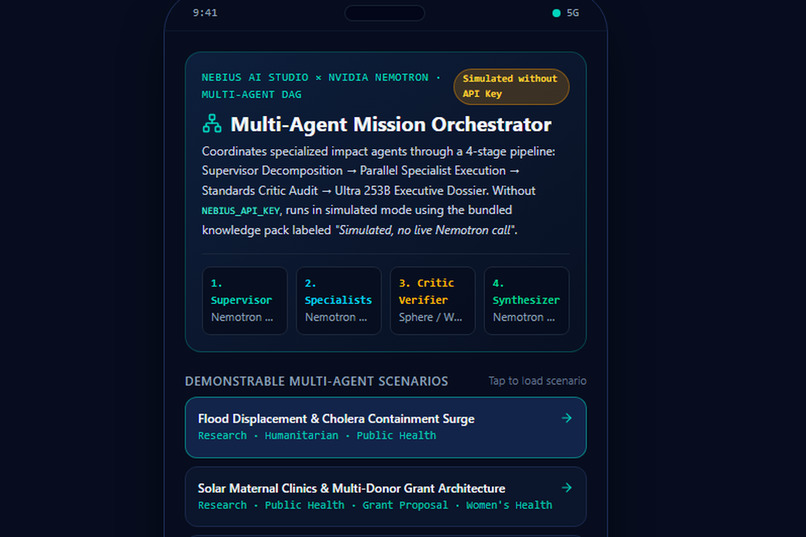
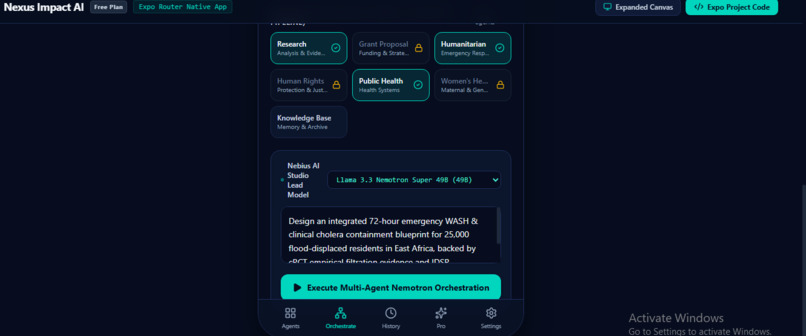
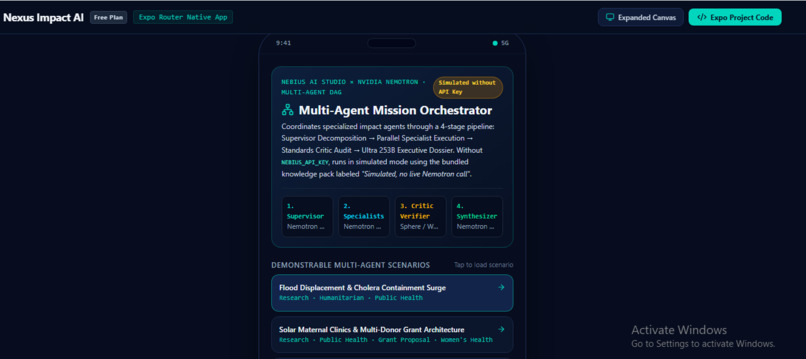
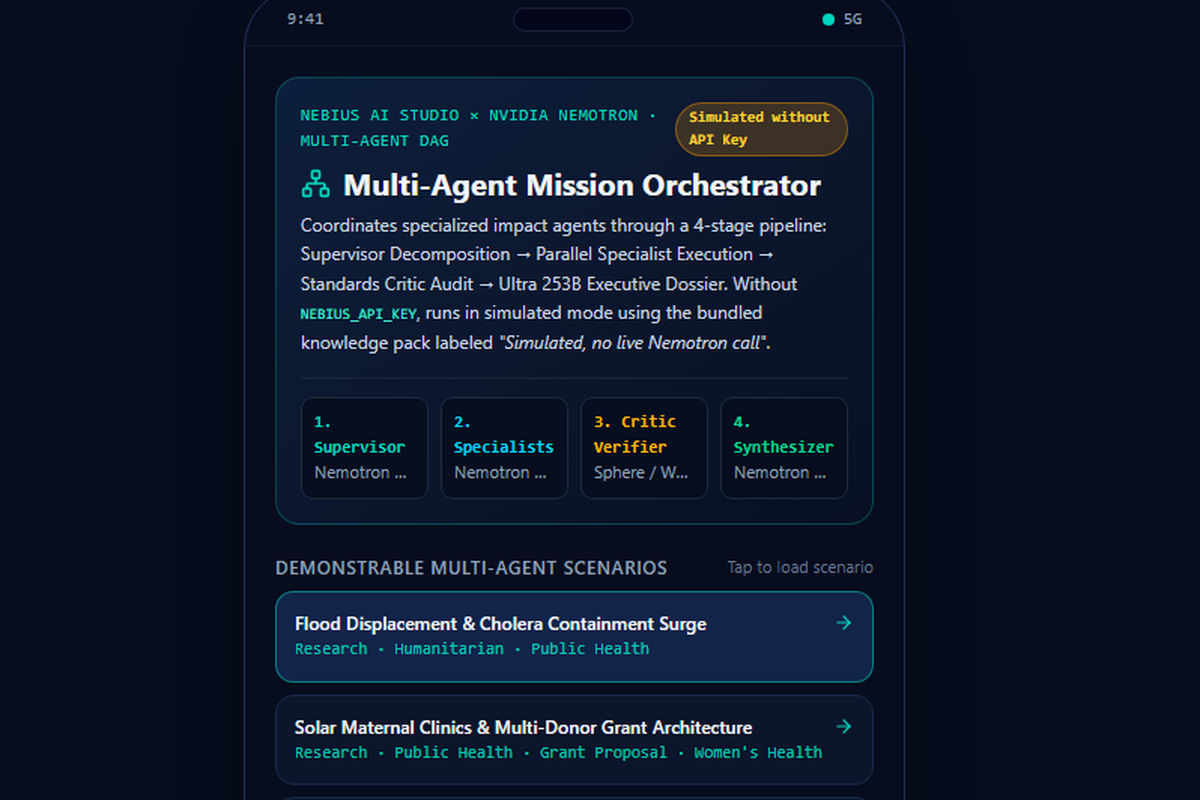
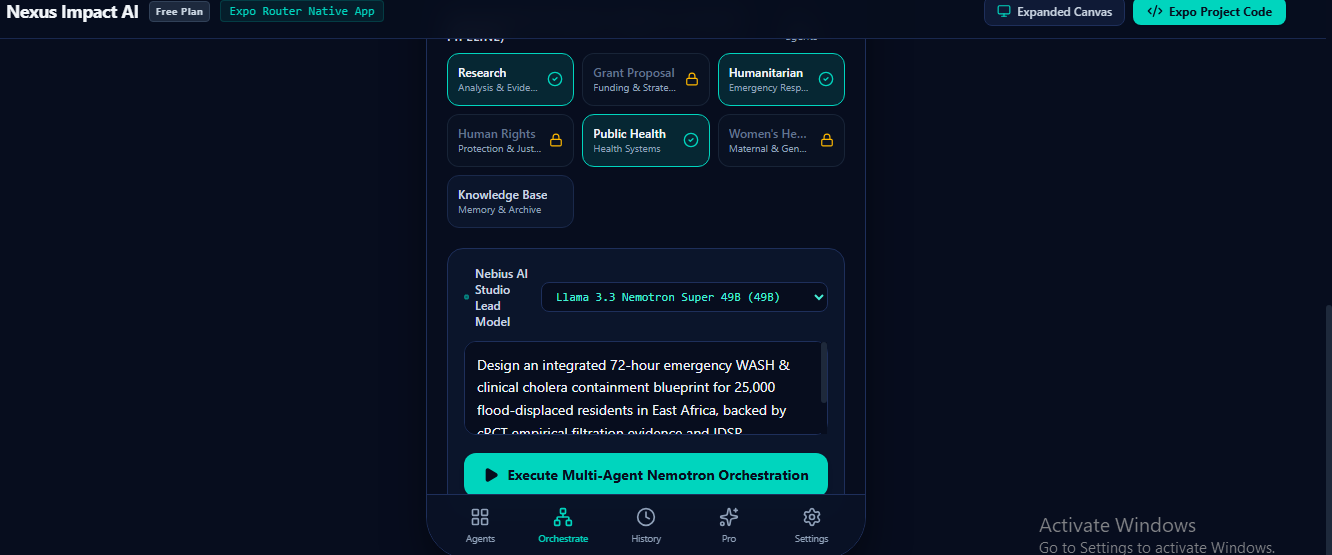
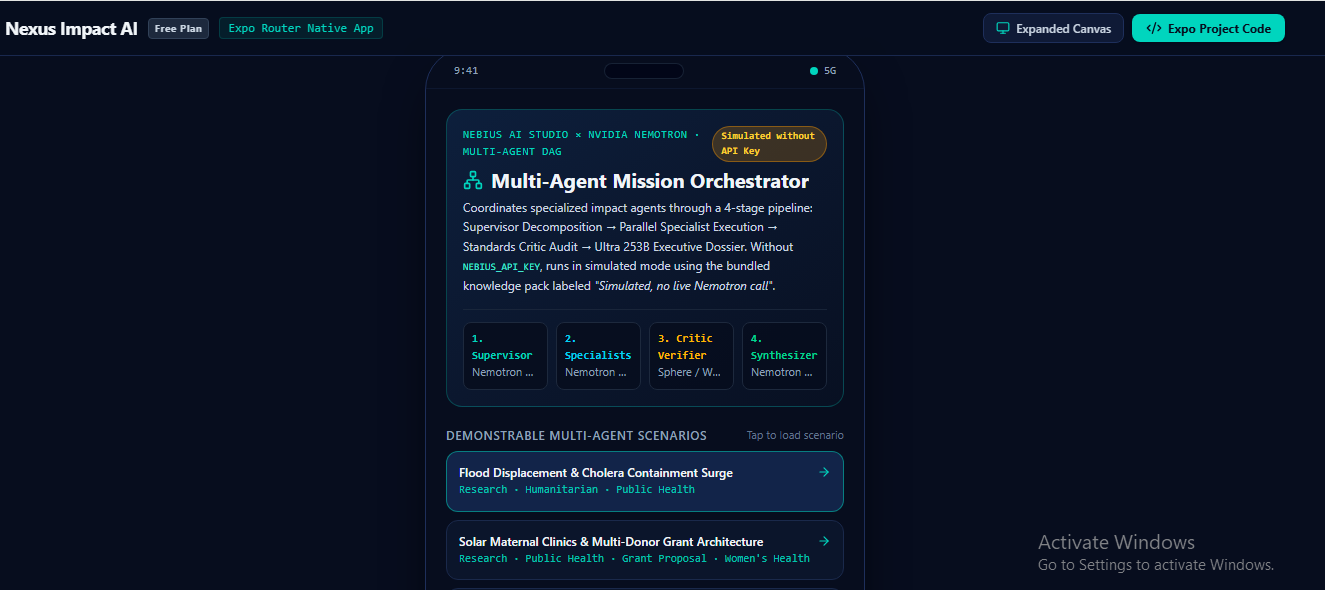
The Orchestrator coordinates the agents through a 4-stage pipeline built around NVIDIA Nemotron models served through Nebius:
- Supervisor Router (Llama-3.3-Nemotron-Super-49B): breaks a complex mission into sub-directives with shared constraints.
- Parallel Domain Specialists (Llama-3.1-Nemotron-70B-Instruct): the relevant agents work in parallel and pass context to each other.
- Compliance Critic (Nemotron Super 49B): audits the combined output against Sphere standards, WHO IDSR thresholds, Berkeley Protocol chains of custody, and USAID budget math.
- Executive Synthesizer (Llama-3.1-Nemotron-Ultra-253B): produces one board-ready mission dossier with copy, history, and PDF export.
The server exposes /api/nemotron/infer, /api/nemotron/orchestrate, and /api/nemotron/status, and extracts reasoning traces along with latency and token telemetry.
4. The Honest Part: Why It Runs in Simulated Mode
I could not run this on Nebius, and I want to say so plainly. Nebius Token Factory requires billing registration with a bank card from a supported country, and Ethiopia is not on that list. I contacted Nebius support (ticket CLOUDSUPPORT-1241254), and they confirmed in writing that they cannot add Ethiopia, make an exception, or offer an alternative activation path, including for hackathon participants and the promotional credit.
I chose not to hide this or fake model output. I built the full Nemotron integration, with the real endpoints and model routing, and a clearly labeled simulated mode that runs when no API key is present:
- Answers come from a bundled humanitarian knowledge pack.
- Every output is marked "Simulated, no live Nemotron call."
- The API reports
isLiveNemotron: false, so nothing simulated can pass as live. - The app never crashes or shows a blank screen if keys are missing.
When Token Factory access becomes possible, I set NEBIUS_API_KEY and the base URL, and live inference switches on with no redesign. The integration is implemented but has not been tested against live Nebius endpoints.
5. Why This Fits Low-Resource Communities
- Works without cloud access: the same fallback that covers my billing problem keeps the app useful when a connection or paid service isn't available. I am still testing exactly which functions work fully offline.
- Easy to reach: a mobile-first app with a free tier, usable on a basic phone or laptop.
- Grounded in humanitarian standards: outputs follow the frameworks that field teams and donors actually use.
- Built for refugee and displaced communities and the teams who serve them. I have not yet piloted it with those communities.
6. Built With
React, TypeScript, Vite, Tailwind CSS, Expo Router, Node.js, Express, NVIDIA Nemotron models, Nebius Token Factory API, RevenueCat (Pro gating), Render.
7. How It Meets the Judging Criteria
Technological Implementation: a full-stack, multi-model pipeline with role-based model routing, reasoning-trace parsing, telemetry, graceful failure handling, and a live deployment. The Nebius integration is complete in code but untested live, and I say so openly.
Design: a mobile-first interface, structured exports, and honest labels that show whether an answer is simulated or live.
Potential Impact: it serves humanitarian teams, researchers, and NGOs who work with limited time, connectivity, and budget. I am not claiming measured impact yet.
Quality of the Idea: a standards-aware agent team for the social sector, designed from the start for people the cloud often excludes.
8. What I Learned
A working integration in code is not the same as a verified result, and billing and country restrictions decide who gets to build and test AI. As an AI ambassador and mentor, I will carry this lesson into my work with other builders: tools meant for underserved communities must be designed around those limits from day one.
9. What's Next
- Verify live Nemotron inference on Nebius Token Factory with supported access.
- Add real-time search so agents can cite current sources.
- Pilot with frontline health and humanitarian teams.
- Have domain experts review output quality against Sphere, WHO, and Berkeley Protocol standards.
- Test the full offline experience on low-end devices.
- Share the open-source code and lessons with the builders I mentor, so more people in unsupported regions can build with open models.
10. Closing
I built Nexus from Ethiopia, in a context affected by conflict, and in a country that Nebius cannot support for billing. So I built a version that runs anyway, tells you exactly what is simulated, and is ready to go live the moment access allows.
Built With
- agentic-ai
- ai-for-good
- artificial-intelligence
- expo-router
- expo.io
- express.js
- github
- google-ai-studio
- humanitarian-technology
- llm
- multi-agent-systems
- nebius
- nebius-token-factory
- node.js
- nvidia
- nvidia-nemotron
- open-source
- public-health
- react
- react-native
- render
- revenuecat
- tailwind-css
- typescript
- vite