NEXUS-H: Context-Aware Human Escalation & Resolution Engine
Inspiration
AI can answer questions and automate repetitive tasks, but what happens when a situation becomes too complex, sensitive, or risky for an AI system to handle independently?
In customer support and operations, a poor decision can lead to incorrect refunds, unresolved complaints, security risks, or frustrated customers. Simply automating everything is not the answer, and sending every issue to a human defeats the purpose of automation.
That inspired us to build NEXUS-H: an AI-powered escalation engine designed to determine when automation should continue, when more information is needed, when human approval is required, and when a case should be handed over to a specialist.
Our goal is simple: make AI-assisted operations more reliable by keeping humans in control of critical decisions.
What it does
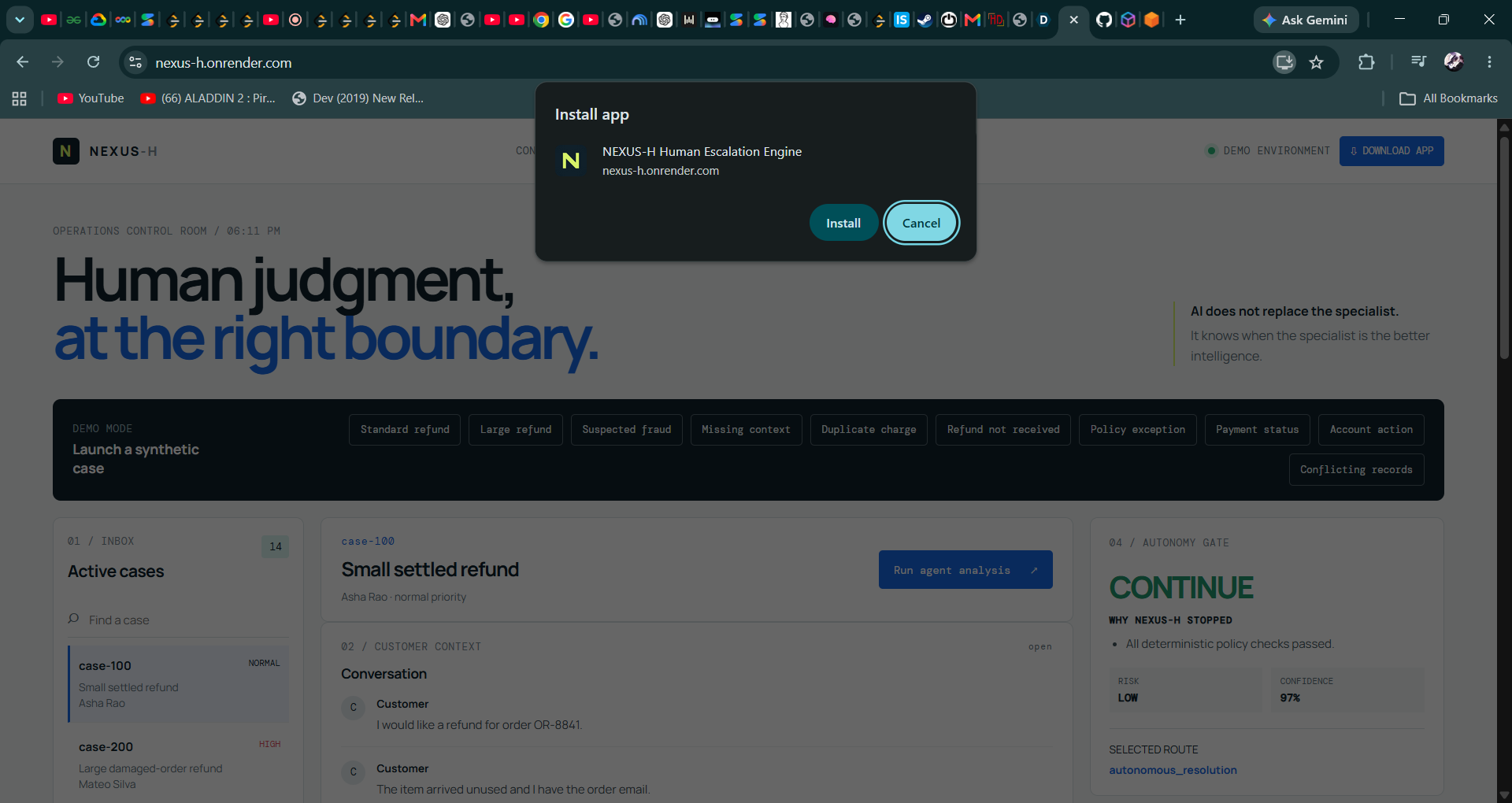
NEXUS-H acts as a decision and control layer between AI automation and human support teams.
Its core capabilities include:
- Context-aware case analysis: Brings together relevant case details, conversations, customer information, transactions, and policy context.
- Four-state autonomy workflow: Classifies the next action into
CONTINUE,CLARIFY,APPROVAL, orHANDOFF. - Human-in-the-loop control: Identifies situations that require human approval or specialist intervention instead of allowing unrestricted automation.
- Specialist routing: Helps direct escalated cases to the appropriate support queue.
- Human Brief: Organizes relevant context and the reason for escalation so a human can understand the issue without starting from scratch.
- Auditability: Records decision-related events to make the workflow easier to inspect and review.
- AI-assisted recommendations: Supports optional model-assisted case analysis through Amazon Bedrock and the Strands Agents SDK.
The project also explores MCP-based access to support-case information and integrations with Amazon platform experiences.
Rather than treating AI as an unrestricted decision-maker, NEXUS-H is designed to make its actions more structured, reviewable, and accountable.
How we built it
NEXUS-H uses a lightweight web architecture that combines backend logic, a dashboard, case data, and optional AI capabilities.
Technology stack:
- Python and Flask: Backend application and REST APIs.
- HTML, CSS, and JavaScript: Interactive web dashboard.
- SQLite: Lightweight application data storage.
- Amazon Bedrock and Amazon Nova 2 Lite: Optional AI-assisted case analysis.
- Strands Agents SDK: Agent and tool-assisted workflow integration.
- Model Context Protocol (MCP): Structured access to selected application capabilities for compatible AI clients.
- AWS Lightsail: Cloud hosting for the application.
- Docker and Gunicorn: Deployment and application serving.
- pytest: Automated testing.
The system combines AI-generated recommendations with deterministic application logic. The intended workflow is to gather context, evaluate the case, determine the appropriate autonomy state, and either continue, request clarification, seek approval, or hand off the case.
This separation is important: AI can help interpret a complex situation, while explicit rules and human oversight govern critical actions.
Challenges we ran into
One of the biggest challenges was balancing useful automation with safe escalation. A system that escalates everything is inefficient, while one that acts too independently can make inappropriate decisions.
We addressed this challenge by designing explicit autonomy states and separating recommendations from critical control decisions.
Other challenges included:
- Context management: Ensuring the information presented to an agent or human reviewer is relevant to the case.
- Integration complexity: Connecting the existing application to agent tools, MCP interfaces, cloud services, and external platform workflows.
- AWS configuration: Handling regional settings, credentials, IAM permissions, and model-access requirements for Amazon Bedrock.
- Testing external integrations: OAuth flows, device discovery, webhooks, and platform-specific requirements need appropriate credentials and end-to-end validation.
- Deployment and reliability: Keeping the application lightweight while making its workflows understandable and testable.
These challenges reinforced the importance of clear interfaces, explicit permissions, deterministic safeguards, and honest validation of integrations.
Accomplishments that we're proud of
We are proud of building more than a conventional AI chatbot. NEXUS-H focuses on the operational decisions surrounding AI automation: what it should do next, when it needs help, and how a human can take over with sufficient context.
Our key accomplishments include:
- Designing a four-state autonomy and escalation workflow.
- Building a support-operations dashboard and backend API.
- Structuring case context into actionable human handoff briefs.
- Incorporating audit-oriented decision workflows.
- Integrating an optional Amazon Bedrock and Strands-based AI advisory path.
- Exploring MCP-based tool access and Amazon ecosystem integrations.
- Creating a foundation that can be extended to additional support and operations scenarios.
Most importantly, the project demonstrates our belief that successful AI automation is not just about what a system can do autonomously, but also about knowing when it should not.
What we learned
Building NEXUS-H taught us that agentic AI is as much a systems-design challenge as a model-selection challenge.
A capable model alone does not make a reliable product. Context retrieval, tool permissions, deterministic rules, error handling, observability, and human intervention all matter.
We also learned that integrations introduce their own challenges: credentials, permissions, API compatibility, deployment configuration, and end-to-end testing must be considered alongside the AI workflow itself.
Most importantly, we learned to treat human oversight as a core architectural component rather than an afterthought. The objective is not to eliminate human involvement, but to make it more focused, informed, and effective.
What's next for NEXUS-H
Our next steps are focused on making NEXUS-H more capable, measurable, and production-ready.
Planned improvements include:
- Better escalation prioritization: Use case severity, uncertainty, and potential impact to help prioritize the human queue.
- Improved context retrieval: Retrieve more precise evidence and policy information for each case.
- Stronger evaluation: Test decision quality, escalation accuracy, false handoffs, and unsafe-action prevention against representative scenarios.
- More robust integrations: Validate MCP, Amazon platform integrations, and model-assisted workflows through end-to-end tests.
- Operational observability: Improve structured logs, error reporting, and audit visibility.
- Scalable storage: Explore a more robust database for larger workloads and concurrent users.
- Human feedback loops: Use reviewer feedback to improve routing and recommendations while retaining appropriate approval boundaries.
Our long-term vision is for NEXUS-H to become a reusable control layer for AI-powered operations—one that enables greater automation without sacrificing human judgment, accountability, or trust.
Built With
- agentic
- agents
- ai
- amazon
- amazon-web-services
- api
- artificial
- automation
- bedrock
- css
- customer
- docker
- flask
- html
- human-in-the-loop
- intelligence
- javascript
- python
- rest
- retrieval-augmented
- sqlite
- workflow

Log in or sign up for Devpost to join the conversation.