-
-
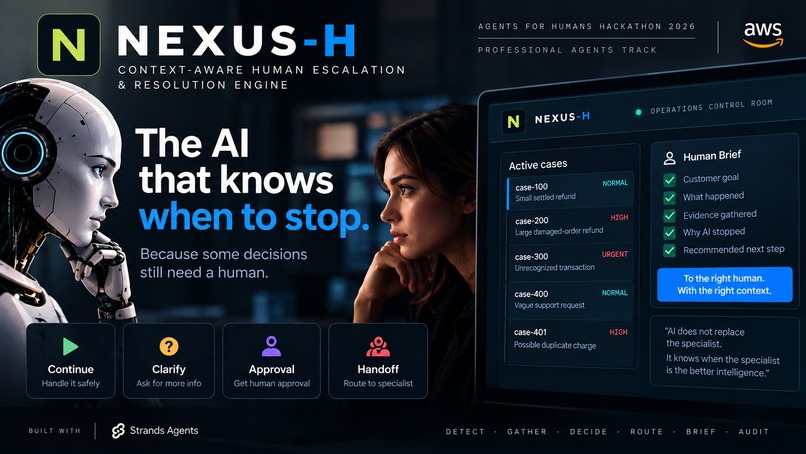
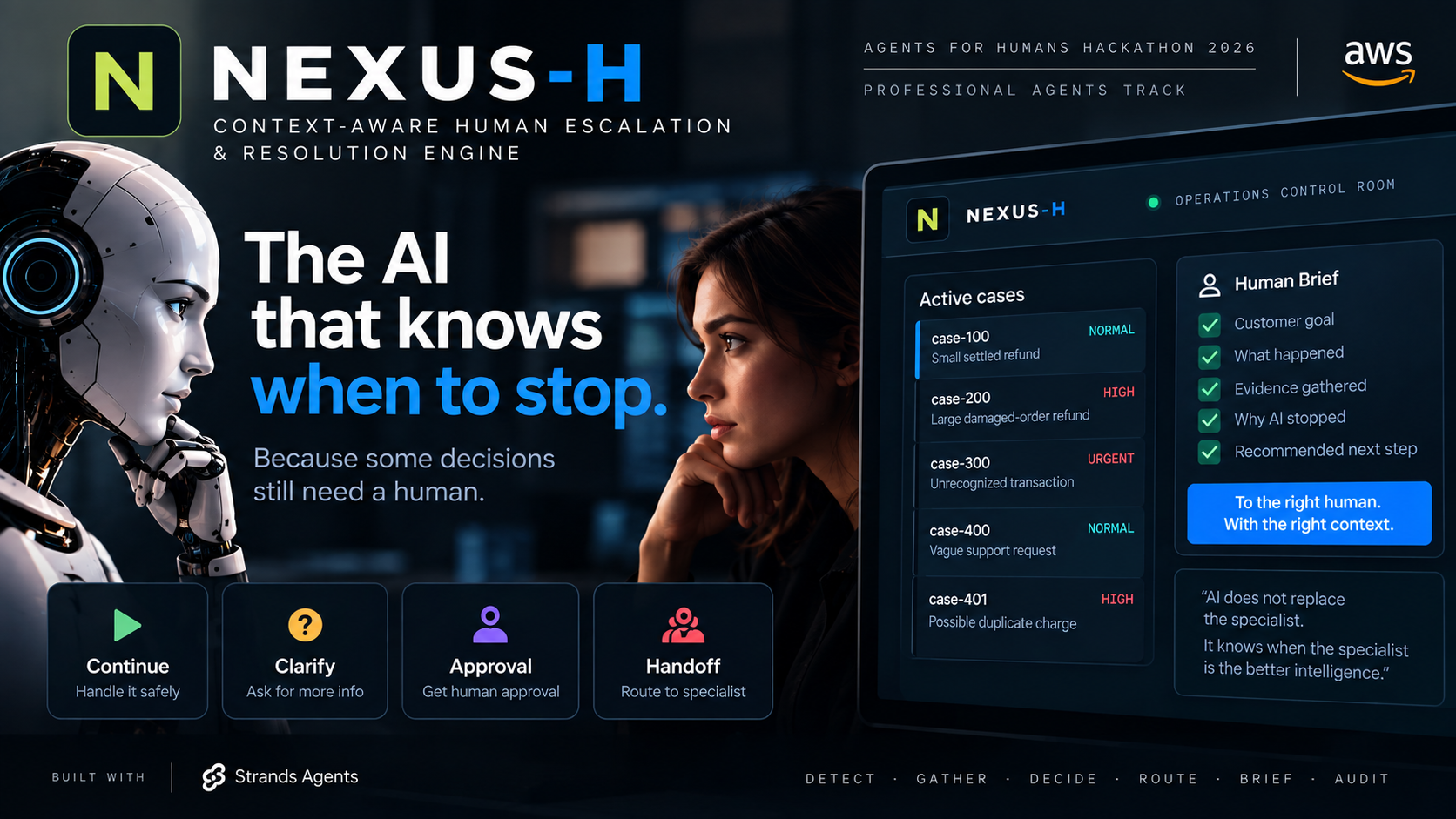
Thumbnail overview of Nexus-H
-

Logo created through Adobe Illustrator
-
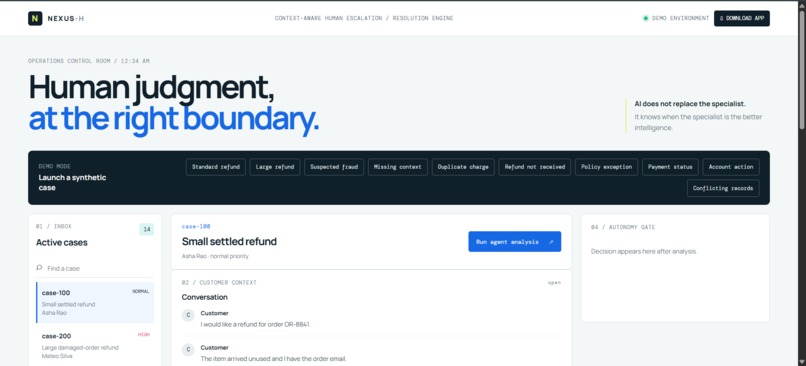
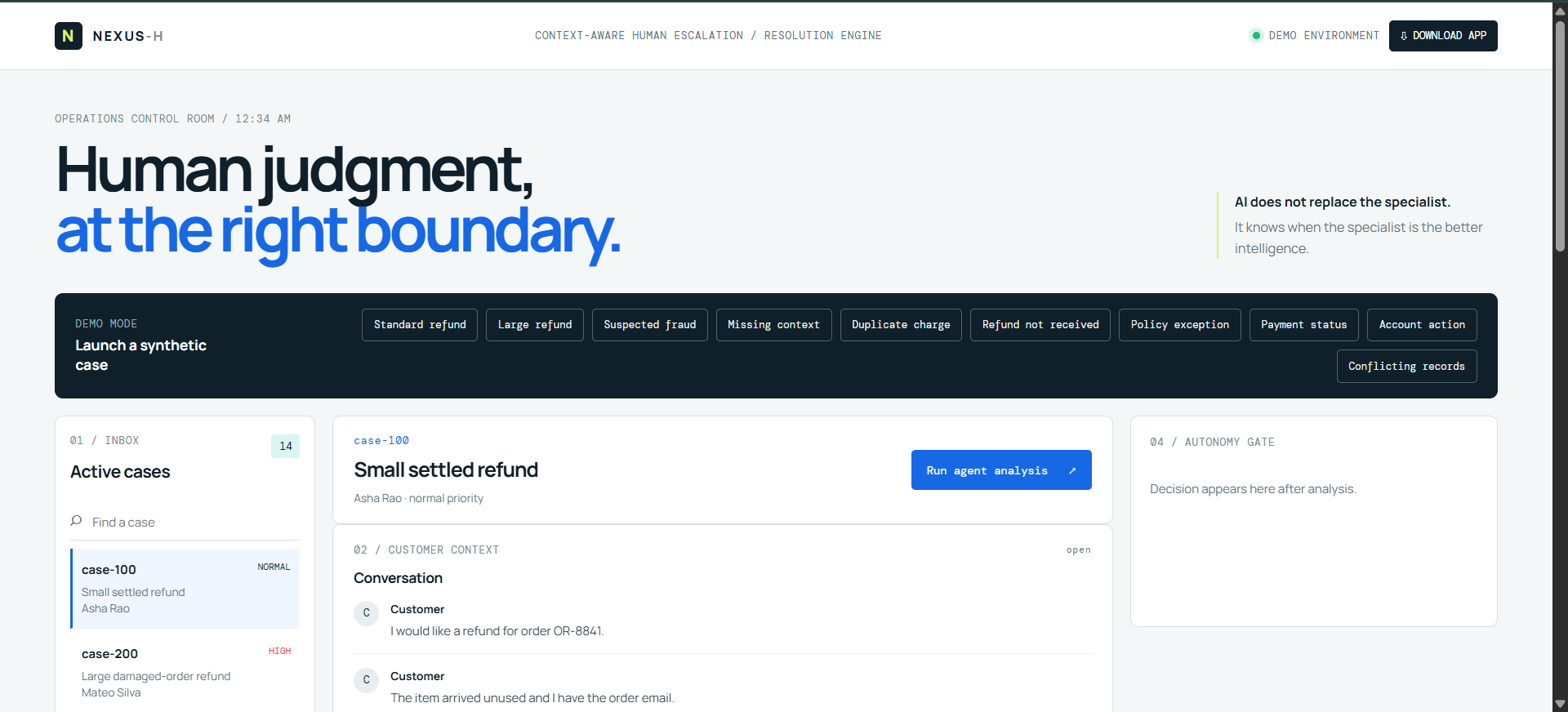
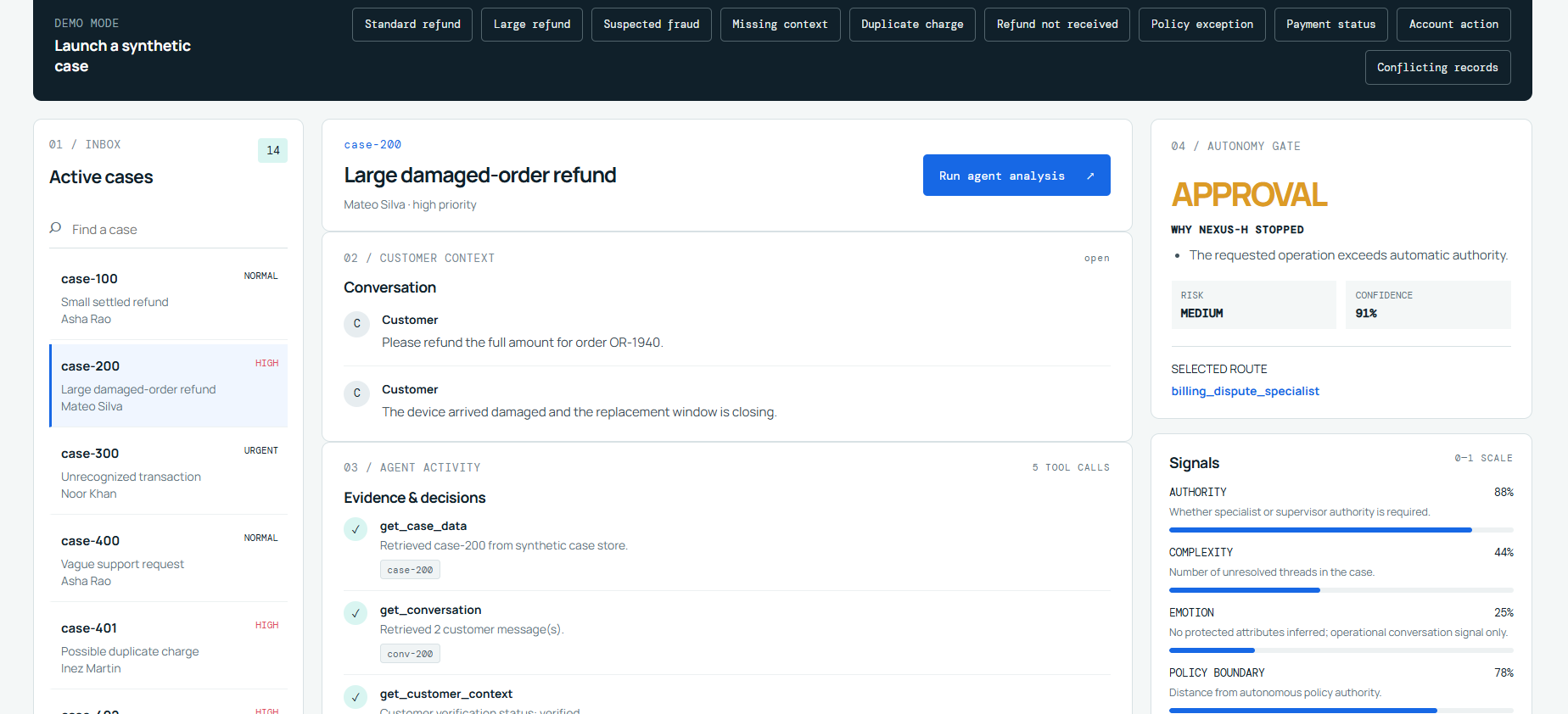
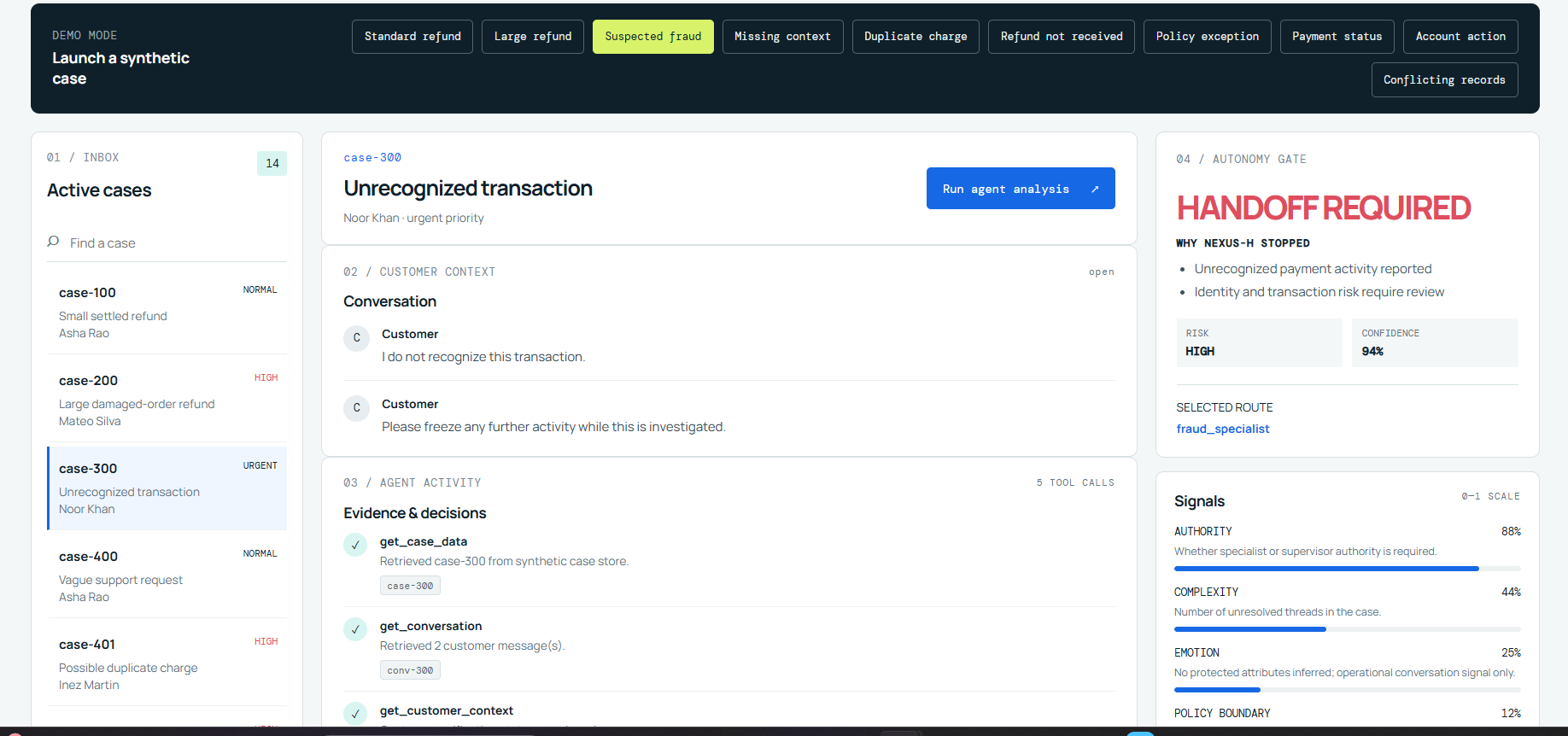
Dashboard of Nexus-H
-
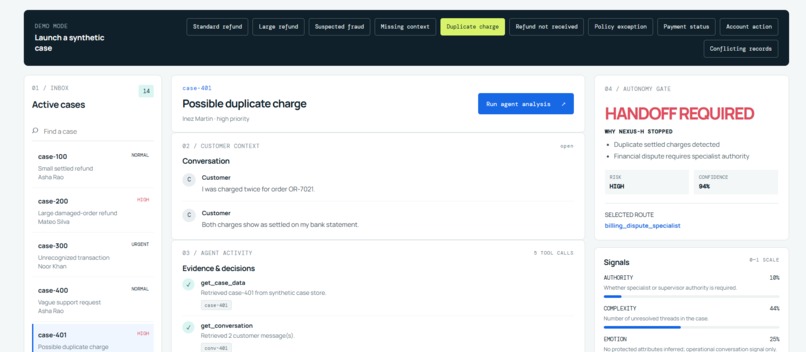
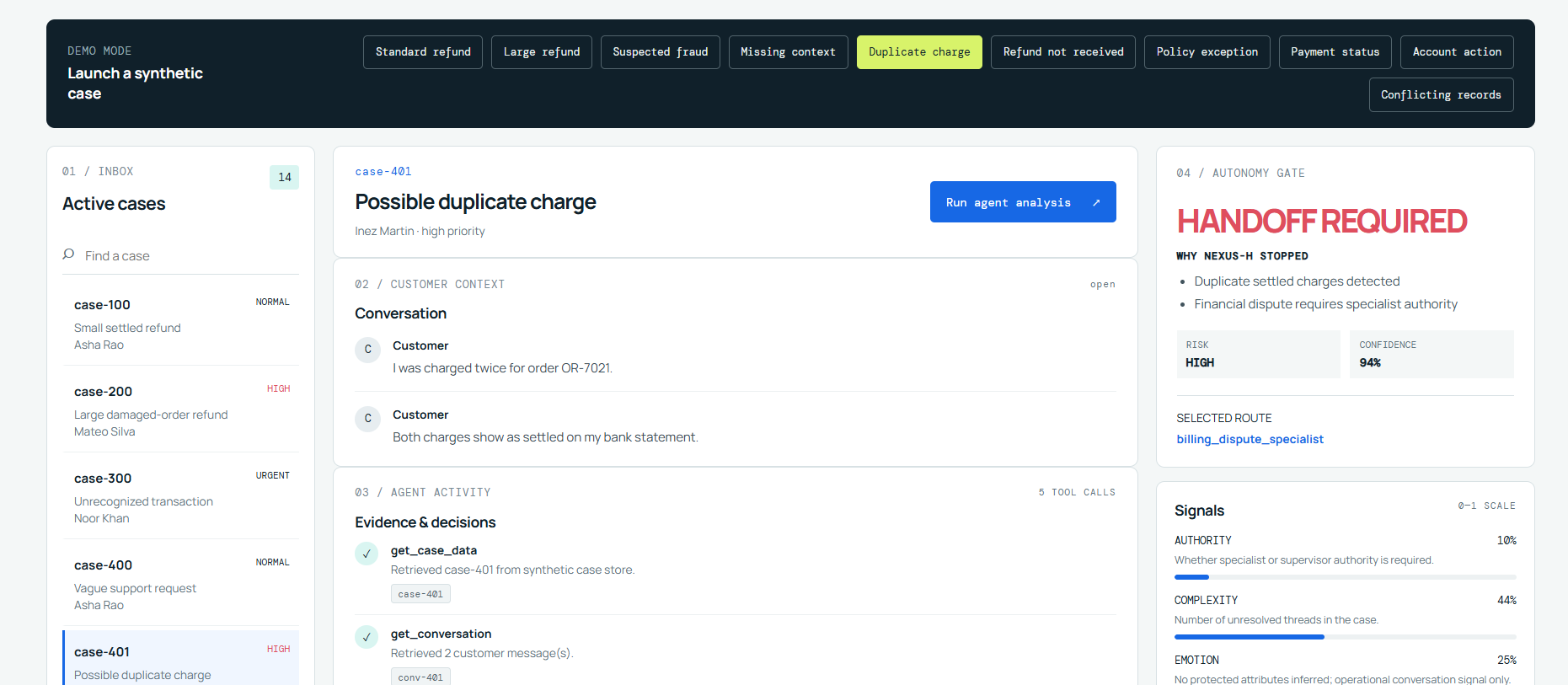
Autonomy Gate — NEXUS-H recognizes when a financial dispute should move to a human specialist.
-
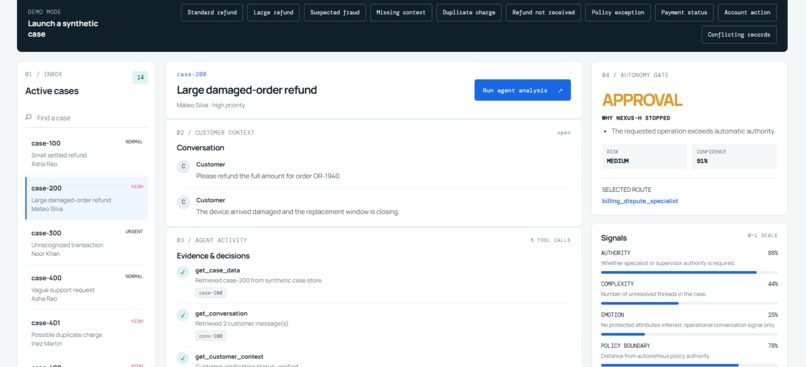
Human Approval — When an action exceeds the AI's authority, NEXUS-H pauses instead of guessing.
-
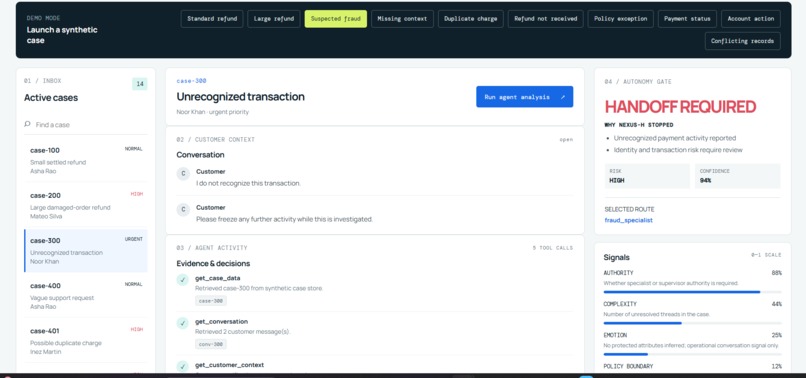
Intelligent Routing — High-risk cases are routed to the appropriate specialist with the relevant context.

Inspiration
We have all experienced the same customer-support loop: we report a simple problem, the chatbot says it understands, and then asks us to explain everything again.
At some point, the customer is no longer solving the problem—they are training the chatbot.
We built NEXUS-H to address this frustration. Our goal is not to make AI handle every situation alone. It is to make AI recognize when it has enough information to continue, when it needs clarification, when human approval is required, and when a human specialist should take over.
What it does
NEXUS-H is a context-aware human escalation and resolution engine for everyday customer-support situations.
It retrieves relevant information from the case, conversation history, customer profile, transaction details, and support policies. Based on that context, it selects one of four actions:
- CONTINUE — proceed with the supported resolution.
- CLARIFY — ask the customer for missing information.
- APPROVAL — request authorization before taking a sensitive action.
- HANDOFF — transfer the case to the appropriate human specialist.
When escalation is necessary, NEXUS-H creates a structured Human Brief containing the customer’s issue, relevant evidence, previous conversation, recommended next step, and reason for escalation. It also records the action in an audit trail so that decisions remain traceable.
How we built it
We built NEXUS-H using Python, Flask, SQLite, HTML, CSS, and JavaScript.
The system includes:
- Context-retrieval tools for cases, customers, conversations, transactions, and policies.
- A deterministic guardrail engine for safe autonomy decisions.
- Specialist routing and idempotent handoff handling.
- Human Brief generation.
- Persistent audit events.
- A Strands Agents adapter with Amazon Nova Lite.
- REST APIs, automated tests, Docker configuration, and deployment support.
Our architecture intentionally separates AI assistance from final safety enforcement. Strands and the model help retrieve and interpret context, while deterministic guardrails remain authoritative over sensitive decisions.
Challenges we ran into
One of our biggest challenges was deciding how much control to give the AI.
A fully autonomous system may appear impressive, but it can also make unsafe decisions when information is incomplete or when a transaction requires approval. We therefore designed NEXUS-H around controlled autonomy rather than unrestricted automation.
We also had to handle inconsistent or missing customer information, prevent duplicate handoffs, maintain useful audit records, and make the system understandable to a human support specialist.
Deployment was another challenge because cloud service access and account activation restrictions affected our original deployment plan. We designed the application to remain portable across local, containerized, and cloud environments.
Accomplishments that we're proud of
We are proud that NEXUS-H is more than a chatbot interface. It is a working decision and escalation workflow with:
- Multiple realistic customer-support scenarios.
- Explicit safety boundaries.
- Context-aware decisions.
- Human specialist routing.
- Structured handoff summaries.
- Persistent audit trails.
- Automated tests.
- A deployable backend and frontend.
Most importantly, the system treats escalation as a useful outcome rather than an AI failure.
What we learned
We learned that good AI systems are not only about generating intelligent answers. They are also about knowing when not to act.
We learned how to combine agent-style context retrieval with deterministic business rules, how to design human-in-the-loop workflows, and how important traceability is when an AI system influences customer-facing decisions.
We also learned that a clear explanation of the system’s boundaries is just as important as demonstrating its capabilities.
What's next for Nexus-H
Our next steps are to strengthen the live Strands and Amazon Bedrock execution path, expand the evaluation dataset, and measure outcomes such as resolution quality, unnecessary escalations, prevented unsafe actions, and time saved for support teams.
We also want to add more integrations with real support platforms, improve multilingual support, and provide richer analytics for organizations using human-in-the-loop AI.
Our long-term vision is simple:
AI should not replace human judgment everywhere. It should know when human judgment matters most.

Log in or sign up for Devpost to join the conversation.