Inspiration
Modern power grids are evolving into highly complex decentralized systems due to renewable energy integration, dynamic urban demand, and large-scale infrastructure interconnectivity. Traditional grid management systems lack the ability to adapt autonomously in real time under uncertain and rapidly changing conditions.
Nexus Grid was inspired by the idea of building an autonomous city-scale energy digital twin powered by cooperative artificial intelligence. The project explores how Multi-Agent Transformers (MAT) combined with QMIX reinforcement learning can coordinate decentralized agents to optimize energy orchestration dynamically.
The inspiration behind the project came from:
- Smart city infrastructure challenges
- Autonomous energy management systems
- Cooperative multi-agent intelligence
- Reinforcement learning for infrastructure optimization
- Digital twin simulations
- Adaptive control systems
- Real-time telemetry orchestration
- Resilient distributed infrastructure
Our goal was to create a platform capable of:
- Emergent coordination
- Adaptive optimization
- Real-time resilience
- Autonomous grid intelligence
- Zero-shot generalization under unseen conditions
through decentralized AI-driven orchestration.
What it does
Nexus Grid is an autonomous smart-grid orchestration platform that creates a real-time digital twin of city-scale energy infrastructure using Multi-Agent Reinforcement Learning.
The platform simulates intelligent decentralized energy ecosystems where multiple AI agents cooperate to optimize:
- Energy distribution
- Grid stability
- Fault tolerance
- Infrastructure resilience
- Demand-response balancing
- Adaptive recovery mechanisms
Core Innovation: Adaptive Multi-Agent Control
Nexus Grid introduces a cooperative AI architecture where decentralized agents coordinate dynamically using:
- Multi-Agent Transformers (MAT)
- QMIX monotonic value decomposition
- Shared reward optimization
- Transformer attention mechanisms
- Cooperative reinforcement learning
Core Features
Autonomous Energy Orchestration
- Dynamic energy allocation
- Adaptive control systems
- Real-time optimization
- Cooperative agent coordination
Smart Grid Intelligence
- Graph-based grid topology modeling
- Dynamic node interaction
- Intelligent transmission coordination
- Topology-aware decision making
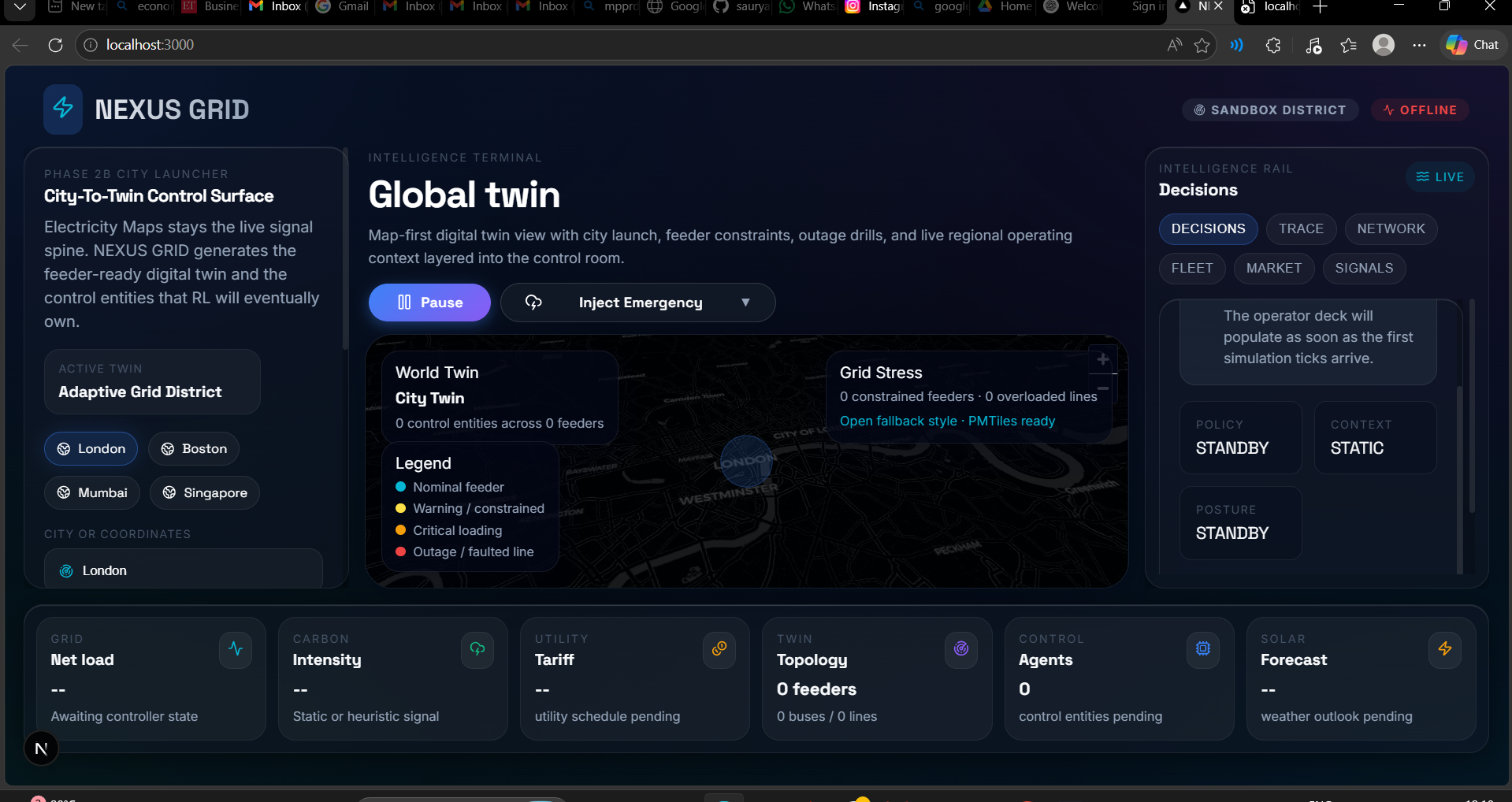
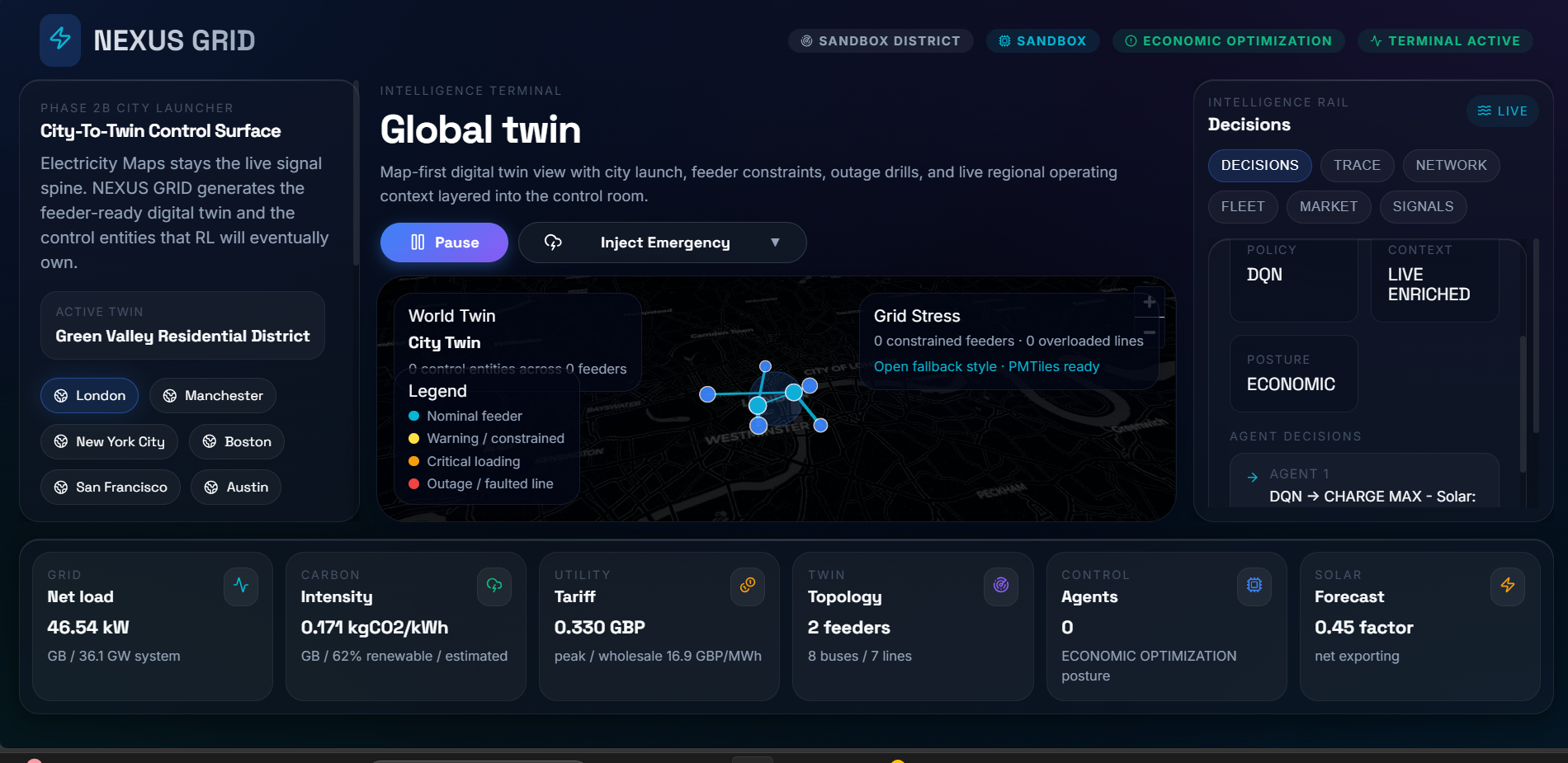
Real-Time Digital Twin
- City-scale infrastructure simulation
- Live telemetry ingestion
- Real-time state synchronization
- Interactive orchestration monitoring
Chaos Engineering & Resilience
- Failure propagation simulations
- Grid stress testing
- Autonomous recovery mechanisms
- Resilience optimization
AI Coordination
- Emergent coordination behavior
- Decentralized execution
- Centralized training
- Cooperative policy learning
Dashboard & Monitoring
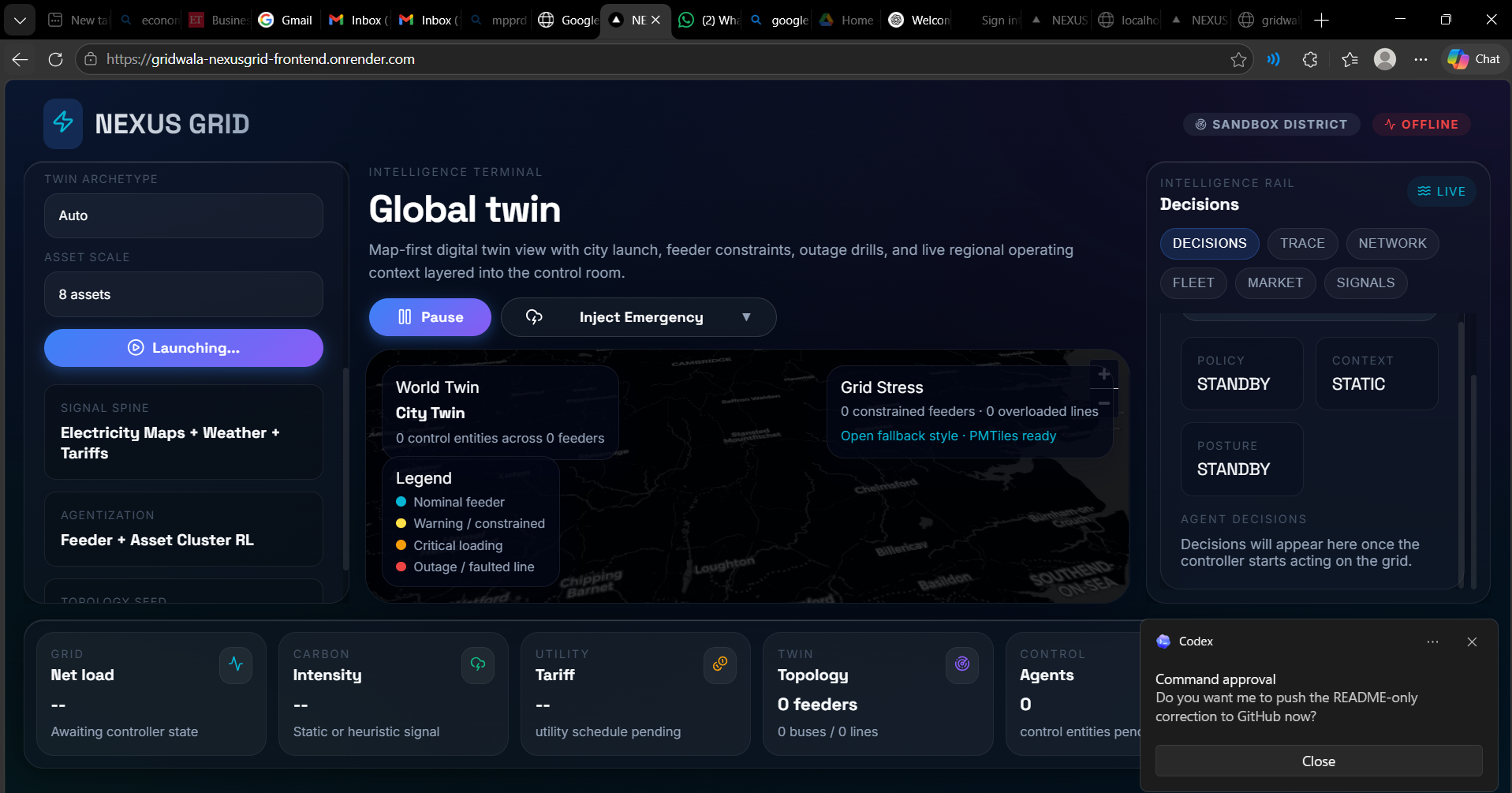
- Next.js interactive frontend
- Real-time telemetry visualization
- Grid node monitoring
- Live orchestration insights
AI/ML Concepts Used
- Multi-Agent Reinforcement Learning
- Multi-Agent Transformers
- QMIX
- Dec-POMDP
- Cooperative optimization
- Reward shaping
- Transformer attention
- Monotonic value decomposition
How we built it
Nexus Grid was built as a distributed AI-driven orchestration platform composed of simulation engines, reinforcement learning systems, telemetry pipelines, and visualization infrastructure.
System Architecture
The platform consists of:
- Multi-agent coordination layer
- Reinforcement learning engine
- Graph topology simulation engine
- Telemetry ingestion system
- Real-time orchestration pipeline
- Visualization dashboard
- Distributed API infrastructure
Backend Stack
- Python 3.11+
- FastAPI
- PyTorch
- NetworkX
Frontend Stack
- Next.js
- Real-time visualization system
AI/ML Stack
- Multi-Agent Transformers (MAT)
- QMIX reinforcement learning
- Cooperative multi-agent systems
- Shared policy optimization
Mathematical Modeling
The smart grid is represented as a graph:
$$ G = (V, E) $$
where:
- (V) represents substations and energy nodes
- (E) represents transmission connections
The environment is modeled as a Decentralized Partially Observable Markov Decision Process (Dec-POMDP), enabling decentralized agents to cooperate under partial observability constraints.
Reinforcement Learning Pipeline
Each agent:
- Observes local grid states
- Learns cooperative policies
- Optimizes shared rewards
- Coordinates through transformer-based attention
QMIX is used for monotonic value decomposition to enable:
- Centralized training
- Decentralized execution
- Cooperative optimization
Repository Structure
agents/
Contains:
- Multi-agent learning logic
- Policy coordination systems
- Reinforcement learning agents
core/
Contains:
- Simulation engine
- Grid topology modeling
- Telemetry orchestration
- Environment management
frontend/
Contains:
- Next.js dashboard
- Visualization systems
- Monitoring interfaces
backend/
Contains:
- FastAPI APIs
- Backend orchestration services
- Telemetry endpoints
Real-Time Infrastructure
- Live telemetry ingestion
- Dynamic orchestration loops
- Simulation synchronization
- Real-time state updates
Deployment
Frontend
Deployed using Render for scalable real-time dashboard access.
Backend
FastAPI backend services deployed with cloud-hosted infrastructure.
Cross-Platform Support
Windows
start.bat
Built With
- fastapi
- multiagent-transformer
- nextjs
- pytorch
- websockets

Log in or sign up for Devpost to join the conversation.