Inspiration
Traditional B2B operations and small-business onboarding processes suffer from massive administrative latency. Dynamic incoming data ranging from client contracts, voice notes, and site inspection photos to custom request forms remains trapped in silos, requiring hours of manual review. We built Nexus Graph AI to bring multi-modal, agentic AI workflows to B2B operations, transforming unstructured customer inputs into real-time operational execution pipelines.
What it does
Nexus-Graph AI is an autonomous multi-agent command center that streamlines B2B onboarding and operational dispatch:
- Multi-Modal Data Ingestion: Processes unstructured documents, audio notes, and site images alongside raw JSON payload streams.
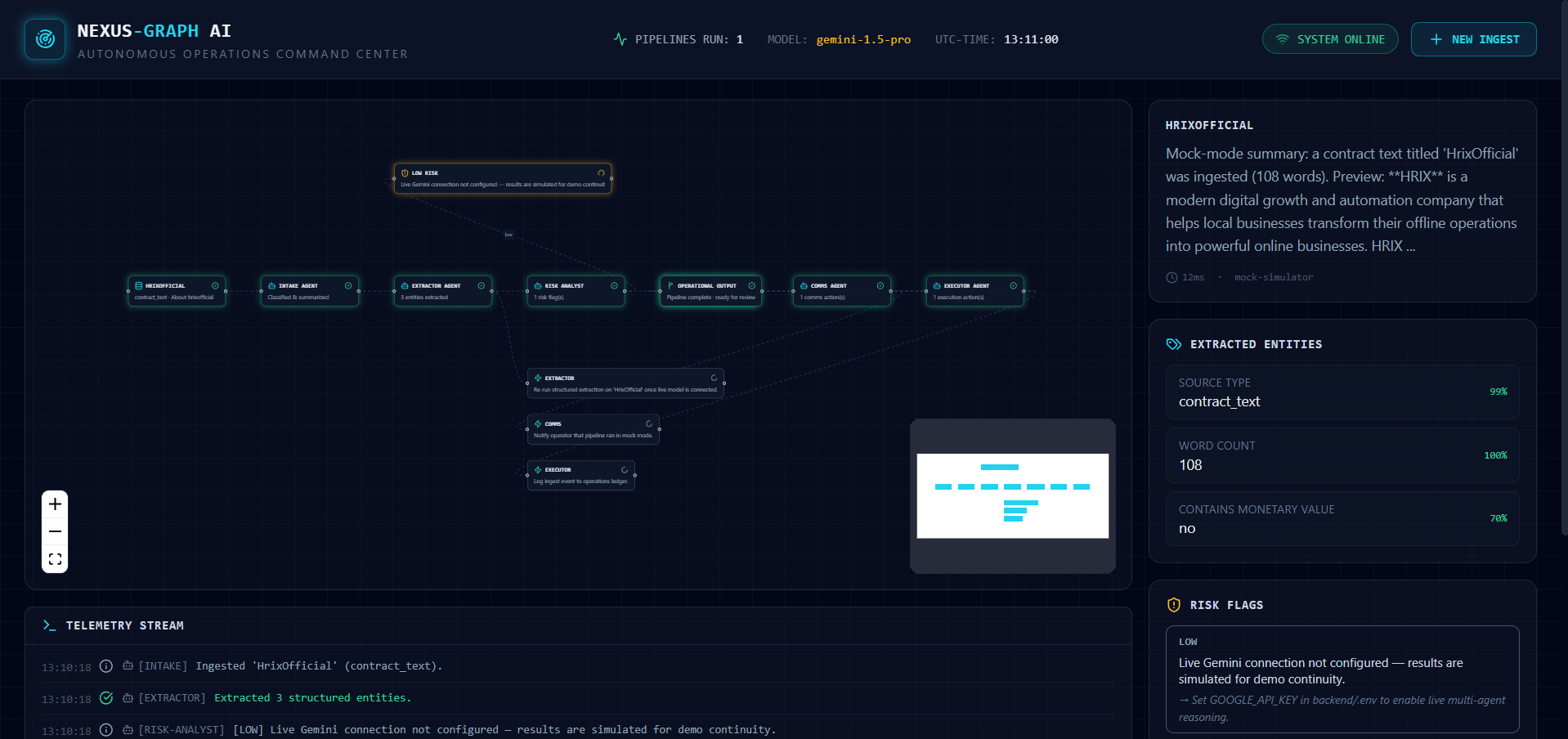
- Autonomous Decision Trees: Dynamically constructs and renders a live dependency action graph (powered by React Flow) to illustrate the AI agent's reasoning.
- Risk & Qualification Scoring: Executes dynamic lead qualification scoring and financial feasibility checks in real time.
- Function-Calling Tool Execution: Automatically triggers downstream tools to generate Statements of Work (SOWs), send personalized outreach, and update system databases.
How we built it
- Backend: Built using Python and FastAPI, powered by Google Gemini 1.5 Flash / Pro for multi-modal context processing, structured JSON response generation, and native function calling.
- Frontend: Developed with Next.js 14 (App Router), TypeScript, Tailwind CSS, Lucide React icons, and React Flow for real-time node-graph visualization.
Challenges we ran into
Handling heterogeneous multi-modal inputs while keeping latency under 500ms required careful prompt structuring and strict schema formatting. We resolved this by utilizing Gemini's native structured JSON outputs (response_mime_type="application/json"), ensuring predictable node structures for frontend rendering.
Accomplishments that we're proud of
- Building a full-stack, end-to-end agentic workflow pipeline with sub-second execution speeds (~150ms node response times).
- Creating a clean, tactical UI command center that gives human operators real-time visibility into the agent's decision-making process.
What we learned
- How to leverage Gemini's structured outputs and function-calling mechanisms to build reliable, production-ready AI agents.
- Best practices for designing intuitive user interfaces that present complex, agentic decision trees clearly.
What's next for Nexus-Graph AI
- Expanding native tool integrations to support direct CRM syncing (HubSpot, Salesforce) and automated accounting dispatch (QuickBooks, Stripe).
- Implementing live WebSocket streaming to broadcast multi-agent collaboration states in real time.
Built With
- fastapi
- geminiapi
- google-cloud
- next.js
- python
- reactflow
- tailwindcss
- typescript

Log in or sign up for Devpost to join the conversation.