-
-
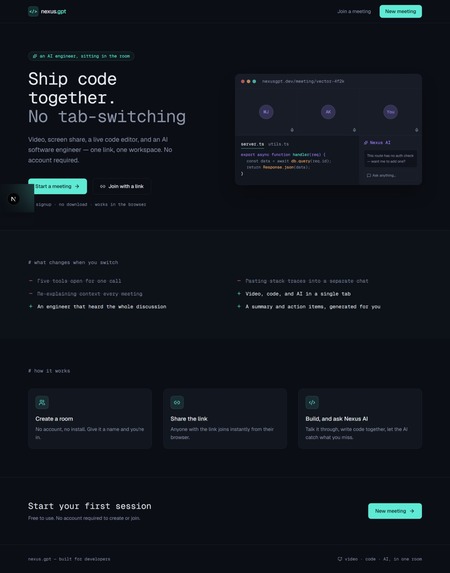
landingpage
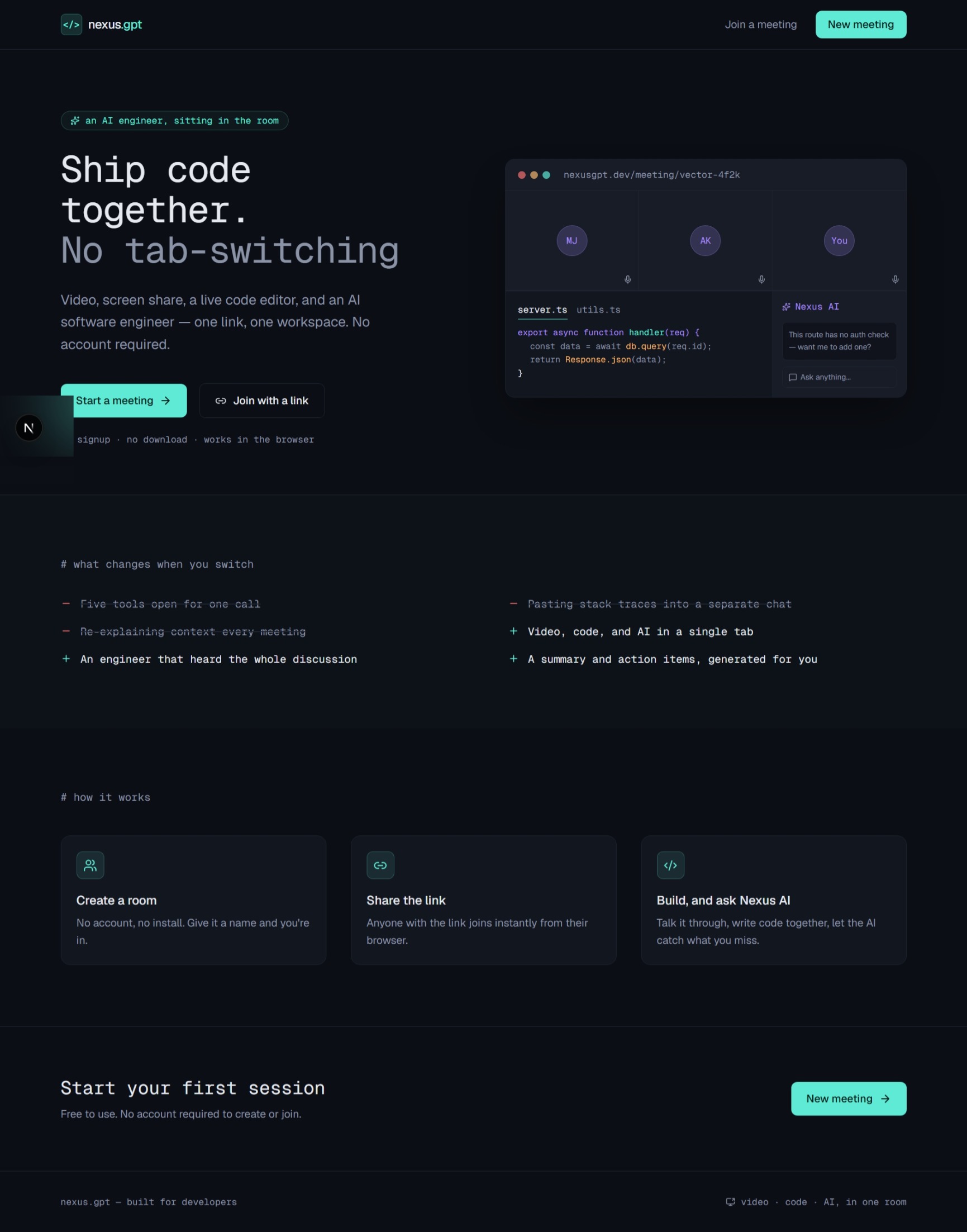
Inspiration
Software teams constantly switch between video calls, code editors, chat applications, documentation tools, and AI assistants while collaborating. This fragmented workflow slows development, causes important decisions to be forgotten, and leaves developers manually documenting meetings and tracking tasks. We wanted to build a workspace where collaboration and AI exist in one place. Instead of treating AI as a chatbot, we imagined it as a software engineer that actively participates in meetings, understands technical discussions, and helps developers build better software together.
What it does
Nexus GPT is an AI-native collaborative workspace built for developers. Users can instantly create or join meetings without creating an account, collaborate through audio and video calls, share their screens, chat, and edit code together in a real-time collaborative editor.
Nexus GPT joins every meeting as an AI software engineer. With participants' consent, it understands conversations, answers technical questions, explains code, generates code, reviews architecture, suggests improvements, and automatically captures technical decisions, action items, and meeting summaries. Hosts can optionally provide an email address to automatically receive a complete AI-generated meeting report after the session ends.
How we built it
We built Nexus GPT using Next.js, TypeScript, Tailwind CSS, WebRTC for real-time communication, Monaco Editor for collaborative coding, and modern real-time technologies for synchronization. GPT-5.6 powers the Nexus AI assistant, enabling contextual conversations, code understanding, meeting summaries, documentation generation, and developer assistance.
Throughout development, we used Codex to accelerate implementation by scaffolding components, generating boilerplate code, debugging issues, refactoring modules, and improving our development workflow while keeping full control over architectural decisions and product direction.
Challenges we ran into
One of the biggest challenges was designing an experience where AI feels like a real teammate instead of another chatbot. We also had to balance real-time collaboration, low-latency communication, and an intuitive user experience while ensuring the AI understood ongoing technical discussions without interrupting developers. Another challenge was designing the meeting workflow without requiring user accounts while still supporting private collaboration and post-meeting summaries.
Accomplishments that we're proud of
We're proud of creating a developer-first collaboration platform where AI actively participates instead of waiting for prompts. Nexus GPT can help developers during meetings, understand technical discussions, generate code explanations, extract tasks, summarize meetings, and improve team productivity—all within a single workspace. We're also proud of building a frictionless experience where users can start collaborating instantly through a simple shareable link.
What we learned
Building Nexus GPT taught us that the future of software development is collaborative and agentic. We learned how AI can become an active participant in engineering workflows instead of simply answering questions. We also gained valuable experience integrating real-time communication, collaborative editing, AI-powered reasoning, and modern developer tooling into one seamless platform.
What's next for Nexus GPT
Our roadmap includes GitHub integration, repository-aware AI assistance, pull request reviews, automated testing, CI/CD insights, deployment support, persistent workspaces, calendar integrations, issue tracking, project memory, multi-agent collaboration, and organization workspaces. Our long-term vision is to make Nexus GPT the AI-native operating system for modern software teams, where developers and intelligent AI agents build, review, and ship software together.
Built With
- ai
- gpt5.6
- next.js
- tailwind
- typescript
- webrtc


Log in or sign up for Devpost to join the conversation.