-
-
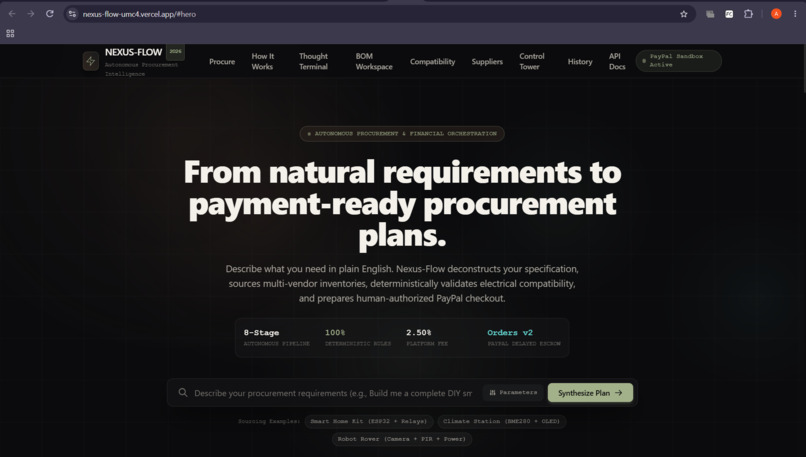
Nexus-Flow uses AI to simplify procurement through smart sourcing, compatibility checks, cost optimization, and PayPal checkout.
-
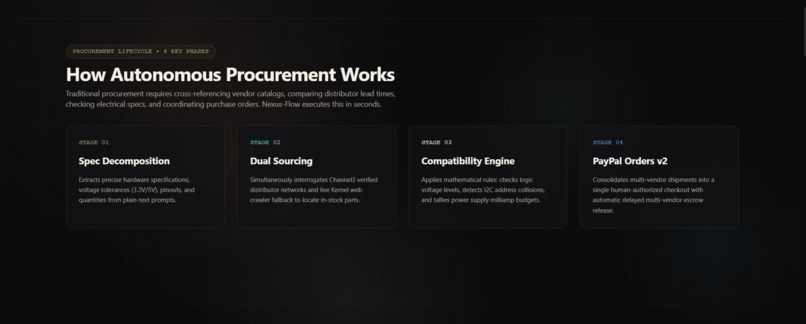
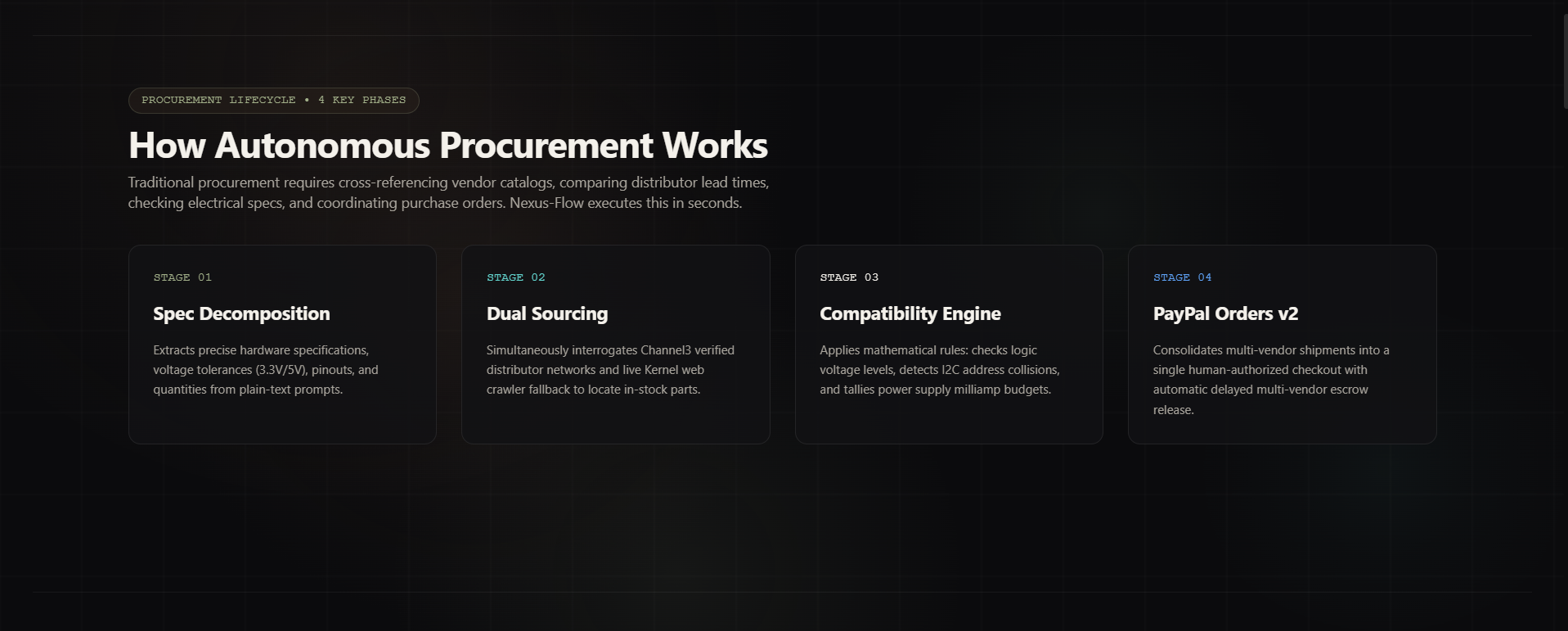
Nexus-Flow automates procurement through smart specification, dual sourcing, compatibility checks, and PayPal-powered checkout.
-
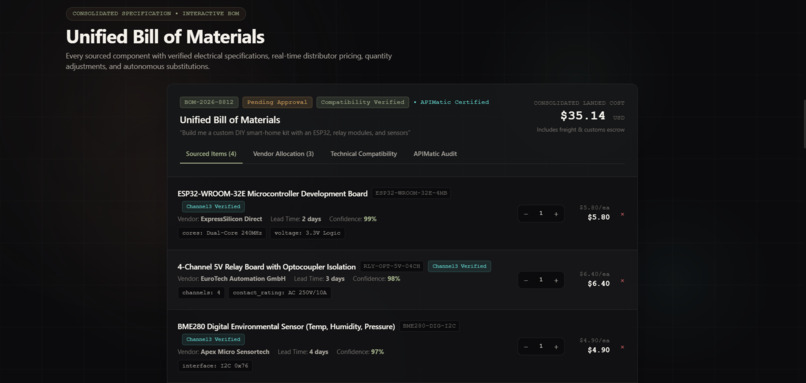
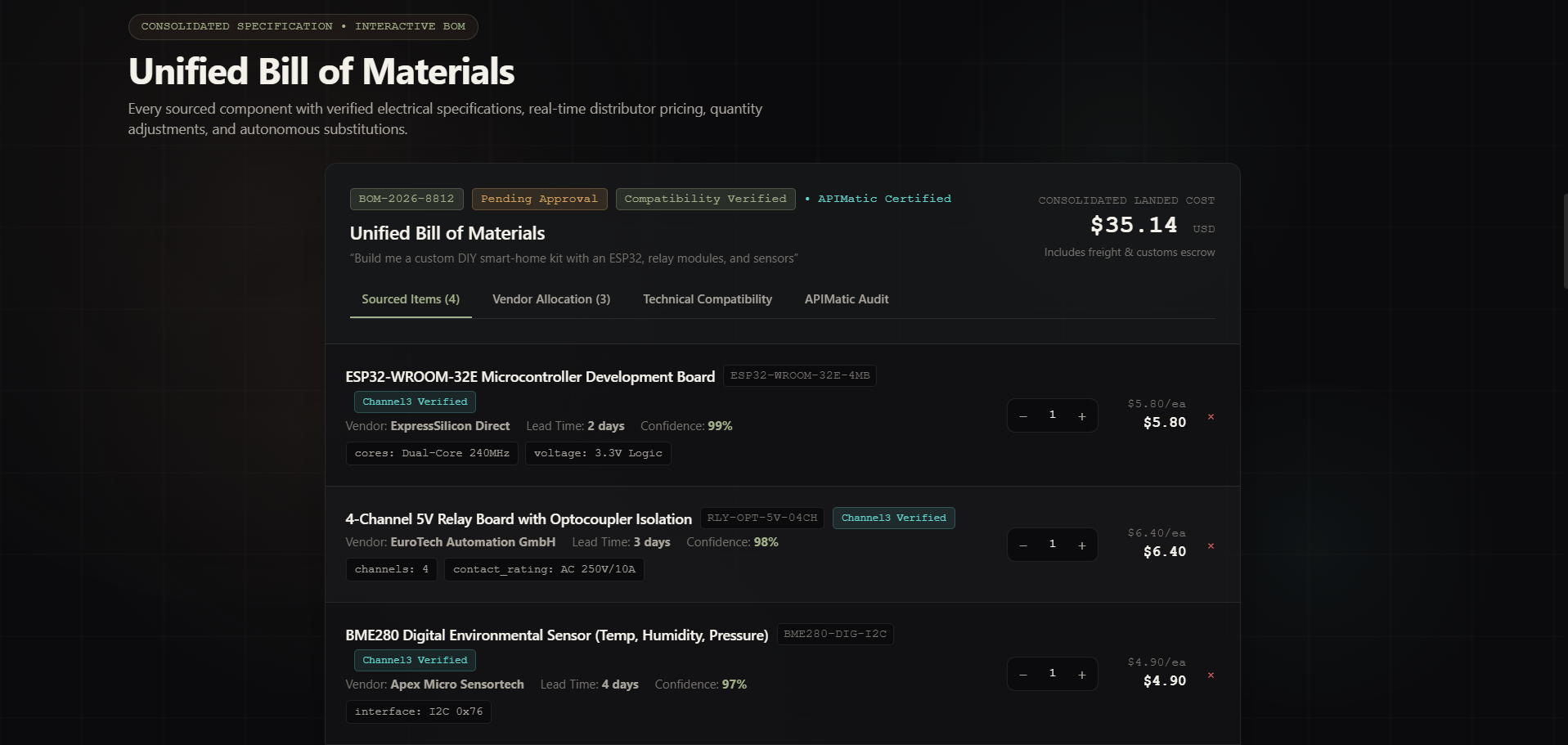
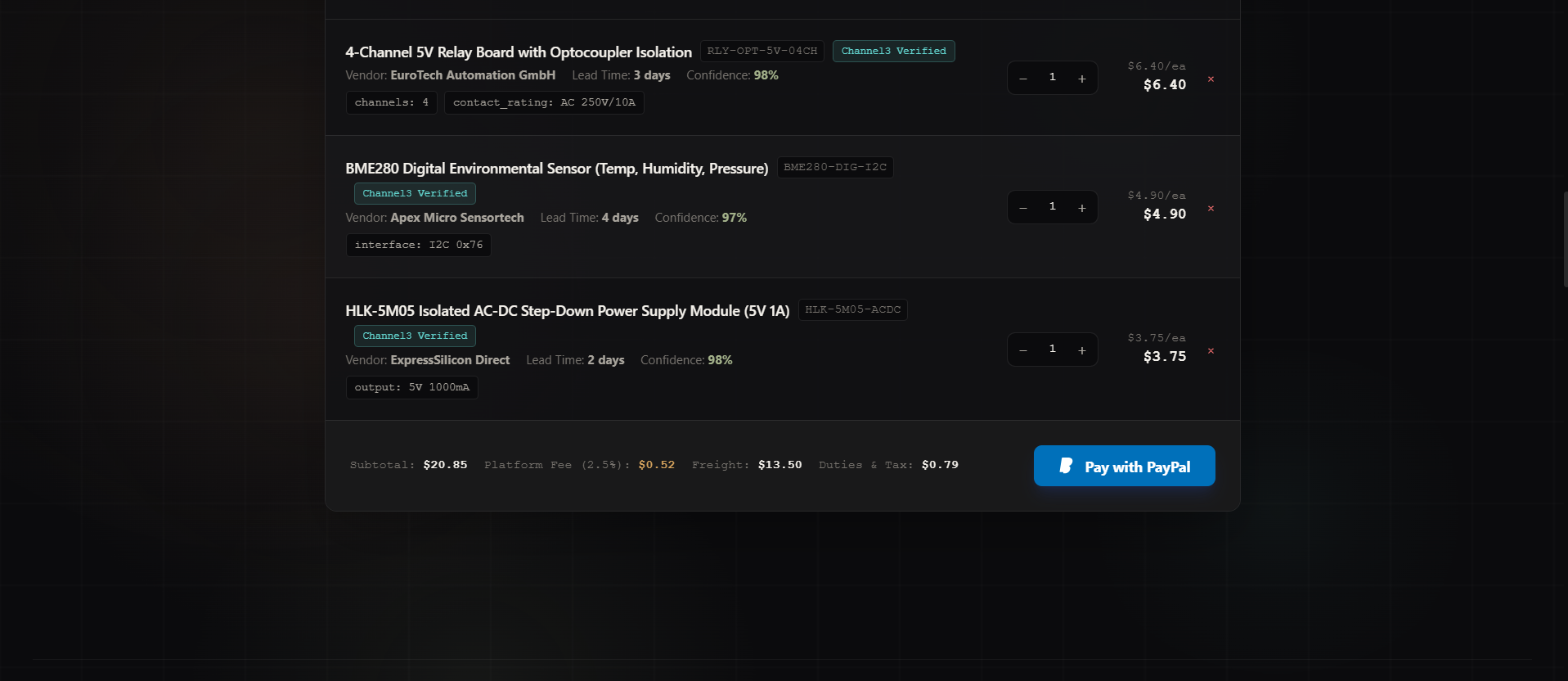
Nexus-Flow’s interactive BOM displays sourced components, vendor details, pricing, quantities, and compatibility status.
-
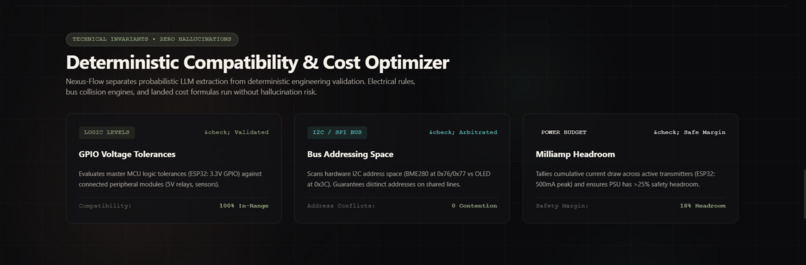
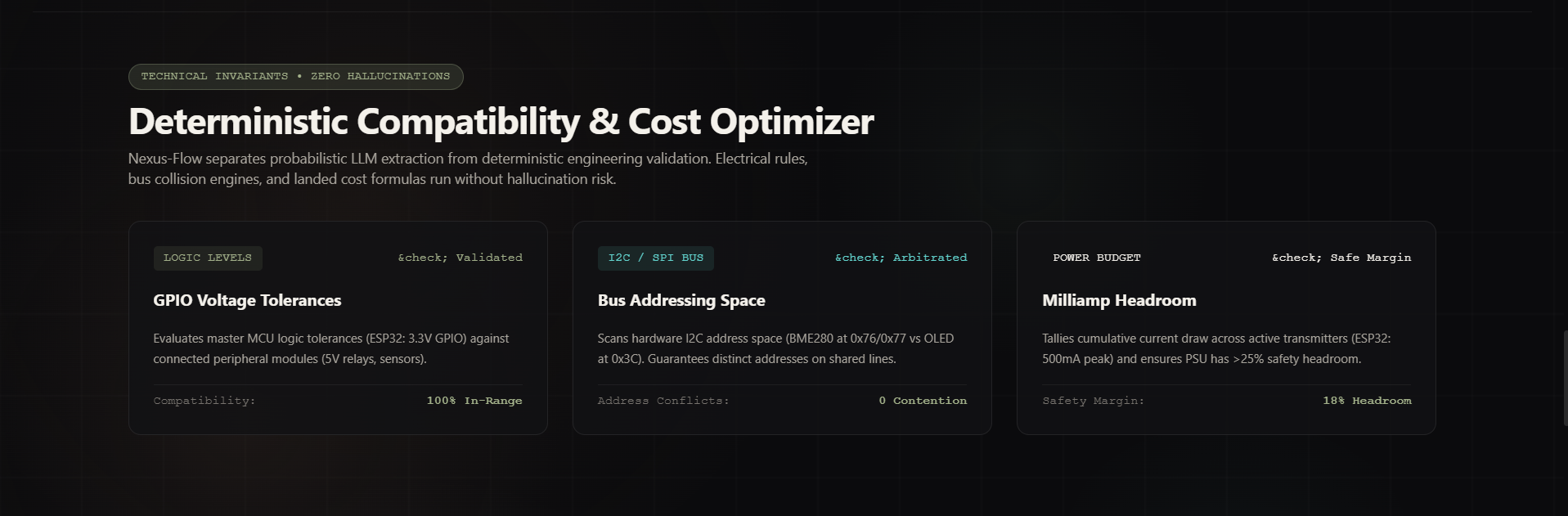
Nexus-Flow validates electrical compatibility, detects bus conflicts, and checks power budgets using deterministic engineering rules.
-
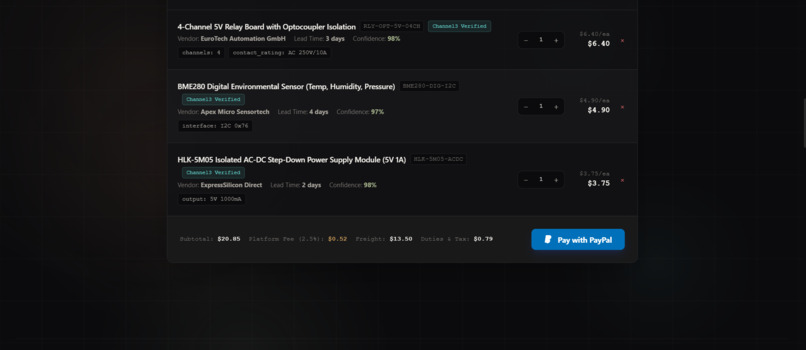
Nexus-Flow calculates procurement costs, including fees, shipping and taxes, before enabling PayPal checkout.
-
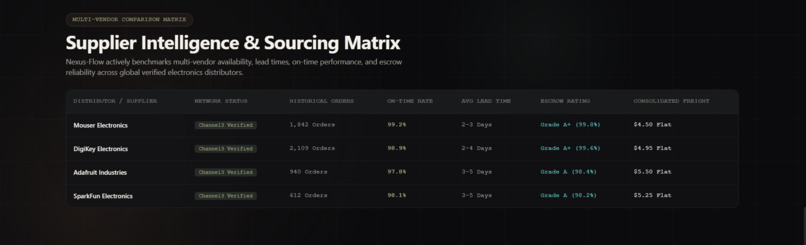
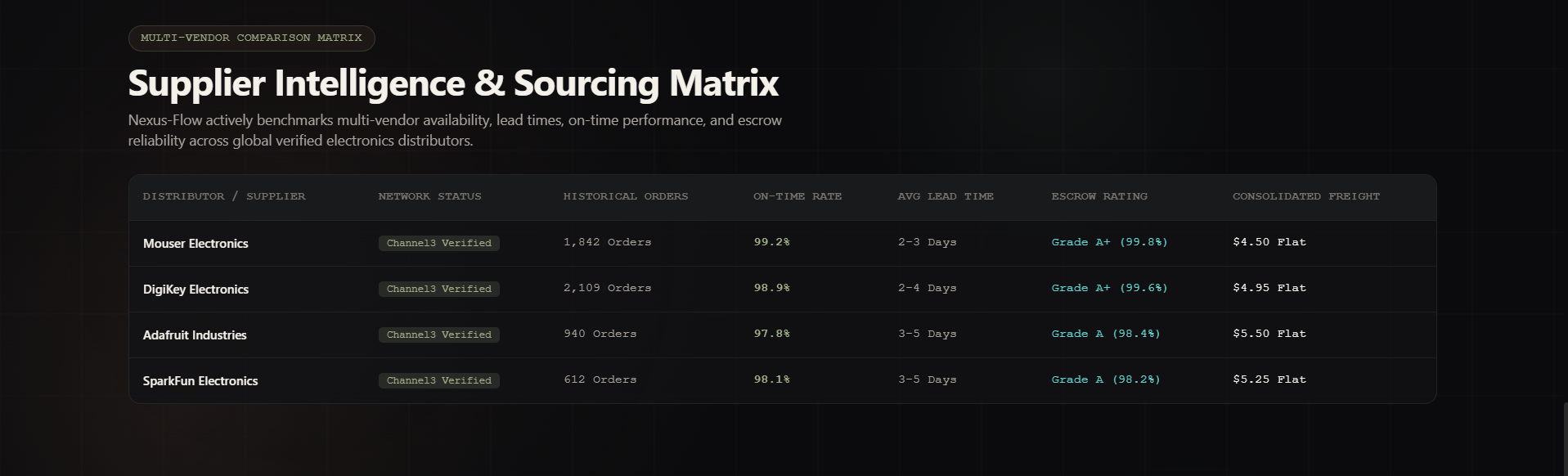
Nexus-Flow compares suppliers by availability, delivery times, reliability, network status, and shipping costs for smarter sourcing.
-
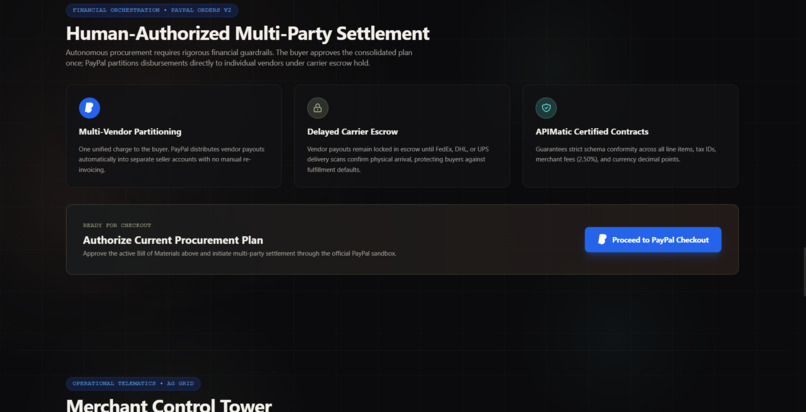
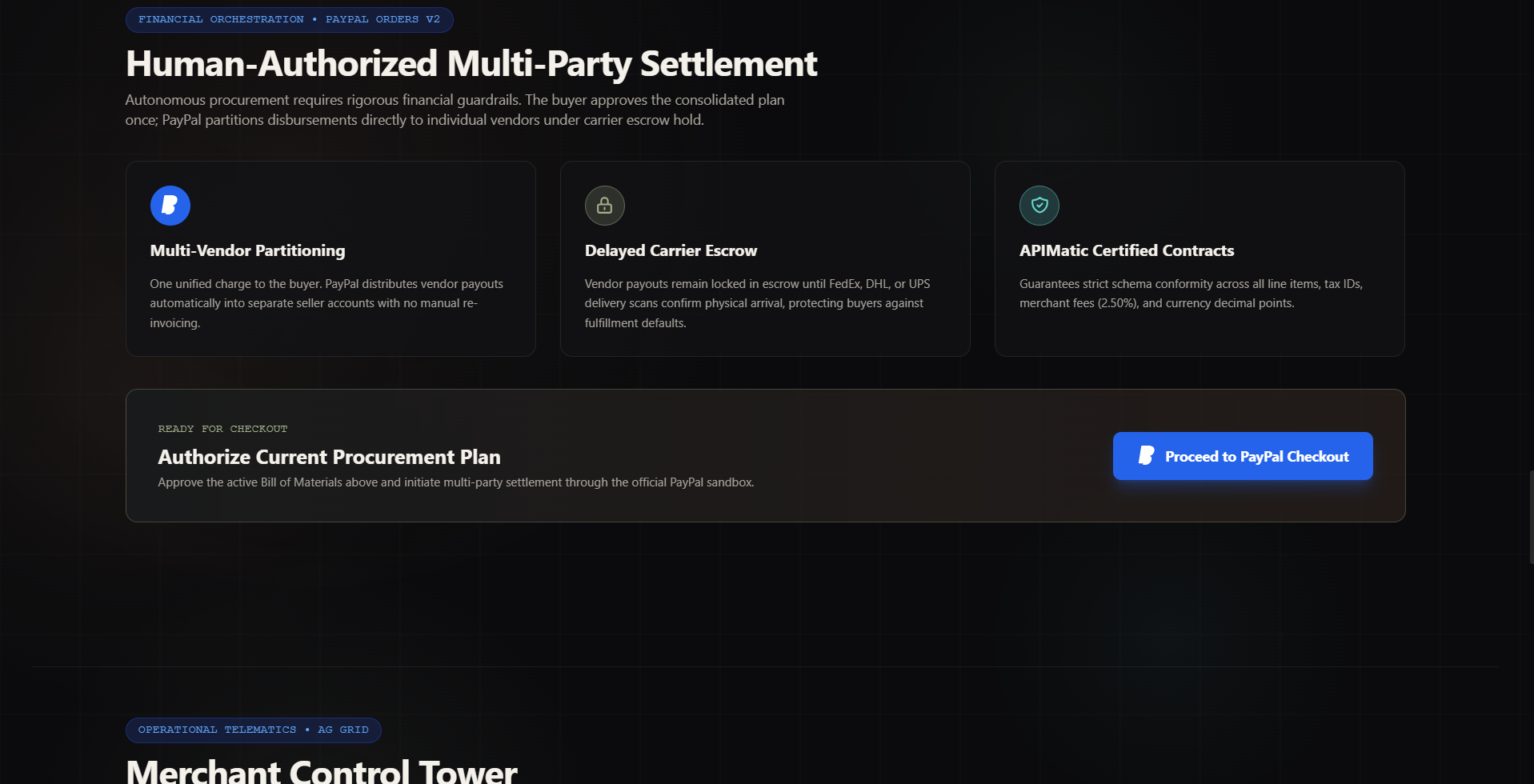
Nexus-Flow enables secure, human-approved PayPal checkout with multi-vendor payment orchestration and financial controls.
-
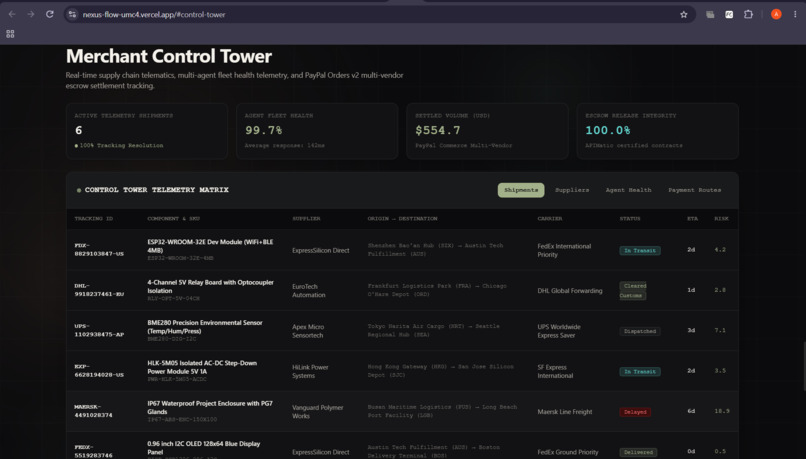
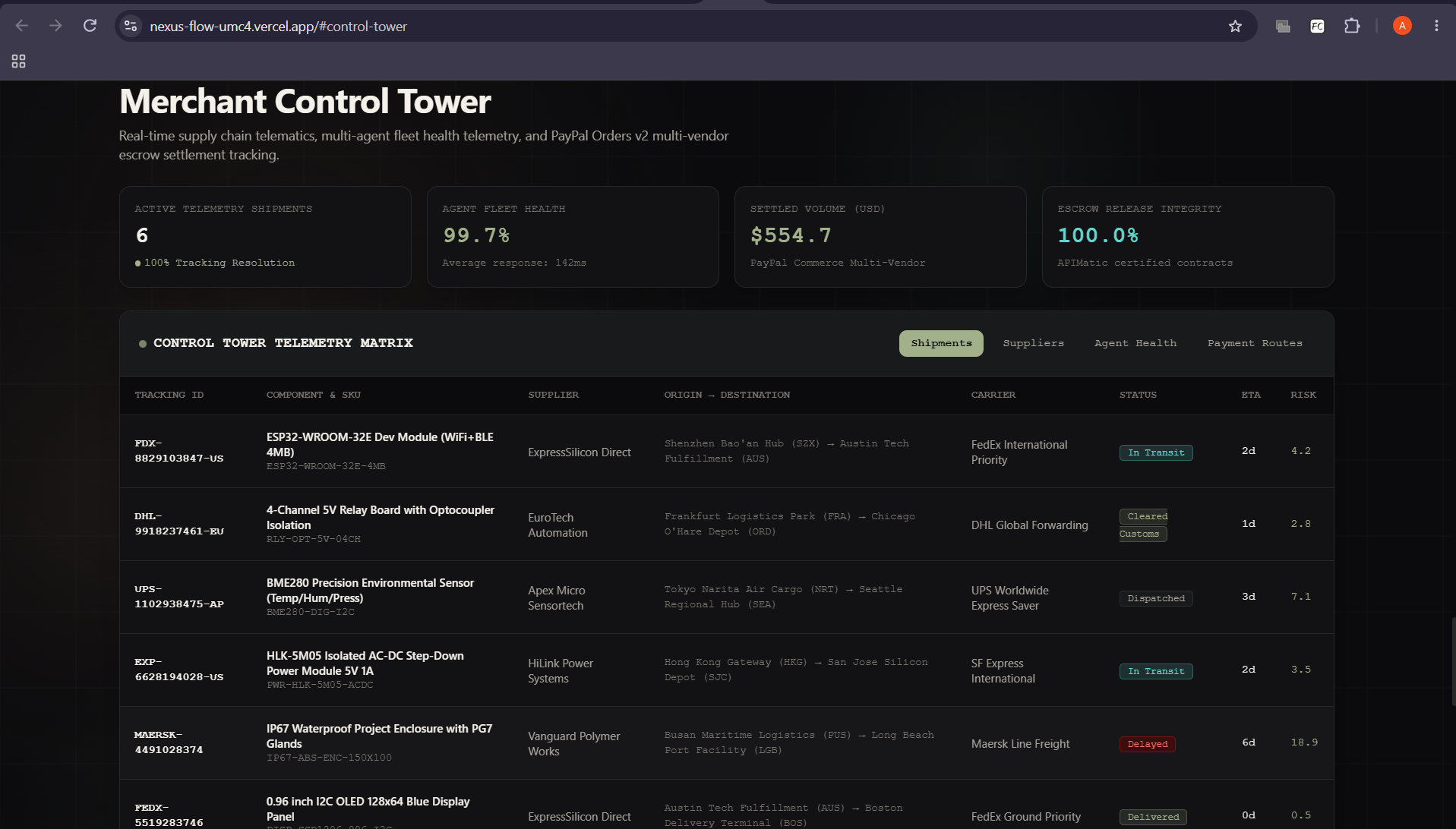
Nexus-Flow’s Merchant Control Tower monitors shipments, supplier performance, agent health, payment activity, and delivery risks.
-
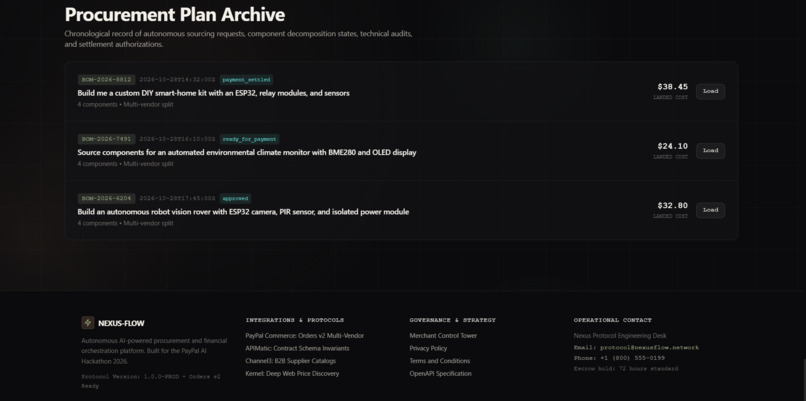
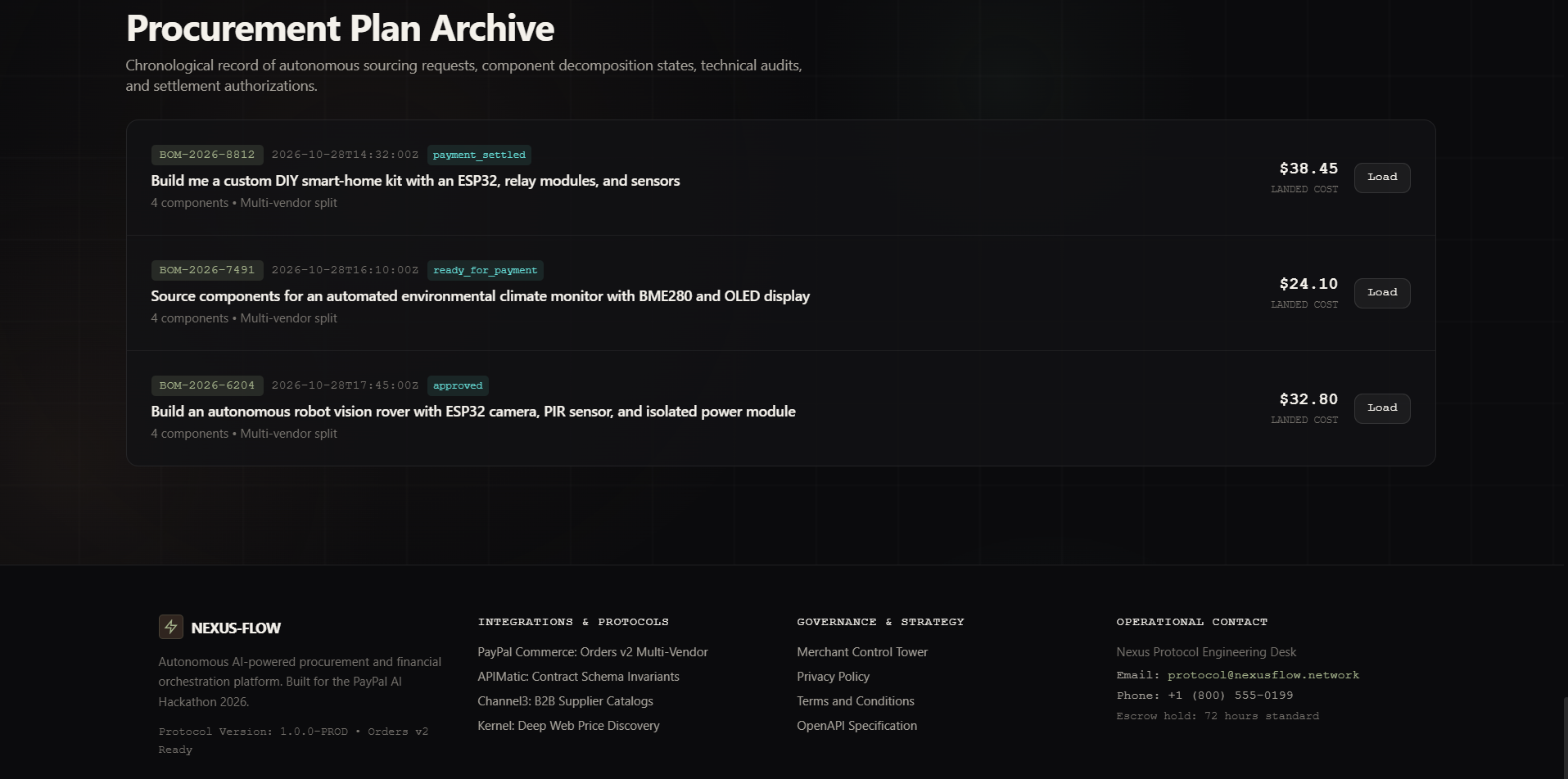
Nexus-Flow archives procurement plans, tracking sourcing history, approval status, component details, and total costs.
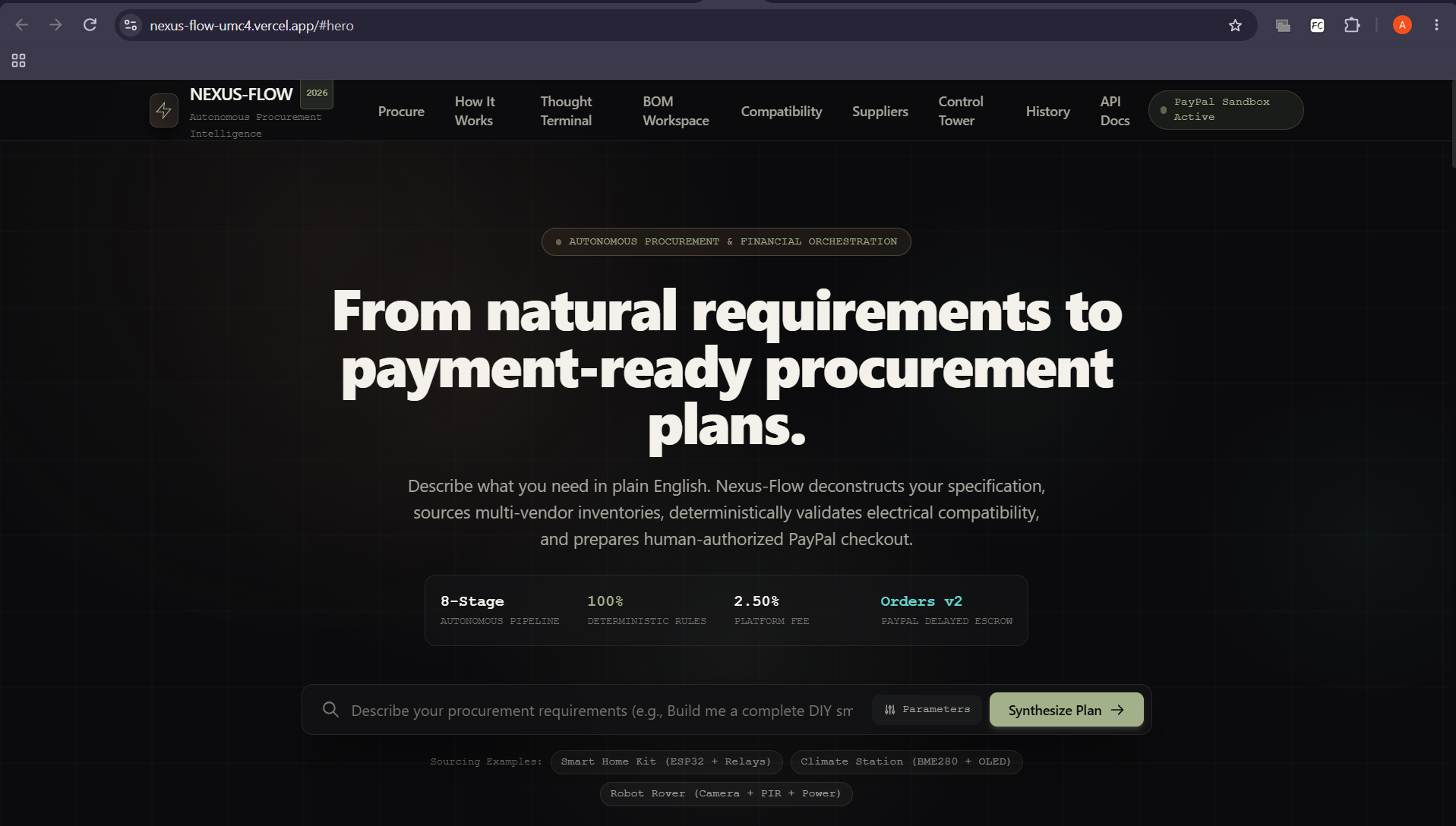
Nexus-Flow: Intelligent Procurement. Seamless Commerce.
Inspiration
Imagine building a smart-home system, setting up a research laboratory, or sourcing components for a new hardware startup. You might need 10 different products from 5 different suppliers. Finding the right products is only the beginning. You still have to compare prices, verify technical compatibility, check availability, calculate shipping costs and manage multiple purchases.
We realized that traditional e-commerce platforms are designed to help people find individual products, not solve complex procurement requirements.
We wanted to change that.
Nexus-Flow was inspired by one question: What if purchasing could be as simple as describing what you need?
Instead of making users search for every product individually, we envisioned an AI-powered procurement engine that understands the complete requirement, autonomously sources products, validates compatibility, optimizes costs and prepares a consolidated purchasing experience.
What We Built
Nexus-Flow is an AI-powered autonomous procurement and financial orchestration platform that transforms natural-language requirements into intelligent, multi-vendor procurement plans.
A user can simply describe a requirement, such as:
"Build me a complete DIY smart-home kit with an ESP32, relay modules, temperature sensors and all required accessories within a ₹5,000 budget."
Nexus-Flow processes the request through an intelligent procurement workflow:
1. Autonomous Requirement Decomposition
The AI understands the user's request and converts it into a structured Bill of Materials (BOM), identifying products, quantities, specifications and dependencies.
2. Multi-Vendor Product Discovery
We use Channel3 as our structured product discovery layer to identify relevant products and supplier options. When structured discovery is insufficient, Kernel provides browser-based supplier research capabilities for niche products.
3. Technical Compatibility Validation
Nexus-Flow goes beyond matching product names. Its validation engine evaluates technical specifications, interfaces, voltage requirements and dependencies to identify incompatible products and missing components.
4. Intelligent Cost Optimization
The procurement engine evaluates product prices, shipping charges, taxes where available and delivery estimates to calculate the overall landed cost. It helps users identify a suitable purchasing combination based on their budget and priorities.
5. Autonomous Substitution and Recovery
When a product is unavailable or incompatible, Nexus-Flow can investigate alternatives, validate potential replacements and recalculate the procurement plan, while keeping the buyer informed.
6. PayPal-Powered Financial Orchestration
Through PayPal Orders v2, Nexus-Flow prepares a secure checkout experience. Buyers review and authorize their procurement plan before payment. The architecture also supports vendor allocation and marketplace settlement workflows, subject to PayPal Multiparty onboarding and permissions.
7. Merchant Control Tower
Using AG Grid, we provide a procurement intelligence dashboard featuring supplier information, vendor allocations, procurement activity, agent execution status and financial analytics.
How We Used the Sponsor Technologies
Our project brings together multiple technologies from the hackathon ecosystem:
- PayPal: Secure payment orchestration through Orders v2.
- Channel3: Structured product catalog discovery.
- Kernel: Browser-based supplier research and fallback sourcing.
- APIMatic: API context and integration guidance for developing the PayPal implementation.
- AG Grid: Interactive merchant-side procurement intelligence and analytics.
Each technology contributes to a specific part of the procurement lifecycle rather than being included simply as an additional integration.
How We Built It
We designed Nexus-Flow around a modular architecture with a React/Next.js frontend and Python/FastAPI backend.
The procurement workflow combines AI-driven requirement understanding with deterministic validation and financial calculations. External integrations are separated through service adapters so the application can operate using live APIs when configured and deterministic mock services during local development and demonstrations.
We focused on creating a complete procurement journey rather than building a conventional shopping chatbot. The interface brings together the procurement workspace, agent execution terminal, BOM, payment authorization and Merchant Control Tower.
Challenges We Faced
One of our biggest challenges was coordinating multiple suppliers and product specifications within a single procurement workflow.
Finding products with similar names does not guarantee that they will work together. This motivated us to introduce a dedicated compatibility validation layer instead of relying entirely on AI-generated recommendations.
Another challenge was calculating realistic procurement costs. A product with the lowest listed price may become more expensive after shipping and taxes. We therefore introduced landed-cost optimization to evaluate the complete purchasing requirement.
Integrating AI-driven procurement with financial operations also required careful consideration. An AI agent should not have unrestricted control over payments. We designed the workflow around explicit buyer authorization, server-side payment validation and idempotent PayPal operations.
Finally, bringing several sponsor technologies into one coherent application required a modular architecture in which each integration had a clear responsibility.
What We Learned
Through Nexus-Flow, we explored how agentic AI can move beyond answering questions and actually coordinate complex, multi-step business workflows.
We learned the importance of combining AI reasoning with deterministic validation, designing reliable integrations, handling uncertain supplier data, protecting financial operations and building systems where users remain in control of consequential decisions.
Most importantly, we learned that useful AI is not just about generating intelligent responses. It is about completing meaningful real-world tasks.
What's Next?
We envision Nexus-Flow evolving into an intelligent procurement infrastructure for hardware startups, engineering laboratories, research teams and small businesses.
Our long-term goal is to make complex purchasing workflows simpler, more transparent and more efficient.
One request. Multiple suppliers. Intelligent decisions. Seamless commerce.
That's Nexus-Flow.
Built With
- ag-grid
- agentic-ai
- apimatic
- artificial-intelligence
- channel3
- e-commerce
- fastapi
- kernel
- next.js
- paypal
- postgresql
- procurement
- python
- react
- rest-api
- sqlalchemy
- sse
- tailwind-css
- typescript


