
NEXUS Infrastructure that remembers, predicts, heals — and evolves. Operational knowledge with a family tree: playbooks that are born, compete by Thompson sampling, mutate from their own failure, promote or retire by Darwinian selection.
Inspiration
Every production incident generates knowledge, and almost all of it evaporates. The next person to see the same failure re-derives the same fix from scratch when it reoccurs after a few months.
The obvious response is "give the agent memory". But almost everything shipped under that name is a transcript: text retrieved to condition a generation, where a language model does the deciding, and the database is a filing cabinet. That design has three properties we did not want:
- It cannot be wrong in a measurable way. If the model's answer is judged by another model, there is no number to argue with.
- It cannot prove what it knew. Ask, "what evidence did you have at 04:12?" and a The transcript store cannot answer because the store has been written to since.
- It does not improve. Adding documents is not learning. Nothing is ever retired.
So we inverted it. In NEXUS a telemetry trajectory is embedded and matched against the trajectories of past incidents, and the k nearest neighbours' outcomes are the parameters of a Beta posterior. That posterior decides whether to predict, whether to act, and which remediation gets the turn. No language model appears anywhere in that path. It appears in exactly three places, all of them authoring a new playbook genome: birth, mutation, merge.
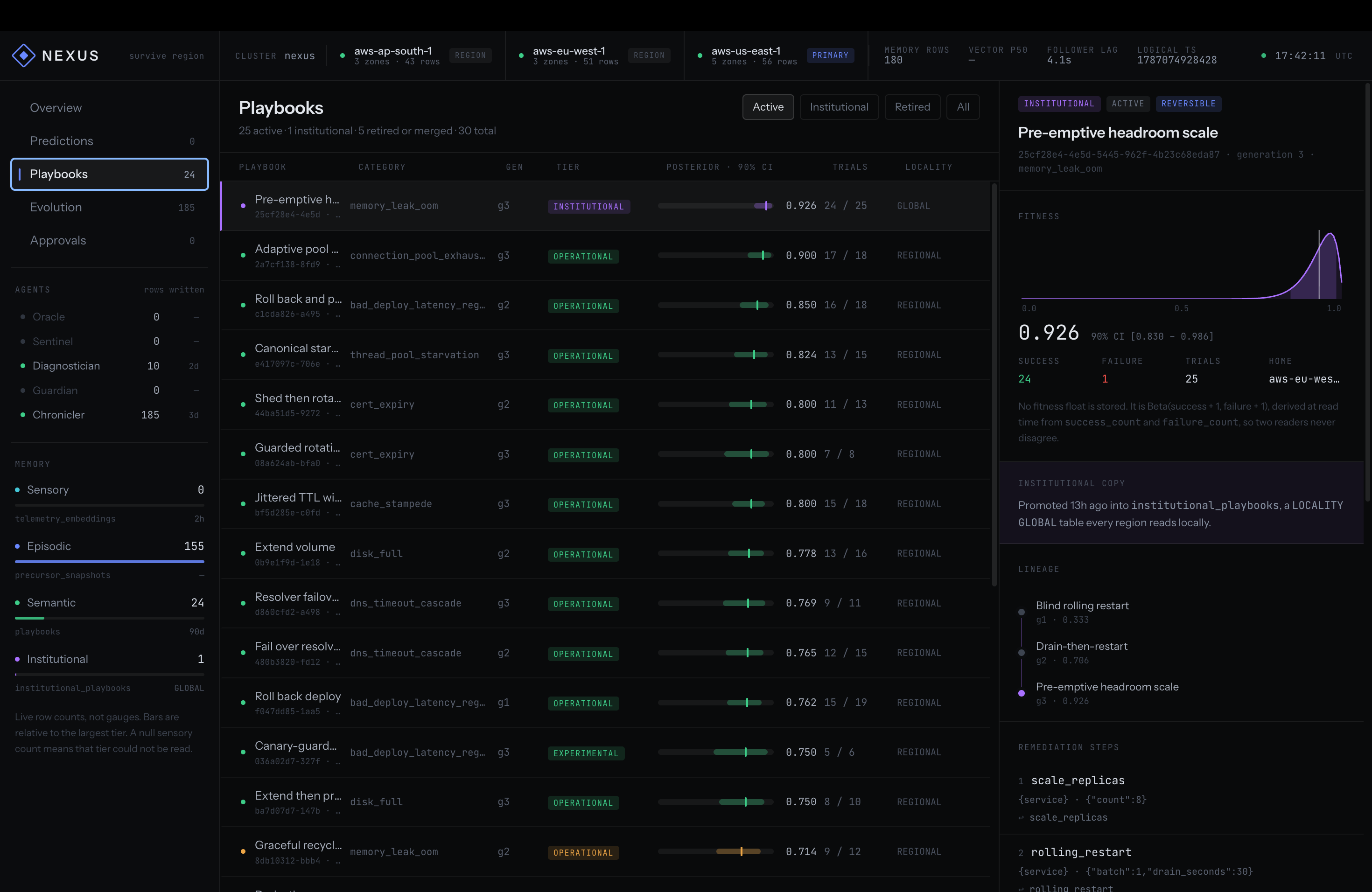
Once memory is a population of competing strategies with measurable fitness rather than a pile of documents, the biological framing stops being a metaphor and starts being the implementation. Playbooks acquire a family tree. Selection has to give newborns a turn or they die untested. Failure has to breed. Convergent siblings have to merge. Proven doctrine has to be promoted somewhere every region can read it locally. And a strategy that keeps losing has to be retired — after breeding on the way down, which turns out to be the entire point of the mechanism.
That is a database problem before it is an AI problem, and it is the reason the whole thing is built on CockroachDB rather than on a vector store bolted to Postgres. Four capabilities are load-bearing, and only one of them is vector search:
| Capability | What it makes possible |
|---|---|
| Distributed vector indexing | k-NN over trajectories inside the transactional store — no consistency gap between the vectors and the rows they describe |
AS OF SYSTEM TIME |
Provenance replay for free out of MVCC—no audit table, no snapshot copies, no write amplification |
| Serializable isolation | SELECT … FOR UPDATE is a correct claim protocol against at-least-once delivery, not an optimistic guess |
REGIONAL BY ROW + LOCALITY GLOBAL |
Each incident homed where it was observed; promoted doctrine in every region's local read path |
What it does
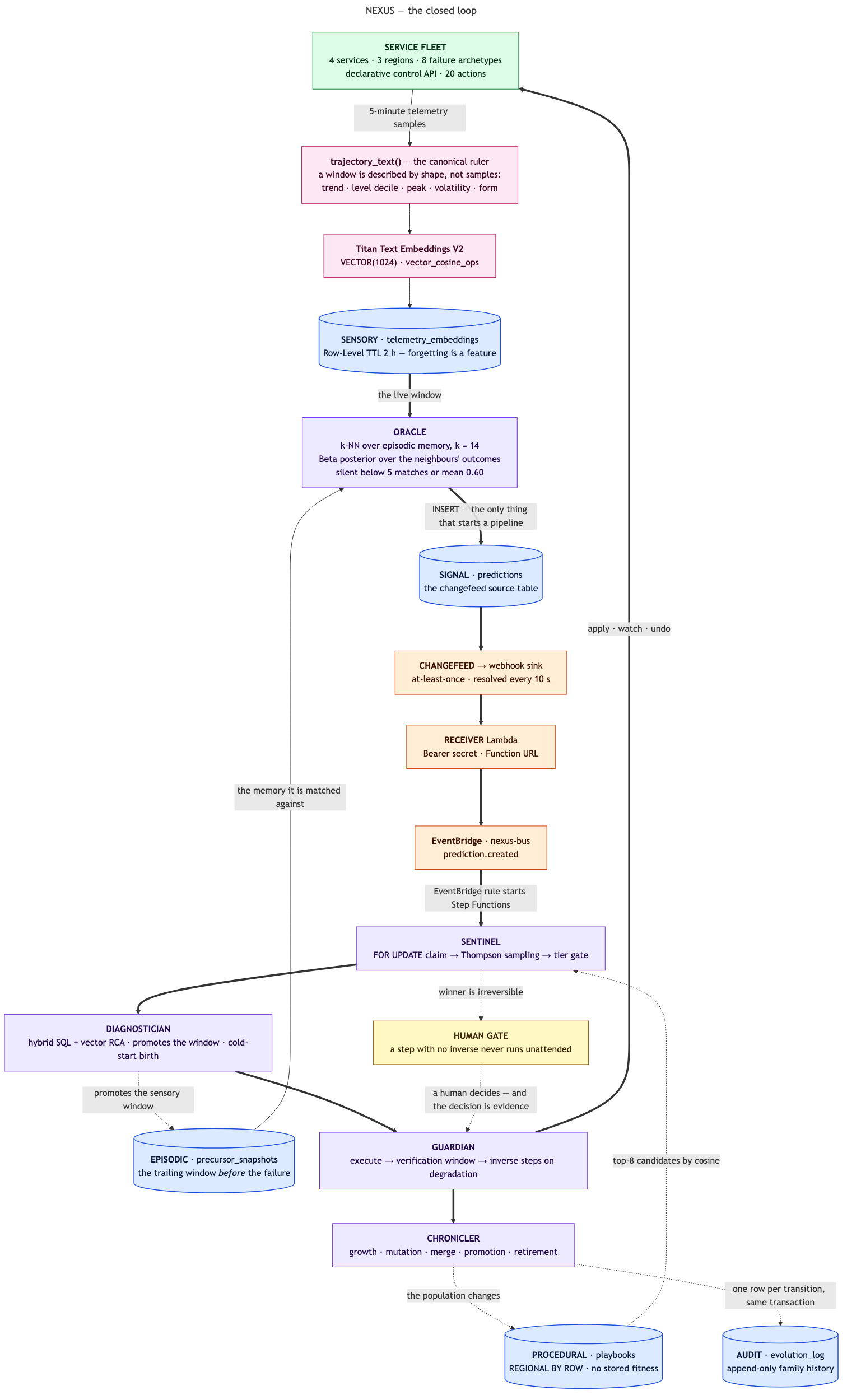
NEXUS watches a fleet and predicts failures before they happen from the shape of the telemetry leading up to them, applies a remediation drawn from an evolving population of playbooks, verifies the result, rolls back if it made things worse, and writes what happened back into the memory that made the next decision better.
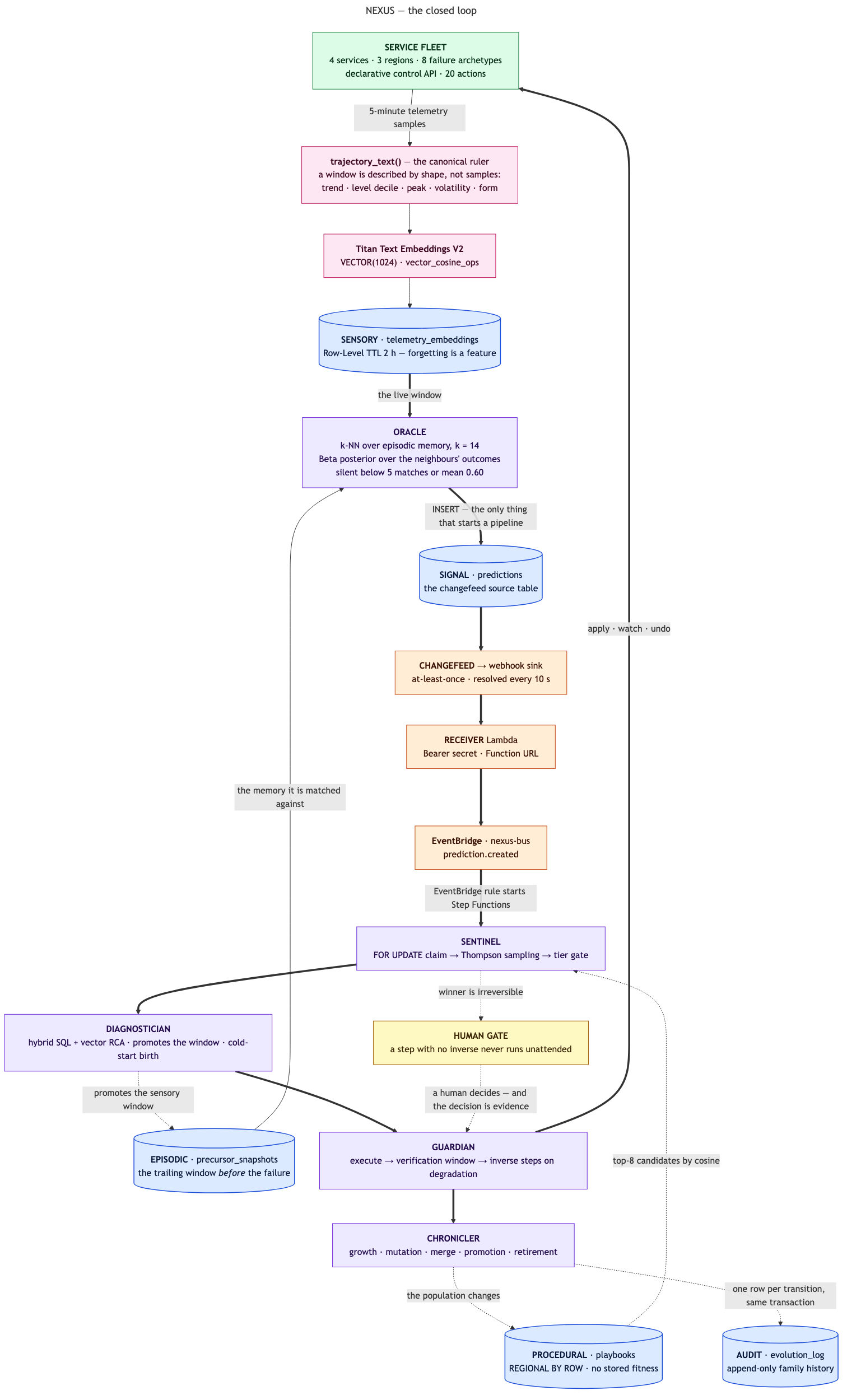
Telemetry becomes a vector, the vector becomes a prediction, the prediction becomes a changefeed event, the event becomes a pipeline — and the pipeline acts on the fleet that produced the telemetry.
The six things it actually does
1 · It predicts with a posterior, not a score. Confidence is a Beta distribution over the matched neighbours' outcomes, and both parameters are stored, so "3 of 3 neighbours agree" never collapses into the same number as "30 of 30 agree." The credible interval survives all the way to the UI.
2 · It can prove what it knew. Every prediction records its own commit timestamp inside the transaction that wrote it. The replay pins to that timestamp. The live pane disagrees — because Diagnostician later promoted the very window the prediction was about — and the posterior is unchanged. That disagreement is the proof: the conclusion did not depend on anything learned afterwards.
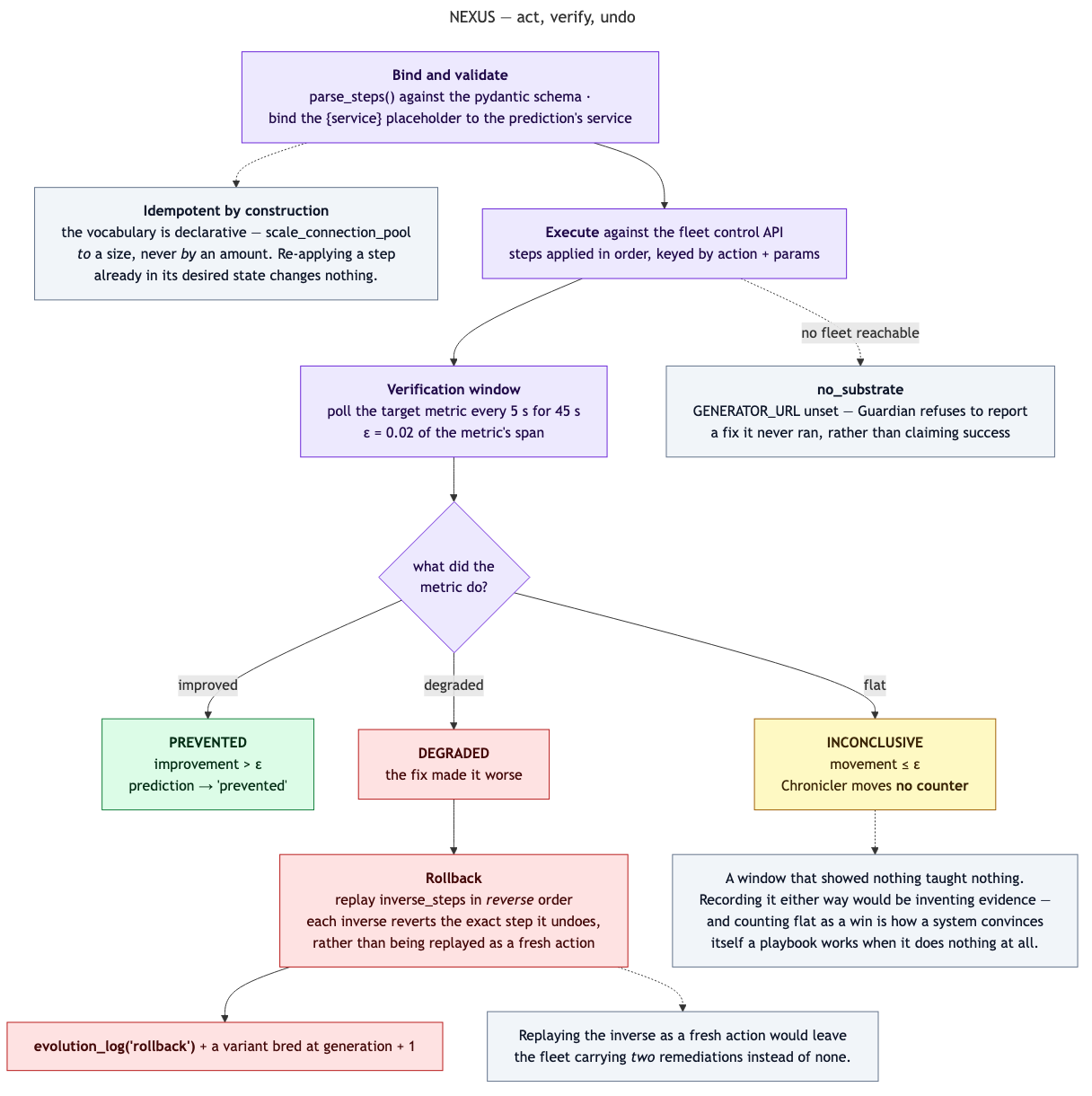
3 · It acts, and it can take the action back. The action vocabulary is closed and declarative: 20 actions, validated by pydantic before anything runs. Every step declares its inverse. Guardian watches the target metric for a verification window and, on degradation, replays each inverse against the exact step it undoes.
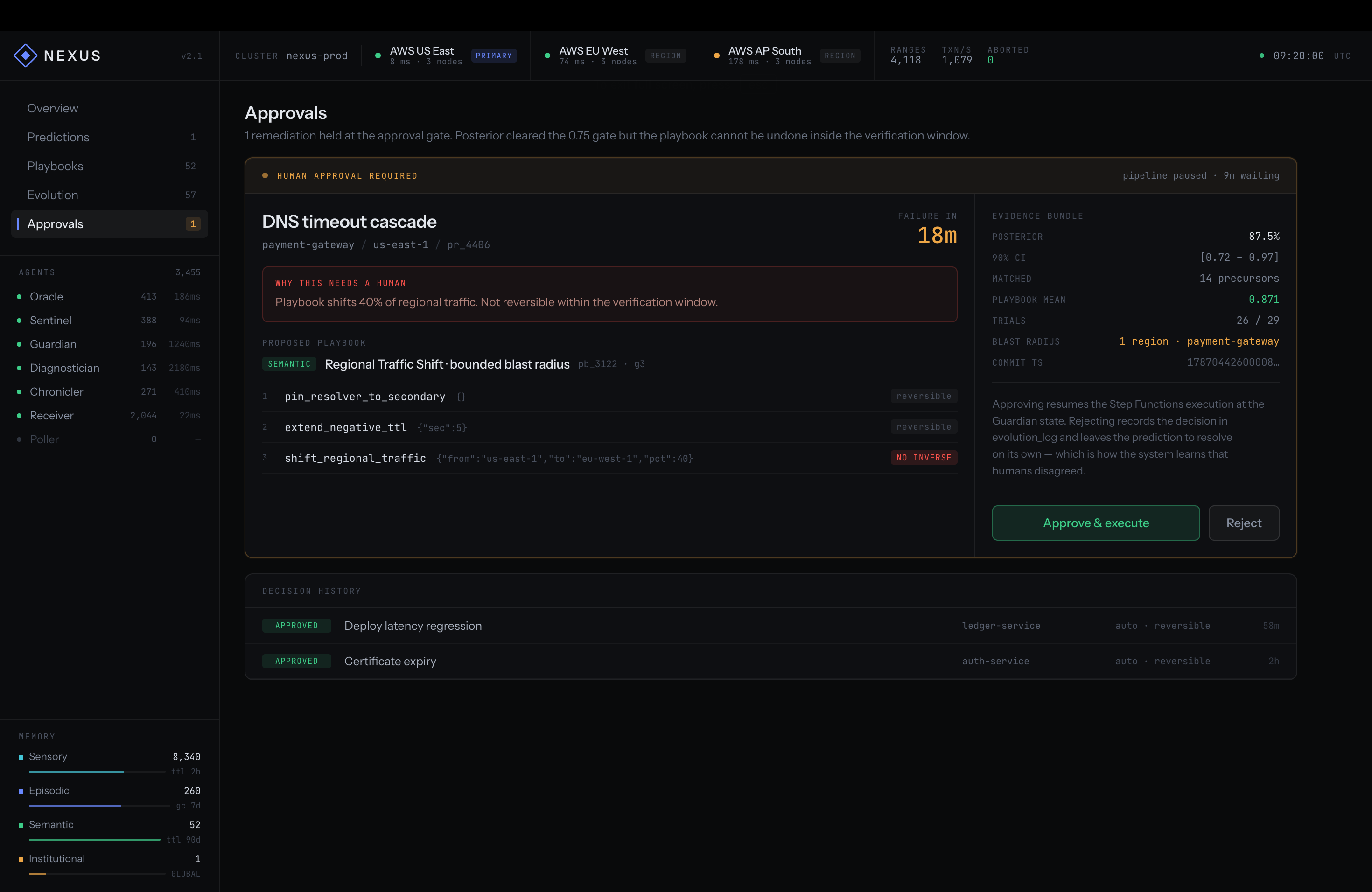
4 · It knows when it must ask a human.
Two of the twenty actions — rotate_certificate, prune_disk — have no inverse. A playbook
containing either is not reversible, and that is a property of the data, not a branch
someone remembered to write. Those never run unattended; they park at an approval gate. And
a human's rejection is not discarded — it becomes a shadow record, scored against whatever
actually happens.
5 · Its memory evolves — including dying.
Thompson sampling rather than argmax, so a zero-trial challenger gets a turn. Failure breeds
a variant. Convergent siblings merge into one canonical child. Proven doctrine is promoted
into a GLOBAL table. Losers retire.
6 · It tells you when it does not know.
"Flat" is reported as inconclusive, never as success. An unreachable model produces "no
proposal produced," never an invented playbook. An unreachable fleet produces
no_substrate, never a fix that was not run.
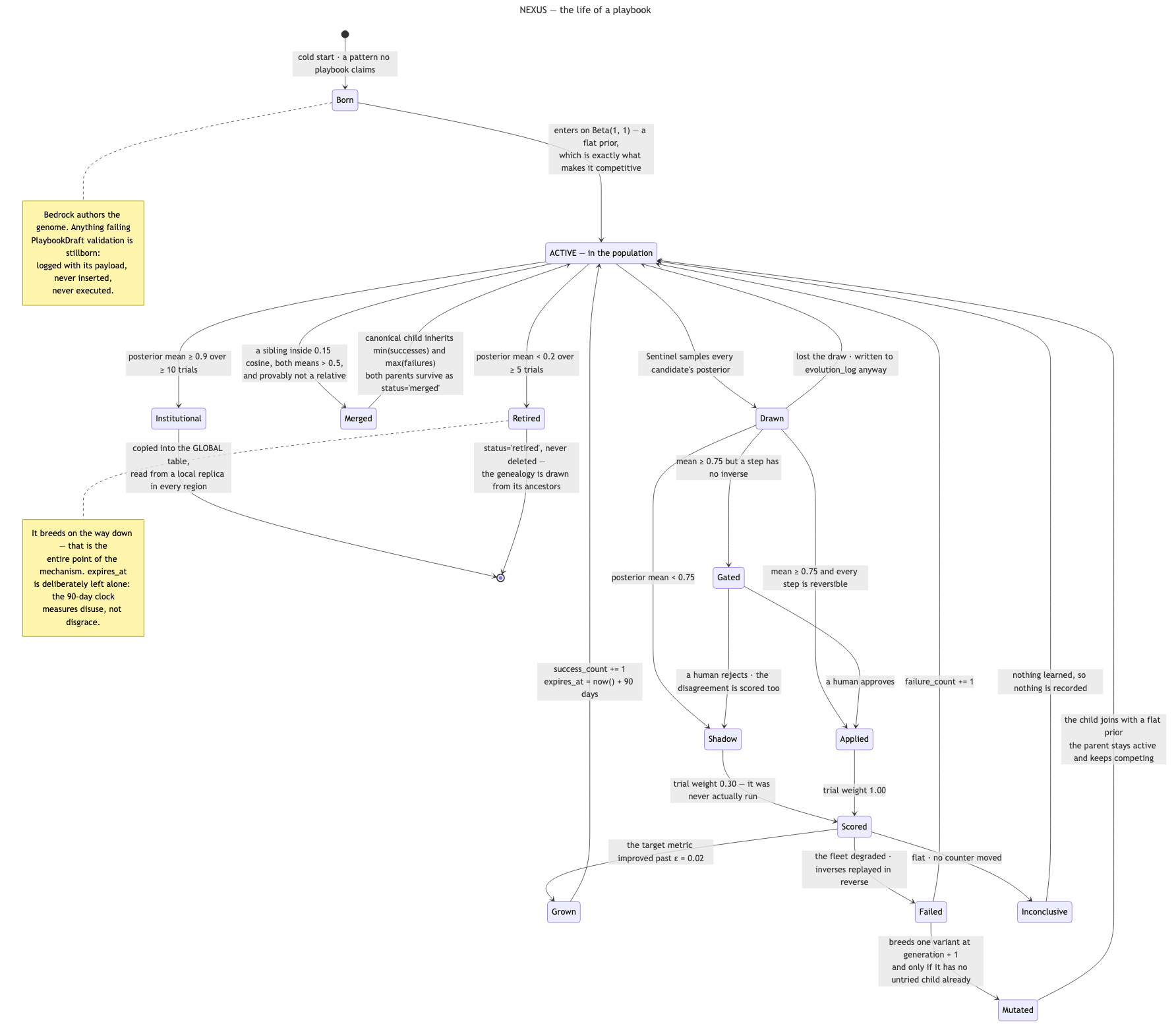
Birth, selection, the tier gate, growth, mutation on failure, merge, promotion into doctrine, and retirement — which still breeds on the way down.
The memory, concretely
Four tiers, four tables, four different lifetimes — and something in the database, not in application code, enforces every one of them:
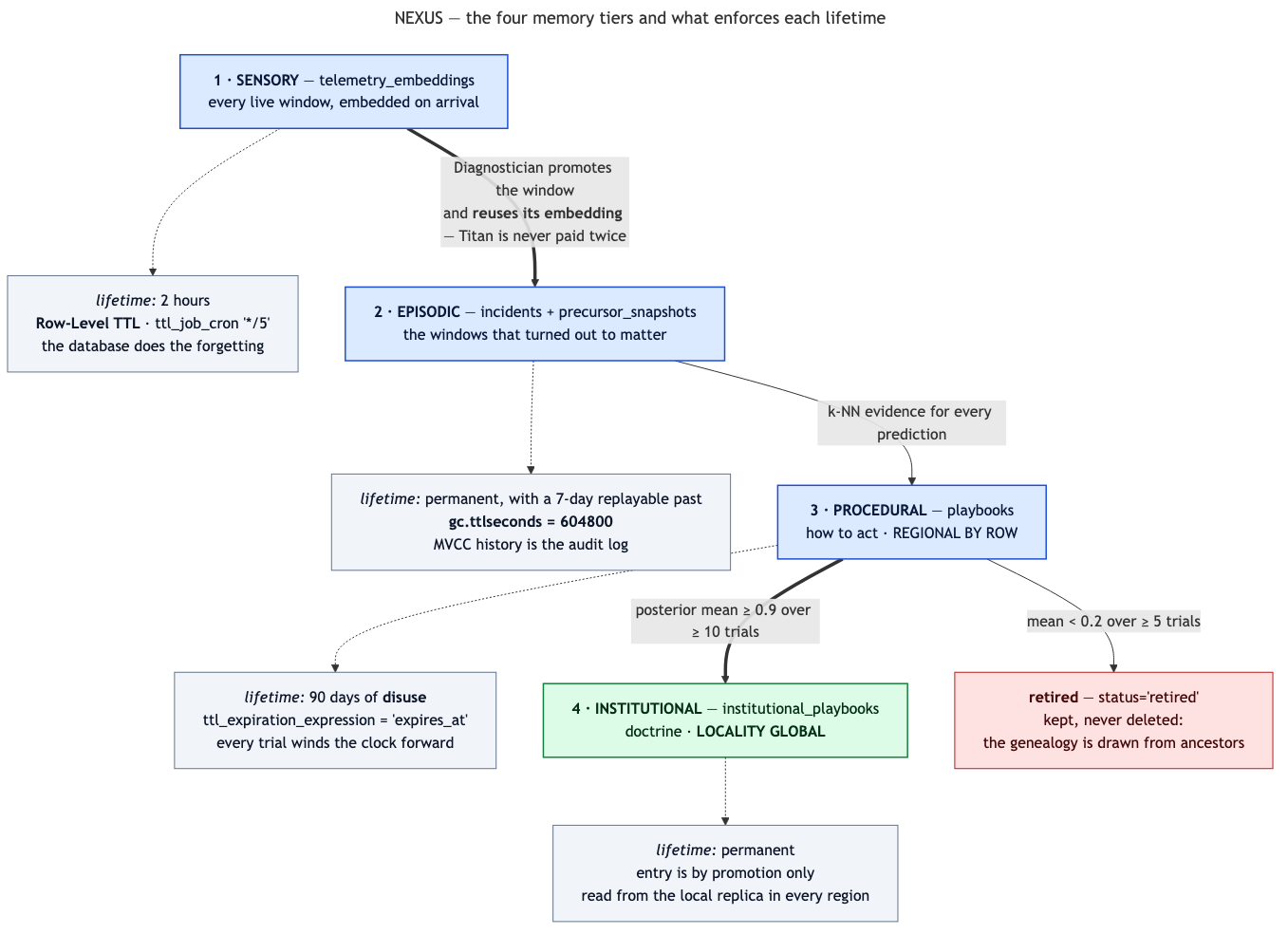
Four tiers, four lifetimes — and in every case the lifetime is enforced by the database, not by application code.
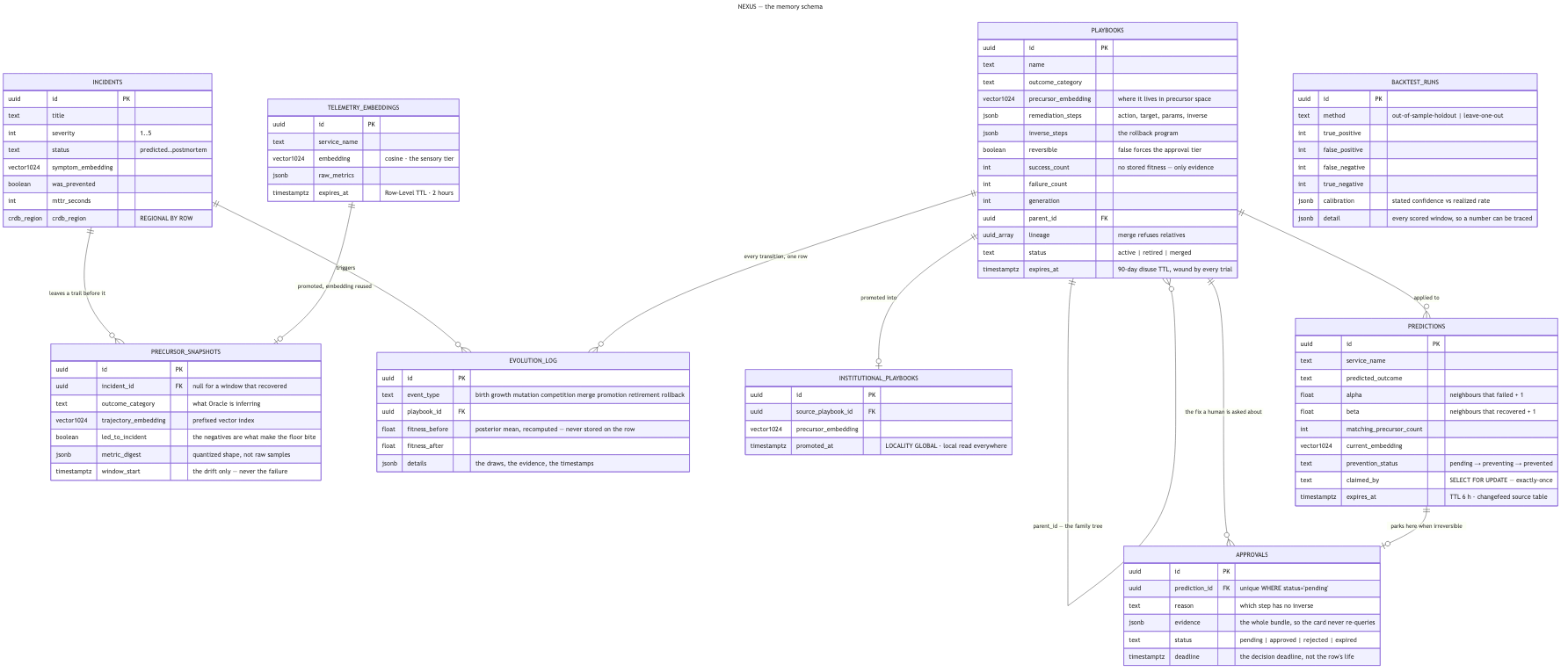
Nine tables. Note what is absent: playbooks has no fitness column, because fitness is recomputed from the trial counters at read time and can never drift from the evidence it came from.
Plus a signal table (predictions, whose changefeed drives the entire pipeline), an
append-only evolution_log, an approvals queue, and a backtest_runs table that stores
the honesty numbers rather than recomputing them.
How we built it
The mathematics
Oracle embeds the live telemetry window and retrieves its \(k\) nearest neighbours from episodic memory under a similarity floor. Let \(N_k\) be the retrieved set. Then:
$$ \alpha = \bigl|{n \in N_k : \text{led to an incident}}\bigr| + 1 \qquad \beta = \bigl|{n \in N_k : \text{recovered on its own}}\bigr| + 1 $$
$$ p \sim \mathrm{Beta}(\alpha, \beta), \qquad \mathbb{E}[p] = \frac{\alpha}{\alpha + \beta} $$
with \(k = 14\), a cosine-similarity floor of \(0.72\), and an emit gate that stays silent unless at least 5 neighbours clear the floor and \(\mathbb{E}[p] \ge 0.60\). Both parameters are persisted, so any consumer downstream recomputes the credible interval rather than trusting a number somebody else already collapsed.
Selection is a contextual bandit, not a leaderboard. For each candidate playbook \(i\) with \(s_i\) successes, \(f_i\) failures and cosine similarity \(\sigma_i\) to the precursor pattern:
$$ \theta_i \sim \mathrm{Beta}(s_i + 1,\; f_i + 1) \qquad \text{winner} = \arg\max_i \; \theta_i \cdot \sigma_i $$
The sampling is the whole point. Argmax over a fitness score is a leaderboard, and a leaderboard means a newborn playbook is never selected, never gathers evidence, and dies by TTL. Drawing from the posterior lets a zero-trial challenger on a flat prior beat a 0.9 incumbent's draw roughly one time in ten — which is exactly often enough to earn a trial.
Fitness is never stored. It is recomputed from success_count and failure_count at
read time, so there is no cached float that can drift away from the evidence it came from.
When two convergent siblings merge, the canonical child inherits
$$ s_{\text{child}} = \min_j s_j, \qquad f_{\text{child}} = \max_j f_j $$
— the most conservative reading of the evidence that still transfers it. A flat prior would retire two proven playbooks in favour of an untested one, leaving a hole exactly where the memory was strongest.
The decision gate
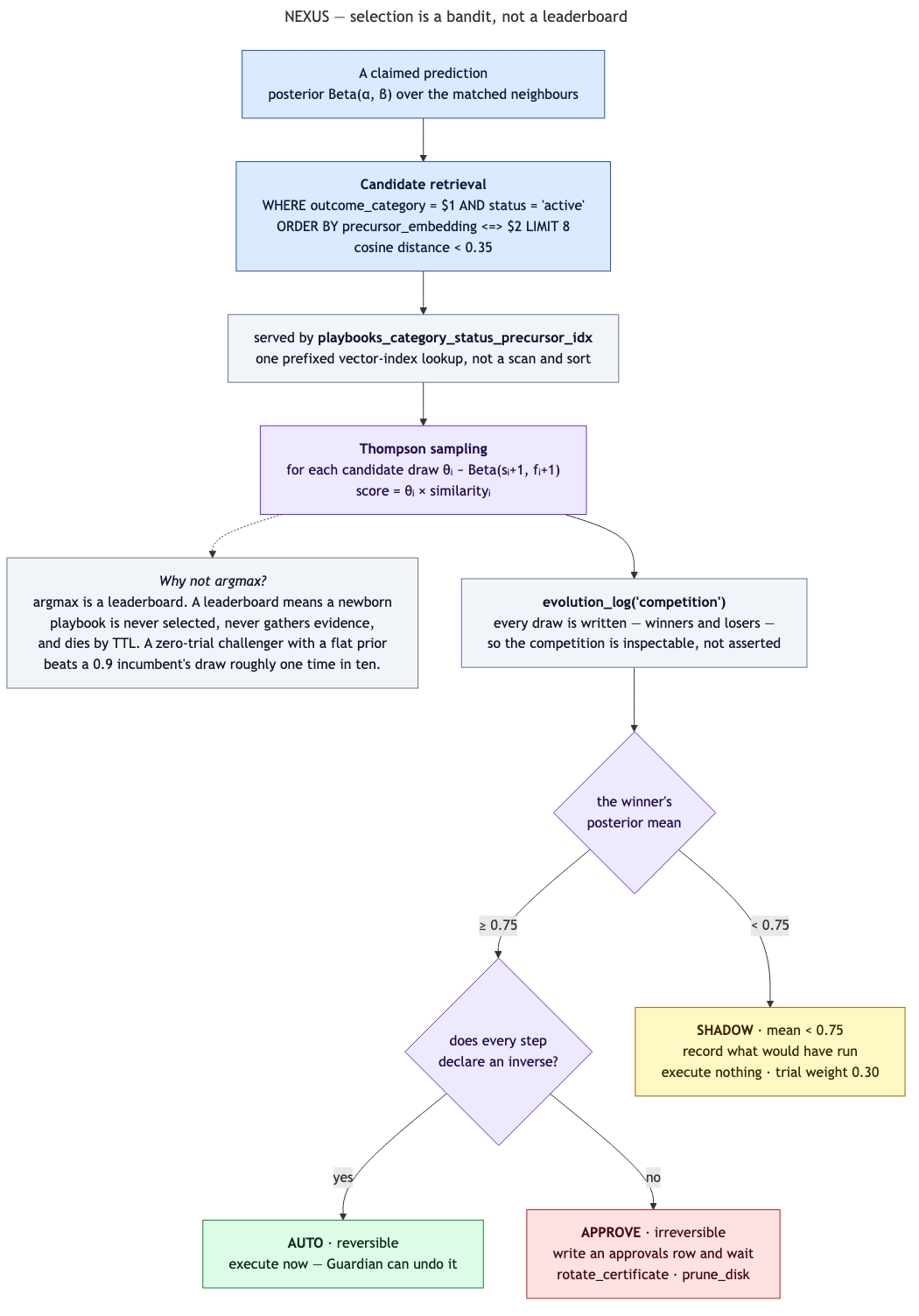
Retrieval, Thompson sampling, and the three-way tier gate. Every draw — winner and loser — is written to evolution_log.
The stack
Per agent: which AWS service runs it, and which CockroachDB capability it thinks with.
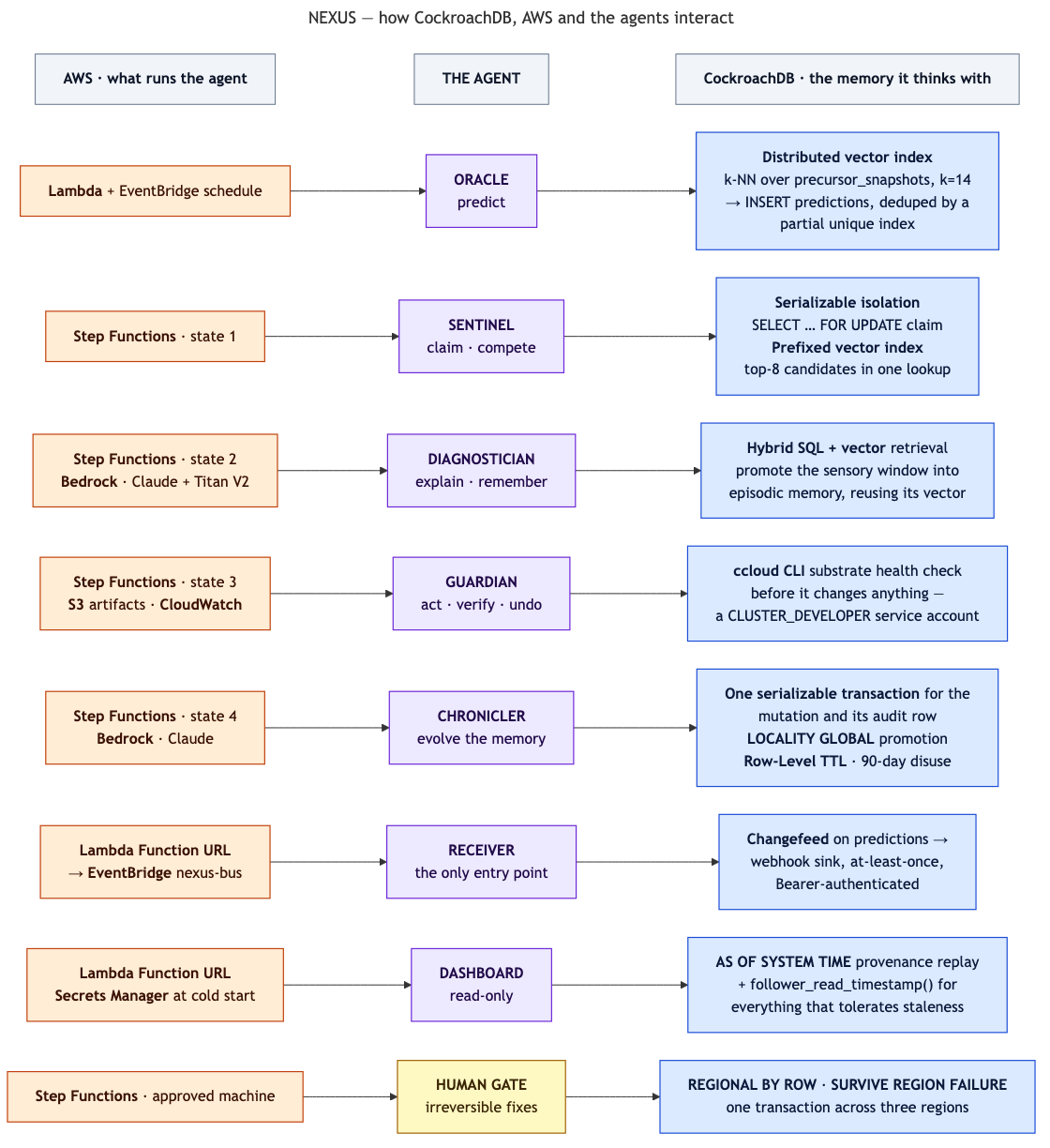
| Layer | Choice | Why |
|---|---|---|
| Memory | CockroachDB Cloud, 3 regions, SURVIVE REGION FAILURE |
The four capabilities in the table above |
| Vectors | VECTOR(1024) · vector_cosine_ops · prefixed vector indexes |
1024 is Titan V2's default, not 1536. Prefixing lets one lookup serve the filtered k-NN |
| Compute | AWS Lambda, 8 functions, Python 3.12, arm64, one shared layer | Thin agents. No agent holds state |
| Orchestration | Step Functions ×2 + EventBridge | A second state machine is entered only after a human approves |
| Trigger | CockroachDB changefeed → webhook → Lambda Function URL | An INSERT is the only thing that starts a pipeline |
| Models | Bedrock — Titan V2 for every vector, Claude for genomes | Three places only: birth, mutation, merge |
| Storage / obs | S3 artifacts, CloudWatch dashboard, structured JSON logs | Every log line carries incident / prediction / playbook ids |
| Secrets | Secrets Manager, read at cold start | Nothing in code, nothing in git history |
| IaC | AWS SAM | 47 resources, one make deploy |
| UI | React 19 · Vite · Tailwind 4 · Recharts · React Flow | Five views over the same handler the Lambda runs |
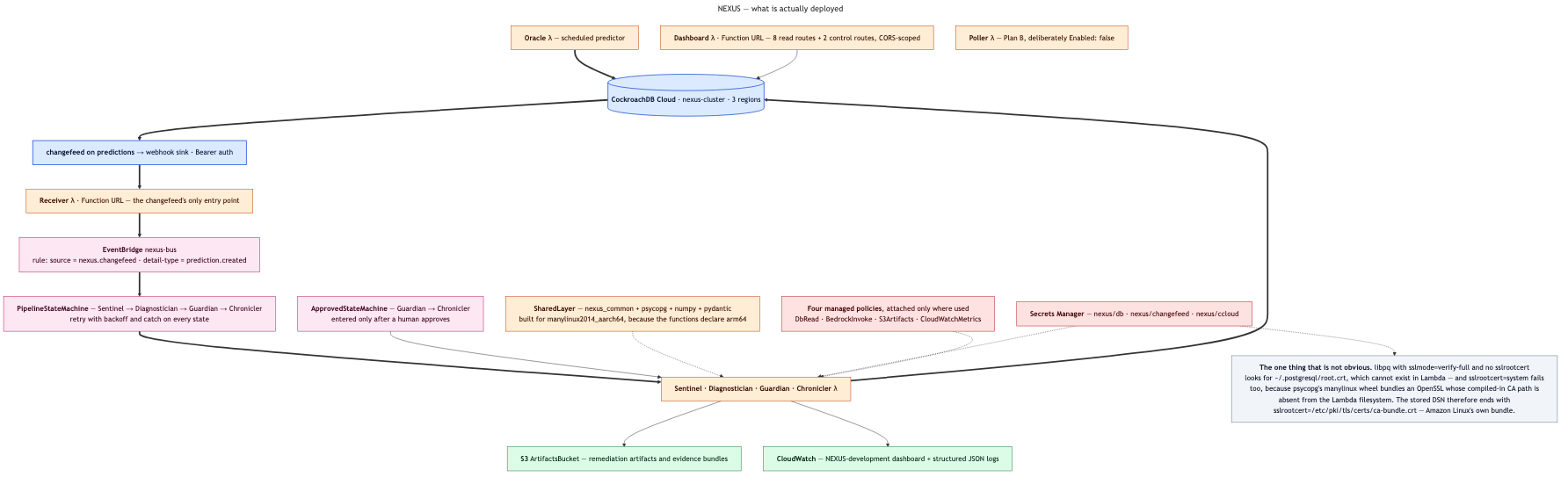
CloudFormation stack nexus in us-east-1 — 47 resources, 8 Lambdas, 2 state machines.
The pipeline, and why it is exactly-once
Changefeed delivery is at-least-once. That is the contract, not a defect to be worked around, so the claim is a database primitive rather than application logic:
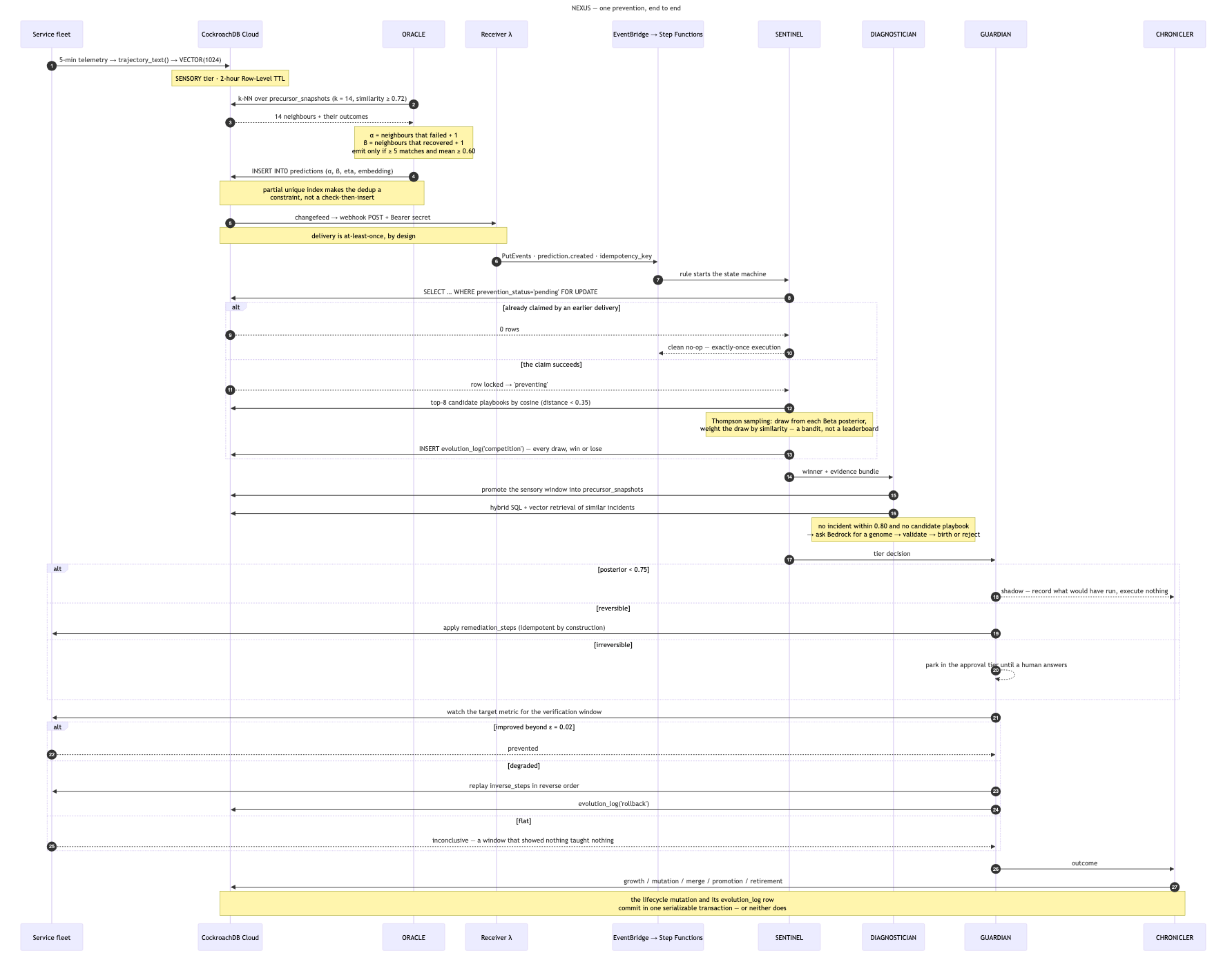
Every branch, including the duplicate-delivery no-op, the three-way tier gate, and the three outcomes of the verification window.
 CHANGEFEED ──POST──►┐
 (delivery 1)        │
                     ├──► RECEIVER λ ──► EventBridge ──► 2 Step Functions executions
 CHANGEFEED ──POST──►┘    Bearer auth      nexus-bus         racing for one row
 (delivery 2, retry)

     exec 1 ─► SELECT … WHERE prevention_status='pending' FOR UPDATE  ─► row locked
                                                                      ─► 'preventing'
     exec 2 ─► blocks on the lock, re-reads under SERIALIZABLE
                                                    ─► 0 rows ─► duplicate ignored

     `make pipeline-concurrency` → five deliveries, one claim, four clean no-ops
And if an execution dies after claiming, the row would sit in preventing forever holding
Oracle's dedup guard — making that failure permanently unpredictable, a silent blind spot
worse than the crash. Chronicler's sweep releases it as missed after 30 minutes.
The synthetic world — how a demo becomes an experiment
A demo becomes an experiment the moment part of the world is withheld from it.
world.build(seed, anchor) is a pure function: the same seed rebuilds the identical world
down to the last sample.
  baseline ──────► precursor drift ──────► failure ──────► recovery
   45 min           60–180 min              20 min          40 min
                         ▲                     ▲
                         │                     └── incidents.symptom_embedding
                         └── precursor_snapshots.trajectory_embedding
                             ── what Oracle matches.
                                The failure is NEVER in it.
| Written to the database | Withheld | |
|---|---|---|
| Incidents | 120 | — |
| Precursor snapshots | 155 — 120 that failed, 35 that recovered on their own | — |
| Playbooks across 4 generations | 30 | — |
| Institutional playbooks | 1 | — |
evolution_log events |
185 | — |
Held-out windows → backtest_set.jsonl |
— | 42 |
The 35 negatives are the load-bearing part. Without windows that drifted and then recovered, the system has never seen a false alarm, and every wobble becomes a prediction.
Remediation is modelled as a counter-force on the same metric axis: an effective step slows the drift, a correct playbook reverses it, a mismatched step accelerates it. That is why the bad-fix rollback is a consequence of the simulation rather than a scripted animation.
Challenges we ran into
These are the ones that changed the design. Each is written as symptom → cause → what it taught, because the cause was never the obvious one.
1 · A provenance proof that looked exactly like a working one
Symptom. The AS OF SYSTEM TIME replay worked perfectly: the historical pane and the
live pane matched, every time.
Cause. We were replaying at crdb_internal_mvcc_timestamp of the prediction row. That
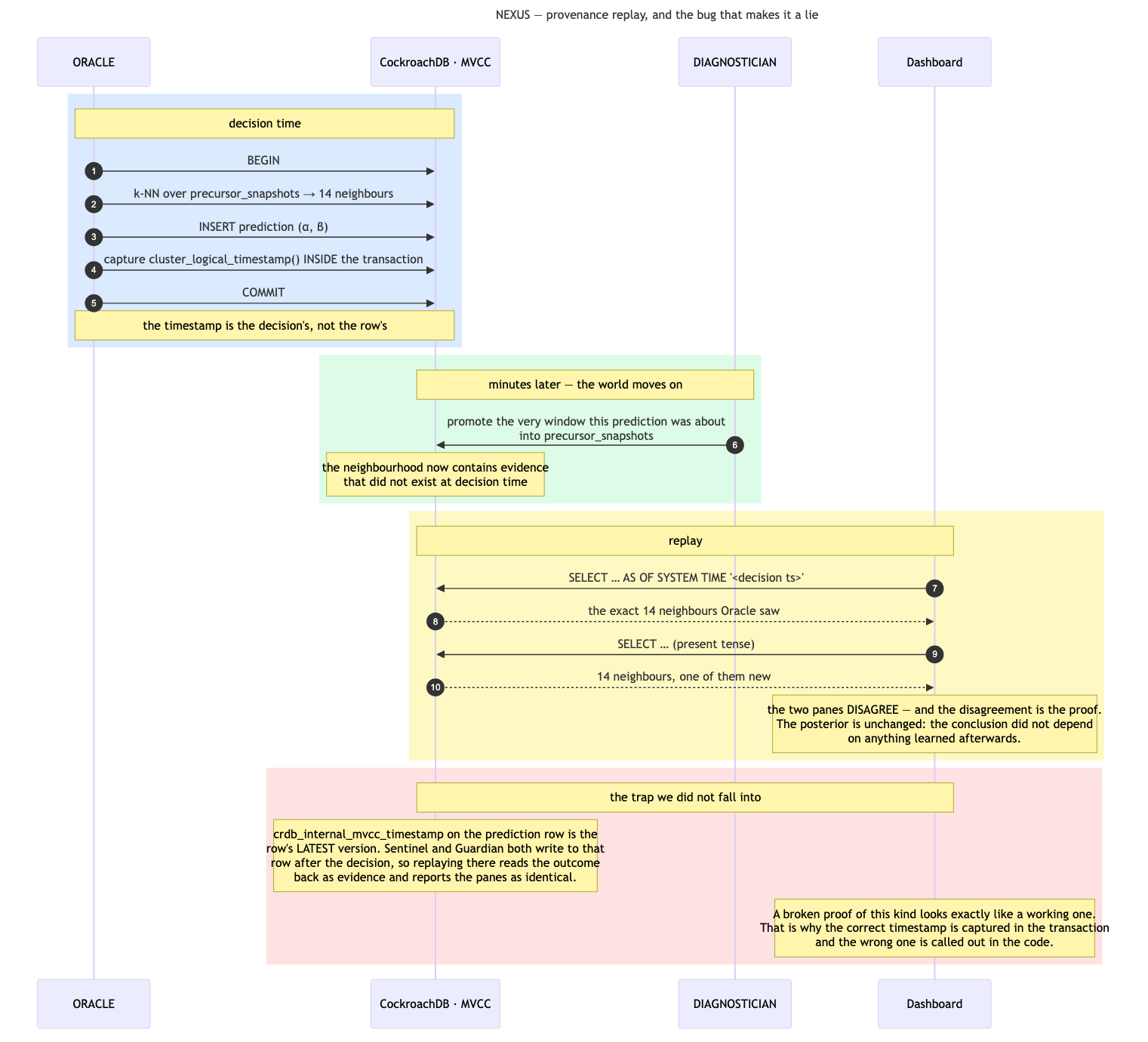
The red band is the trap: replaying at the row's latest MVCC version reads the outcome back as evidence, and reports the two panes as identical — which is exactly what success is supposed to look like. is the row's latest version — and Sentinel and Guardian both write to that row after the decision. We were reading the outcome back as evidence.
What it taught. A broken proof of this class is indistinguishable from a working one,
because "the panes agree" is what success is supposed to look like. The fix was to capture
cluster_logical_timestamp() inside the transaction that writes the prediction. The panes
now disagree — a neighbour was promoted afterwards — and that disagreement is the actual
evidence. The wrong timestamp source is called out in a comment in the code, because
avoiding a trap silently means the next person walks into it.
2 · TRUNCATE silently discarded a zone config
Symptom. None. For days. Everything passed.
Cause. A manual TRUNCATE during development recreated precursor_snapshots under a
new table ID — which discards its zone configuration. The 7-day gc.ttlseconds reverted
to a 75-minute default. Provenance replay kept passing the entire time, because a replay in
a test runs seconds after the decision it replays.
What it taught. The failure mode of a retention setting is invisible until exactly the
moment you need the retention. Reset now uses DELETE, re-asserts the zone configs from the
migration, and make verify asserts gc.ttlseconds = 604800 on both tables as a standing
check.
3 · The vector index that was not being used
Symptom. Retrieval was correct and quick at demo scale.
Cause. Our real queries are filtered nearest-neighbour searches
(WHERE outcome_category = $1 … ORDER BY embedding <=> $2). Against an unprefixed vector
index the planner cannot combine the two halves: it picks the secondary index on the filter
columns, index-joins, and sorts the survivors. Correct — but a scan.
What it taught. "It returns the right answer" and "it will still return the right answer
at a million rows" are different claims. CockroachDB vector indexes accept prefix
columns, which partition the index so one lookup serves the whole query; EXPLAIN then
shows a vector search node with prefix spans. make verify now asserts that shape —
and separately asserts recall 1.000 against an exact scan, because an approximate index
that returns plausible neighbours is indistinguishable from a correct one until you check.
We also left a tradeoff open rather than hiding it: Oracle's neighbourhood query has no category filter by design — the category is the thing it is inferring, so filtering by it would assume the conclusion — and a prefixed index cannot serve a query with no prefix. That one query falls back to a scan, and it is in the gaps table.
4 · Serialization failures under concurrent incidents
Symptom. make load — three simultaneous incident ramps — produced RETRY_SERIALIZABLE
errors escaping to the caller.
Cause. We were holding a serializable transaction open across a Bedrock call. A model round-trip is hundreds of milliseconds of contention window, for work that touches no rows.
What it taught. Serializable isolation does not punish you for being distributed; it
punishes you for holding transactions across things that are not database work. Model calls
moved outside the transaction boundary and the failures went to zero. The reproduction is
still a make target.
5 · Every merge returned the parent
Symptom. The merge rule, which should join two convergent siblings, kept selecting a playbook's own parent.
Cause. A mutation is deliberately placed at its parent's position in precursor space —
that is what makes it a variant rather than a stranger. So ORDER BY distance LIMIT 1
returns the parent every single time. Without a lineage check, every family collapses into
itself the moment a child wins a trial.
What it taught. In a system where similarity is engineered, "nearest" and "related"
are not the same relation, and the distinction has to be expressed in SQL. Merge now refuses
relatives via the lineage[] array.
6 · Three ways for a Lambda to fail to reach the database
Deploying the pipeline surfaced a chain of failures with nothing in common but the error message being about something else:
No module named 'nexus_common'— SAM'spython3.12layer builder shipped the package to/opt/python/python/, because ourContentUrialready containedpython/.no pq wrapper available— the makefile builder used SAM's default x86_64 image while the functions declare arm64, so the wheels weremanylinux2014_x86_64. Fixed by pinning--platform manylinux2014_aarch64 --only-binary=:all:.root certificate file "~/.postgresql/root.crt" does not exist— libpq withsslmode=verify-fulland nosslrootcertlooks for a path that cannot exist in Lambda. Andsslrootcert=systemfails too, because psycopg's manylinux wheel bundles an OpenSSL whose compiled-in CA path is absent from the Lambda filesystem. The cluster presents an ordinary Let's Encrypt chain, so the answer was Amazon Linux's own bundle:sslrootcert=/etc/pki/tls/certs/ca-bundle.crt.
What it taught. Serverless build toolchains fail at the packaging layer and report at the application layer. We now build the layer explicitly rather than letting the builder infer.
7 · Rotating a secret did nothing
Symptom. We wrote a new secret version. Nothing changed. The old value kept working.
Cause. config.get_secret is @functools.cached and the connection pool is a module
global. A warm execution environment serves the old value until it ages out.
What it taught. This is the worst shape a failure can have: it looks like success, then
breaks hours later with no deploy to blame. Rotation is documented as two steps — write
the value, then replace every execution environment — with an explicit warning never to
cycle them via --environment, which replaces the whole variable map instead of merging.
8 · The one we did not fix, on purpose
Bedrock model access has not been granted for the account: Titan V2 and Claude both return
ValidationException: Operation not allowed with IAM verified correct. Birth, mutation and
merge therefore log and decline rather than fabricating a playbook. The lifecycle harness
substitutes exactly one seam and stamps proposed_by: "lifecycle-harness" on every row it
writes — never "bedrock".
Faking that path would have been about twenty minutes of work and would have made every other number in the project untrustworthy.
Accomplishments that we're proud of
The honesty layer is a feature, not a disclaimer.
make backtest scores Oracle on 42 windows the seeder deliberately never wrote to the
database, using Oracle's own retrieval and emit gate. A window it declines to predict on
counts as a negative, because that is what silence means in production.
| Metric | Value |
|---|---|
| Held out | 42 windows — 30 incidents, 12 negatives |
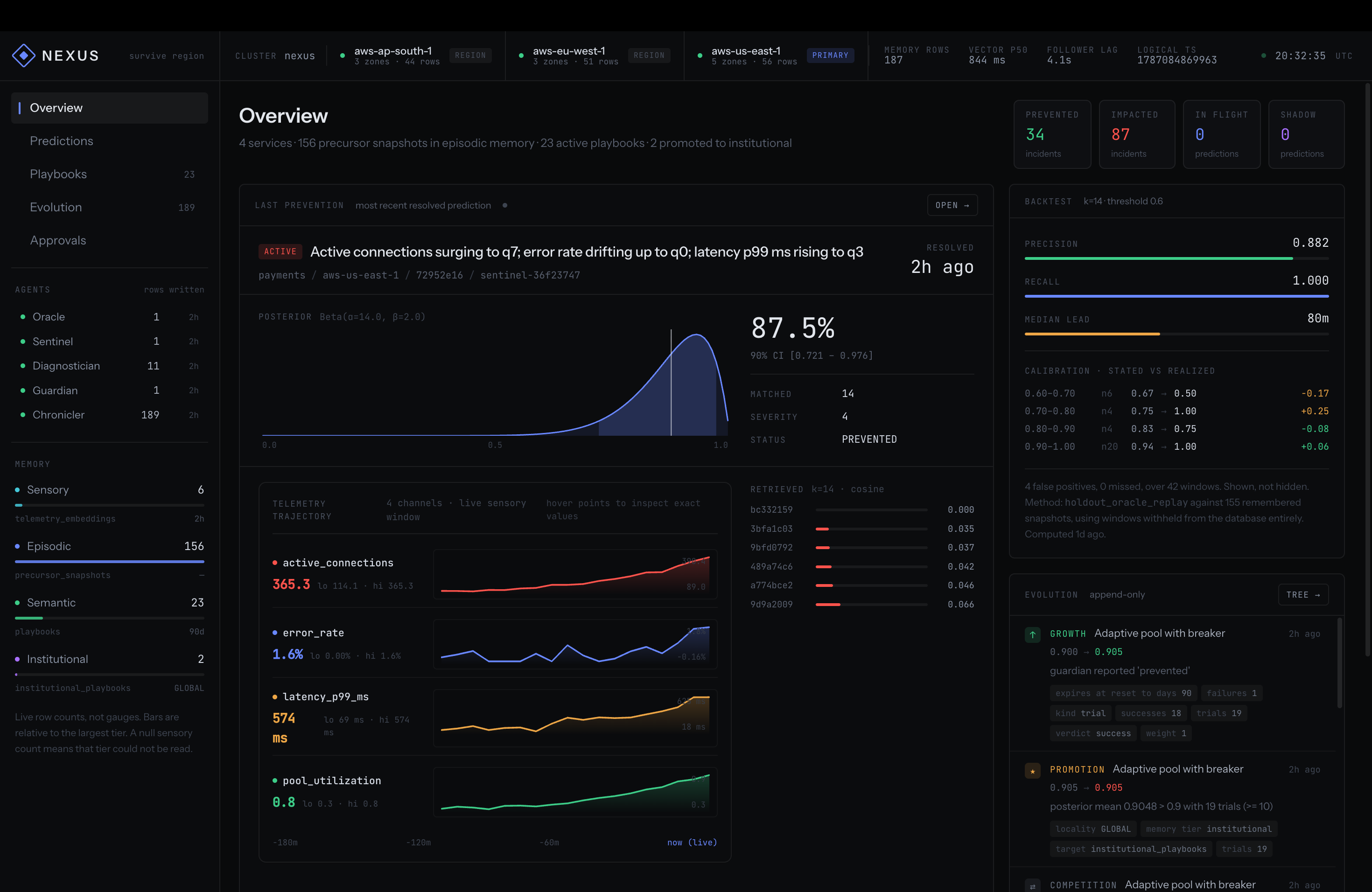
| Precision · Recall | 0.882 · 1.000 |
| Confusion | TP 30 · FP 4 · FN 0 · TN 8 |
| Category named correctly | 32 of 34 predictions |
| Median warning available | 80 minutes of precursor pattern before failure |
And the calibration table is on the dashboard, not buried:
| Bucket | n | Stated | Realized | Gap |
|---|---|---|---|---|
| 0.60–0.70 | 6 | 0.667 | 0.500 | −0.167 |
| 0.70–0.80 | 4 | 0.750 | 1.000 | +0.250 |
| 0.80–0.90 | 4 | 0.828 | 0.750 | −0.078 |
| 0.90–1.00 | 20 | 0.938 | 1.000 | +0.062 |
We say the uncomfortable part out loud: the model is over-confident in the 0.60–0.70 bucket, and recall of 1.000 is the easiest possible case — held-out incidents are complete precursor windows, and eight synthetic archetypes are far more separable than real telemetry. The number worth trusting is precision.
Every claim has a command.
| Claim | Command | Evidence |
|---|---|---|
| The vector index really serves the query | make verify |
vector search + prefix spans, recall 1.000 vs exact scan · 21/21 live |
| Predictions are not overfitted | make backtest |
0.882 / 1.000 on withheld windows |
| The evidence is replayable | make verify |
AOST at the decision's own commit timestamp |
| Duplicates cannot double-execute | make pipeline-concurrency |
one claim, four no-ops |
| A bad fix is undone | make pipeline-rollback |
fleet degrades → inverses replay → variant bred |
| Memory evolves, including dying | make lifecycle |
36 assertions, all 8 event types |
| The pipeline holds under load | make load |
three concurrent ramps · 7/7 |
| The cluster survives a region | make region-config |
survival goal + replica spread, live · 5/5 |
| The whole story runs | make demo-run |
24-check scorecard |
| AWS is deployed, not written | make deploy + make changefeed |
INSERT → changefeed → Step Functions SUCCEEDED |
Plus 242 unit tests that need no database, and CI on every push.
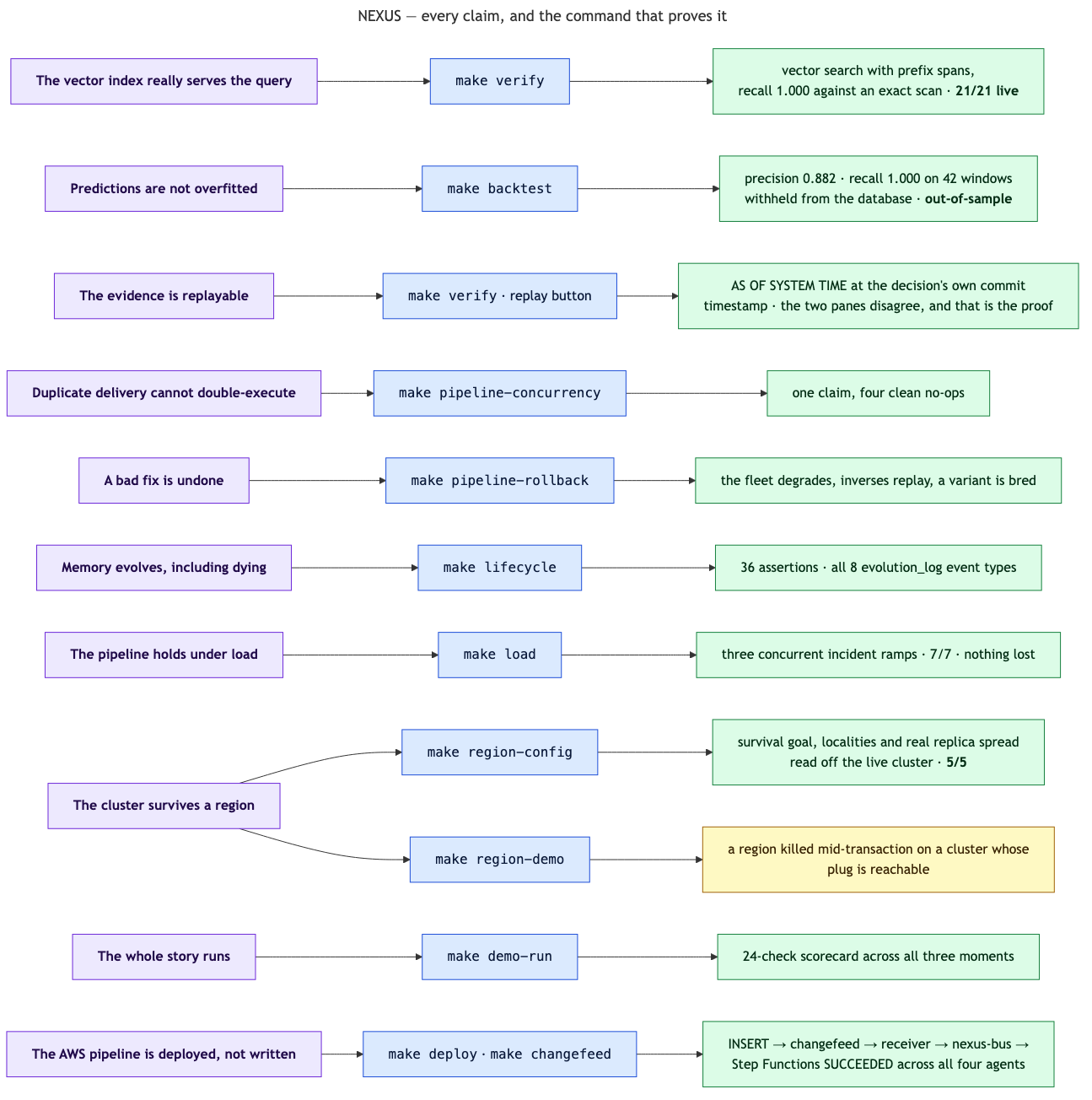
The same map, as a diagram: no claim in this project is asserted without a command that produces the evidence.
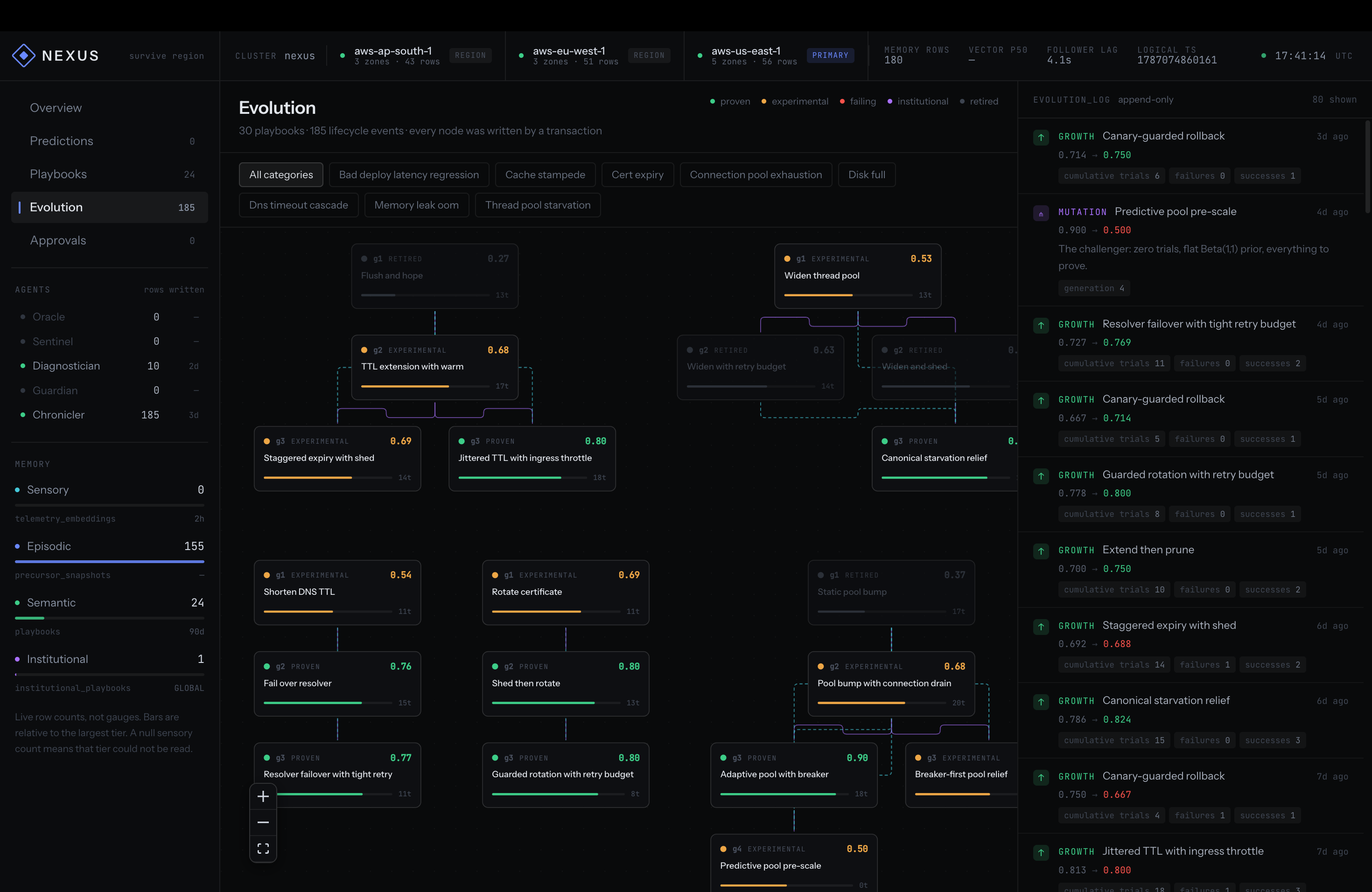
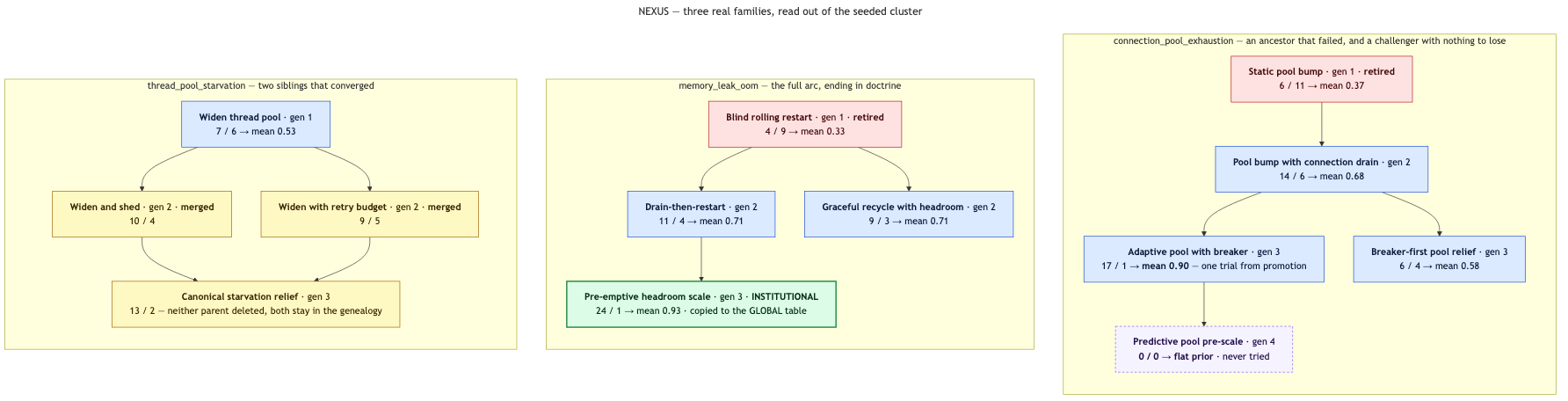
The genealogy is real. These three families were read out of the seeded cluster, not drawn by hand:
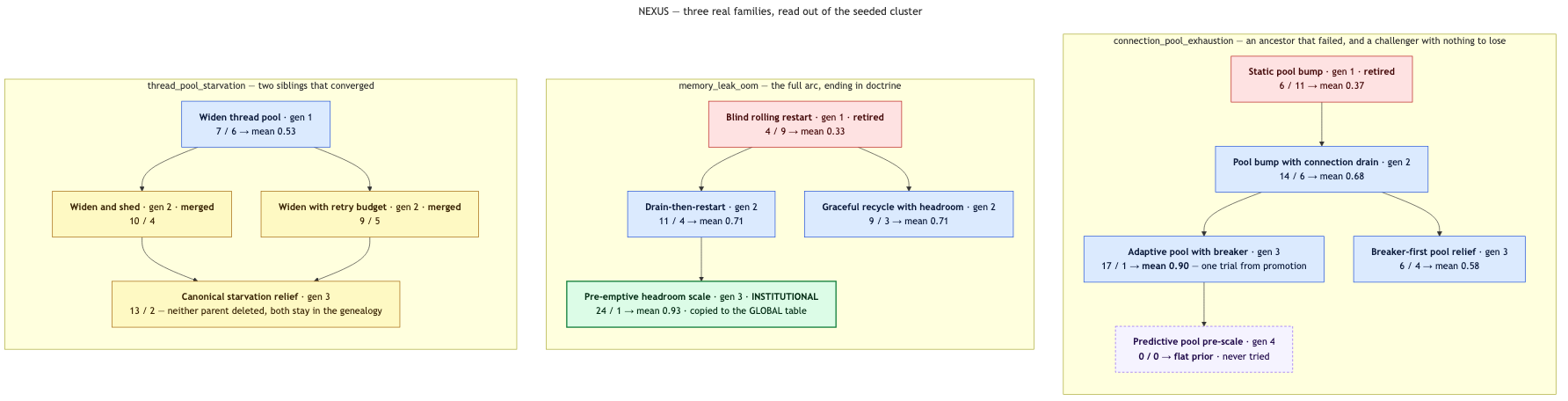
Not schematic. These three families were read out of the live seeded cluster: a retired founder still in the tree, a lineage that improved across generations, two convergent siblings merged with both parents preserved, a genome promoted into institutional doctrine, and a zero-trial challenger on a flat prior.
Read across, that is the entire thesis in data: a founder that failed and was retired but is still in the tree; a lineage that improved across generations; two convergent siblings replaced by one canonical child with both parents preserved; a genome promoted into institutional doctrine; and a zero-trial challenger on a flat prior, waiting for the sampler to give it a turn.
Production readiness was designed, not retrofitted. Three diagrams carry it.
What each locality actually buys, and what survives a region loss:
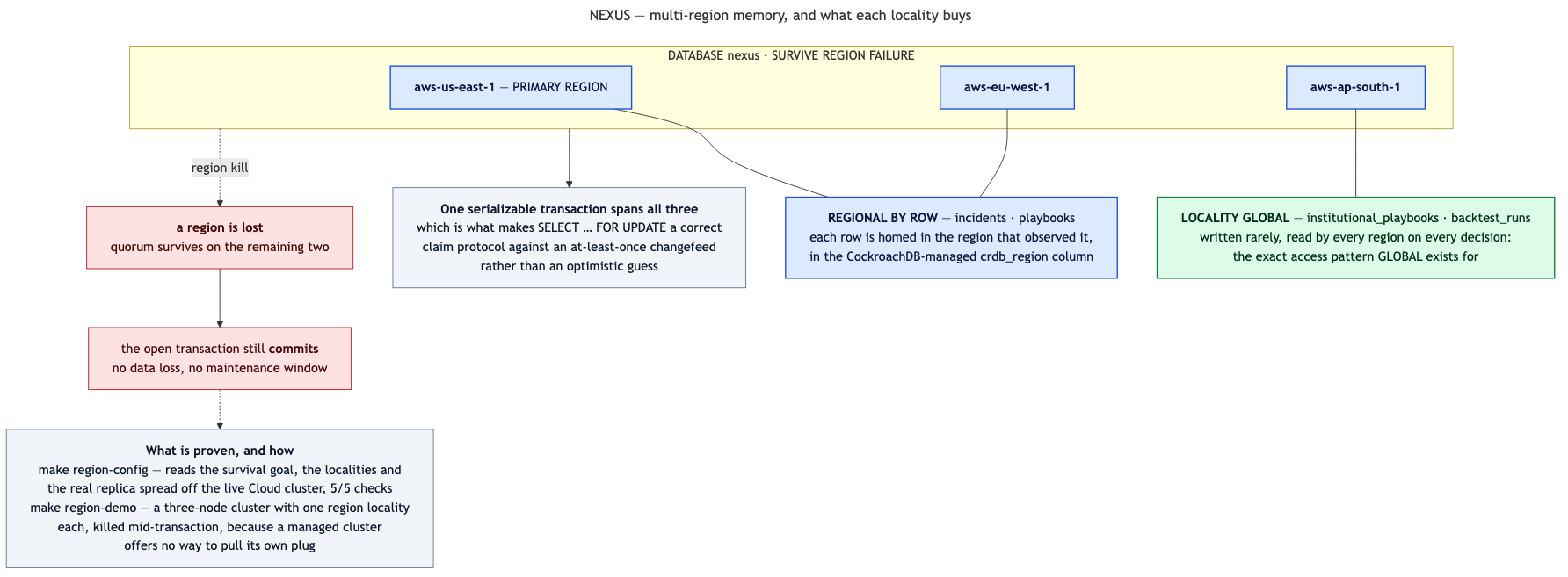
Model output is treated as untrusted input, because it is. One pydantic gate, shared by every path that can produce a genome:

And for every way this can go wrong, a defined behaviour — with the reasoning for why the honest failure is the better answer:
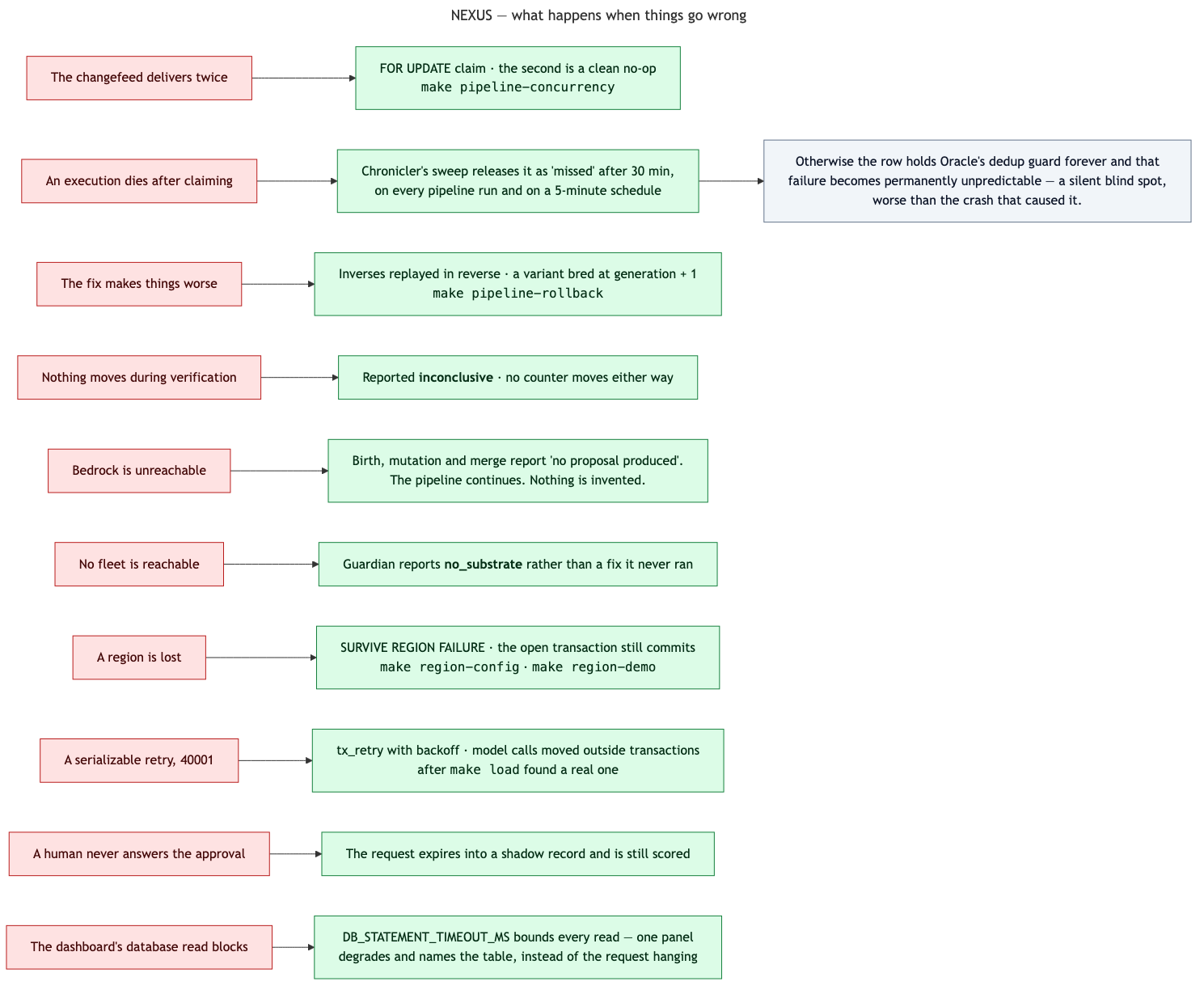
Exactly-once execution over at-least-once delivery, proven by delivering one prediction five times in parallel — not argued for in a design document.
Honest degradation everywhere. no_substrate instead of a tunnel that would make the
beat "work." "No proposal produced" instead of an invented playbook. inconclusive instead
of a flattering win. In every case the honest failure was the better answer, and in every
case it took more work than faking it.
What we learned
Retention policy is a correctness property. We started treating TTLs and GC windows as housekeeping. The 75-minute GC window taught us they are load-bearing: a provenance guarantee is exactly as strong as the MVCC history behind it, and it fails silently, and it fails at the moment you need it most.
The most dangerous bug is the one that looks like success. The provenance replay, the zone config, the secret rotation — all three passed. None of them raised an error. We now ask a different question in review: not "does this work?" but "what would this look like if it were broken?" If the answer is "the same," the test is not a test.
Argmax is a policy, and it is usually the wrong one. The first competition implementation picked the highest fitness. It worked, and it quietly made the entire evolutionary mechanism inert: no newborn was ever selected, so no newborn ever gathered evidence, so every newborn died by TTL. Thompson sampling is three lines of difference and it is the difference between a population and a leaderboard.
In an engineered similarity space, "nearest" is not "related." Placing a mutation at its parent's position is what makes it a variant — and it is also what makes distance-based sibling selection return the parent forever. Structure has to be represented explicitly, not inferred from geometry.
Serializable isolation is a scalpel, not a tax. It gave us the FOR UPDATE claim
protocol for free — a genuinely correct answer to at-least-once delivery. It only ever cost
us when we held a transaction across work that was not database work.
Building the plumbing first was the highest-leverage decision. The changefeed → webhook → EventBridge → Step Functions spine was built before any agent had real logic in it. Every later capability was demoable the day it was written, rather than integrated at the end.
Saying "we did not build that" is cheap; making it cheap is the hard part. The reason we could afford honesty about Bedrock is that the degradation paths were designed in from the start. Honesty is not a virtue you apply at write-up time — it is an architectural property you pay for early.
What's next for NEXUS
Real telemetry. The synthetic world is deliberately separable — eight archetypes with distinct metric signatures. The honest next step is Prometheus or CloudWatch ingestion against a real fleet, where archetypes overlap, labels are wrong, and the emit gate has to earn its floor.
Cross-organisation institutional memory. institutional_playbooks is already LOCALITY
GLOBAL. The interesting question is whether a promoted playbook can transfer between
organisations — an anonymised doctrine exchange where a strategy proven at one company
enters another's population as a challenger with a flat prior, and has to earn its trials
like anything else.
The MCP Server and Agent Skills. Both are scope cuts, not rejections. Exposing NEXUS's memory through the Managed MCP Server would let any MCP client query the genealogy and the provenance replay directly — which is, in the end, the same argument as the rest of the project: the memory should be the interface.
Repository, and the full diagram set
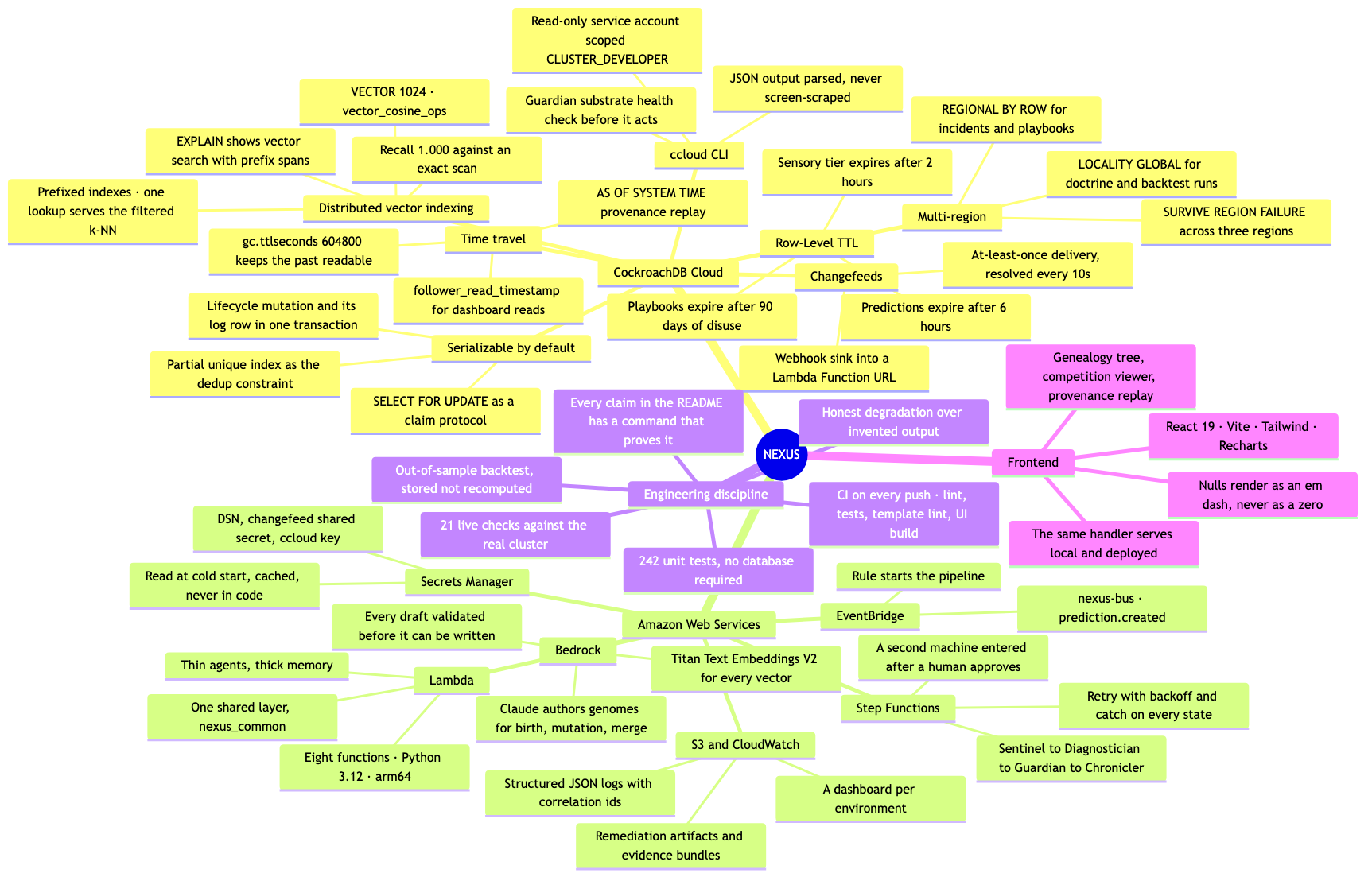
Every diagram above is generated from a checked-in mermaid source, and each one compiles in CI before it can reach the documentation — so none of them can drift away from the system they describe. The whole surface, on one page:
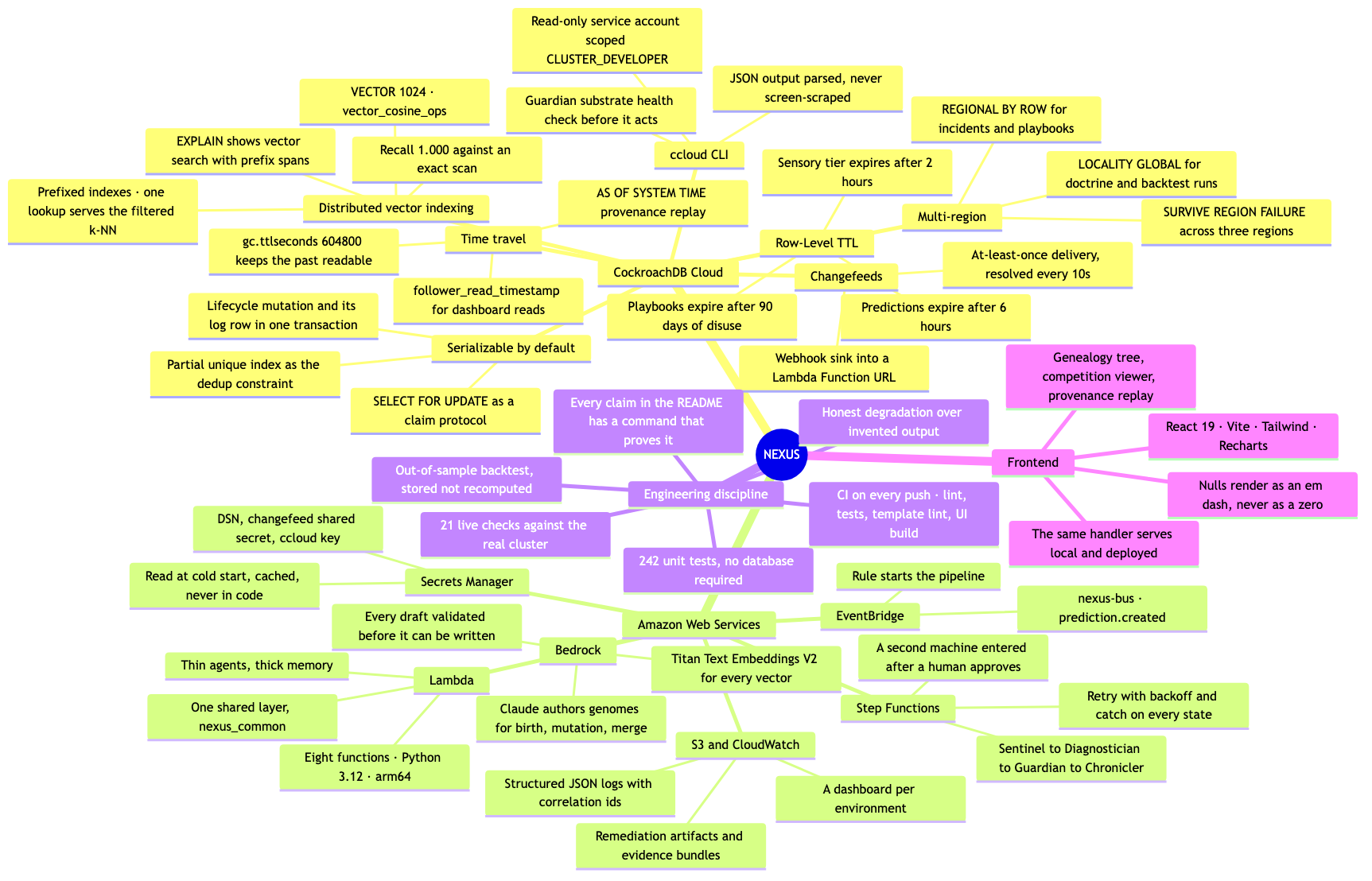
Eighteen diagrams in total. The eight not shown above cover the embedding pipeline, rollback semantics, changefeed idempotency, and the demo shot map:
Where to go in the repository:
| ARCHITECTURE.md | The deep document — 20 sections, 17 diagrams, every design decision and the reasoning behind it |
| README.md | Status, the honest gaps table, and the quickstart |
| diagrams/ | Every mermaid source, plus rendered SVG and PNG |
| Makefile | One command per claim |
Built With
- amazon-bedrock
- amazon-cloudwatch
- amazon-eventbridge
- amazon-titan-embedding
- amazon-web-services
- aws-lambda
- aws-secrets-manager
- aws-step-functions
- cockroachcli
- cockroachcloud
- cockroachdb
- distributed-vector-indexing

Log in or sign up for Devpost to join the conversation.