Claude finished the response
Absolutely. The screenshot shows Devpost's Project Story template, so the content should directly answer those seven headings: Inspiration What it does How we built it Challenges we ran into Accomplishments we're proud of What we learned What's next for Nexus CMO Here is a ready-to-paste version,
pasted
Convert the following into a suitable single markdown for a hackathon submisson but in limited wordskeeping the same tone and meaning in less words
at*. It protects the credibility of the submission while still making it very clear what **you and Vishesh actually added*.
Distilled verbose content into punchy hackathon-ready markdown format Distilled verbose content into punchy hackathon-ready markdown format Nexus CMO: Your Personal Social CMO Network Inspiration Marketers constantly ask: "What should my brand be talking about right now?" Nexus CMO answers this by discovering high-opportunity signals and intelligently determining which content deserves to be created—not just generating everything possible.
What It Does Nexus CMO combines trend intelligence with AI-powered content generation. It discovers marketing opportunities, scores them (0–100), prioritizes high-impact topics for broader platform coverage, and generates platform-specific content automatically—while maintaining human review before publishing.
How We Built It Backend: Python, FastAPI, SQLite, APScheduler, Playwright
AI Layer: Google Gemini for content generation; deterministic Opportunity Score for decision-making (keeping logic separate from generative reasoning for explainability)
Multi-Agent Pipeline:
Scout → Opportunity Score → Planner → Creator → Reviewer → Publisher → Analyst Each agent has clear responsibility, input, output, and purpose Frontend: AI CMO command center with Opportunity Radar, agent network visualization, content pipeline, and real-time workflow visibility
Challenges We Ran Into Rapid AI ecosystem changes: Gemini model was retired during development; diagnosed and updated configuration with smoke tests Backward compatibility: Extended existing API to add Opportunity Score without breaking contracts Autonomy + safety: Retained review stage between generation and publishing to prevent blind automation Scope: Focused on core loop (Discover → Score → Plan → Create → Review) rather than building everything Accomplishments We're Proud Of Deterministic Opportunity Score – Interpretable 0–100 ranking (not black-box AI judgment) Score-driven planning – Intelligence directly influences platform coverage decisions Six-agent architecture – Behaves like coordinated marketing team, not a single chatbot Working Gemini integration – End-to-end: Topic → AI generation → Platform-specific content Explainable AI design – Deterministic logic for transparency; generative AI for creativity Visual command center – Users see opportunities, agents, workflows, and intelligence What We Learned AI needs structure: Models alone don't create reliable systems; clear responsibilities and data flow are essential Not every decision needs an LLM: Deterministic scoring + generative AI beats "make every decision with AI" Multi-agent requires specialization: Each agent needs purpose; more agents ≠ better Autonomy needs boundaries: Human oversight coexists with automation; users need visibility Product design is AI engineering: Users must see how the system thinks, not just get results What's Next Richer real-time trend sources Deeper audience intelligence & brand memory Campaign-level planning & adaptive content strategies Cross-platform optimization & analytics-driven strategy Long-term: Persistent AI marketing team for creators, startups, brands Vision: Don't just automate posting. Automate marketing intelligence.
Built on: SocialFlow open-source foundation with significant custom intelligence layer, AI integration, and product experience additions.
I want a markdown file with all the necessary details, send me the elements in markdown format only
Architected comprehensive markdown structure for hackathon submission Architected comprehensive markdown structure for hackathon submission Done! I've created a complete markdown file for your Nexus CMO hackathon submission with all sections:
✅ Inspiration – Problem & solution ✅ What It Does – Core functionality ✅ How We Built It – Architecture, tech stack, multi-agent pipeline ✅ Challenges – Problems faced & solutions ✅ Accomplishments – 6 key achievements ✅ What We Learned – Insights from development ✅ What's Next – Roadmap & long-term vision ✅ Technical Details – Stack, foundation, transparency note
The file is:
Concise – Condensed while keeping meaning intact Markdown-formatted – Ready to paste anywhere Structured – Easy to read and scan Complete – All hackathon submission elements included Ready to download and submit!
Nexus cmo submission Document · MD
Claude is AI and can make mistakes. Please double-check responses.
Nexus cmo submission · MD
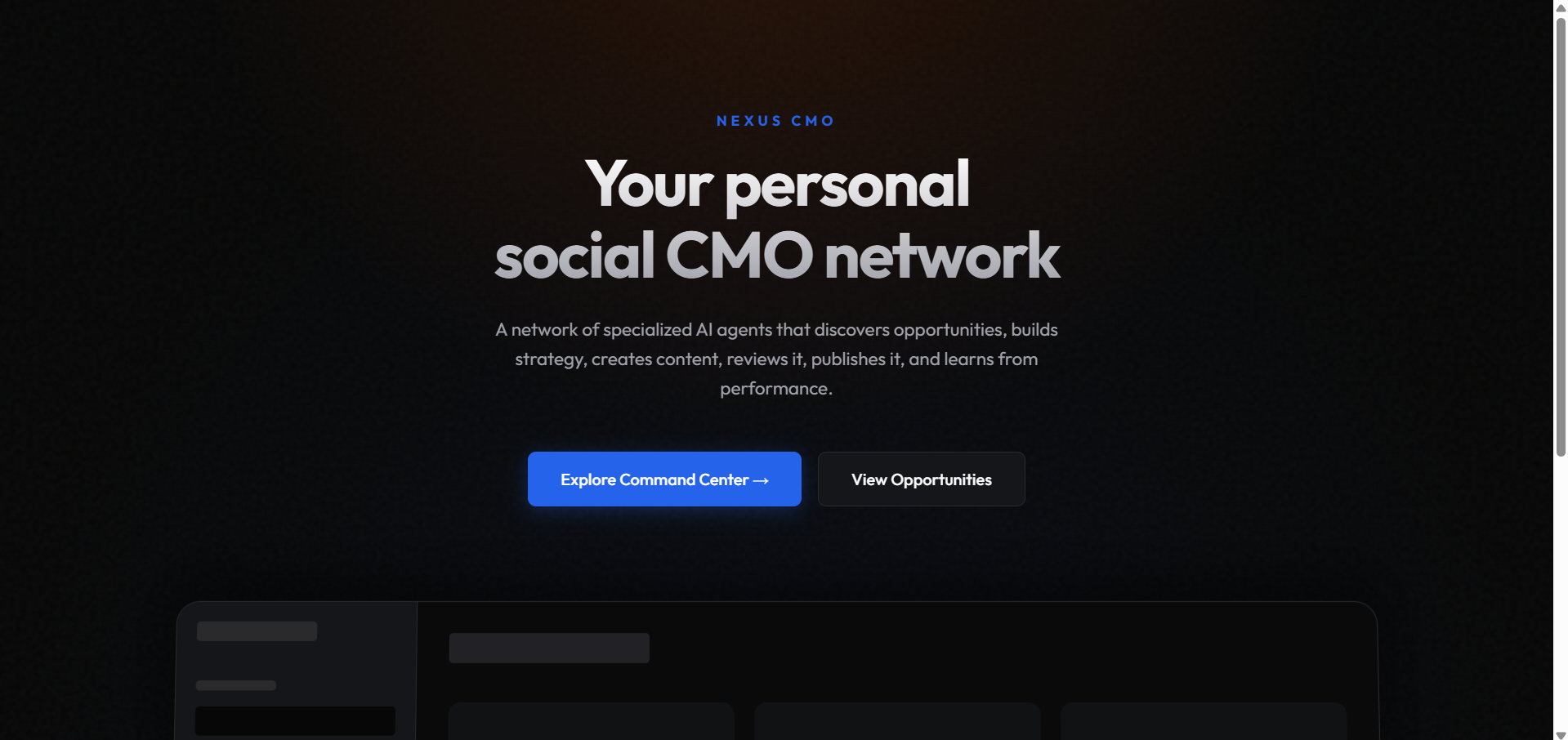
Nexus CMO: Your Personal Social CMO Network
Inspiration
Marketers constantly ask: "What should my brand be talking about right now?"
Most content tools generate everything possible. Nexus CMO is different—it discovers high-opportunity signals and intelligently determines which content deserves to be created in the first place.
High-opportunity signals receive broader platform coverage. Lower-opportunity signals are handled selectively. The system integrates Google Gemini for AI-powered generation, moving opportunities from intelligence to actual platform-specific content.
Result: A system that doesn't just generate content—it helps determine which content matters.
What It Does
Nexus CMO combines trend intelligence with autonomous marketing execution:
- Discover high-opportunity signals in real-time
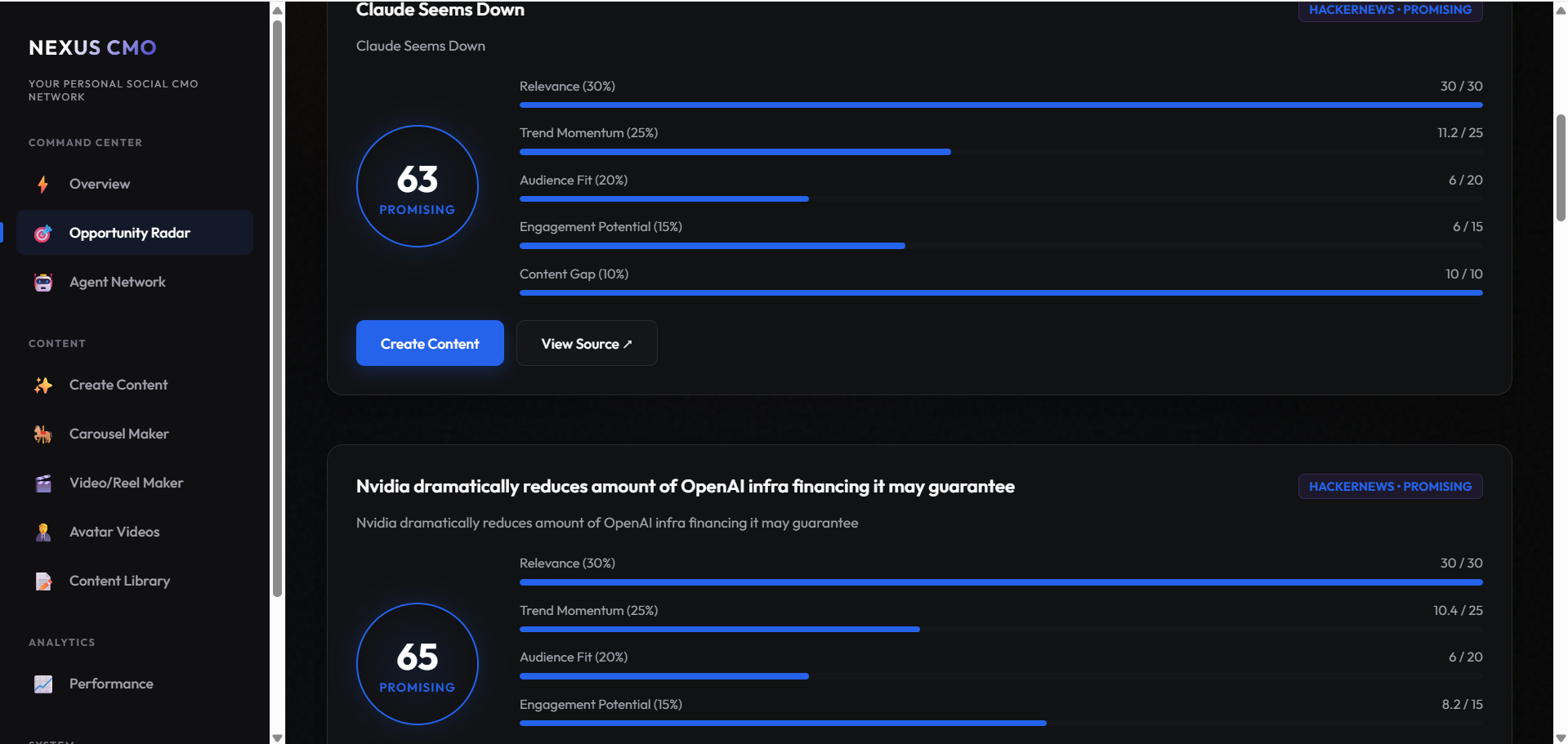
- Score opportunities (0–100) based on measurable signals
- Prioritize high-impact topics for broader platform coverage
- Generate platform-specific content with Google Gemini
- Review before publishing (human oversight built-in)
- Analyze performance and feed insights back into discovery The system operates as a coordinated marketing team, not a single chatbot.
How We Built It
Backend Stack
- Python + FastAPI for core application
- SQLite for data persistence
- APScheduler for autonomous workflow scheduling
- Playwright for signal discovery automation APIs expose:
- Signal discovery
- Opportunity Scores
- Autonomous pipeline execution
- Content generation & post management
- Account workflows & analytics
- Media generation ### AI Layer
Google Gemini handles content generation—where creativity and reasoning matter.
Deterministic Opportunity Score handles decision-making—where transparency matters.
This separation ensures explainability and control. Not every decision needs an LLM.
Multi-Agent Pipeline
Scout
  ↓
Opportunity Score
  ↓
Planner
  ↓
Creator
  ↓
Reviewer
  ↓
Publisher
  ↓
Analyst
Each stage has specific responsibility, defined inputs/outputs, and clear purpose.
Frontend
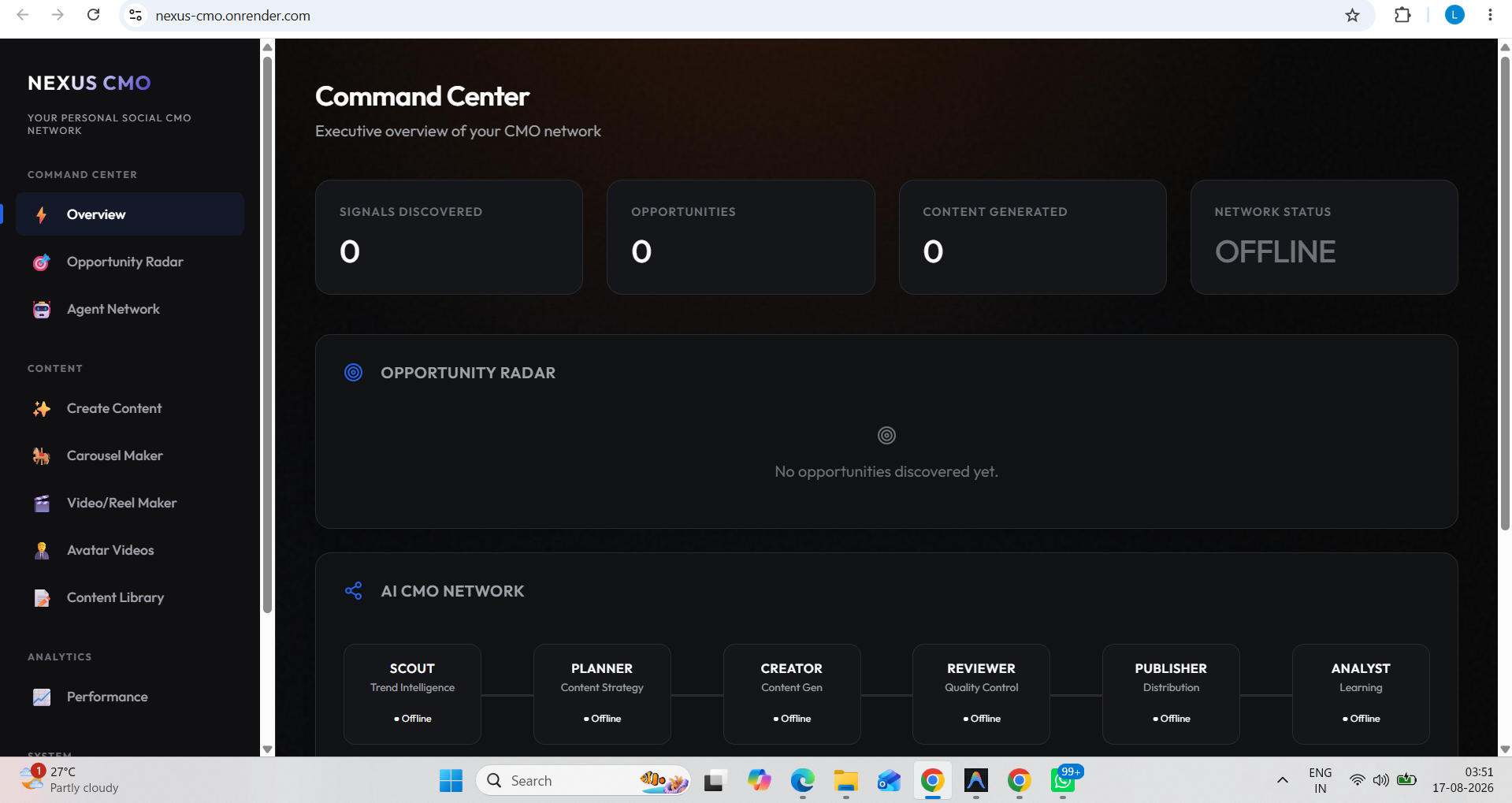
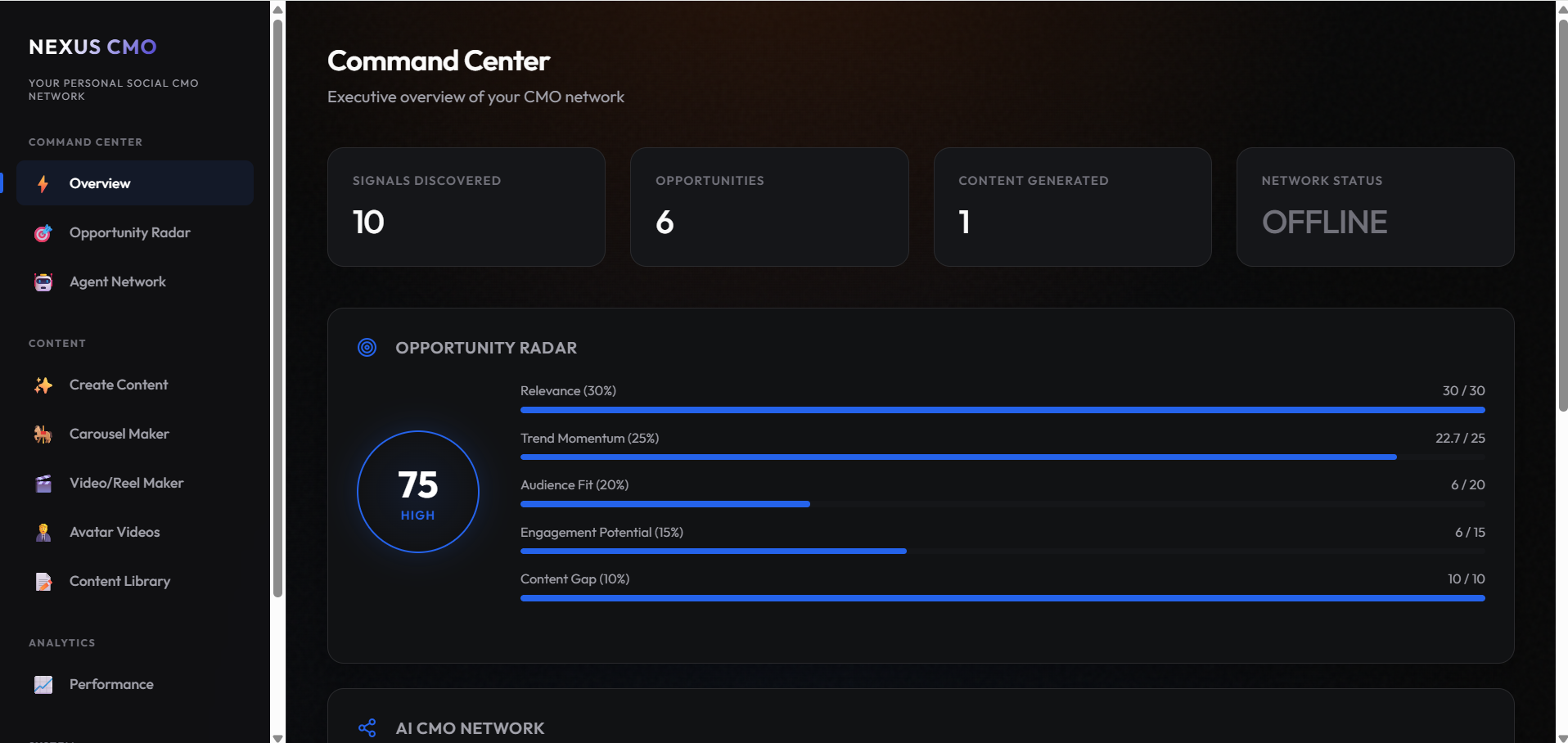
Redesigned product experience as an AI CMO command center:
- Opportunity Radar – Visual trend intelligence
- Agent Network – See autonomous system thinking
- Executive Dashboard – Marketing overview
- Content Pipeline – Real-time workflow visibility
- Platform Intelligence – Cross-platform insights
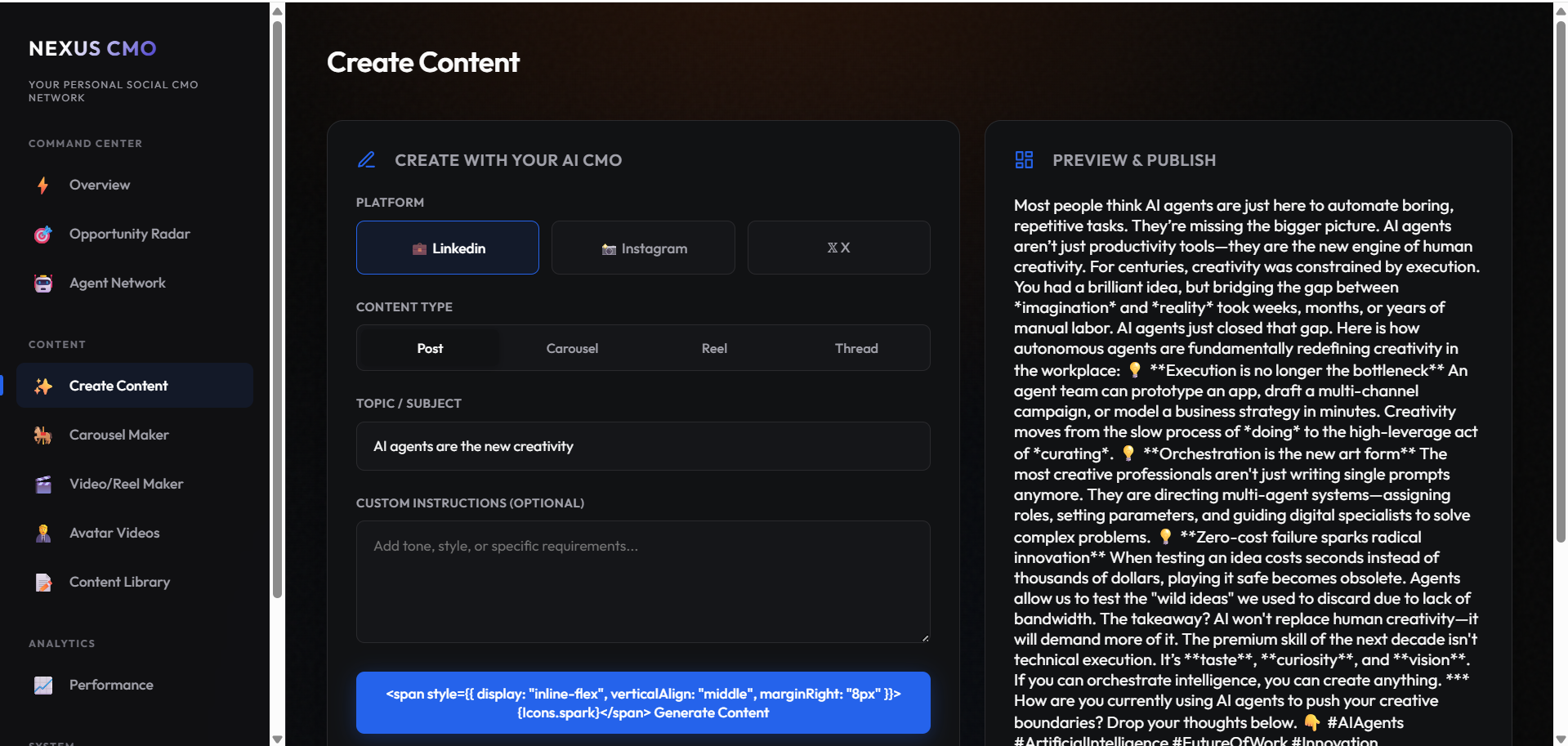
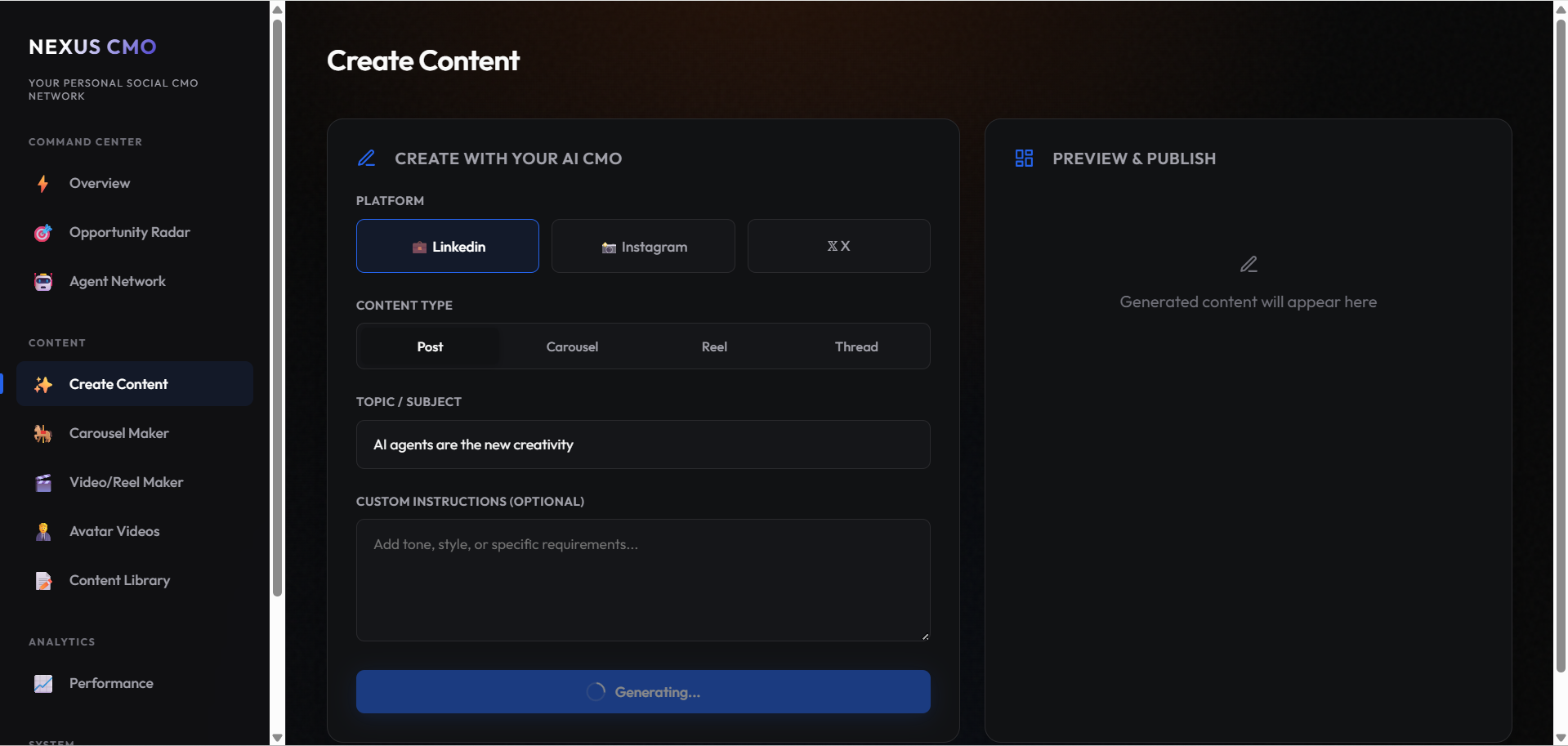
- AI Content Generation – Direct creation interface Users see how the autonomous system works, not just results.
Challenges We Ran Into
Rapid AI Ecosystem Changes
- Gemini model was retired during development
- Initial smoke test returned 404 NOT_FOUND error
- Solution: Diagnosed, updated model configuration, validated with new smoke tests ### Backward Compatibility
- Wanted to add Opportunity Score without breaking existing API contracts
- Solution: Extended existing signal and planning pipeline; score flows through existing architecture ### Autonomy + Safety
- Autonomous systems shouldn't blindly publish AI-generated content
- Solution: Retained review and approval stage between generation and publishing ### Scope vs. Reliability
- Countless features possible in autonomous marketing platform
- Solution: Focused on core loop that works: Discover → Score → Plan → Create → Review
Accomplishments We're Proud Of
1. Deterministic Opportunity Score
- Interpretable 0–100 ranking system
- Explains why a topic is valuable
- Replaces black-box AI judgment with transparent logic ### 2. Score-Driven Planning
- Opportunity Score directly influences Planner decisions
- Higher-value signals get higher priority & broader platform coverage
- Score is actionable, not just a dashboard metric ### 3. Six-Agent Architecture
- Clear division of responsibility across Scout, Planner, Creator, Reviewer, Publisher, Analyst
- Behaves like coordinated marketing team
- Better than single-agent chatbot approach ### 4. Working Gemini Integration
- Successfully integrated Google Gemini for content generation
- End-to-end flow: Topic → AI generation → Platform-specific content
- Validated with dedicated smoke tests ### 5. AI CMO Command Center
- Transformed UX into visual command center
- Users see opportunities, agent activity, workflows, marketing intelligence
- Visibility into autonomous system behavior ### 6. Explainable AI + Generative AI
- Deterministic logic where transparency matters (scoring)
- Generative AI where creativity matters (content)
- System is practical and controllable, not a black box
What We Learned
AI Needs Structure
Powerful models alone don't create reliable autonomous systems. Clear responsibilities, data flow, validation, and handoffs are essential.
Deterministic Logic Still Matters
Not every decision needs an LLM. Opportunity Score uses measurable signals for transparent decisions. Gemini focuses on generation. This combination balances intelligence, explainability, and control.
Multi-Agent Requires Specialization
Effective multi-agent architecture means:
- Clear responsibility per agent
- Defined input and output
- Reason to exist Multiple agents without specialization add complexity without value.
Autonomy Requires Boundaries
Autonomous ≠ uncontrolled. Reviewer and approval stages show how human oversight coexists with automation.
Product Design Is AI Engineering
Users need visibility into what autonomous systems are doing. That's why Nexus CMO visualizes Opportunity Score, agent network, and content pipeline instead of hiding everything behind a single "Generate" button.
Building AI ≠ Connecting LLMs to UI
Real engineering challenge: designing the system around the model, not the model around the system.
What's Next for Nexus CMO
Nexus CMO is designed as foundation for a broader autonomous marketing operating system.
Immediate Next Steps
- Richer real-time trend sources
- Deeper audience intelligence
- Stronger brand memory
- Campaign-level planning
- Adaptive content strategies
- Cross-platform optimization
- Deeper performance feedback loops
- Analytics-driven strategy adaptation
- Sophisticated content opportunity detection ### Long-Term Vision
A persistent AI marketing team for creators, startups, and brands.
Instead of manually moving between:
- Trend discovery
- Content generation
- Scheduling & publishing
- Analytics tools One intelligent system continuously works across entire marketing lifecycle.
The human remains responsible for strategy, judgment, and brand direction. The AI handles the repetitive operational work.
Vision
Don't just automate posting. Automate marketing intelligence.
Technical Foundation
Built on: SocialFlow open-source foundation
Custom additions:
- Intelligence layer (Opportunity Score)
- AI integration (Google Gemini)
- Prioritization logic & prompts
- Product experience & interface
- Nexus CMO workflows Transparency note: We extend an open-source foundation while making clear what we built and added.
Team & Tools
Team: Multi-disciplinary hackathon team
Stack Summary:
- Backend: Python, FastAPI, SQLite, APScheduler, Playwright
- AI: Google Gemini API
- Frontend: React-based command center
- Architecture: Multi-agent autonomous pipeline

Log in or sign up for Devpost to join the conversation.